


When filing a final tax return for crypto assets (also known as virtual currencies) in Japan, one of the biggest questions investors face is whether to calculate their taxes themselves or hire a tax accountant.
To find out, Clabo conducted an independent survey of 305 people with crypto investment experience, asking about their history of using tax accountants and the factors behind that decision.
The survey revealed a clear "tipping point" for hiring a tax accountant: an investment size of ¥500,000 (roughly USD 3,300 at ¥150/USD). Once investment size passes that threshold, the share of respondents who choose to hire a professional rises sharply compared with smaller investors — reaching 100% among respondents in this survey who had ever considered the question.
This article breaks down how the rate of hiring a tax accountant changes by investment size, along with differences in motivation by generation and income bracket.
Whether you should hire a professional for your own investment size is a common question — this piece aims to answer it and offer guidance for balancing accurate tax filing with risk management.
Editor's note (as of July 2026): Under Japan's current law, gains from selling crypto assets are treated as miscellaneous income and taxed under the aggregate (progressive) taxation system. On July 15, 2026, an amended Financial Instruments and Exchange Act (FIEA) was passed by Japan's House of Councillors, reclassifying crypto assets as financial instruments under the FIEA; a flat 20% separate self-assessment tax rate is expected to take effect from the fiscal year following the amendment's enforcement (currently projected for January 2028). Under both current and prospective rules, losses on crypto assets can only be offset against other miscellaneous income — they cannot be offset against employment income or other income categories.
¥500,000 Is the Tipping Point — Higher-Balance Investors Lean on Professionals
Hiring Rate Hits 100% Above ¥500,000, Rising in Step With Portfolio Size
Investment size | n | Hired (total) | Never hired | Considered but didn't hire |
|---|---|---|---|---|
Under ¥10,000 | 31 | 31 people (100.0%) | 0 people (0.0%) | 0 people (0.0%) |
¥10,000–under ¥100,000 | 61 | 61 people (100.0%) | 0 people (0.0%) | 0 people (0.0%) |
¥100,000–under ¥500,000 | 46 | 46 people (100.0%) | 0 people (0.0%) | 0 people (0.0%) |
¥500,000 or more | 14 | 14 people (100.0%) | 0 people (0.0%) | 0 people (0.0%) |
Prefer not to answer | 2 | 2 people (100.0%) | 0 people (0.0%) | 0 people (0.0%) |
Cross-tabulating investment size against tax-accountant usage shows a clear pattern: the larger the investment, the more likely respondents were to hire a professional.
Once investment size reaches ¥500,000 or more, the share choosing to hire jumps sharply compared with smaller brackets, marking this level as a practical tipping point.
Investors with smaller portfolios tend to attempt self-filing, but once the ¥500,000 line is crossed, the tax impact and the complexity of the calculations push demand toward professional help.
*Note: this question (Q6) was only answered by respondents who had considered or made a decision about hiring a tax accountant, which is why the "hired" share reaches 100% within this data structure.
It's a natural outcome that investors with larger holdings place greater weight on the risk of penalty taxes from filing errors or omissions.
Once investment size crosses a certain threshold, we can infer a shift in mindset — from viewing a tax accountant's fee as a cost to reframing it as "an investment in peace of mind," and this shift appears to occur around the ¥500,000 mark.
People in Their 20s Consider Hiring Even at Small Amounts, Prioritizing Time Efficiency
Age group | n | Under ¥10,000 | ¥10,000–under ¥100,000 | ¥100,000–under ¥500,000 | ¥500,000 or more | Prefer not to answer |
|---|---|---|---|---|---|---|
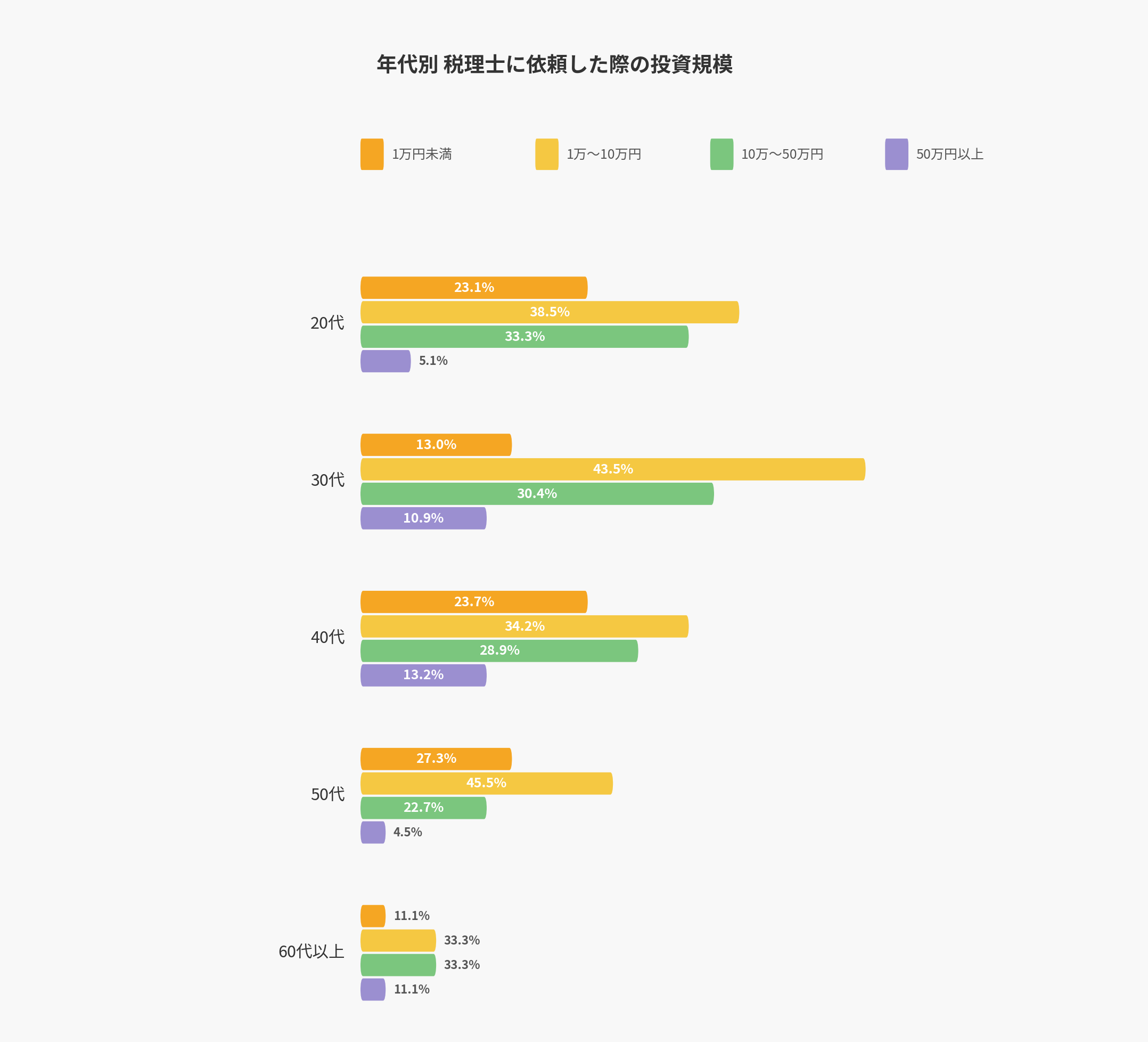
20s | 39 | 9 people (23.1%) | 15 people (38.5%) | 13 people (33.3%) | 2 people (5.1%) | 0 people (0.0%) |
30s | 46 | 6 people (13.0%) | 20 people (43.5%) | 14 people (30.4%) | 5 people (10.9%) | 1 person (2.2%) |
40s | 38 | 9 people (23.7%) | 13 people (34.2%) | 11 people (28.9%) | 5 people (13.2%) | 0 people (0.0%) |
50s | 22 | 6 people (27.3%) | 10 people (45.5%) | 5 people (22.7%) | 1 person (4.5%) | 0 people (0.0%) |
60s and older | 9 | 1 person (11.1%) | 3 people (33.3%) | 3 people (33.3%) | 1 person (11.1%) | 1 person (11.1%) |
Breaking the data down by age group reveals a somewhat surprising pattern: younger respondents in their 20s were more willing to consider hiring a tax accountant even at relatively small investment amounts.
Compared with older generations, this reflects a value system that prioritizes time-performance — outsourcing to a professional rather than spending time figuring out an unfamiliar area alone.
Among respondents in their 20s, 33.3% considered hiring in the ¥100,000–under ¥500,000 bracket, a notably high share that suggests this group moves to connect with professionals earlier.
This can be read as a reflection of both high information literacy and a digital-native generation's prudent risk-management mindset — trying to head off the complex tax risks unique to crypto assets before they become a problem.
It also suggests a desire to free up bandwidth for one's main job or investment analysis by outsourcing even small amounts to a professional.
While the ¥10,000–under ¥100,000 bracket was the thickest across all age groups, younger respondents showed a stronger tendency — more pronounced than among middle-aged and older respondents — to seek accuracy regardless of the amount involved.
Higher-Income Households Make Faster Hiring Decisions as Investment Size Grows
Household income | n | Under ¥10,000 | ¥10,000–under ¥100,000 | ¥100,000–under ¥500,000 | ¥500,000 or more | Prefer not to answer |
|---|---|---|---|---|---|---|
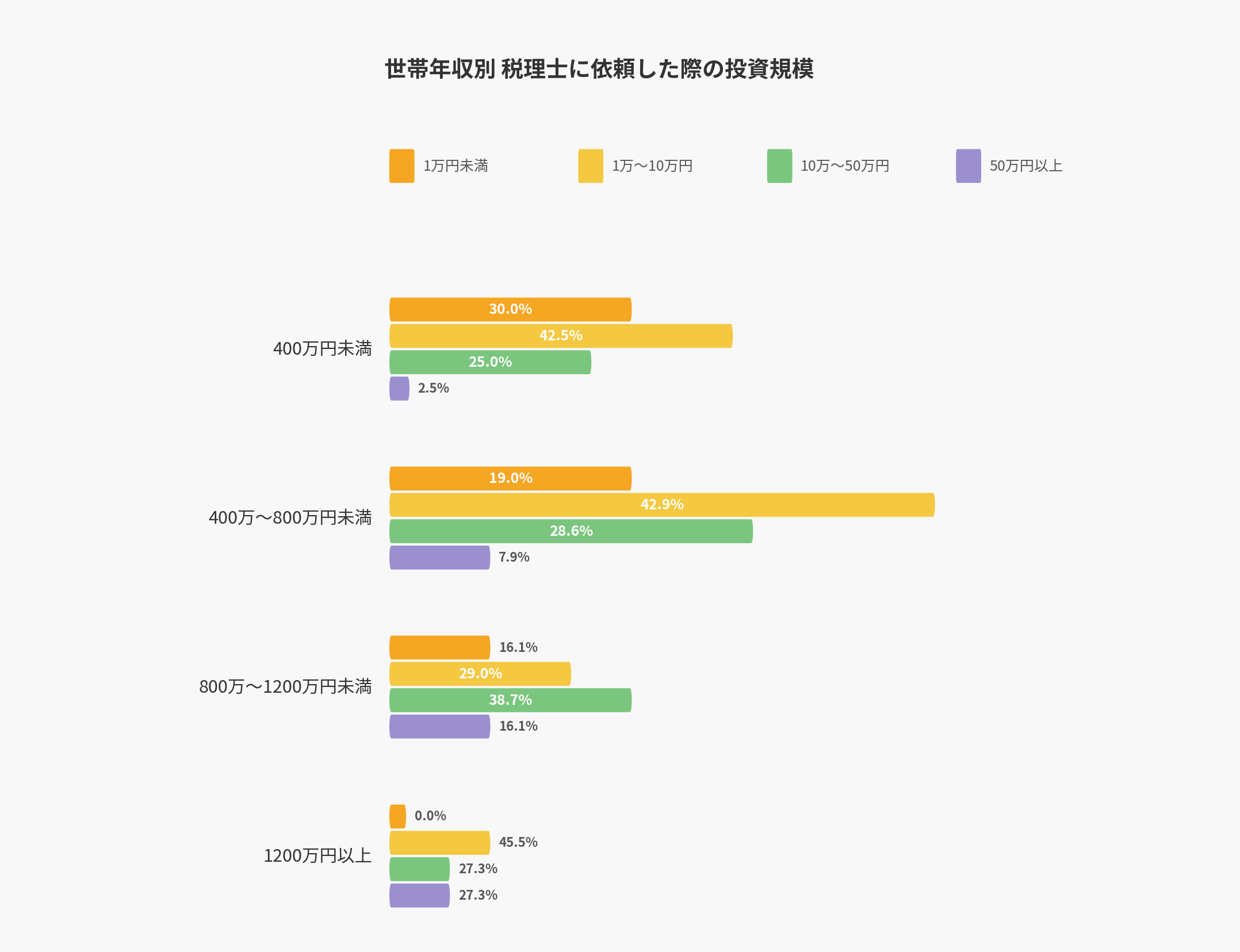
Under ¥4 million | 40 | 12 people (30.0%) | 17 people (42.5%) | 10 people (25.0%) | 1 person (2.5%) | 0 people (0.0%) |
¥4 million–under ¥8 million | 63 | 12 people (19.0%) | 27 people (42.9%) | 18 people (28.6%) | 5 people (7.9%) | 1 person (1.6%) |
¥8 million–under ¥12 million | 31 | 5 people (16.1%) | 9 people (29.0%) | 12 people (38.7%) | 5 people (16.1%) | 0 people (0.0%) |
¥12 million or more | 11 | 0 people (0.0%) | 5 people (45.5%) | 3 people (27.3%) | 3 people (27.3%) | 0 people (0.0%) |
Analysis by household income shows an even more pronounced pattern among households earning more than ¥8 million a year: as investment size grows, these respondents switch to hiring a tax accountant without hesitation.
Households with more financial headroom tend to place a higher value on their own time, making the cost of doing the calculations themselves relatively expensive — so as investment size rises, the switch to hiring becomes a highly rational decision.
Among households earning ¥12 million or more, not a single respondent considered hiring at the under-¥10,000 level; instead, they show a clear pattern of handling things themselves until reaching a certain volume, then handing everything to a professional at once.
These respondents tend to view their crypto holdings as part of a broader investment portfolio rather than a hobby, and their willingness to accept a professional's fee as a necessary expense underpins the high hiring rate that scales with investment size.
By contrast, among households earning under ¥4 million, 30.0% considered hiring even at the under-¥10,000 level — an interesting finding suggesting that the trigger for considering a tax accountant differs by income bracket.
The data suggests a divergence in motivation: higher-income respondents focus on operational efficiency, while lower-income respondents are driven more by fear of an unknown loss, when weighing whether to use a tax accountant.
About Half of Respondents Have Hired a Tax Accountant, With Higher-Balance Investors Choosing to Outsource
Fewer Than 1 in 5 Hire Every Year; About 3 in 10 Have Used One Only Once
Response | Count | Share |
|---|---|---|
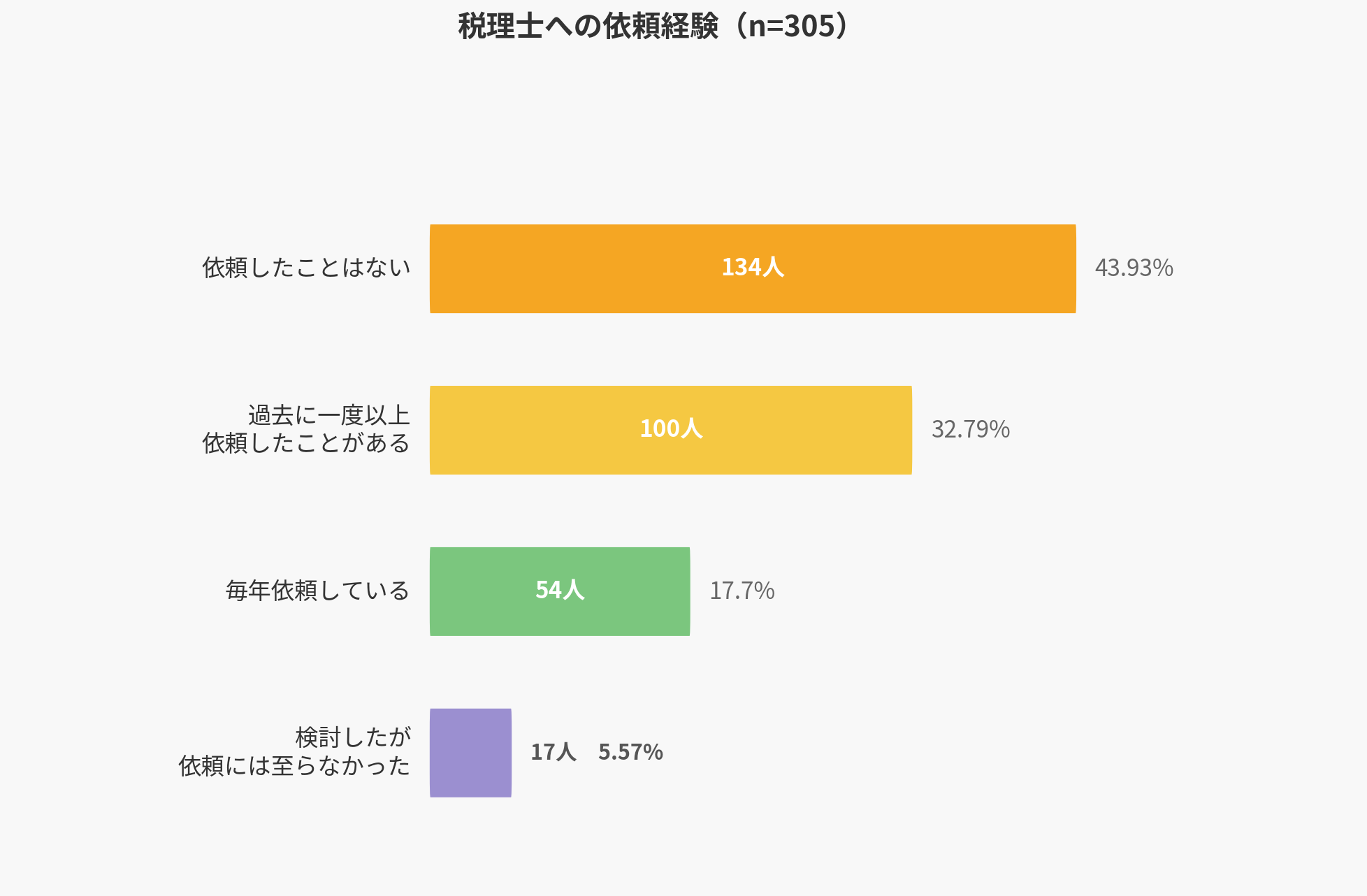
Never hired | 134 | 43.93% |
Hired at least once in the past | 100 | 32.79% |
Hires every year | 54 | 17.70% |
Considered it but did not hire | 17 | 5.57% |
Combining "hired at least once in the past" and "hires every year," 50.49% of respondents overall have experience hiring a tax accountant for crypto tax filing.
With more than half of investors already having used professional support, outsourcing crypto tax work is clearly not a niche practice — it has become an established, mainstream option.
Notably, the "hires every year" group makes up just 17.70%, while the "hired at least once" one-off group forms the largest segment at 32.79%.
This suggests strong demand for spot use of professional expertise — for example, in a year with large gains or unusually complex transactions — rather than a fixed, ongoing engagement.
Clabo's own survey results also point to a savvy investor profile: rather than outsourcing everything indefinitely, many investors switch between self-filing and professional help depending on their situation in a given year.
This includes learning-oriented use, where someone hires a professional once to understand the process — a sign that today's crypto investors treat tax accountants as a strategic resource to be used deliberately.
Half of Salaried Employees Have Hiring Experience, Reflecting a Conscientious Approach to Tax Compliance
Occupation | n | Hired (total) | Not hired (total) |
|---|---|---|---|
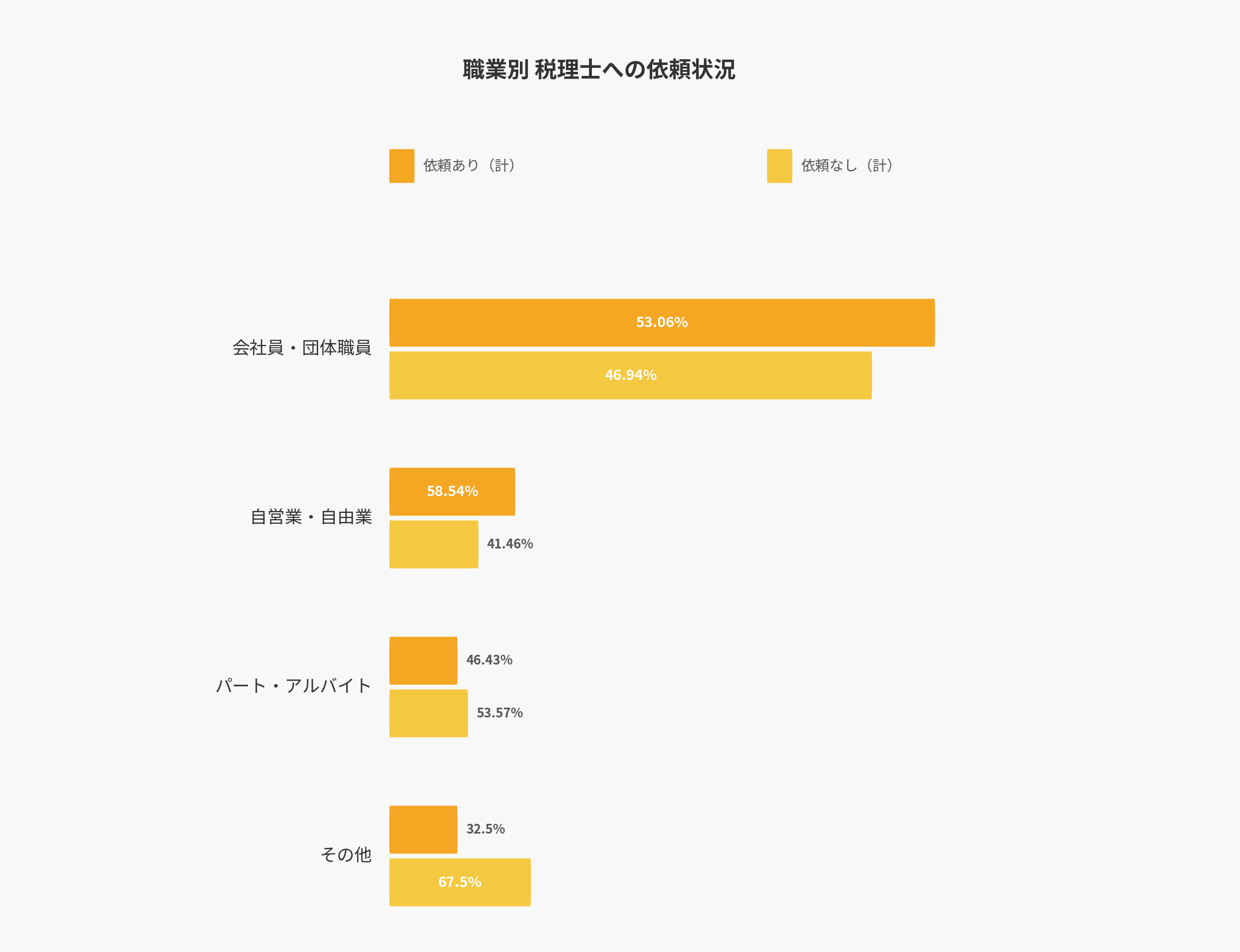
Company employee / corporate staff | 196 | 104 people (53.06%) | 92 people (46.94%) |
Self-employed / freelance | 41 | 24 people (58.54%) | 17 people (41.46%) |
Part-time / temporary worker | 28 | 13 people (46.43%) | 15 people (53.57%) |
Other | 40 | 13 people (32.50%) | 27 people (67.50%) |
Breaking down hiring status by occupation, 53.06% of company employees and corporate staff — the largest occupational group in the survey — have experience hiring a tax accountant.
For salaried investors balancing a demanding day job, handling complex gain/loss calculations alone is a heavy physical burden, and outsourcing for efficiency is strongly favored.
Self-employed and freelance respondents show an even higher hiring rate of 58.54%, reflecting a rational choice to bundle crypto tax calculations together with their business-income filing and hand both to a professional.
Regardless of occupation, the results point to a strong sense of caution around the emergence of non-salary income and a desire to sustain their investment activity through proper tax compliance.
By contrast, part-time workers, temporary staff, and students in the "other" category show a lower hiring rate of roughly 30–40%, suggesting they weigh the cost-effectiveness of paying a professional fee against their investment gains more carefully.
Respondents affiliated with an organization appear more likely to seek a tax accountant's support to ensure their filing is airtight, given the potential impact on internal side-business rules or social credibility.
Men Hire More Often Than Women, Possibly Reflecting Higher Trading Frequency
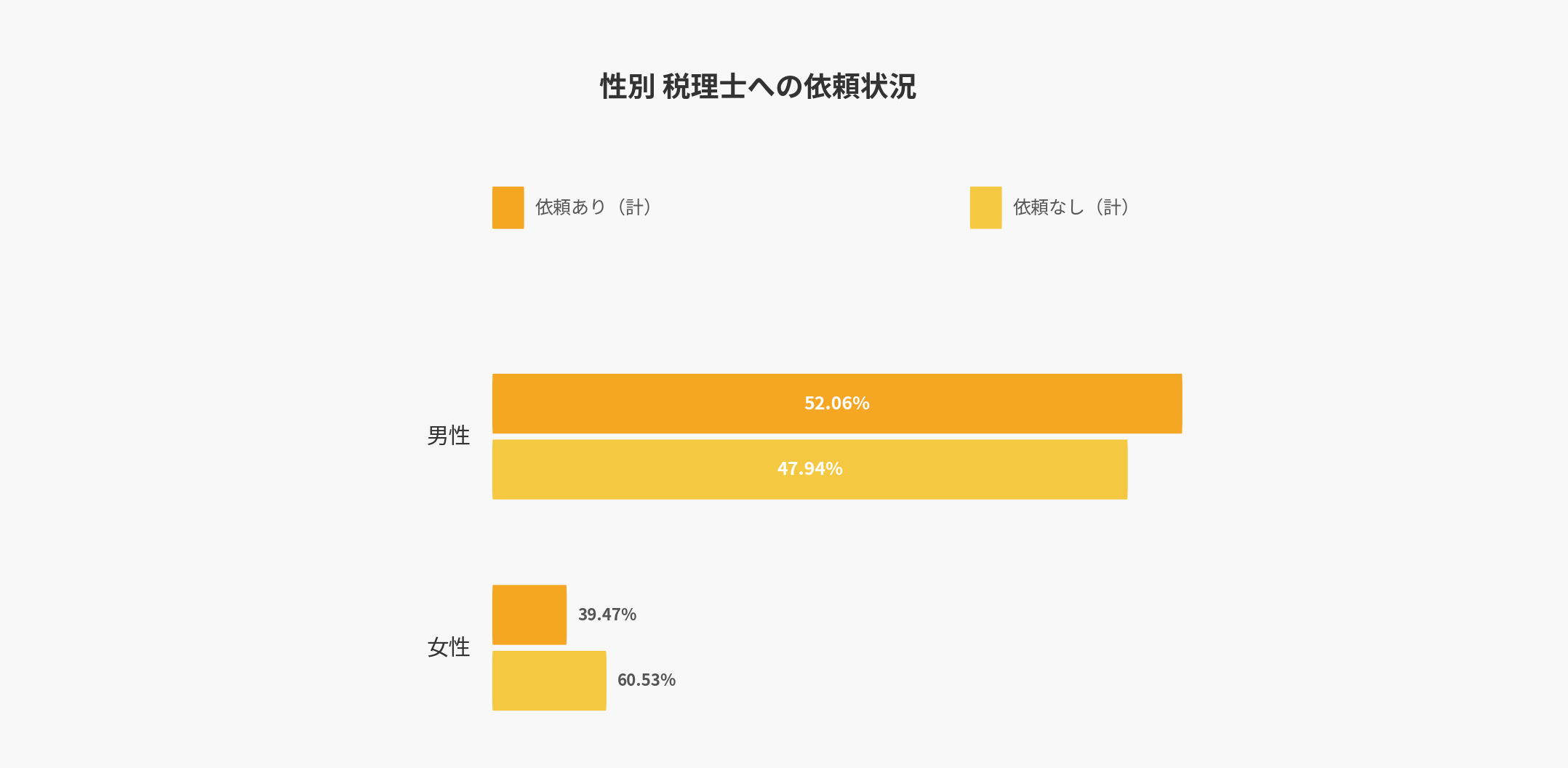
Gender | n | Hired (total) | Not hired (total) |
|---|---|---|---|
Male | 267 | 139 people (52.06%) | 128 people (47.94%) |
Female | 38 | 15 people (39.47%) | 23 people (60.53%) |
By gender, male respondents had a hiring rate of 52.06%, compared with 39.47% for female respondents — a clear gap.
Men, in general, tend to favor high-risk, high-return short-term trading and diversification across a wider range of tokens, which likely results in more complex transaction histories.
For active investors whose trade counts run into the hundreds or thousands, manual calculation with spreadsheets alone hits its limits, making reliance on specialized software or a tax accountant's expertise almost unavoidable.
Female investors are presumed more likely to favor long-term holding or small, regular investing, which may keep their filing within a range they can manage themselves — a possible driver of the gap in hiring rates.
It's a striking finding that differences in investment style by gender map directly onto the decision of whether to outsource tax filing or handle it in-house.
The more complex one's own trading activity, the stronger the motivation to hire a tax accountant regardless of gender — but under current market conditions, that need appears more pronounced among men.
Complex Transactions and Lack of Confidence Top the List of Reasons for Hiring
Two Leading Reasons Both Exceed 70% — Complexity and Lack of Confidence
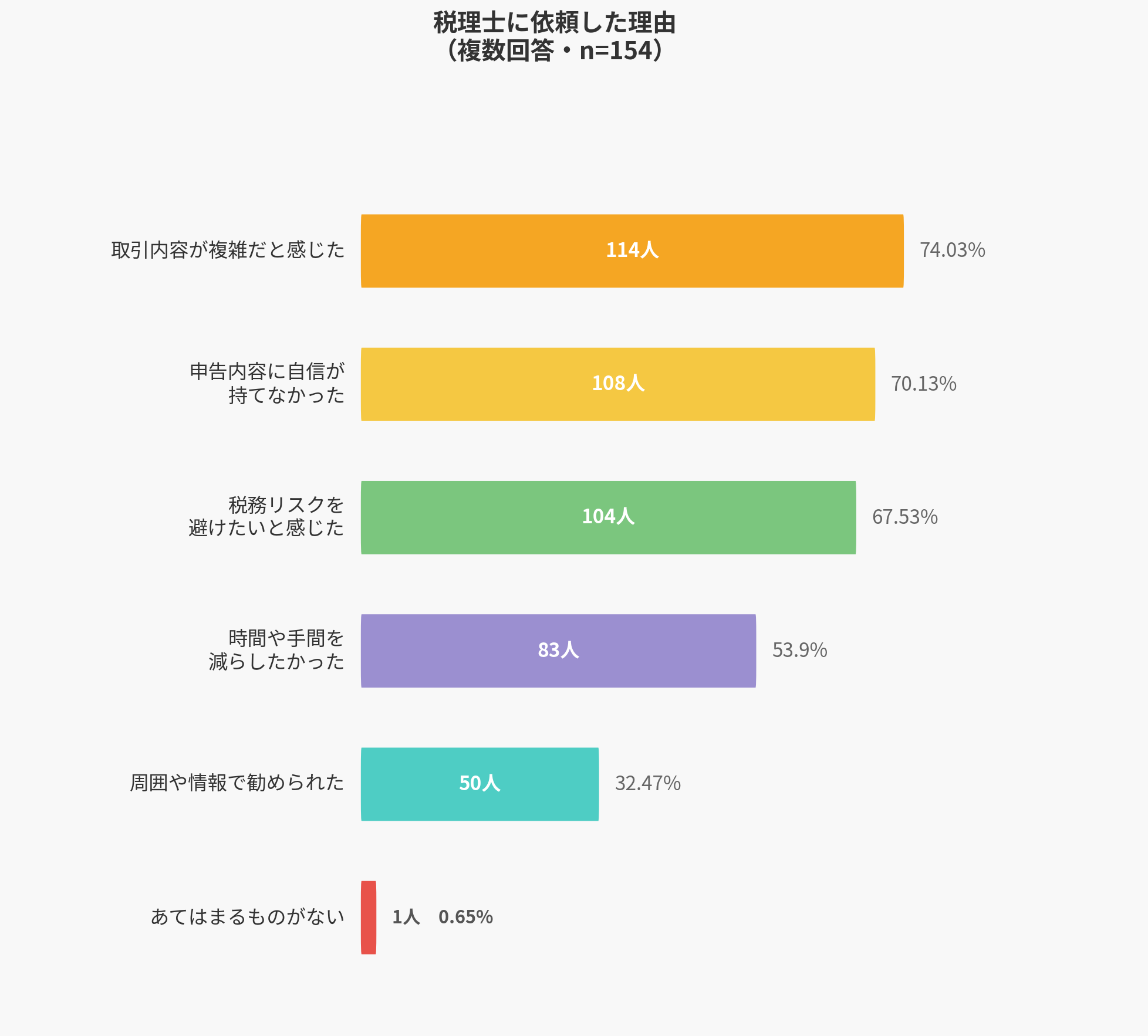
Reason for hiring | Count | Share |
|---|---|---|
Felt transactions were complex | 114 | 74.03% |
Lacked confidence in filing correctly | 108 | 70.13% |
Wanted to avoid tax risk | 104 | 67.53% |
Wanted to save time and effort | 83 | 53.90% |
Recommended by others or by information sources | 50 | 32.47% |
None of the above | 1 | 0.65% |
Asked why they hired a tax accountant, 74.03% of respondents cited "felt transactions were complex" as the top reason, followed closely by "lacked confidence in filing correctly" at 70.13%.
This points to investors reaching the limits of self-organizing their own transaction records — from crypto-specific gain/loss calculation rules to the wide variety of activity across DeFi and NFTs.
Beyond the sheer effort of calculation, more than 60% of respondents also cited wanting to avoid tax risk, reflecting a strong fear of being flagged for errors after the fact.
Because crypto tax treatment often involves legal interpretations that can be contested, investors may feel more comfortable buying peace of mind through a professional's guarantee rather than relying on their own self-taught judgment.
Meanwhile, more than half of respondents also cited wanting to save time and effort — a strong time-performance motivation.
As investment size grows, the workload of calculation grows with it, and many investors appear to use a tax accountant strategically so they can focus on their main job or investment analysis.
Higher-Balance Investors Prioritize Avoiding Tax Risk and Freeing Up Time
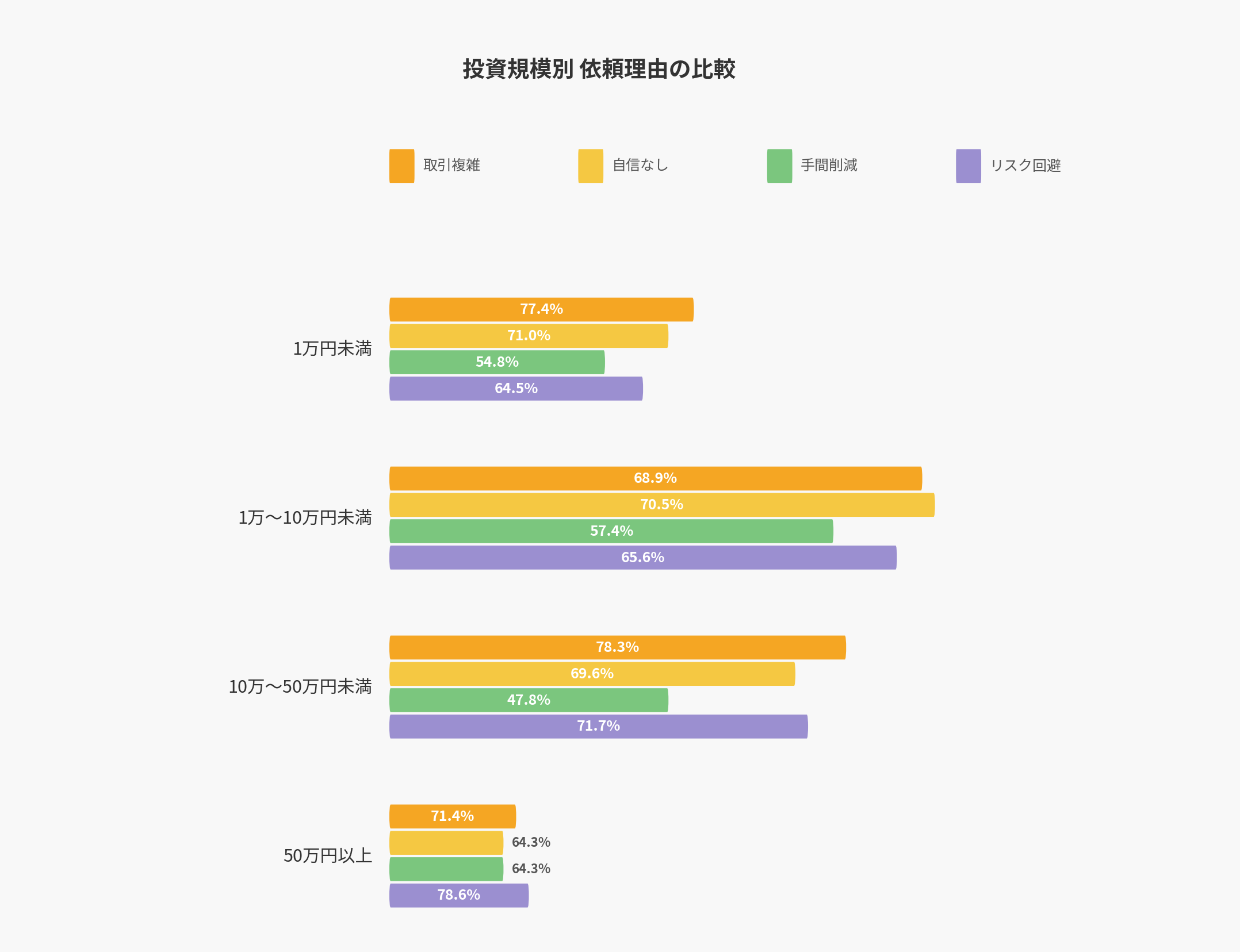
Investment size | n | Complex transactions | Lack of confidence | Time/effort savings | Risk avoidance |
|---|---|---|---|---|---|
Under ¥10,000 | 31 | 24 people (77.4%) | 22 people (71.0%) | 17 people (54.8%) | 20 people (64.5%) |
¥10,000–under ¥100,000 | 61 | 42 people (68.9%) | 43 people (70.5%) | 35 people (57.4%) | 40 people (65.6%) |
¥100,000–under ¥500,000 | 46 | 36 people (78.3%) | 32 people (69.6%) | 22 people (47.8%) | 33 people (71.7%) |
¥500,000 or more | 14 | 10 people (71.4%) | 9 people (64.3%) | 9 people (64.3%) | 11 people (78.6%) |
Breaking down reasons for hiring by investment size, respondents with ¥500,000 or more invested cited "wanted to avoid tax risk" at 78.6% — the highest share of any bracket for this reason.
As gains grow larger, so does the potential impact of penalty taxes from filing omissions, making higher-balance investors more likely to hire a tax accountant defensively.
In the ¥500,000-and-above bracket, "wanted to save time and effort" was also cited at a high 64.3%, suggesting these investors place more weight on separating out day-to-day operations than smaller-balance investors do.
Conversely, in the under-¥10,000 bracket, "felt transactions were complex" was the top reason at 77.4%, suggesting that even at small amounts, the inherent difficulty of crypto tax calculations is a barrier to self-filing.
The complexity of the calculations is a shared pain point regardless of amount, but higher-balance investors increasingly focus on practical risk management and time efficiency.
This can be seen as a professional mindset — treating investing as a business and being willing to spend on quality and speed as a necessary expense.
Respondents in Their 40s Are Especially Sensitive to Tax Risk and Value Professional Expertise
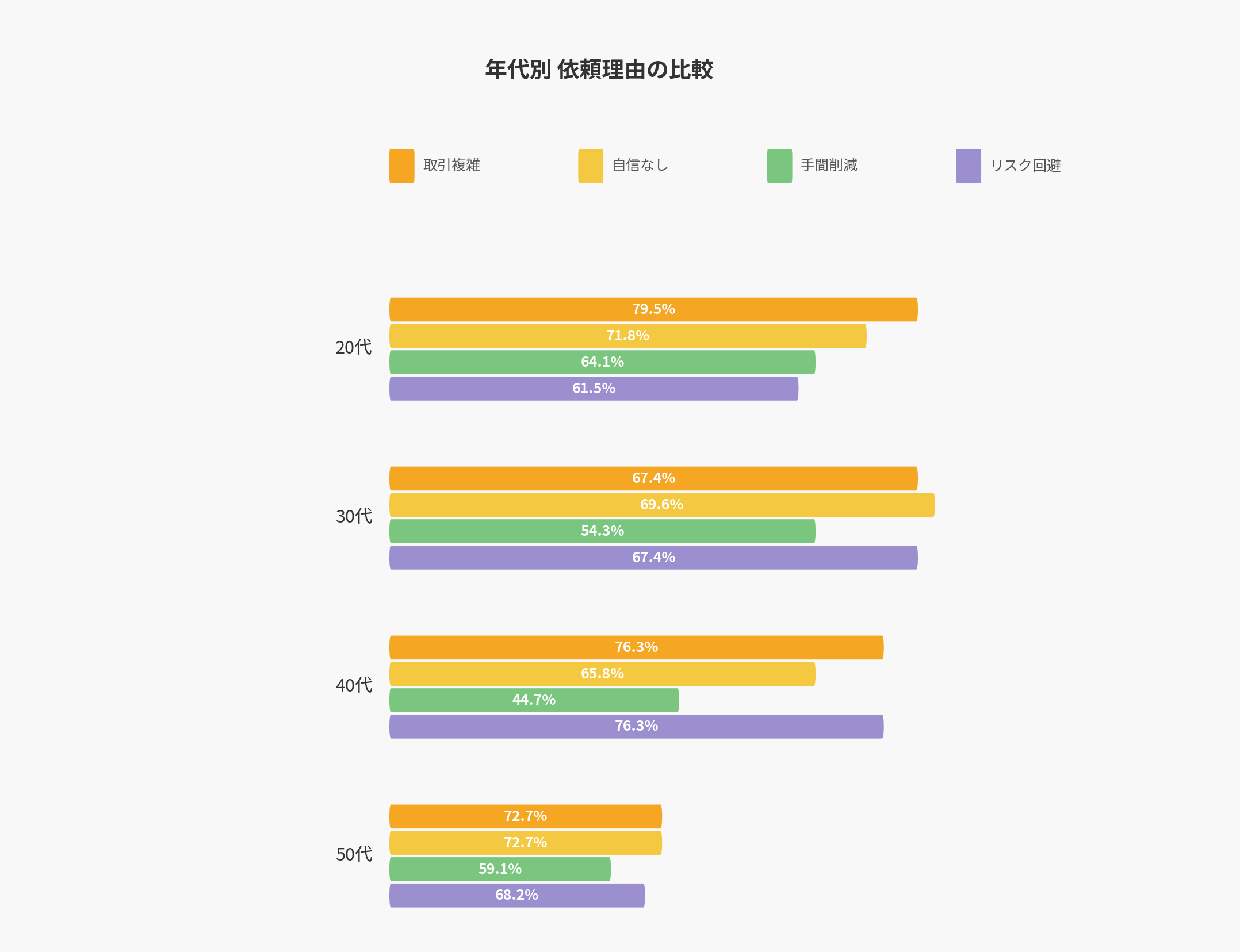
Age group | n | Complex transactions | Lack of confidence | Time/effort savings | Risk avoidance |
|---|---|---|---|---|---|
20s | 39 | 31 people (79.5%) | 28 people (71.8%) | 25 people (64.1%) | 24 people (61.5%) |
30s | 46 | 31 people (67.4%) | 32 people (69.6%) | 25 people (54.3%) | 31 people (67.4%) |
40s | 38 | 29 people (76.3%) | 25 people (65.8%) | 17 people (44.7%) | 29 people (76.3%) |
50s | 22 | 16 people (72.7%) | 16 people (72.7%) | 13 people (59.1%) | 15 people (68.2%) |
By age group, 76.3% of respondents in their 40s cited "wanted to avoid tax risk" — a notably higher level of risk-management awareness than other generations.
At a life stage when social responsibility and asset-building matter more, a cautious desire to minimize the impact of any tax shortfall on daily life appears to be the deciding factor behind hiring.
Among respondents in their 20s, "felt transactions were complex" stood out at 79.5%, suggesting a generation that embraces the newest trading methods but also struggles with the resulting processing burden.
20-somethings also cited "wanted to save time and effort" at a high 64.1%, reflecting a preference for paying to solve a problem quickly rather than working through it alone.
Among respondents aged 50 and older, "lacked confidence in filing correctly" exceeded 70%, suggesting a stronger tendency to seek a professional's guarantee rather than deepen their own understanding of the system.
Across all age groups, a lack of confidence in self-filing sits at the root of the decision to hire, but the specific priority — saving time versus eliminating risk — varies subtly by generation.
Cost and Confidence in Self-Filing Are the Main Barriers to Hiring for Some Investors
More Than 70% Cite Cost as a Concern — the Biggest Barrier to Hiring
Reason for not hiring | Count | Share |
|---|---|---|
Felt the cost was too high | 114 | 75.50% |
Felt able to handle it themselves | 100 | 66.23% |
Felt transactions were simple | 78 | 51.66% |
Didn't know which tax accountant to ask | 32 | 21.19% |
Didn't know how to hire one | 13 | 8.61% |
None of the above | 2 | 1.32% |
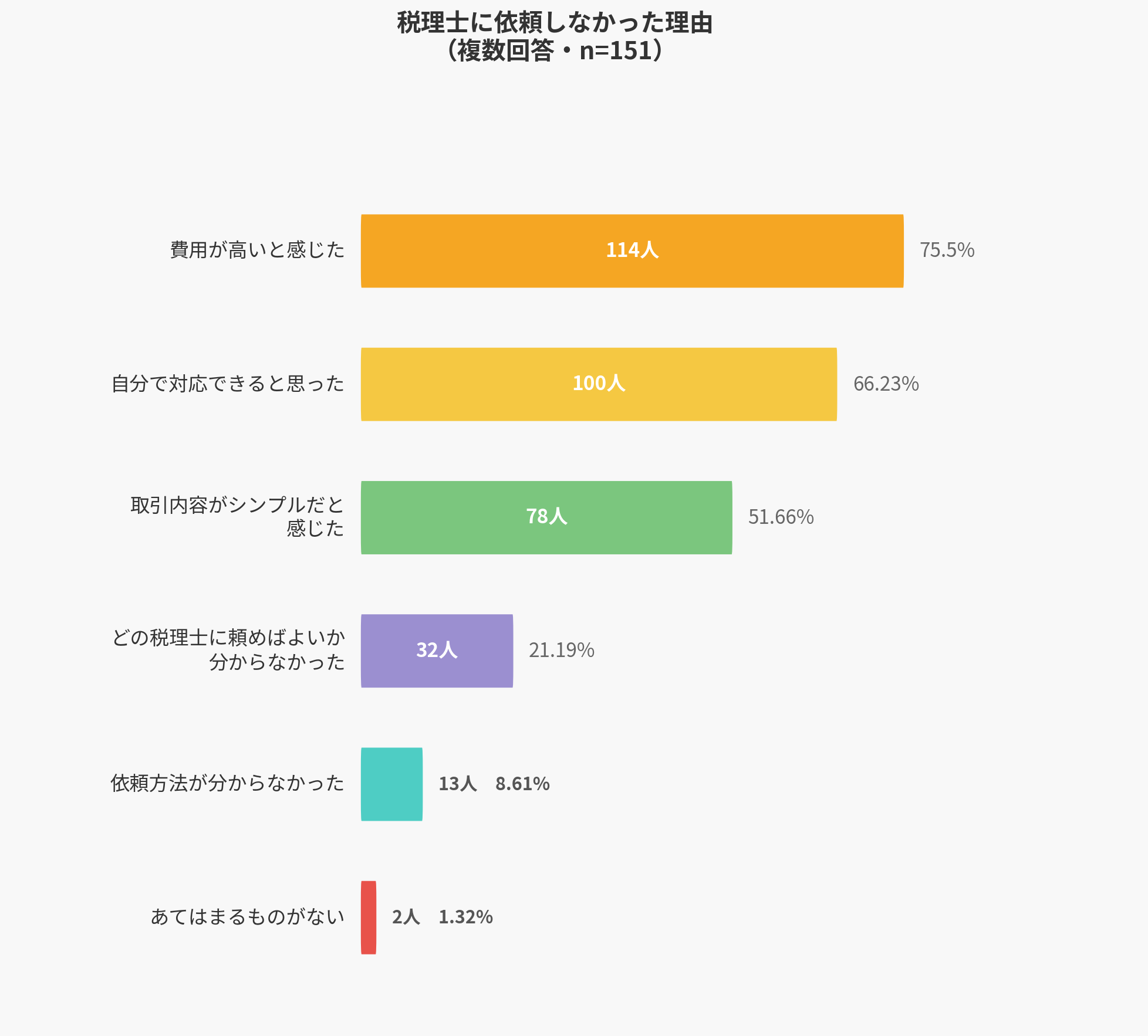
Asked why they did not hire a tax accountant, 75.50% of respondents cited "felt the cost was too high" as the top reason, followed by "felt able to handle it themselves" at 66.23%.
Many investors view a tax accountant's fee as a cost that eats into their gains, and tend to forgo outsourcing when they judge self-filing to be feasible.
More than half also cited "felt transactions were simple" — a natural response for investors whose strategy is simply holding a specific token long-term, where professional help isn't seen as necessary.
That said, it's worth watching whether continuing to self-file indefinitely becomes riskier as investment size or trading frequency changes.
Meanwhile, about 20% of respondents cited "didn't know which tax accountant to ask" — a practical barrier rooted in a lack of information rather than a preference for self-filing.
This points to a latent pool of demand for professional help among people who aren't self-filing by choice, but who simply haven't found the right person to ask.
Smaller Investors Worry About Cost, While Higher-Balance Investors Struggle to Find a Tax Accountant
Investment size | n | Cost too high | Can handle it myself | Simple transactions | Unsure how to find one |
|---|---|---|---|---|---|
Under ¥10,000 | 12 | 10 people (83.3%) | 9 people (75.0%) | 7 people (58.3%) | 2 people (16.7%) |
¥10,000–under ¥100,000 | 27 | 19 people (70.4%) | 18 people (66.7%) | 14 people (51.9%) | 5 people (18.5%) |
¥100,000–under ¥500,000 | 10 | 8 people (80.0%) | 7 people (70.0%) | 5 people (50.0%) | 3 people (30.0%) |
¥500,000 or more | 1 | 1 person (100.0%) | 0 people (0.0%) | 0 people (0.0%) | 1 person (100.0%) |
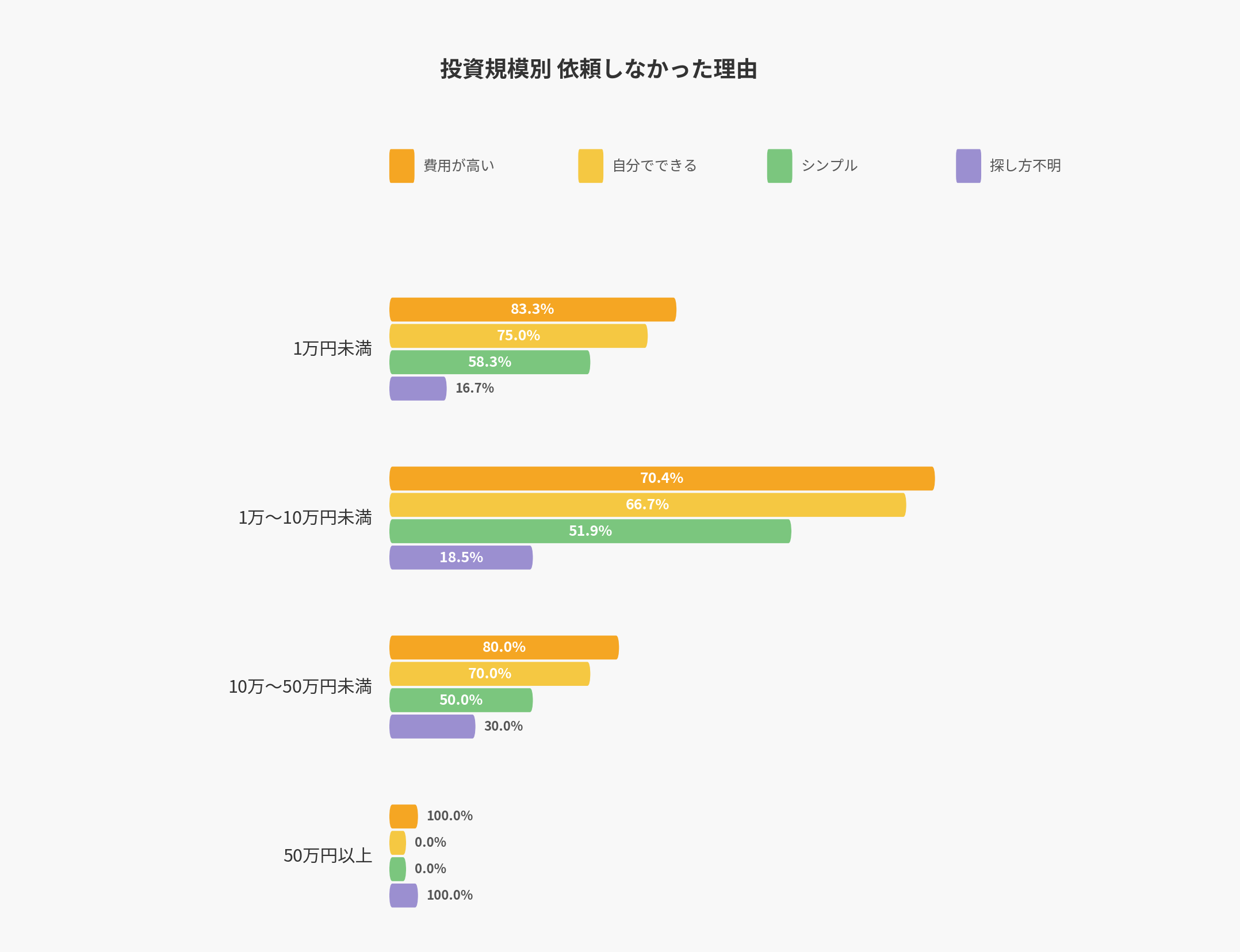
Breaking down reasons for not hiring by investment size, respondents with under ¥10,000 invested cited "felt the cost was too high" at a very high 83.3%, reflecting a rational judgment that professional fees aren't worth it against a small amount of gains.
Smaller-balance investors also show strong confidence in handling things themselves, prioritizing cost control by completing the filing independently.
Notably, in the ¥100,000–under ¥500,000 bracket, 30.0% of respondents cited "didn't know which tax accountant to ask" — the highest share among the brackets.
This group appears to be reaching the limits of self-filing but lacks access to a tax accountant with crypto expertise, leaving them stuck just short of hiring one.
Among higher-balance investors, the bottleneck shifts away from cost and toward finding a trustworthy professional and understanding the hiring process itself, which may be discouraging some from outsourcing.
The data suggests that as investment size grows, investor priorities shift from cost-consciousness toward securing genuine expertise.
Long-Term Holders Are More Likely to See Their Filing as Simple Enough to Handle Themselves
Investment style | n | Cost too high | Can handle it myself | Simple transactions | Unsure how to find one |
|---|---|---|---|---|---|
Mainly long-term holding | 79 | 59 people (74.7%) | 51 people (64.6%) | 42 people (53.2%) | 17 people (21.5%) |
Mainly short-term trading | 24 | 19 people (79.2%) | 18 people (75.0%) | 12 people (50.0%) | 4 people (16.7%) |
Mix of both | 42 | 31 people (73.8%) | 26 people (61.9%) | 21 people (50.0%) | 10 people (23.8%) |
Currently on the sidelines | 6 | 5 people (83.3%) | 5 people (83.3%) | 3 people (50.0%) | 1 person (16.7%) |
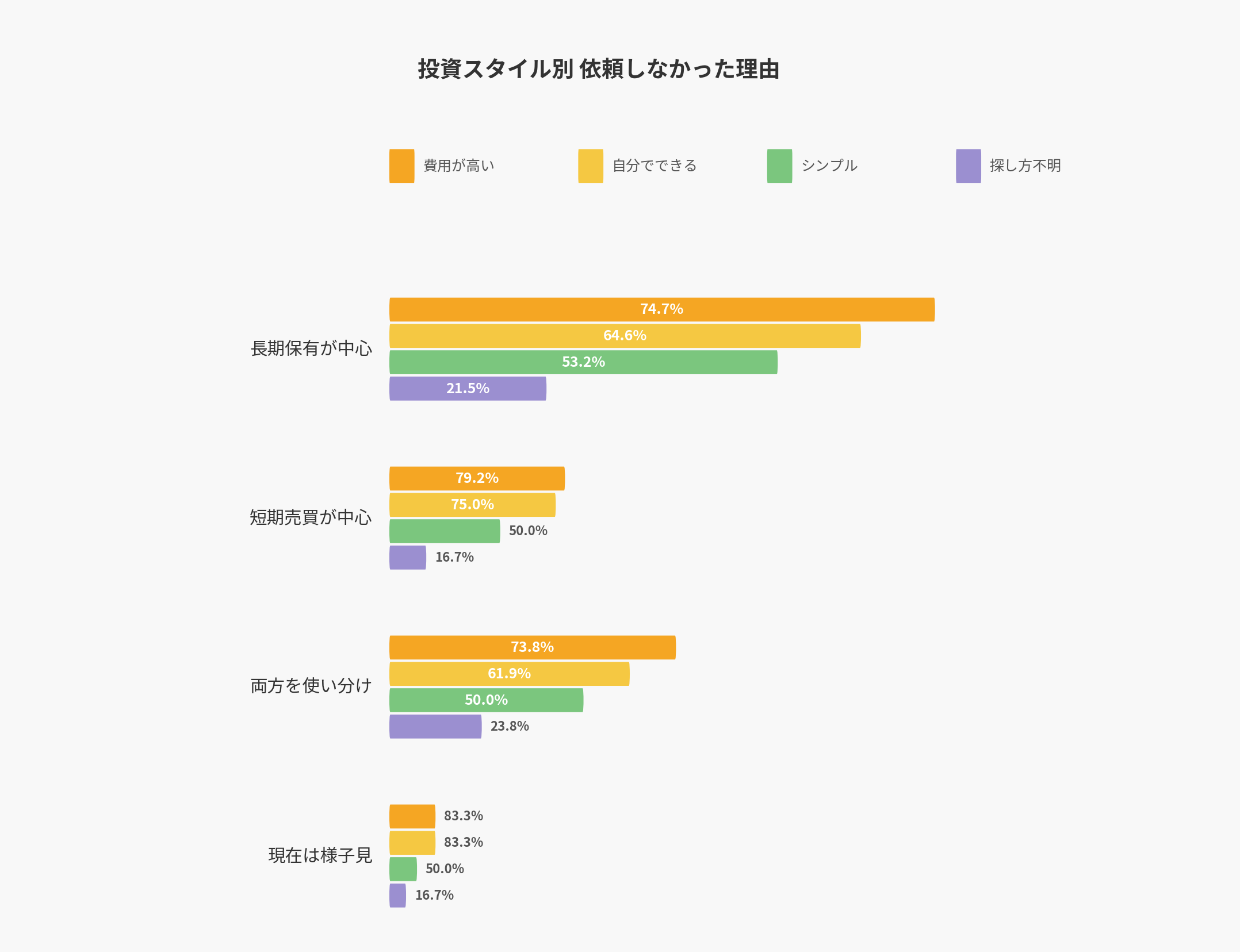
By investment style, 53.2% of respondents who mainly hold long-term cited "felt transactions were simple" — a higher share than other styles, suggesting less resistance to self-filing.
With fewer trades, there are fewer gain/loss calculations to make, so many long-term holders judge that they can file accurately without a tax accountant.
Among active short-term traders, "felt the cost was too high" was cited by a high 79.2%, reflecting strong wariness that the cost of calculating a high volume of trades would be passed on if outsourced to a professional.
At the same time, 75.0% also cited "can handle it myself" — a high level of confidence rooted in the belief that no one understands their own trades better than they do.
Regardless of style, cost is the single biggest motivator for not hiring, but confidence in self-filing is a common thread that includes even the "currently on the sidelines" group.
That said, a hybrid approach — combining a gain/loss calculation tool with a tax accountant to optimize costs while still securing expertise — is likely to become essential as investment size grows.
Summary
This survey found that the clearest dividing line in whether crypto investors hire a tax accountant is an investment size of ¥500,000.
Once investment size exceeds ¥500,000, the hiring rate reaches 100%, with larger-balance investors clearly prioritizing accurate filing and avoiding tax risk.
About half of all respondents have hiring experience, and outsourcing for efficiency is especially well-supported among busy salaried employees and higher-income households.
More than 70% of reasons for hiring were "transaction complexity" and "lack of confidence in self-filing," while most non-hirers cited "cost" as the barrier.
Younger respondents in their 20s show a tendency to hire professionals even for small amounts, prioritizing time efficiency — motivations for using a professional diverge by generation and income bracket.
Wisely alternating between a gain/loss calculation tool and a tax accountant, matched to one's own investment style and size, is likely to be the standard approach for protecting long-term investment outcomes.
Survey overview
Survey date: February 24, 2026
Method: Internet survey
Respondents: Men and women residing in Japan (people currently investing in crypto assets, or with past investment experience)
Valid responses: 305
Conducted by: Clabo Inc.
Survey questions
- Have you ever used crypto assets?
- Have you ever hired a tax accountant for crypto tax or final tax return matters?
- What were your main reasons for deciding to hire a tax accountant?
- What were your main reasons for not hiring a tax accountant?
- At the time you considered or decided on hiring a tax accountant, what was your approximate investment size?
- Which best describes your crypto usage style?
This article is for informational purposes only and does not constitute financial or investment advice. Please consult a qualified professional before making investment decisions.


