


"Isn't crypto (also known as virtual currency) kind of suspicious?"
Have you ever been asked this by people around you, or wondered it yourself?
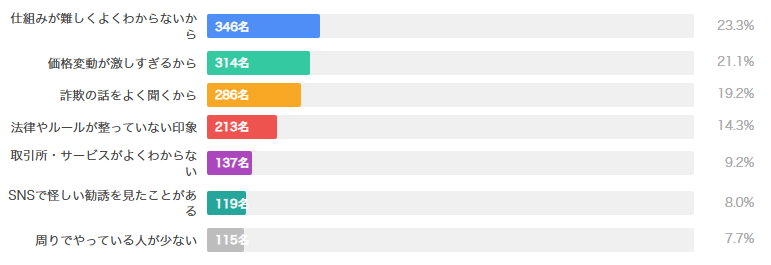
According to this survey (n=1,486), 23.3% of respondents said crypto assets (also known as virtual currencies) feel "suspicious because I don't understand how they work," while 21.1% cited "price volatility that's too extreme."
At the same time, the number of users who understand crypto assets correctly and continue investing is steadily growing. Read on to see how real perceptions of crypto assets compare across generations and levels of experience.
Respondent Profile
Category | Responses | Share |
|---|---|---|
Male | 860 | 57.9% |
Female | 626 | 42.1% |
Generation | Responses | Share |
|---|---|---|
Generation Y (Millennials), born 1982–1996 | 553 | 37.2% |
Ice Age Generation (Baby Boomer Jr. / parents of Gen Z), born 1971–1981 | 407 | 27.4% |
Generation Z, born 1997–2012 | 208 | 14.0% |
Bubble Generation, born 1965–1970 | 134 | 9.0% |
Shinjinrui Generation, born 1956–1964 | 123 | 8.3% |
Shirake Generation & Baby Boomer Generation | 61 | 4.1% |
Awareness and Knowledge of Crypto Assets

We first asked respondents how much they know about crypto assets. "I have a vague idea" was the most common answer at 41.7% (619 respondents), followed by "I know it well, including how it works" at 24.1% (358 respondents).
Meanwhile, 23.4% (347 respondents) said they "only know the term," and 10.9% (162 respondents) said they "know almost nothing." There is a wide gap between "knowing" and "being able to explain" — most users have heard the name but have not reached a level where they could actually explain how crypto assets work.
Investment Experience: One in Two Have Yet to Invest

When asked about their investment experience with crypto assets (virtual currencies), the largest group — 50.6% (752 respondents) — said they have "no investment experience." Only 33.7% (501 respondents) are currently investing, while 15.7% (233 respondents) used to invest but have since stopped.
Although Japan's domestic crypto asset market has grown rapidly, the survey reveals that many potential investors still remain on the sidelines.
The large number of people who "know about it but don't act" suggests that gaps in information and negative perceptions are acting as a barrier to action.
Even now, many people appear to hold a vague sense that "virtual currency equals suspicious."
What is behind that feeling? Let's explore the reasons behind that unease together.
Ranking of Reasons for Feeling Crypto Is "Suspicious" (Multiple Answers)

We asked respondents, in a multiple-choice format, why they consider crypto assets "suspicious" or "somewhat suspicious."
The top answer was "the mechanism is too complicated to understand" at 23.3% (346 respondents), followed by "price volatility is too extreme" at 21.1% (314 respondents) and "I often hear about scams" at 19.2% (286 respondents).
Other reasons cited included "it feels like laws and rules aren't well established" at 14.3% (213 respondents), "I don't understand exchanges/services" at 9.2% (137 respondents), "I've seen suspicious solicitations on social media" at 8.0% (119 respondents), and "few people around me are doing it" at 7.7% (115 respondents).
What stands out is that "lack of understanding of the mechanism" topped the list. The fact that cognitive uncertainty — simply "not understanding" — is a bigger barrier than objective risks such as price volatility or scam damage is a strong signal that the industry as a whole needs more educational content.
Cross-Analysis of "Suspicious" Perceptions by Generation
The reasons behind feeling that crypto is "suspicious" differ by generation. Generation Z, digital natives who are frequently exposed to social media solicitations and scam-related information, appear to combine social media literacy with a cautious view of crypto assets.
The Bubble Generation and Shinjinrui Generation, on the other hand, face the highest barrier in the form of "the mechanism is too difficult," suggesting they need a clearer entry point.
Generation Y (Millennials) has the highest proportion of people with investment experience and includes many who actively gather information.
Generation | Birth Years | Respondents | Main Info Source |
|---|---|---|---|
Generation Z | 1997–2012 | 208 | YouTube (most common) |
Generation Y | 1982–1996 | 553 | Social media + news |
Ice Age Generation | 1971–1981 | 407 | News sites |
Bubble Generation & older | Before 1970 | 318 | TV |
Where People Encounter Crypto Information
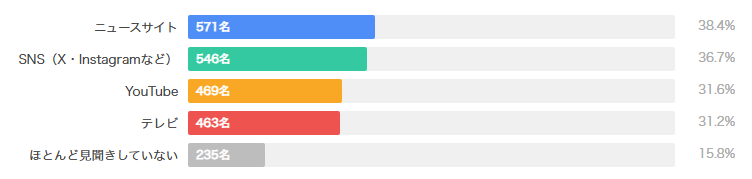
Asked (multiple answers allowed) where they had seen or heard about crypto assets in the past month, the top answer was "news sites" at 38.4% (571 respondents), followed by "social media" at 36.7% (546 respondents), "YouTube" at 31.6% (469 respondents), and "TV" at 31.2% (463 respondents).
Only 15.8% (235 respondents) said they had "seen or heard almost nothing," showing that most people encounter crypto-related information in some form.
As a source of information for investment decisions, "YouTube" ranked first at 27.0% (401 respondents), followed by "news sites" at 18.1% (269 respondents) and "social media" at 17.0% (253 respondents).
Ranking of Information Needed to Ease Concerns (Multiple Answers)
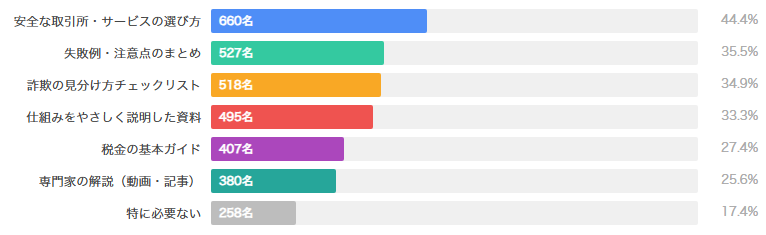
Asked what kind of information would ease their concerns about crypto assets (multiple answers allowed), the top response was "how to choose a safe exchange or service" at 44.4% (660 respondents). This was followed by "a summary of failure cases and precautions" at 35.5% (527 respondents), "a checklist for spotting scams" at 34.9% (518 respondents), and "materials that explain the mechanism in simple terms" at 33.3% (495 respondents). "A basic guide to taxes" (27.4%, 407 respondents) and "expert commentary (video/articles)" (25.6%, 380 respondents) also scored highly.
Only 17.4% (258 respondents) said they "don't particularly need" any such information, making clear that the vast majority of people have some form of information need.
These results show that, for the crypto asset (virtual currency) market to spread further, what people need most is practical, defensive information covering "where it's safe," "what kinds of failures happen," and "how to spot scams."
Users appear to consider gathering information on risk management and safety more important than theoretical explanations of how crypto assets work.
Experience Levels and Entry Motivations Among Investors
Among respondents with investment experience, "1 to 3 years" was the most common length of experience at 17.8% (264 respondents), followed by "3 to 5 years" at 11.7% (174 respondents), "less than 1 year" at 11.2% (167 respondents), and "5 years or more" at 7.9% (118 respondents).
While relatively new entrants make up a large share, a meaningful number of long-term investors with five or more years of experience also exist. The most common initial investment amount was "under ¥10,000" (16.9%), indicating a strong tendency to start small. Monthly investment amounts followed the same pattern, with "under ¥10,000" the most common at 20.5%, suggesting that dollar-cost averaging and diversified investing have become the dominant style.
What the Industry Should Do to Overcome Crypto's "Suspicious" Image
What this survey reveals is that, while the image of "crypto assets equals suspicious" remains deeply rooted, its root cause is a lack of understanding.
Progress in legal reform — including amendments to the Financial Instruments and Exchange Act (FIEA) and the Payment Services Act (PSA) — and stronger self-regulation by the Japan Virtual and Crypto Assets Exchange Association (JVCEA) mean that Japan's domestic crypto environment has steadily improved. However, these institutional changes have not yet reached users' perceptions.
In particular, the finding that "how to choose a safe exchange" (44.4%) is the most sought-after information points to strong demand for educational content that clearly explains exchange selection criteria — Financial Services Agency (FSA) registration, segregated management of customer assets, two-factor authentication support, and customer support quality.
Demand for a "checklist for spotting scams" (34.9%) also reflects the fact that impersonation scams on social media remain a serious problem. Spreading accurate knowledge about crypto assets and delivering practical information on protecting oneself from scams can help restore trust and drive adoption across the industry.
Investor Behavior: Small Initial Amounts and Long-Term Accumulation Are the Norm
Looking at initial investment amounts among experienced investors, "under ¥10,000" was the most common at 16.9% (251 respondents), followed by "¥10,000 to ¥50,000" at 11.2% (166 respondents) and "¥50,000 to ¥100,000" at 10.2% (152 respondents). For monthly investment amounts, "under ¥10,000" was again the most common at 20.5% (305 respondents), suggesting that continuing to invest small amounts over time is the dominant approach.
In terms of years of experience, "1 to 3 years" was the most common at 17.8% (264 respondents), followed by "3 to 5 years" at 11.7% (174 respondents) and "less than 1 year" at 11.2% (167 respondents). Long-term investors with five or more years of experience account for 7.9% (118 respondents).
These figures show that crypto asset (virtual currency) investing is settling in not as a way to "strike it rich," but as a means of building wealth over the long term starting from small amounts. Even as a suspicious image lingers, the investor base is steadily expanding.
Conclusion
A "suspicious" image often stems from a lack of information. This survey suggests that many users find their concerns eased once they gain accurate knowledge.
If you feel a vague sense of unease about crypto assets, the first step is to learn the basics from a trustworthy source of information.
As the investor base expands across generations, having your own criteria for making judgments is becoming increasingly important.
This report is intended for informational purposes only and does not constitute a solicitation or recommendation to invest. Crypto asset investing carries significant risk, and investment decisions are made at your own responsibility. We make no guarantee as to the accuracy, completeness, or usefulness of the content of this report. Please make final investment decisions on your own judgment and consult a professional as needed.
Survey Overview
Survey date: February 24, 2026
Survey method: Internet survey
Survey subjects: Men and women residing in Japan (people currently investing in crypto assets, or who have invested in the past)
Valid responses: 1,486
Conducted by: Clabo, Inc.
Survey Questions
- How much do you know about virtual currency?
- Do you have any experience investing in virtual currency?
- Please select the option that best describes your impression of virtual currency.
- What is your main reason for feeling that virtual currency is "suspicious" (or "somewhat suspicious")?
- Has your sense that virtual currency is "suspicious" changed in the past year or two?
- Where did you mainly see or hear information about virtual currency in the past month?
- Which of the following virtual currency-related news topics interests you the most?
- What kind of information would help ease your concerns about virtual currency?
- Which information sources do you find trustworthy when it comes to virtual currency?
- How many years of experience do you have investing in virtual currency?
- What was your initial investment amount range?
- What is your current monthly investment amount?
- Please select the option that best describes your investment style.
- Which information sources do you refer to when making investment decisions?
This article is for informational purposes only and does not constitute financial or investment advice. Please consult a qualified professional before making investment decisions.


