


We surveyed 992 people to find out what they trust when deciding whether to buy or sell crypto assets (also known as virtual currencies).
The results show that roughly one in three respondents cite social media platforms such as YouTube and X as their primary information source.
Yet despite the convenience, 66.4% of investors who relied on social media reported that their trades "failed."
This article takes a close look at how the choice of information source affects investment outcomes.
In particular, we highlight the striking fact that the failure rate among Discord users reaches 88.5%, along with the paradoxical pattern in which investors who are more satisfied with their information source tend to suffer larger losses.
Drawing on expert perspectives, we decode the investor psychology hidden behind the data and explain the information literacy needed to protect your assets in an era dominated by social media.
Take this opportunity to check whether your "go-to information source" might actually be a source of risk.
YouTube Tops the List of Information Sources, Highlighting Heavy Reliance on Social Media
YouTube Ranks First as Video Content Shapes Investment Decisions
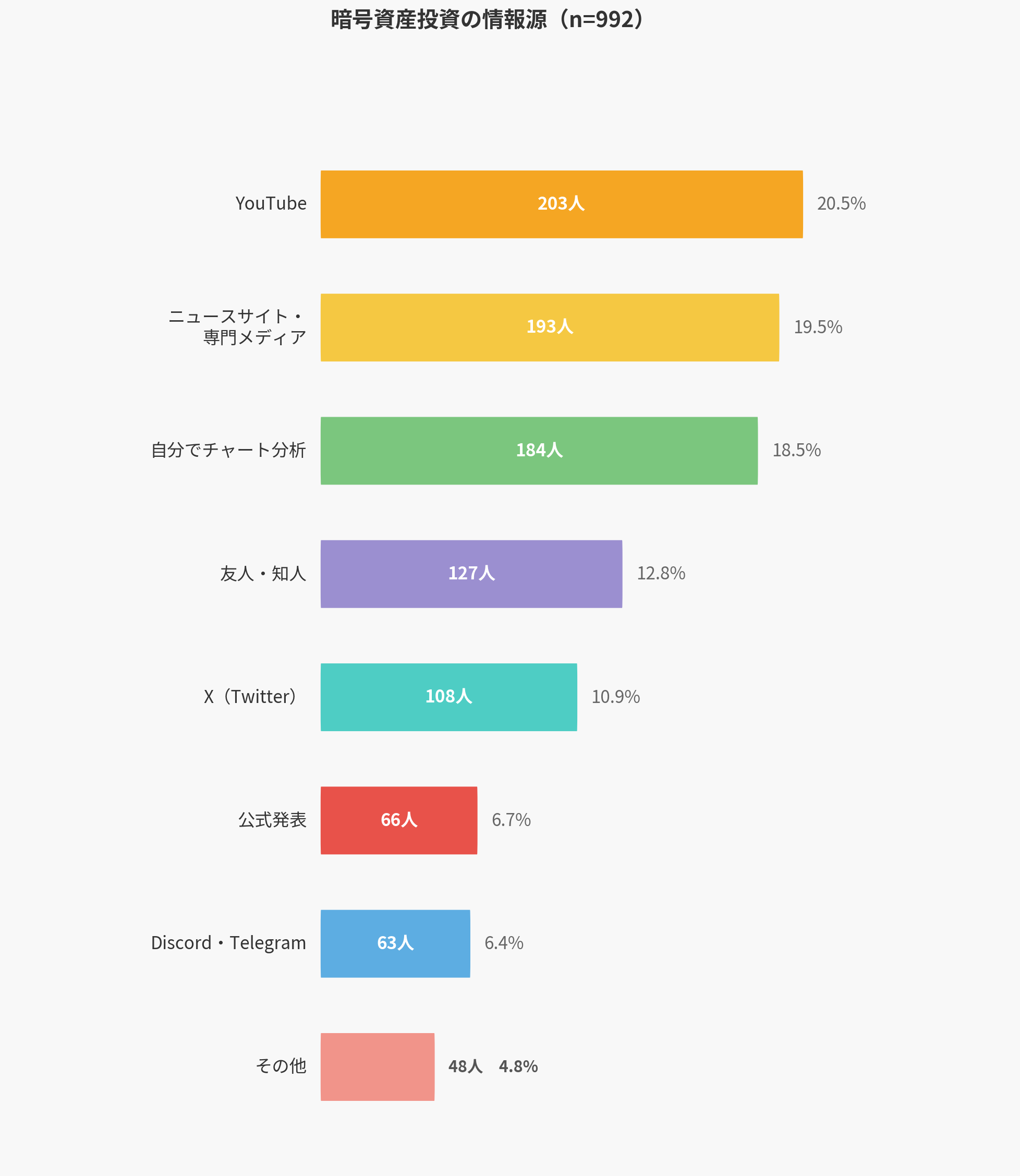
Response | Respondents | Percentage |
|---|---|---|
YouTube | 203 people | 20.5% |
News sites / specialist media | 193 people | 19.5% |
Self-directed chart analysis | 184 people | 18.5% |
Friends / acquaintances | 127 people | 12.8% |
X (Twitter) | 108 people | 10.9% |
Official announcements | 66 people | 6.7% |
Discord / Telegram | 63 people | 6.4% |
Other | 48 people | 4.8% |
The way investors gather information on crypto assets is clearly shifting from text to video.
In this survey, the most widely used information source was YouTube at 20.5%, narrowly edging out specialist media at 19.5%.
The results reveal that video content, which visually explains complex technical concepts and market trends, has become the leading decision-making material for many investors.
Meanwhile, only 6.7% of respondents place the greatest weight on official announcements, the primary source of information from projects themselves.
This suggests a strong tendency to prioritize secondary information, such as commentary from influencers and explainer videos, over highly reliable official sources.
This ranking reflects an investor mindset that values "taipa" (time performance, i.e. getting the gist quickly) and ease of understanding over the accuracy of the information itself.
Combined Social Media Sources Exceed 30%, Underscoring Rising Reliance on the Internet
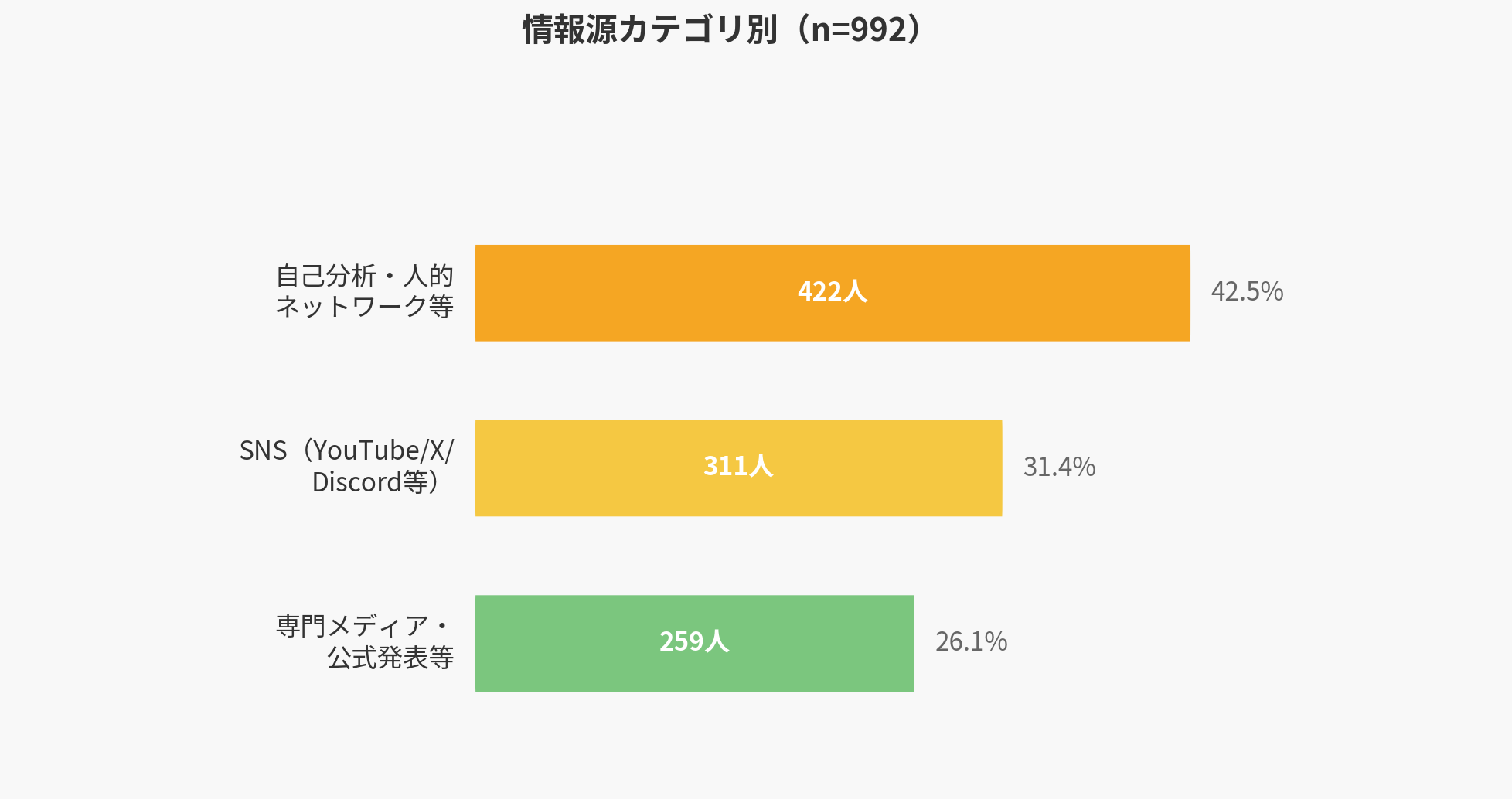
Response | Respondents | Percentage |
|---|---|---|
Social media (YouTube / X / Discord, etc.) | 311 people | 31.4% |
Specialist media / official announcements, etc. | 259 people | 26.1% |
Self-analysis / personal networks, etc. | 422 people | 42.5% |
The share of respondents who mainly rely on social media sources—combining YouTube, X, Discord, and Telegram—reached 31.4%.
This means that roughly one in three investors bases trading decisions on information from highly interactive platforms.
While the immediacy of social media can be a powerful tool in a highly volatile market, it also carries the risk that scrutinizing the information is left entirely up to each individual's own literacy.
When closed communities such as Discord and Telegram are factored in, the influence of social media becomes too large to ignore.
These platforms are characterized by extremely fast information propagation, which makes them prone to fueling excessive hype around specific tokens.
The data suggests that investors may be making decisions swept along by the energy of a community rather than through their own independent analysis.
Social Media Use Peaks Among Users in Their 20s, With Younger Investors Trusting It Most
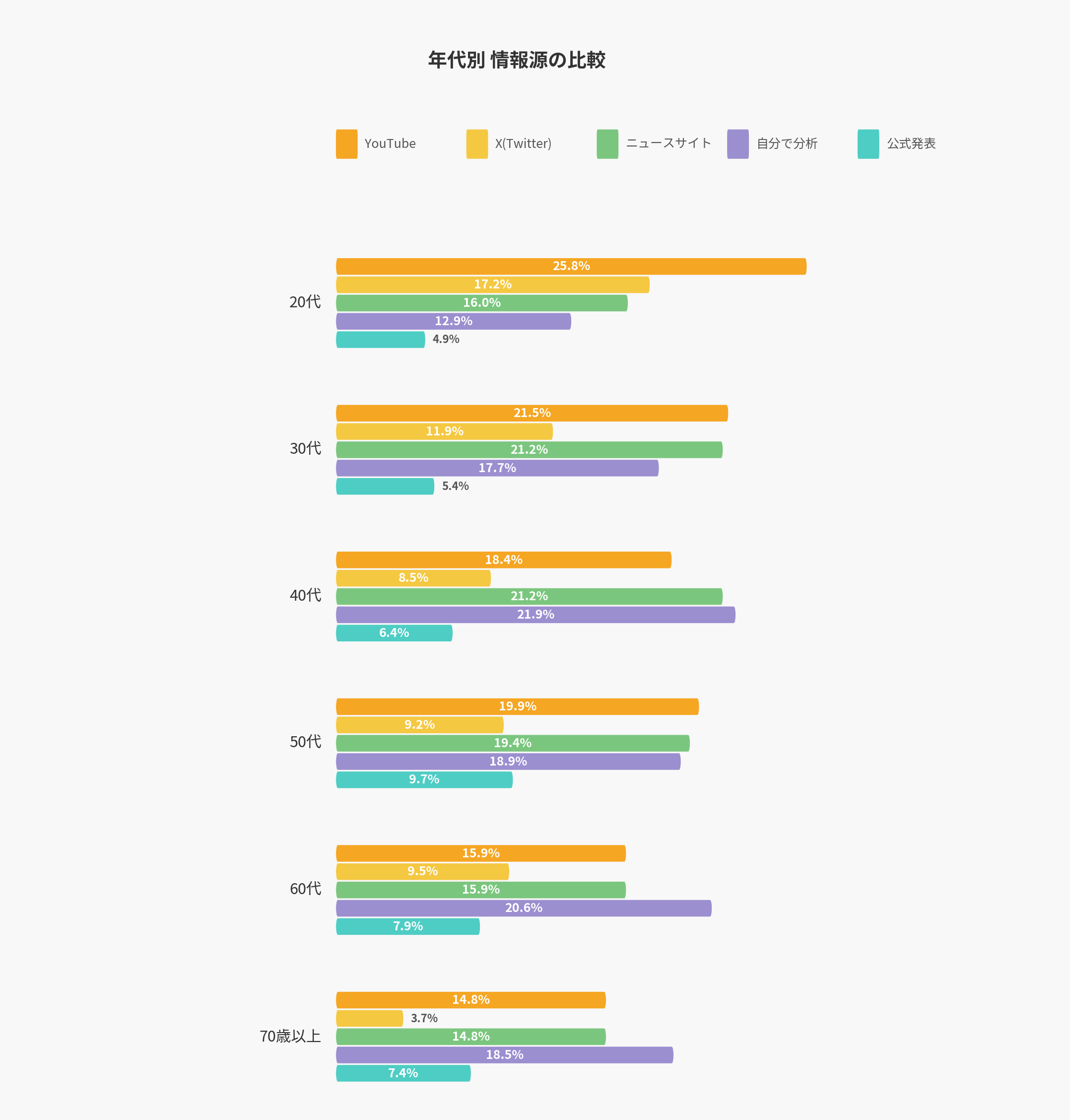
Age group | n | YouTube | X (Twitter) | News sites | Self-directed analysis | Official announcements |
|---|---|---|---|---|---|---|
20s | 163 people | 42 people (25.8%) | 28 people (17.2%) | 26 people (16.0%) | 21 people (12.9%) | 8 people (4.9%) |
30s | 260 people | 56 people (21.5%) | 31 people (11.9%) | 55 people (21.2%) | 46 people (17.7%) | 14 people (5.4%) |
40s | 283 people | 52 people (18.4%) | 24 people (8.5%) | 60 people (21.2%) | 62 people (21.9%) | 18 people (6.4%) |
50s | 196 people | 39 people (19.9%) | 18 people (9.2%) | 38 people (19.4%) | 37 people (18.9%) | 19 people (9.7%) |
60s | 63 people | 10 people (15.9%) | 6 people (9.5%) | 10 people (15.9%) | 13 people (20.6%) | 5 people (7.9%) |
70 and older | 27 people | 4 people (14.8%) | 1 person (3.7%) | 4 people (14.8%) | 5 people (18.5%) | 2 people (7.4%) |
The cross-tabulation by age group confirmed a clear trend: the younger the age bracket, the higher the reliance on social media.
Among respondents in their 20s, YouTube and X combined account for 43.0%, the highest social media usage rate of any age group.
By contrast, as age increases, a growing share of respondents turn to more traditional or self-directed methods, such as news sites and chart analysis.
In particular, respondents in their 20s show a stronger tendency than other age groups to trust word-of-mouth and influencer comments on social media over official announcements.
While they excel at quickly picking up information, there is also a hidden risk in that the very filter used to judge whether that information is true or false depends on the social media platform itself.
This generational gap in information-gathering style may translate directly into a difference in sensitivity to investment risk.
Social-Media-Driven Failures Exceed 60%, Sounding an Alarm for Investors
66.4% Report Losses, Exposing the Trap of Social Media
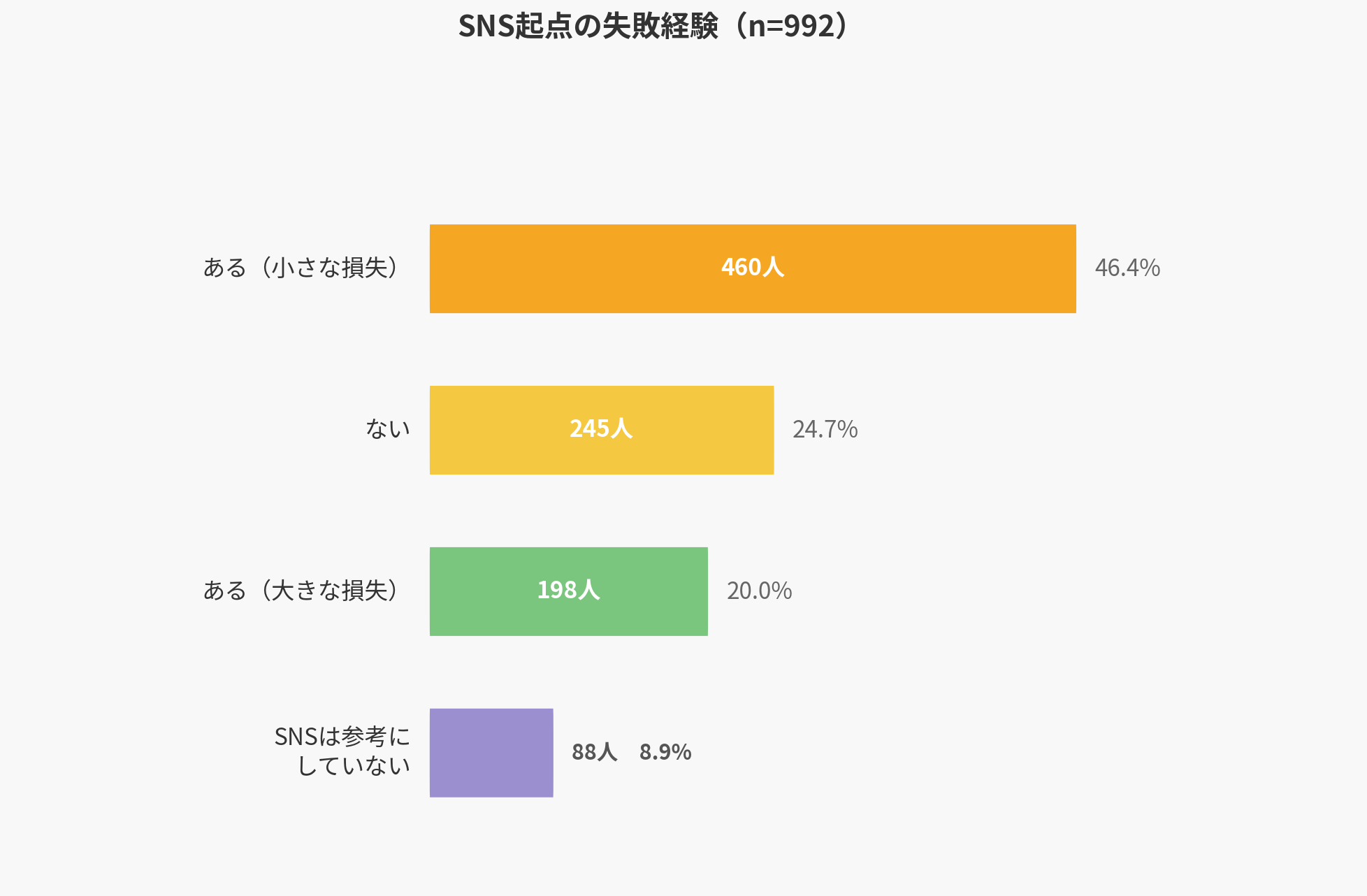
Response | Respondents | Percentage |
|---|---|---|
Yes (a small loss) | 460 people | 46.4% |
Yes (a large loss) | 198 people | 20.0% |
No | 245 people | 24.7% |
I don't use social media as a reference | 88 people | 8.9% |
Investors who take social media information at face value continue, without fail, to suffer real losses.
This survey found that a combined 66.4% of respondents have experienced a failed trade triggered by social media, meaning roughly two out of every three investors have suffered some kind of loss.
Notably, 20.0% acknowledged a "large loss," revealing the serious reality that one in five investors has sustained damage severe enough to threaten their ability to keep investing.
It is also worth noting that only 8.9% of respondents said they "don't use social media as a reference."
This suggests that, in today's crypto asset investing environment, it is practically difficult to trade without being exposed to any social media information at all.
The current situation—where many investors are swept up in a torrent of information and make decisions without an adequate filter—appears to translate directly into the high failure rate.
This high failure rate is believed to stem from the information asymmetry and "hype" characteristic of social media.
While social media offers high immediacy, its environment rarely holds those who post content accountable, making it easy for false information or posts that create excessive expectations to spread.
Investors need to learn from these figures that the excitement on the other side of the screen is not necessarily the truth of the market.
Over 80% of Discord Users Report Failure, Far Outpacing Other Platforms
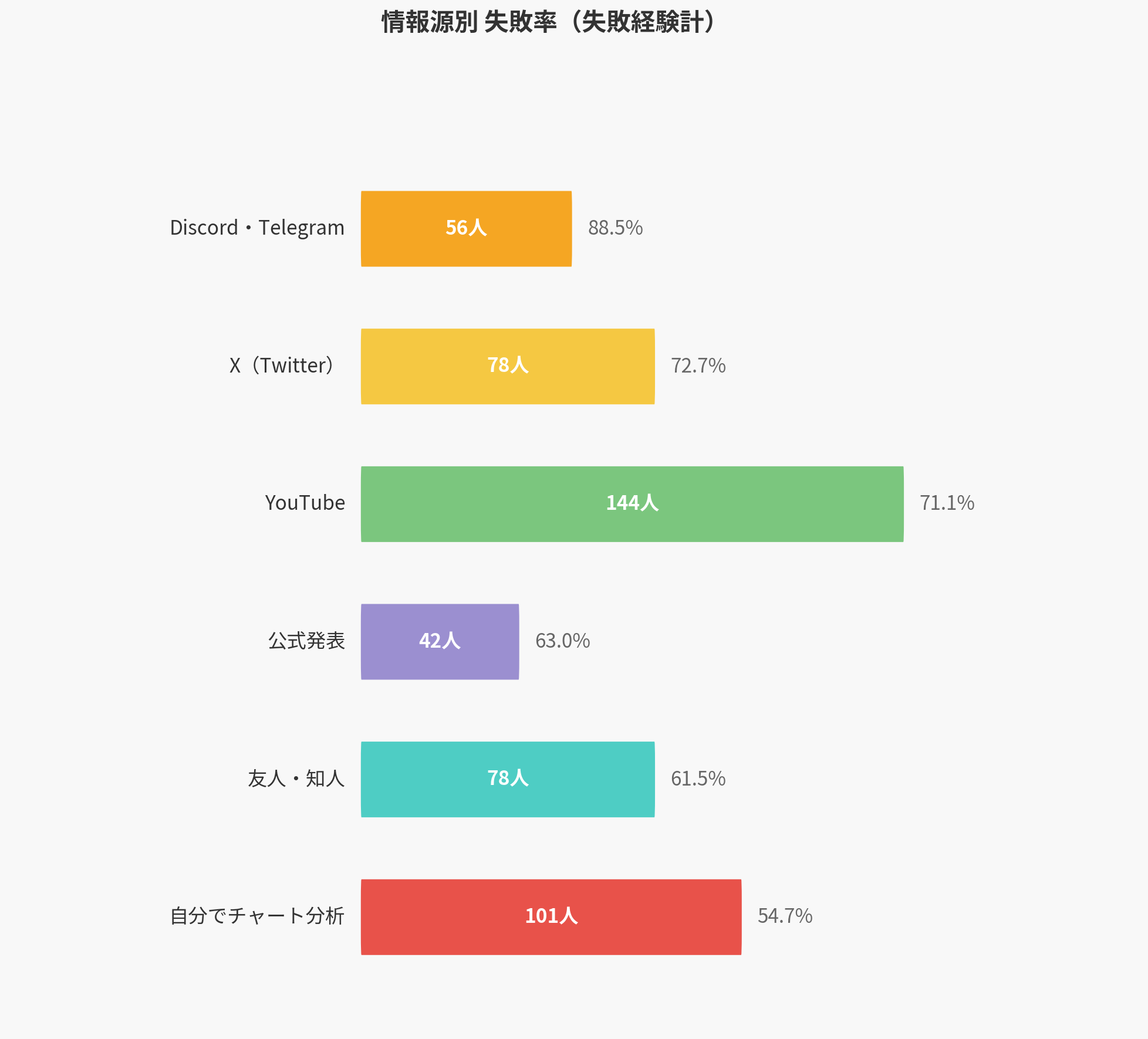
Information source | Large loss | Small loss | Total failure rate |
|---|---|---|---|
Discord / Telegram | 38.5% | 50.0% | 88.5% |
X (Twitter) | 25.0% | 47.7% | 72.7% |
YouTube | 22.9% | 48.2% | 71.1% |
Friends / acquaintances | 19.2% | 42.3% | 61.5% |
Self-directed chart analysis | 20.0% | 34.7% | 54.7% |
Official announcements | 7.4% | 55.6% | 63.0% |
A detailed breakdown of failure rates by information source shows that the degree of risk varies dramatically depending on the platform used.
Discord and Telegram users stand out in particular, posting a staggering 88.5% failure rate—a level of risk far above any other platform.
It is highly likely that the closed, insular excitement unique to these communities significantly impairs calm investment judgment.
The next-highest risk is X (Twitter) at 72.7%, revealing a structure in which the faster information spreads on a platform, the more likely it is to induce failure.
This appears to be the result of many users being swept up by inflammatory phrases such as "now is the time to buy," posted anonymously by an unspecified number of people.
By contrast, the failure rate among those who conduct their own chart analysis is a relatively lower 54.7%, and the figures demonstrate the importance of moving away from being a "passive" recipient of information.
Among respondents who base decisions on official announcements, the "large loss" rate is the lowest of all categories at 7.4%, showing that checking primary information serves as a barrier against fatal mistakes.
A clear correlation exists: the higher the anonymity and immediacy of an information source, the higher an investor's failure rate.
Investors should use these figures to understand the risk hidden behind convenience and reassess where their own information source stands.
High Failure Rates Among Younger Investors Expose a Literacy Gap
Age group | n | Reported a failed trade (total) |
|---|---|---|
20s | 163 people | 120 people (73.6%) |
30s | 260 people | 175 people (67.3%) |
40s | 283 people | 185 people (65.4%) |
50s | 196 people | 122 people (62.2%) |
60s | 63 people | 38 people (60.3%) |
70 and older | 27 people | 15 people (55.6%) |
Looking at failure experience by age group, the numbers clearly reflect differences in investment experience and literacy.
The failure rate among respondents in their 20s is 73.6%, the highest of any age group, revealing the reality that younger investors are paying a heavy price for uncertain information originating on social media.
This confirms a harsh pattern in which a high rate of social media use translates directly into a high degree of exposure to risk.
Meanwhile, the failure rate declines gradually with age, improving to 55.6% among respondents 70 and older.
This is presumed to reflect a tendency among older age groups to place greater weight on official announcements and specialist media, prioritizing certainty over the immediacy of information.
It can be said that investors who have spent longer in the market, or who have accumulated more life experience, are instinctively more wary of the uncertainty of information found online.
For younger investors to break free of this high failure rate, it is not enough to simply master how to operate trading platforms—improving the literacy needed to read the context behind information is an urgent priority.
Unless investors develop the habit of consulting well-founded primary data—rather than diving into the sweet trap of "ease of understanding"—this high failure rate will not improve.
This generational data illustrates the danger of handing over the initiative in investment decisions to others on social media.
The Gap Between Satisfaction and Failure Creates Investment Risk
60% Report Satisfaction, Yet the Majority Have Actually Lost Money
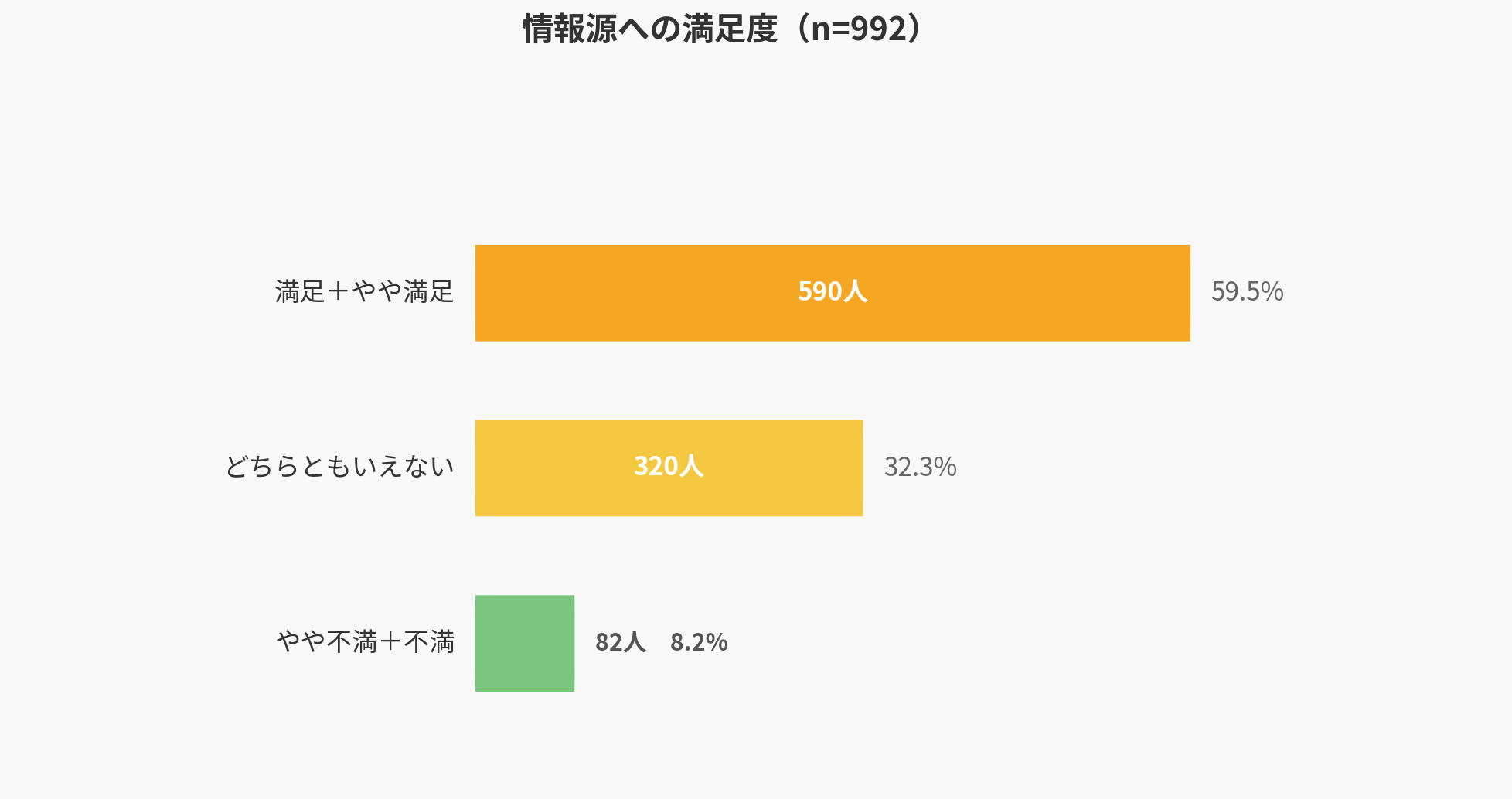
Satisfaction level | Respondents | Percentage |
|---|---|---|
Satisfied + somewhat satisfied | 590 people | 59.5% |
Neither satisfied nor dissatisfied | 320 people | 32.3% |
Somewhat dissatisfied + dissatisfied | 82 people | 8.2% |
A surprising result emerged: roughly 60% of investors say they are "satisfied" with the information source they use.
"Satisfied" plus "somewhat satisfied" together reach 59.5%, showing that the majority of users place a certain level of trust in their current information-gathering environment.
Meanwhile, those who feel "dissatisfied" account for only 8.2%, meaning investors who question the quality of their information source currently make up a very small minority.
However, this high level of satisfaction does not necessarily translate into better investment outcomes.
When set against the earlier finding that 66.4% have experienced social-media-driven failures, a distorted structure emerges in which many investors are "satisfied with their information source despite having failed."
There is a risk that easy-to-understand explanations and the comfortable atmosphere of a community are obscuring the objective accuracy of the information itself.
This very gap between satisfaction and failure rate may be the single greatest risk factor in the crypto asset market.
Once overconfidence sets in—the belief that "I'm getting accurate information"—investors tend to neglect fact-checking and risk management.
What is needed is an approach that reassesses information sources based on objective facts such as actual gains and losses, rather than the subjective measure of satisfaction.
Satisfied Investors Show Higher Failure Rates as Overconfidence Leads to Serious Losses
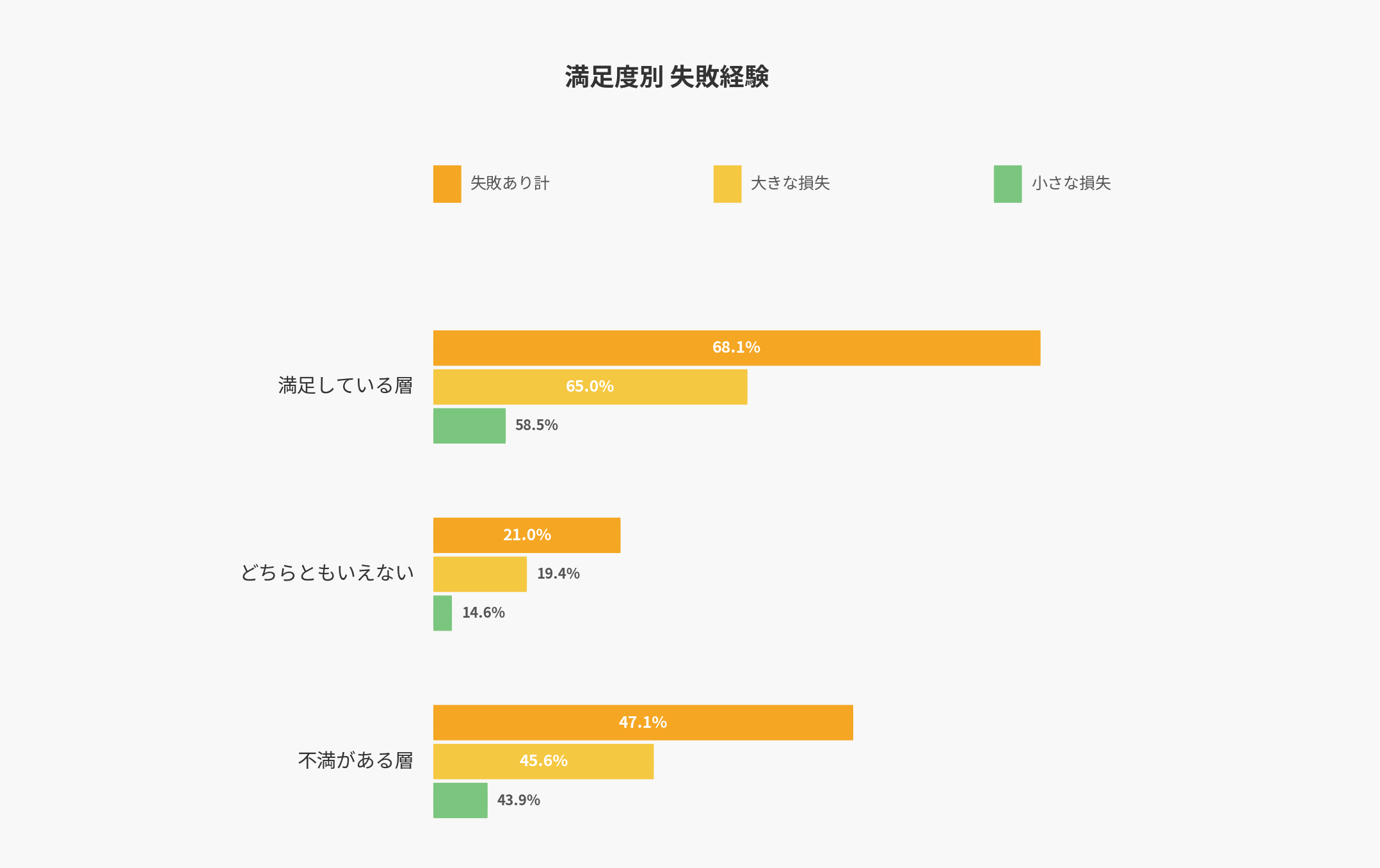
By satisfaction level | Reported a failed trade (total) | Large loss | Small loss |
|---|---|---|---|
Satisfied respondents | 402 people (68.1%) | 124 people (21.0%) | 278 people (47.1%) |
Neutral respondents | 208 people (65.0%) | 62 people (19.4%) | 146 people (45.6%) |
Dissatisfied respondents | 48 people (58.5%) | 12 people (14.6%) | 36 people (43.9%) |
Analyzing failure rates by satisfaction level revealed the ironic finding that the more satisfied a respondent is, the more likely they are to have experienced a failed trade.
The failure rate among those who answered "satisfied" reaches 68.1%, significantly higher than the 58.5% among those who feel dissatisfied.
Notably, the share of respondents who suffered a "large loss" is also higher among satisfied investors, suggesting that attachment to and trust in an information source may be inducing fatal errors in judgment.
This can be seen as an example of a confirmation-style bias, well known in psychology, negatively affecting investment decisions.
It reflects a psychological desire to validate the information source one has chosen, leading investors to ignore negative signs and tell themselves "it's still fine."
Whether information feels "comfortable" and whether it is actually "useful" are two separate questions—and the more satisfied an investor feels, the more composure they need to question their own judgment.
At the same time, it should not be overlooked that respondents who are dissatisfied with their information source have a relatively lower failure rate.
Precisely because they are skeptical of the information available to them, a self-protective instinct appears to be at work, leading them to compare multiple sources and time their trades more carefully.
Abandoning the assumption that "satisfaction equals safety," and keeping the uncertainty of information constantly in mind, is a survival strategy for building assets over the long term.
A Professional Perspective: Improving Literacy to Avoid Risk
Source characteristics | Reliability | Immediacy | Recommended use |
|---|---|---|---|
Official announcements | Extremely high | Low | Use as the final basis for investment decisions |
Specialist media | High | Moderate | Use to grasp the overall market picture |
Social media (YouTube, etc.) | Low | High | Use to spot early signs of trends |
Discord, etc. | Extremely low | Extremely high | Use only as a reference for speculative decisions |
To break free of social media dependence and improve this high failure rate, it is essential to clearly define the role each information source plays.
Social media platforms such as YouTube and X should be positioned strictly as supplementary tools for sensing "market excitement" or "emerging trends."
From a professional standpoint, it is strongly recommended that investors practice a "return to primary information"—always checking an official whitepaper or public information from bodies such as the Financial Services Agency (FSA), Japan's financial regulator, before making a final buy or sell decision.
It is also important to avoid fixating on a specific influencer or community, and to make cross-checking information a habit.
Rather than basing a decision on a single video or post, comparing at least three information sources of a different nature can help correct for bias in the information.
Not being swayed by "ease of understanding," and continually questioning the intent and evidence behind information, is an essential quality for investors in an era dominated by social media.
Finally, it is important not to forget the principle that responsibility for investment decisions always rests with the individual investor.
Many people who have failed because of social media have unknowingly handed the initiative in their decision-making over to the person posting the content.
Returning to the basics—thinking for yourself and committing funds only once you are genuinely convinced, rather than simply accepting information at face value—is the first step toward investing without regret.
Summary
This survey brought into sharp focus the fact that, in crypto asset investing, the choice of information source can be the deciding factor in an investor's fate.
The survey found that 31.4% of investors rely most on social media platforms such as YouTube and X, but behind that convenience, 66.4% have experienced a social-media-driven failure.
The failure rate among Discord users in particular is extremely high at 88.5%, suggesting that "hype" within closed environments carries a real danger of causing serious losses.
What is particularly concerning is the gap in perception: roughly 60% of investors say they are "satisfied" with their current information source, even though many of them are actually losing money.
Easy-to-understand videos and the familiarity of social media content can easily create the "overconfidence" of feeling like you understand something, which becomes a trap that dulls calm judgment.
The shortcut to success is nothing other than consistently confirming facts through primary information from official sites and public institutions, rather than being swayed by subjective satisfaction.
Rather than chasing immediacy alone, making autonomous decisions based on well-founded data is the only defense for surviving in such a turbulent market.
Survey Overview
Survey date: March 23, 2026
Survey method: Internet survey
Survey population: Men and women residing in Japan (people currently investing in crypto assets, or who have invested in the past)
Valid responses: 992
Conducted by: Clabo Inc.
Survey Questions
- Have you ever invested in crypto assets (virtual currencies)?
- Which of the following is closest to the total amount you have invested in crypto assets to date?
- When making investment decisions about crypto assets, which information source do you rely on most?
- How satisfied are you with the outcome of investment decisions based on that information source?
- Have you ever felt that you "failed" after investing based on information from social media (X, YouTube, etc.)?
- Do you think having no one to consult affects your investment decisions?
This article is for informational purposes only and does not constitute financial or investment advice. Please consult a qualified professional before making investment decisions.


