


As crypto assets (also known as virtual currencies) become more widespread, scams targeting holders are growing increasingly sophisticated. Clabo's own survey found that 55.6% of users have experienced either actual financial harm or a near-miss.
People in their 30s and inexperienced investors in particular are more likely to be targeted through social media and fake websites, with a notable number of cases involving losses of ¥100,000 or more. Impatience for profit and excessive trust in information are key factors behind these devastating losses.
This article provides a detailed analysis of the latest scam trends based on data from 302 respondents, covering the defensive measures essential to protecting your assets and how to evaluate information to avoid risk.
55.6% of Users Have Faced Crypto Scams
Nearly 40% Have Come Close to Being Scammed
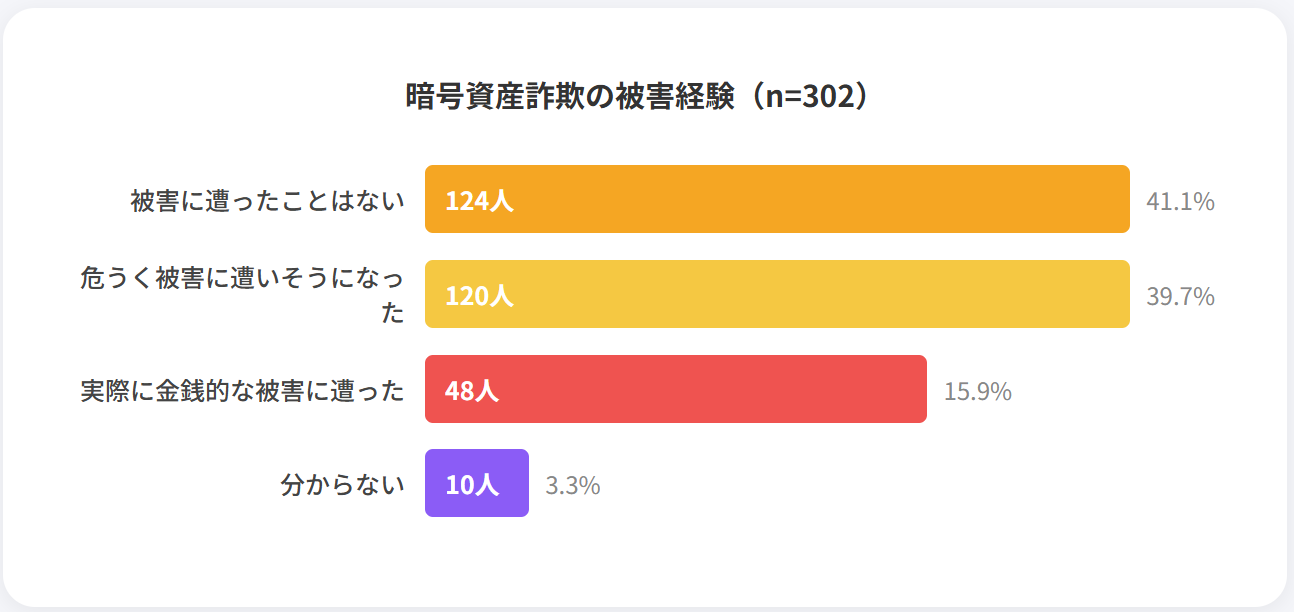
Response | Responses | Share |
|---|---|---|
Have never been scammed | 124 | 41.1% |
Have not been scammed, but came close | 120 | 39.7% |
Suffered actual financial harm | 48 | 15.9% |
Not sure | 10 | 3.3% |
The survey asked crypto asset holders about their experiences with scams. The results showed that 15.9% of respondents with crypto experience had suffered actual financial harm.
Notably, 39.7% of respondents said they came close to being scammed even though they avoided actual harm. Combined, this means 55.6% of users have been directly exposed to the threat of scams, making clear that persistent attacks from bad actors have become the norm.
Protecting your assets now requires more than personal vigilance alone — it is essential to understand the structural patterns behind these scams and combine that understanding with system-level safeguards.
Younger Holders Face More Sophisticated Scam Tactics
Age Group | Suffered Actual Harm | Experienced a Near-Miss | No Harm | Not Sure |
|---|---|---|---|---|
20s | 11 | 30 | 14 | 1 |
30s | 15 | 36 | 33 | 3 |
40s | 11 | 32 | 25 | 4 |
50s | 9 | 13 | 41 | 2 |
60s | 0 | 8 | 6 | 0 |
70s and older | 2 | 1 | 5 | 0 |
Cross-tabulating the results by age reveals a clear vulnerability among people in their 30s: 58.6% of respondents in this age group reported either falling victim to a scam or narrowly avoiding one.
Among people in their 20s, the actual-harm rate was 19.6% — the highest of any age group — underscoring that even digital-native users cannot easily spot every scam. Younger holders, who tend to follow trends closely, are more likely to be drawn in by sophisticated hooks disguised as the latest trends, such as fake investment schemes or NFT giveaways.
By contrast, a larger share of respondents in their 50s and older reported no harm at all. This may reflect a more cautious approach to investing, but it is also likely influenced by the fact that this group has fewer inflow channels such as social media compared with younger users, reducing their physical exposure to scam attempts.
Investors With Under a Year of Experience See the Most Harm
Investing Experience | Suffered Actual Harm | Experienced a Near-Miss | No Harm | Not Sure |
|---|---|---|---|---|
Less than 6 months | 13 | 9 | 20 | 3 |
6 months to under 1 year | 16 | 33 | 26 | 2 |
1 to under 3 years | 10 | 47 | 40 | 1 |
3 years or more | 8 | 25 | 29 | 0 |
Prefer not to say | 1 | 6 | 9 | 4 |
Looking at the relationship between years of investing experience and scam exposure, beginners with less than six months of experience stand out for their high rate of actual harm — 28.9% suffered financial losses, by far the highest figure among all experience brackets.
Among veteran investors with three or more years of experience, on the other hand, the actual-harm rate drops to 12.9%. Even so, more than 40% of this group reported a near-miss, showing that attackers do not ease up even on seasoned holders who have weathered several market cycles.
In the early stages of investing, gaps in technical and institutional understanding — such as on-chain operations, transfer mechanics, and how to distinguish official information — are easy for attackers to exploit. Being willing to invest time in learning ultimately benefits your assets more through avoiding devastating losses than through chasing returns.
Mid-Sized Losses Are the Most Common
How Scammers Drain Assets Completely
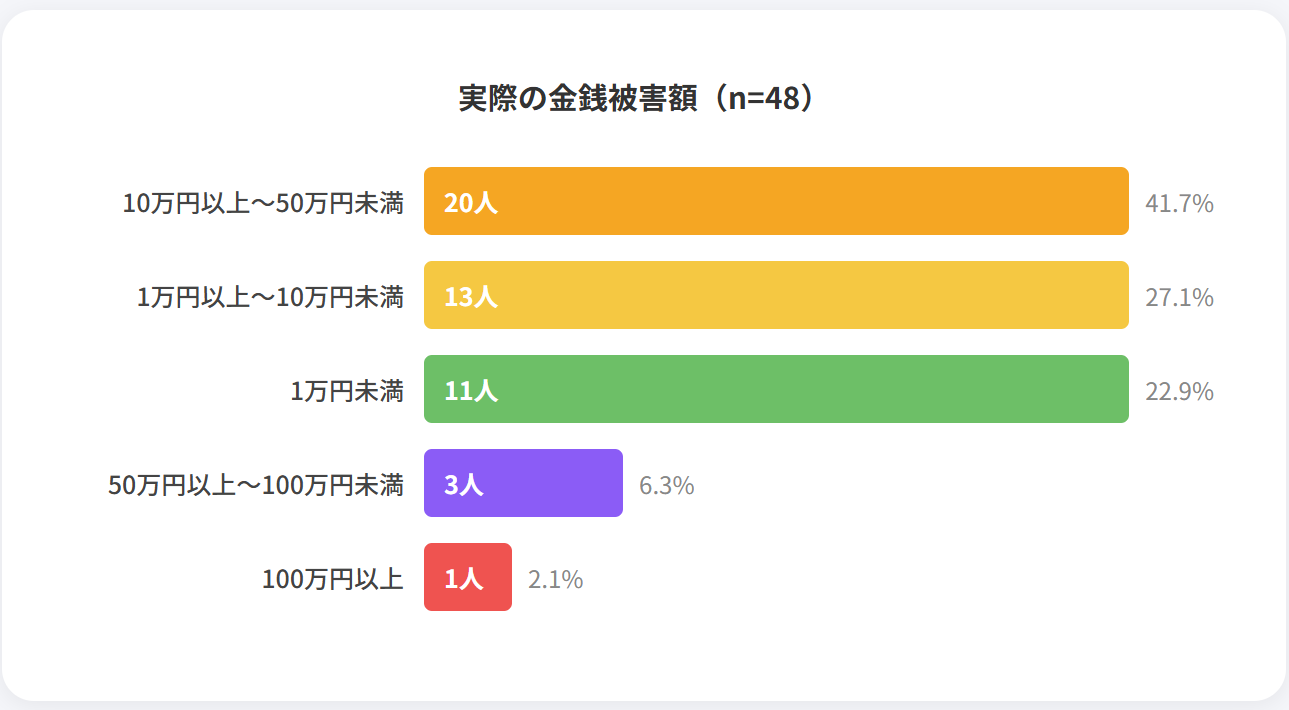
Amount Lost | Responses | Share |
|---|---|---|
Under ¥10,000 | 11 | 22.9% |
¥10,000 to under ¥100,000 | 13 | 27.1% |
¥100,000 to under ¥500,000 | 20 | 41.7% |
¥500,000 to under ¥1,000,000 | 3 | 6.3% |
¥1,000,000 or more | 1 | 2.1% |
Among the 48 respondents who suffered actual financial harm, losses in the ¥100,000-to-under-¥500,000 range were the most common at 41.7%. This is a bracket that individual holders commonly invest as surplus funds, making it an efficient target for attackers looking to extract a substantial sum.
At the same time, relatively small losses of under ¥100,000 accounted for about half of all cases, showing that risk is present from the very earliest stages of investing, even with small amounts. Once a crypto transaction is sent, there is no central authority to reverse it, so it is essentially irreversible. Holders should keep in mind that even losses of a few tens of thousands of yen are almost impossible to recover.
Cases of high-value losses exceeding ¥1,000,000 were also confirmed, showing that elaborate, long-running scams — which first build trust before pushing victims toward additional "investments" — remain a real threat. Regardless of the amount involved, skipping the step of verifying a recipient wallet address or a site's authenticity can be enough to trigger the loss of your entire holdings.
Digital Touchpoints Are the Gateway to Scams
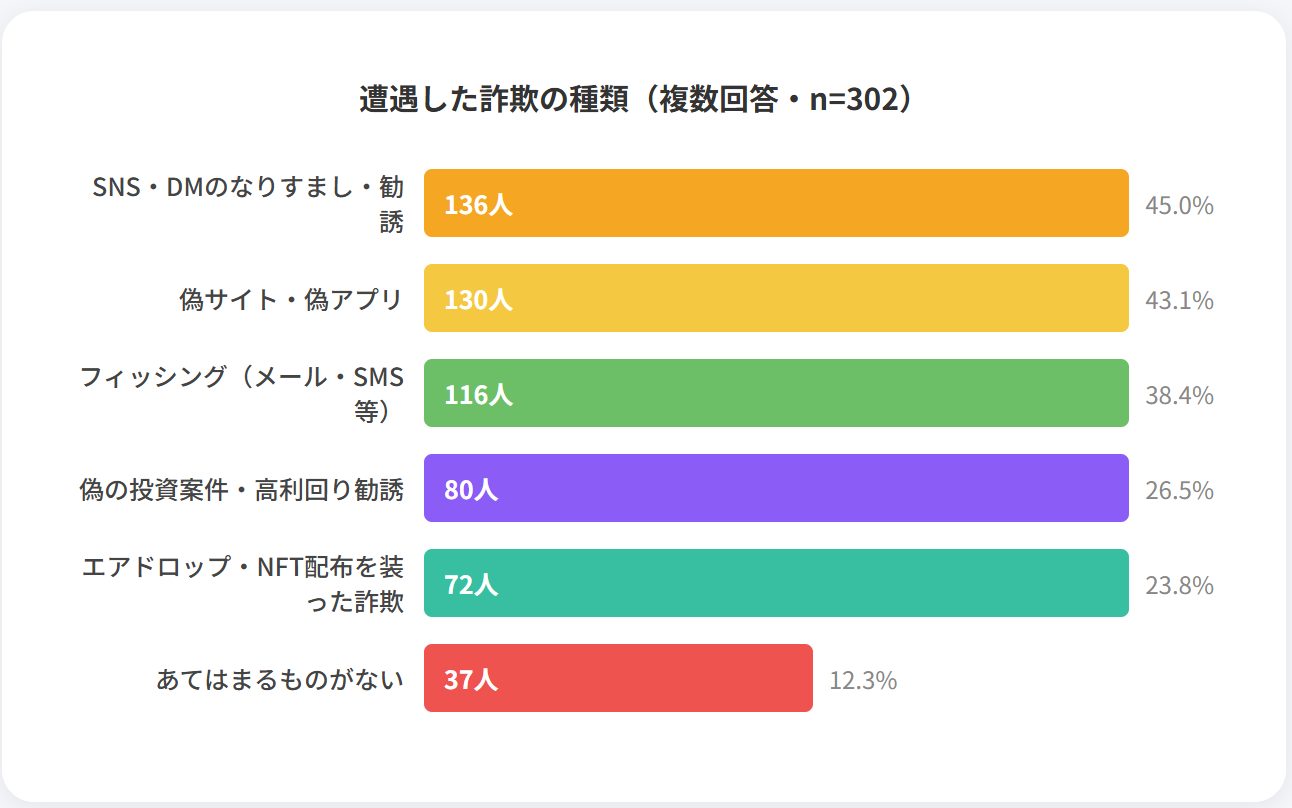
Type of Scam (multiple answers allowed) | Responses | Share |
|---|---|---|
Impersonation or solicitation via social media/DMs | 136 | 45.0% |
Fake websites or apps | 130 | 43.1% |
Phishing (email, SMS, etc.) | 116 | 38.4% |
Fake investment schemes or high-yield solicitations | 80 | 26.5% |
Scams disguised as airdrops or NFT giveaways | 72 | 23.8% |
None of the above | 37 | 12.3% |
The most common trigger for a scam or near-miss was "impersonation or solicitation via social media/DMs," at 45.0%. While platforms such as X (formerly Twitter) and YouTube are essential for gathering information, they are also environments where it is remarkably easy for accounts impersonating official sources to make contact.
Close behind, "fake websites or apps" came in at 43.1%, highlighting how common it is for scammers to lure victims to sites with meticulously copied user interfaces in order to steal private keys (signature keys) or login credentials. These are designed to be visually indistinguishable from the real thing, meaning the risk materializes the moment a victim clicks the link.
Notably, scams disguised as airdrops or NFT giveaways accounted for more than 20% of cases. These exploit the Web3 culture of "free distribution," and it has become common for such scams to use sophisticated techniques that trick victims into signing a smart contract, which then illicitly transfers assets out of their wallet.
Losses Scale With Investment Size
Current Investment Amount | Loss Under ¥100,000 | Loss of ¥100,000–¥500,000 | Loss of ¥500,000 or More |
|---|---|---|---|
Under ¥10,000 | 13 | 2 | 1 |
¥10,000 to under ¥100,000 | 9 | 9 | 2 |
¥100,000 to under ¥500,000 | 2 | 5 | 0 |
¥500,000 or more | 0 | 4 | 1 |
Cross-analyzing current investment amounts against actual losses reveals a strong correlation: holders with larger portfolios tend to suffer larger losses when scammed. Among respondents investing ¥500,000 or more, all five who were scammed lost at least ¥100,000, and one of them lost more than ¥1,000,000.
By contrast, among holders investing under ¥10,000, the majority — 13 cases — kept their losses under ¥10,000 as well. This suggests that the larger a holder's investment, the more their potential losses scale up accordingly.
Notably, even among the mid-tier group investing more than ¥100,000, some respondents suffered losses of ¥500,000 or more — losses that exceeded their original investment. This illustrates the frightening effectiveness of psychologically manipulative scams that push victims to send additional funds, even by going into debt, beyond their initial investment.
Losing Composure Is What Leads to Being Scammed
Over 30% Cite Emotional Decision-Making as the Reason They Were Scammed
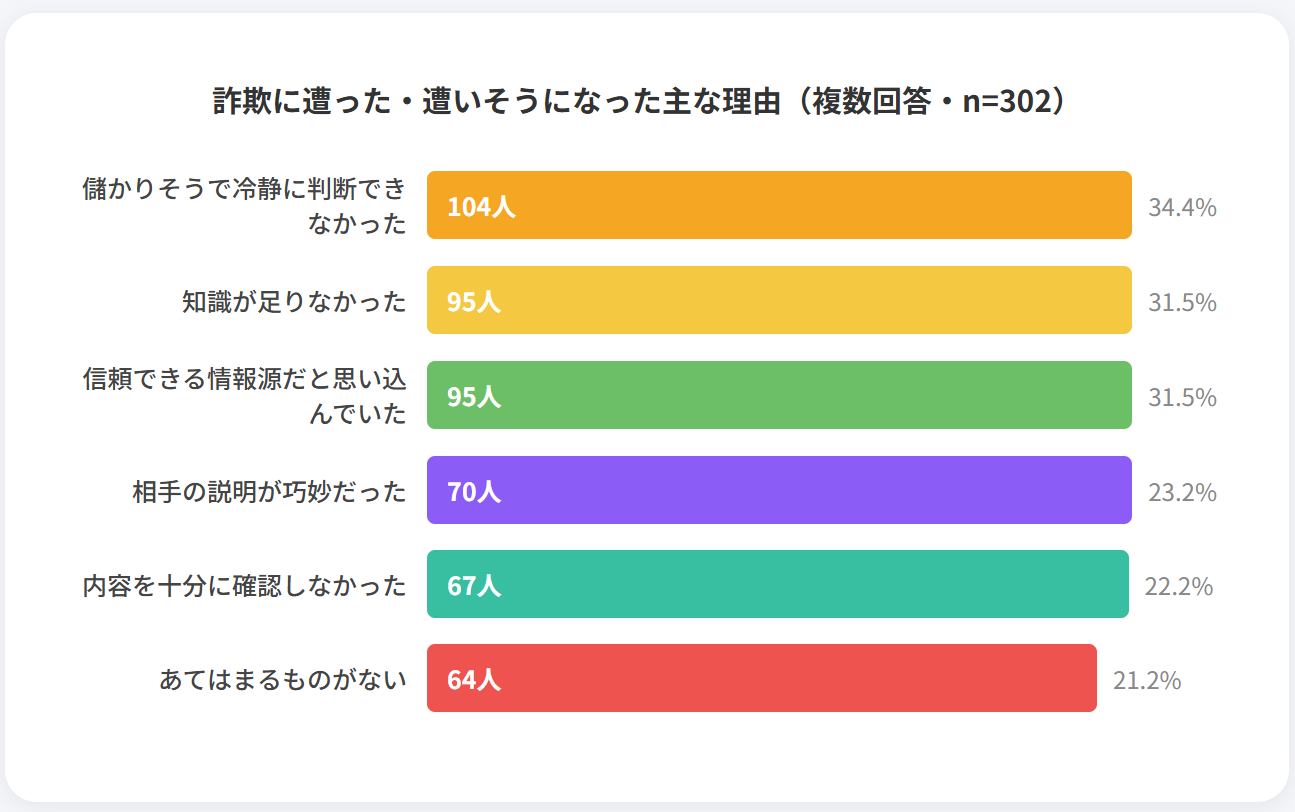
Main Reason for Falling Victim (multiple answers allowed) | Responses | Share |
|---|---|---|
Felt it seemed profitable and lost the ability to judge calmly | 104 | 34.4% |
Lacked sufficient knowledge | 95 | 31.5% |
Assumed the information source was trustworthy | 95 | 31.5% |
The scammer's explanation was convincing | 70 | 23.2% |
Did not verify the details thoroughly | 67 | 22.2% |
None of the above | 64 | 21.2% |
Analyzing the reasons behind these scams and near-misses, the most common factor was the psychological gap created by "feeling it seemed profitable," cited by 34.4% of respondents. Crypto markets are highly volatile, and sudden short-term surges are reported on a near-daily basis, so it appears that holders' FOMO — the fear of missing out — is undermining their ability to calmly assess risk.
"Lack of knowledge" and "excessive trust in the information source" tied at 31.5%, also confirming a tendency to blindly trust seemingly authoritative voices without sufficient technical understanding. Malicious actors deliberately impersonate influencers or pile on complex technical jargon in an attempt to short-circuit users' critical thinking and get them to skip the verification process.
The fact that 22.2% of respondents said they "did not verify the details" points to a serious problem. Even when a scammer's explanation is convincing, simply pausing to check the objective facts before sending funds or signing anything could prevent much of this harm. The golden rule for protecting your assets is to maintain a critical mindset — the more attractive an offer designed to stir up emotion sounds, the more it deserves questioning the intent behind it.
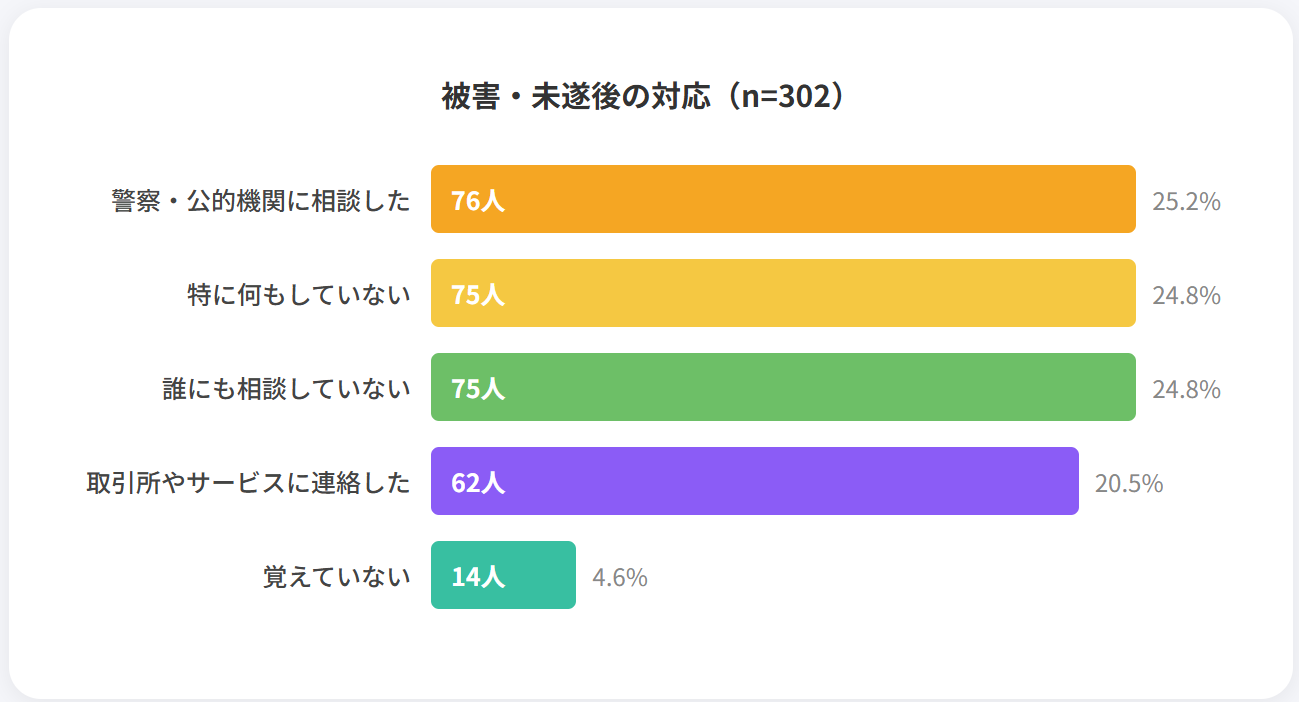
1 in 4 Who Experienced Trouble Consulted a Public Authority
Response After the Incident | Responses | Share |
|---|---|---|
Consulted the police or a public authority | 76 | 25.2% |
Did nothing in particular | 75 | 24.8% |
Did not consult anyone | 75 | 24.8% |
Contacted the exchange or service | 62 | 20.5% |
Don't remember | 14 | 4.6% |
Regarding their response to the incident, "consulting the police or a public authority" was the most common at 25.2%. However, "did nothing in particular" and "did not consult anyone" together account for 49.6%, revealing that about half of all users are shouldering the harm alone and giving up on resolving it.
This "silence" likely stems from a widespread sense of resignation — given the anonymity and decentralized nature of crypto assets, victims may assume there is little chance of recovering their funds even if they report the incident. While recovering stolen funds is indeed an extremely high bar, failing to disclose the incident or report it to the appropriate authorities can create fertile ground for new victims and embolden scammers further.
Only 20.5% contacted the exchange or service provider, also revealing that platform support functions are not being sufficiently trusted or used. To minimize harm and prevent it from spreading further, every user needs to set aside any embarrassment and take swift, transparent initial action.
Victims Most Often Turn to the Police
Follow-up Response | Suffered Actual Harm | Near-Miss |
|---|---|---|
Consulted the police or a public authority | 23 | 37 |
Contacted the exchange or service | 20 | 33 |
Did not consult anyone | 5 | 38 |
Did nothing in particular | 0 | 11 |
Analyzing responses by severity of harm shows that victims who actually lost money are markedly more likely to proactively contact public authorities and exchanges. Of the 48 respondents who suffered financial harm, 23 consulted the police or a public authority and 20 contacted an exchange or similar service — meaning a majority of actual victims reached out to a public authority or exchange.
Among the "near-miss" group who avoided actual harm, on the other hand, 38 respondents said they had not consulted anyone, confirming that this group tends to be more isolated than actual victims. It is understandable to conclude "I wasn't scammed, so it's fine," but failing to share the sophisticated tactics encountered during a near-miss risks creating the next victim.
It is notable that not a single actual victim answered "did nothing in particular." Losing assets clearly drives people to act, but what matters more than after-the-fact responses is the preventive mindset seen among the near-miss group — sharing what happened. Sharing knowledge across the wider community is what will reduce the number of holders fighting this battle alone and close the gaps that attackers exploit.
How Information-Gathering Habits Relate to Avoiding Scams
News Sites and Social Media Are the Two Leading Information Sources
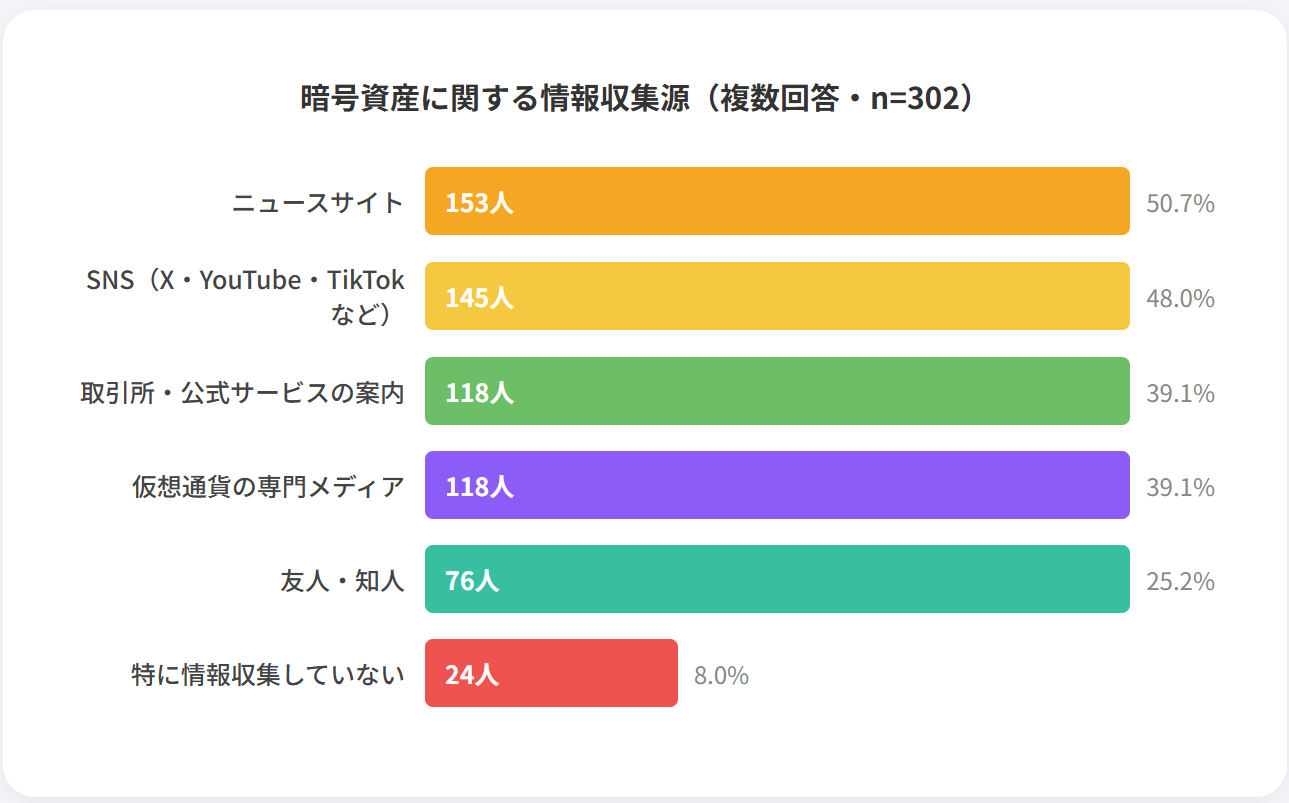
Information Source (multiple answers allowed) | Responses | Share |
|---|---|---|
News sites | 153 | 50.7% |
Social media (X, YouTube, TikTok, etc.) | 145 | 48.0% |
Exchange or official service announcements | 118 | 39.1% |
Specialist crypto media | 118 | 39.1% |
Friends and acquaintances | 76 | 25.2% |
Do not actively gather information | 24 | 8.0% |
Asked where they get crypto-related information, news sites (50.7%) and social media (48.0%) came in nearly tied, showing that both have become firmly established as go-to sources. Holders routinely gather information across multiple platforms rather than relying on a single source, weighing and filtering what they find.
By contrast, only 39.1% of respondents referenced exchange or official service announcements, suggesting a tendency to weigh secondary curated media and community voices more heavily than primary sources. While this diversification of information sources offers the benefit of multiple perspectives, it also cannot be denied that it raises the risk of exposure to misinformation or deliberately misleading content, such as scam advertisements.
The 25.2% of respondents who cited friends and acquaintances as an information source are especially notable, since emotional trust within relationships can dull judgment, potentially leaving them vulnerable to closed-community solicitations. Having trusted sources is important, but continually verifying the freshness and origin of information with your own eyes is what functions as the most effective defense in an opaque market.
Assuming "Checking Official Information Is Enough" Is Dangerous
Scam Status | Uses Social Media | Uses News Sites | Uses Specialist Media | Uses Official Announcements |
|---|---|---|---|---|
Suffered actual harm | 20 | 34 | 26 | 26 |
Near-miss | 49 | 56 | 49 | 57 |
No harm | 74 | 61 | 41 | 34 |
Analyzing the correlation between scam status and information sources, 70.8% of the 48 respondents who suffered actual financial harm used news sites, and 54.2% used specialist media or official announcements, as information sources. At first glance, this appears paradoxical — the group using the most credible media seems more likely to have been scammed.
This suggests that victims may have over-trusted the authority of information because "I saw it in the news" or "an expert said so," and skipped detailed verification of individual transactions, such as checking contract addresses. By contrast, the group that avoided harm also had high social media usage, suggesting they may have cross-referenced multiple sources.
Rather than taking comfort in the name or reputation of a media outlet, holders need to individually judge the legitimacy of any specific action being asked of them. No matter how authoritative the source of the information, it is ultimately the individual who clicks "send" or "sign," and that responsibility cannot be passed off to the media — a principle that must be upheld without exception.
Younger Holders Face the Challenge of Instant Information vs. Verifying the Truth
Age Group | Social Media (X, etc.) | News Sites | Exchanges, etc. | Friends and Acquaintances |
|---|---|---|---|---|
20s | 33 | 25 | 25 | 17 |
30s | 33 | 38 | 31 | 18 |
40s | 40 | 35 | 31 | 21 |
50s | 17 | 22 | 22 | 11 |
Looking at information-gathering patterns by age, respondents in their 20s are the only age group whose primary source was social media — a distinct pattern. In this group, social media use far outpaced news sites as a source, reflecting the digital-native tendency to prioritize speed and "the voice of individuals."
However, social media is also a breeding ground for scams, flooded with fake accounts impersonating influencers and meticulously crafted ads for fraudulent projects. While it offers highly immediate information, the process of verifying that information tends to be neglected, which appears to increase the risk of being lured to fake websites or falling for impersonation.
Among respondents in their 30s and older, by contrast, there is a stronger tendency to use multiple platforms in a balanced way, with more people verifying information from multiple angles. For younger holders to turn their information-gathering skills into a defense, it is essential to build the habit of not taking social media information at face value and always cross-checking it against primary sources or official announcements.
A Market Structure Built on Small Initial Investments
Over Half of Holders Have More Than a Year of Experience
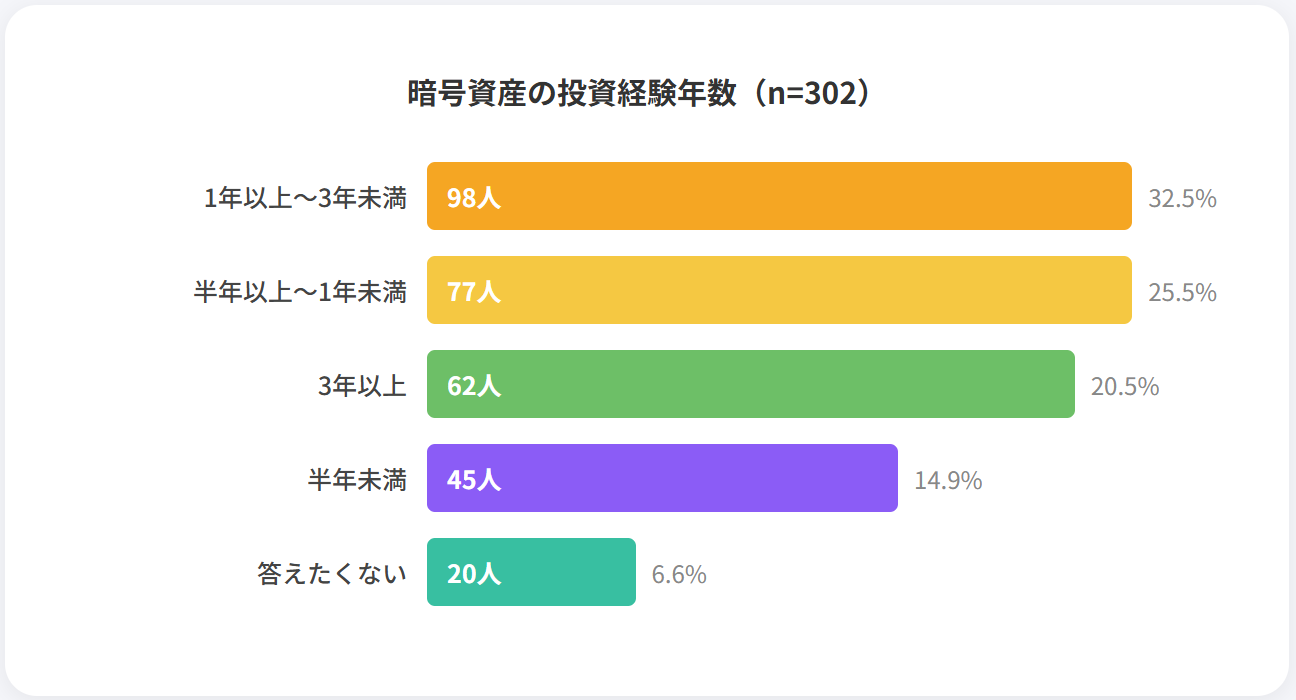
Investing Experience | Responses | Share |
|---|---|---|
Less than 6 months | 45 | 14.9% |
6 months to under 1 year | 77 | 25.5% |
1 to under 3 years | 98 | 32.5% |
3 years or more | 62 | 20.5% |
Prefer not to say | 20 | 6.6% |
Asked about their years of crypto investing experience, "1 to under 3 years" was the largest bracket at 32.5%. Adding the veteran group of 3 years or more (20.5%), more than half of all respondents have over a year of ongoing investing experience, suggesting the market has moved beyond a temporary boom and into a period of establishment.
At the same time, new and relatively new entrants with less than a year of experience account for about 40%, reconfirming that this remains a dynamic market with a steady inflow of new holders. With such a diverse mix of experience levels, risk awareness clearly differs by phase. In particular, early success often lowers defensive awareness, carrying the risk of a large loss down the line.
The longer someone has been investing, the more likely they are to have witnessed past crashes and scams firsthand, which tends to build the caution needed to verify whether information is true. For beginners, learning from the knowledge-updating process that holders with more than a year of experience have gone through, and building up their own ability to filter information, is key to long-term wealth building.
Low-Risk "Trial Investing" Is Widespread
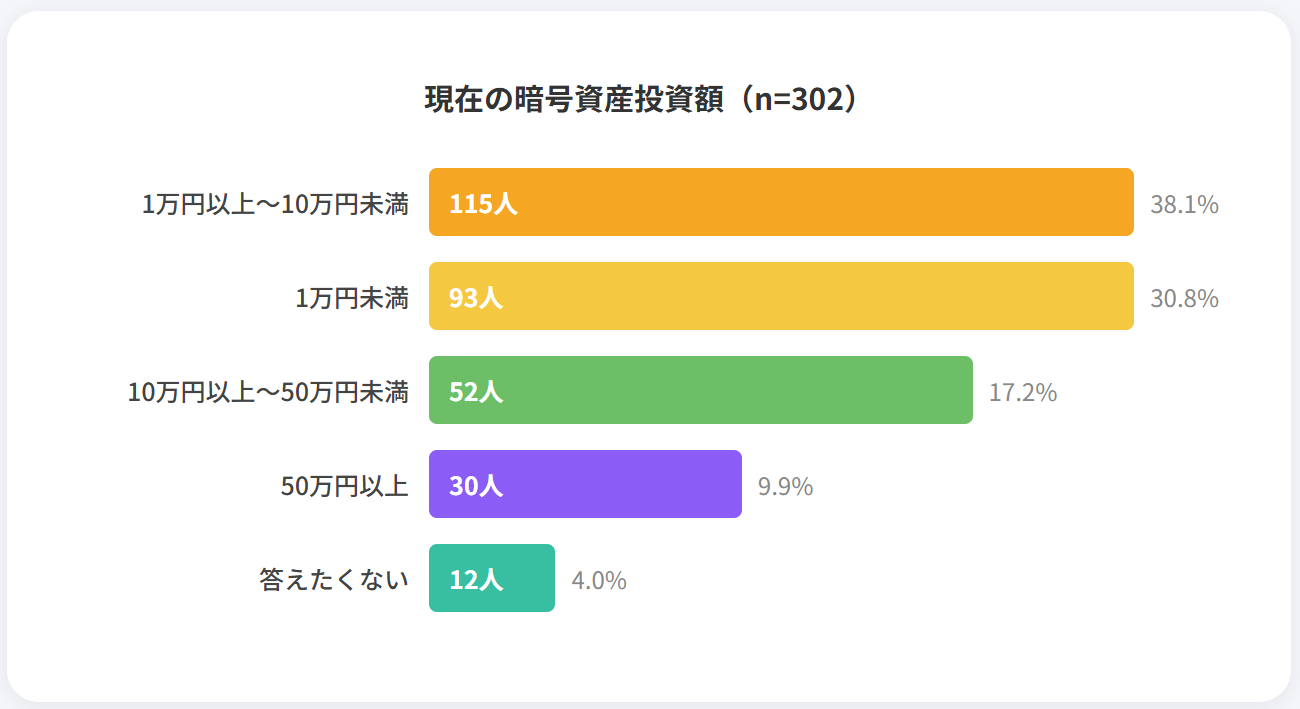
Current Investment Amount | Responses | Share |
|---|---|---|
Under ¥10,000 | 93 | 30.8% |
¥10,000 to under ¥100,000 | 115 | 38.1% |
¥100,000 to under ¥500,000 | 52 | 17.2% |
¥500,000 or more | 30 | 9.9% |
Prefer not to say | 12 | 4.0% |
Regarding current investment amounts, holders investing under ¥100,000 made up about 70% of the total, at 68.9%. "¥10,000 to under ¥100,000" was the largest single bracket at 38.1%, highlighting how common it has become to invest surplus funds within a range that does not affect daily life.
However, a small investment is no reason for complacency. Attackers use efficient automated tools to run scams at scale, aiming to rack up enormous profits even when the amount taken per victim is small.
Holders with small holdings tend to think "it wouldn't hurt much to lose this," leading them to neglect security settings such as two-factor authentication or click suspicious links casually. Even with an investment of just ¥10,000, holders should keep in mind that the vulnerability of the wallet or account behind it could become a critical weakness once their investment grows.
Smaller Investors Focus on "Tactics," Larger Investors on "Patterns"
Current Investment Amount | Latest Tactics | Common Patterns | Checkpoints | Countermeasures |
|---|---|---|---|---|
Under ¥10,000 | 35 | 20 | 18 | 11 |
¥10,000 to under ¥100,000 | 23 | 59 | 20 | 7 |
¥100,000 to under ¥500,000 | 6 | 22 | 23 | 1 |
¥500,000 or more | 10 | 11 | 6 | 1 |
Cross-analyzing investment amounts against future security needs reveals a clear difference in the information holders want, depending on their portfolio size. Among holders investing under ¥10,000, "the latest scam tactics and case studies" was the top request, while among the mid-tier and larger holders investing more than ¥100,000, interest shifts toward "an organized overview of common scam patterns" and "checkpoints."
This is likely because smaller holders are seeking "symptomatic" knowledge focused on individual cases, whereas larger holders increasingly take a more logical, preventive approach — trying to understand scams structurally. Among the group investing ¥500,000 or more, the emphasis is less on specific checkpoints and more on grasping general "common patterns," prioritizing fundamental defensive skill over being swayed by individual incidents.
As investment amounts grow, so does the sense of urgency that a single mistake could lead to an irreversible loss, and this process changes the quality of learning as well. What holds true across all holders is that the most robust defense comes not just from following the latest cases, but from deepening one's understanding of the psychological and technical structures behind scams — in other words, understanding why people fall for them in the first place.
Summary
This original survey revealed an extremely serious reality: 55.6% of crypto asset users are facing the threat of scams. The fact that more than half of all users have become criminal targets illustrates just how exposed this market is to malicious attacks. Protecting your assets deserves a priority equal to, or even higher than, building an investment strategy.
In particular, the notably high rate of harm among working-age holders in their 30s and beginners with under six months of investing experience deserves attention. Even digital natives cannot easily spot every sophisticated tactic, such as impersonation or fake websites, on social media. It is precisely in the early stages that holders need to build the habit of thoroughly scrutinizing their information sources and exercising caution before signing anything.
Common threads behind the harm include the psychological gap created by "this seems profitable" and an unconscious over-trust in the authority of information. Whether you can maintain calm, critical thinking when presented with an emotionally compelling offer is a turning point for protecting your assets. What is needed is not just technical knowledge, but also improving one's "psychological defenses" — the ability to view one's own investment decision-making process objectively.
Furthermore, the fact that about half of victims choose to stay silent, consulting no one, is a significant concern that risks letting the true scale of scam damage go unseen. Isolated holders face a higher risk of being targeted again, and the failure to share knowledge can create a vicious cycle that produces new victims. Prompt reporting the moment something seems wrong, together with sharing knowledge across the community, is the most effective way to raise safety across the entire market.
For crypto assets to become more widely adopted as a mainstream asset class going forward, it is essential to raise the overall level of security awareness in a way that does not rely too heavily on individual effort alone. Holders should not just follow the latest tactics, but understand the structural patterns behind scams and consistently manage their transactions with the worst-case scenario in mind.
Clabo Inc. also offers consultations on wallet recovery, security measures, asset-protection procedures, and other crypto asset matters.
If you have any concerns related to crypto assets, we encourage you to make use of our free initial consultation.
We can also advise on scams and other issues, but please also consider using the public and government consultation contacts below (available to residents of Japan).
Consult Clabo (free initial consultation): https://www.clabo-inc.co.jp/contact
Police Consultation Hotline (Japan): #9110
Fraudulent Investment Consultation Line (FSA, Japan): 0570-050588
Survey Overview
Survey date: February 24, 2026
Method: Internet survey
Respondents: Men and women residing in Japan who currently invest in, or have previously invested in, crypto assets
Valid responses: 302
Conducted by: Clabo Inc.
Survey Questions
- Have you ever used virtual currency (crypto assets)?
- Have you ever been the victim of a crypto-related scam?
- What was the approximate amount of your loss?
- What type(s) of scam did you fall victim to, or nearly fall victim to?
- What were the main reasons you fell victim, or nearly fell victim, to the scam?
- What action(s) did you take after being scammed, or after a near-miss?
- What best describes your years of crypto investing experience?
- What best describes your current investment amount in crypto assets?
- Where do you primarily get information about crypto assets and investing?
- What information would you like to know more about regarding crypto scams going forward?
This article is for informational purposes only and does not constitute financial or investment advice. Please consult a qualified professional before making investment decisions.


