


Scams that exploit the convenience of crypto assets (also known as virtual currencies) are becoming more sophisticated every year. Our latest in-house survey revealed a shocking reality: 73.1% of users have encountered a suspected scam, and roughly one in six has actually suffered financial losses.
Impersonation on social media and redirection to fake websites, in particular, are crafted so convincingly that even experienced users can be fooled. Drawing on survey data from 298 respondents, this article breaks down the most common scam tactics, the reasons people cite for successfully avoiding harm, and the checkpoints users should keep in mind going forward.
We hope these findings help you build the accurate knowledge and up-to-date awareness needed to protect your assets.
Over 70% of Users Have Encountered a Scam
Many Users Report Being Targeted Multiple Times
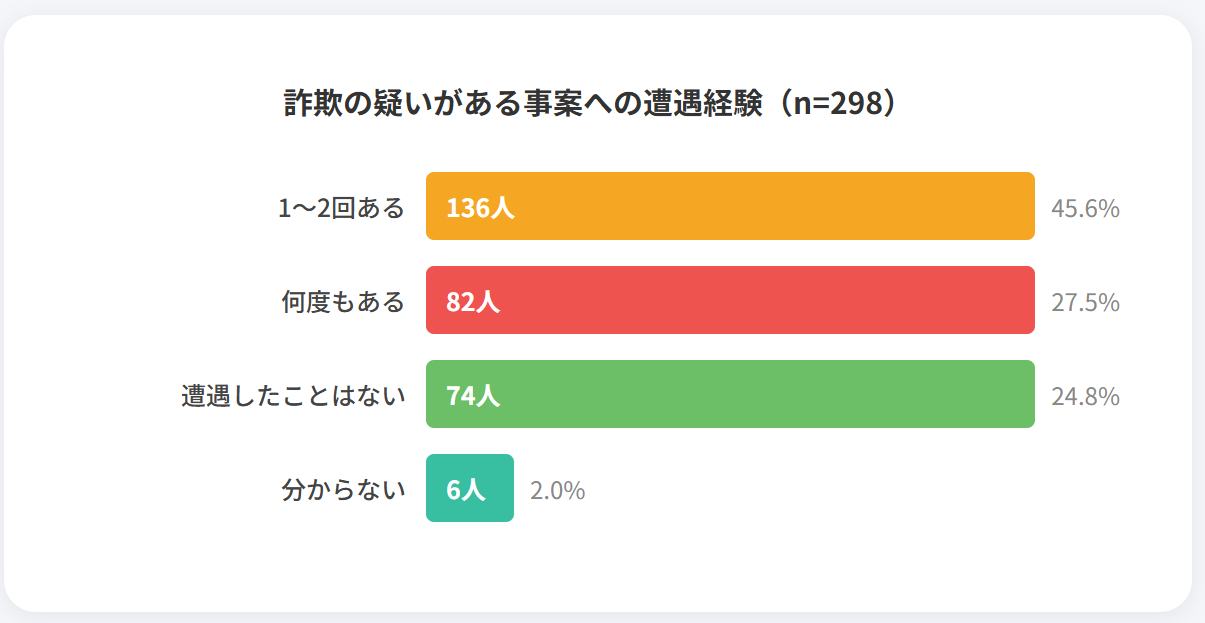
Response | Responses | Share |
|---|---|---|
1–2 times | 136 | 45.6% |
Many times | 82 | 27.5% |
Never encountered one | 74 | 24.8% |
Not sure | 6 | 2.0% |
More than 70% of crypto asset users have encountered a suspected scam. The most common response was “1–2 times” at 45.6%, highlighting a serious reality that goes beyond a single, isolated incident.
Notably, 27.5% of respondents selected “many times,” suggesting that certain users are being repeatedly targeted—or that attackers are reaching out indiscriminately.
While entering the crypto asset market offers convenience and earning opportunities, users must recognize that scam risk is a constant companion. Even those who answered “never encountered one” are not necessarily free from future risk—the market as a whole appears to be in a phase that demands heightened vigilance.
About 3 in 84 People in Their 30s Report Scam Encounters
Age Group | 1–2 times | Many times | Not sure | Never encountered one |
|---|---|---|---|---|
20s | 27 | 15 | 2 | 9 |
30s | 38 | 27 | 1 | 20 |
40s | 37 | 19 | 3 | 14 |
50s | 23 | 13 | 0 | 27 |
60s | 8 | 2 | 0 | 4 |
70+ | 3 | 6 | 0 | 0 |
Breaking down the encounter rate by age group shows that scam risk appears to rise alongside the active investment activity of people in their 30s. Combining “1–2 times” and “many times,” the encounter rate for this age group reaches 75.6%, suggesting that working-age adults may be a prime target.
People in their 40s also show a high encounter rate, confirming that users who are highly focused on building assets are being targeted. Meanwhile, about 43% of people in their 50s said they had “never encountered” a scam—higher than other age groups—suggesting that differences in online activity and information-gathering habits may affect exposure.
It is deeply concerning that such high encounter rates are recorded not only among younger users but also among the generations at the core of asset management. This shows that even those closer to being digital natives cannot easily see through increasingly sophisticated scam tactics.
Gender Differences in Risk and Preventing Harm
Gender | 1–2 times | Many times | Not sure | Never encountered one |
|---|---|---|---|---|
Female | 45 | 23 | 1 | 26 |
Male | 91 | 59 | 5 | 48 |
Looking at differences by gender, male users appear to face relatively higher risk. Combining “1–2 times” and “many times,” 73.9% of men reported encountering a scam, slightly above the 71.6% figure for women.
For the “many times” response in particular, men reached 29.1%, revealing that they face repeated, persistent approaches. This may be because men tend to exchange information across a broader range of communities and social media, increasing their opportunities for contact with scammers.
With encounter rates above 70% for both men and women, all crypto asset users—regardless of gender—need to raise their level of vigilance. Every user is called on to strengthen their defenses by dropping the overconfidence that “it won't happen to me” and thoroughly verifying official information.
40% of Users with Under Six Months' Experience Report Repeated Encounters
Investment Experience | 1–2 times | Many times | Not sure | Never encountered one |
|---|---|---|---|---|
Under 6 months | 9 | 19 | 0 | 15 |
6 months–1 year | 45 | 22 | 1 | 13 |
1–3 years | 51 | 19 | 2 | 24 |
3+ years | 25 | 22 | 1 | 16 |
Prefer not to say | 6 | 0 | 2 | 6 |
Examining the relationship between investment experience and scam encounters reveals a pattern in which newcomers who have only recently entered the market are targeted intensively. Among users with less than six months of experience, as many as 44.2% answered “many times”—by far the highest share of any experience bracket.
Normally, exposure to risk would be expected to increase with experience, so this level of frequent encounters among users with under six months' experience is unusual. It seems beyond doubt that bots or groups exist that automatically detect users posing as “beginners” on social media and immediately launch scam approaches against them.
Among users with more than a year of experience, the share who “never encountered” a scam rises to over 20%, suggesting they have developed a certain level of screening ability. However, even among veteran users with three or more years of experience, about 70% have encountered a scam—confirming this as an unavoidable risk for anyone dealing in crypto assets.
Social Media Impersonation and Email Are the Two Leading Contact Routes
Fake Websites and Phishing Are Widespread
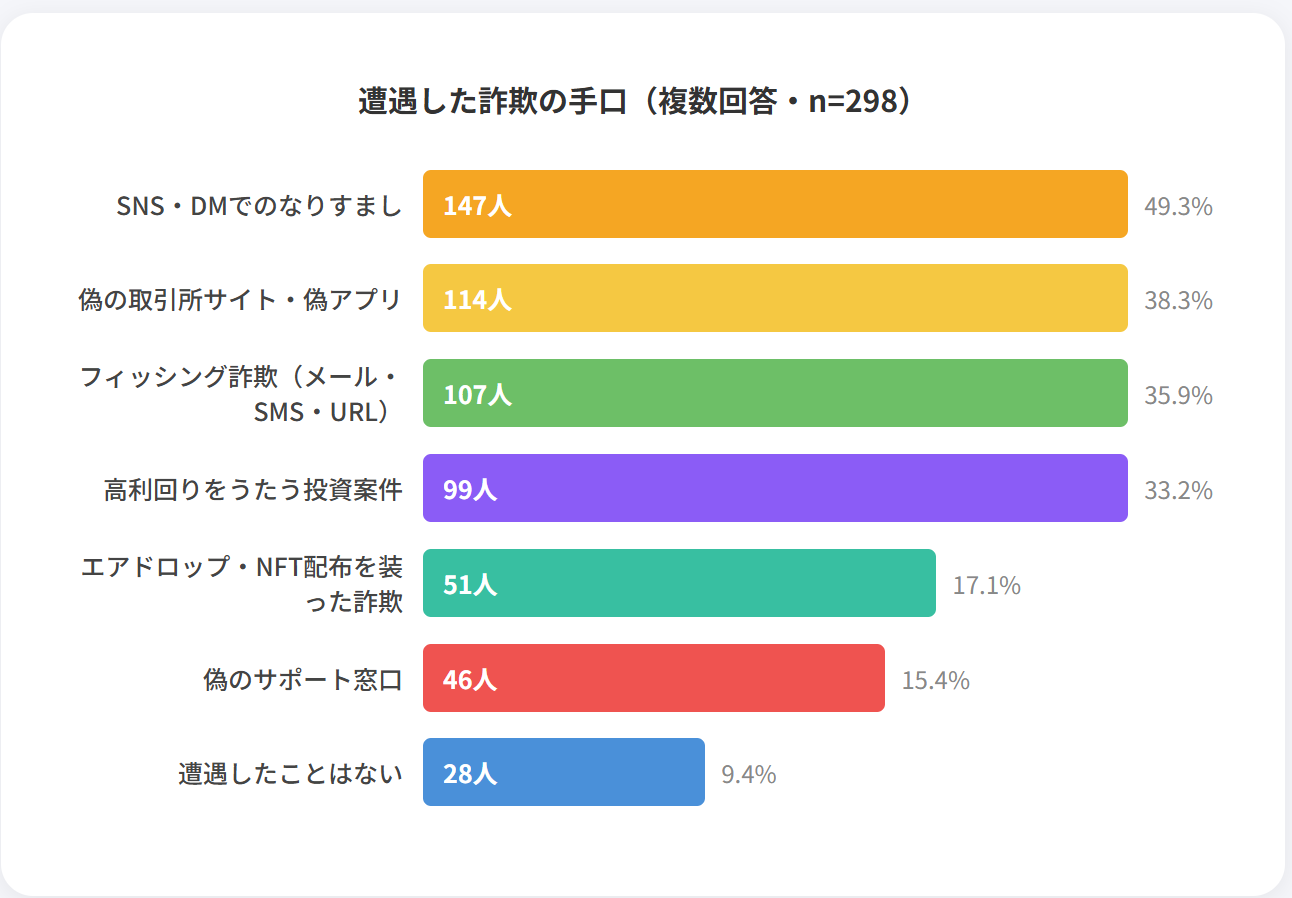
Tactic (multiple choice) | Responses | Share |
|---|---|---|
Impersonation via social media/DMs (celebrities, exchanges, etc.) | 147 | 49.3% |
Fake exchange websites/apps | 114 | 38.3% |
Phishing (email, SMS, links) | 107 | 35.9% |
Investment schemes/asset management services promising high returns | 99 | 33.2% |
Scams disguised as airdrops or NFT giveaways | 51 | 17.1% |
Fake support desks/customer support | 46 | 15.4% |
Never encountered one | 28 | 9.4% |
None of the above | 14 | 4.7% |
Asked about scam tactics they had encountered or heard of, respondents most often cited “impersonation via social media/DMs” at 49.3%—nearly half. Contact from accounts posing as celebrities or major crypto asset exchange service providers is now arguably the tactic that warrants the most caution.
Next came “fake exchange websites/apps” at 38.3% and “phishing” at 35.9%, with technically sophisticated tactics ranking highly. These scams elaborately mimic legitimate services, making them extremely difficult to identify as fraudulent at a glance.
“Investment schemes promising high returns” also remain persistent at 33.2%, showing that this classic tactic—preying on users' desire to grow their assets—is still rampant. Attackers are combining multiple tactics into layered attacks, making it difficult to defend against them with any single measure.
Email Is the Leading Contact Route at 56.0%
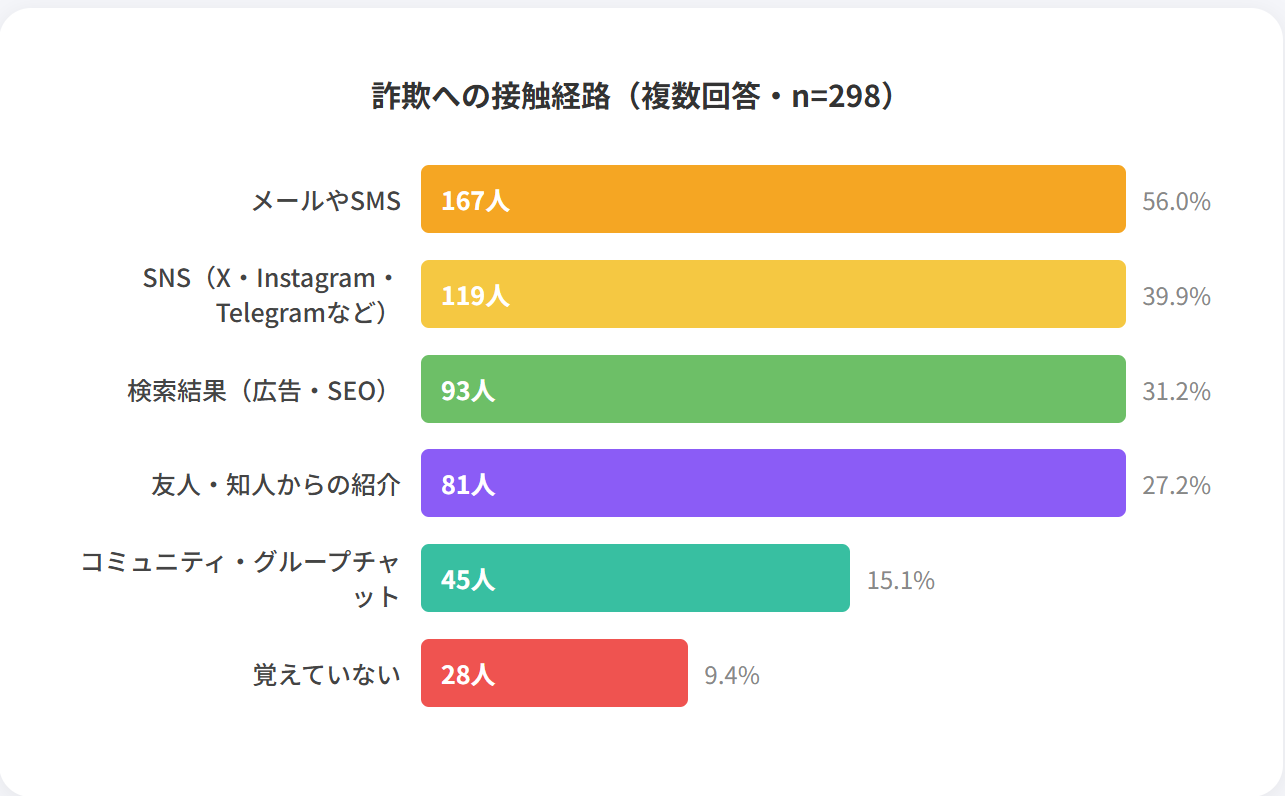
Route | Responses | Share |
|---|---|---|
Email/SMS | 167 | 56.0% |
Social media (X, Instagram, Telegram, etc.) | 119 | 39.9% |
Search results (ads/SEO) | 93 | 31.2% |
Referrals from friends/acquaintances | 81 | 27.2% |
Community/group chats | 45 | 15.1% |
Don't remember | 28 | 9.4% |
As for the route through which respondents encountered scams, “email/SMS” topped the list at 56.0%, surpassing a majority. Despite being a classic method, email remains one of the biggest threats in the crypto asset market because it delivers messages directly to a user's device.
Meanwhile, contact via “social media” was also very high at 39.9%, confirming that scams exploiting high shareability have become commonplace. Particularly notable is that “search results (ads/SEO)” reached 31.2%, showing that numerous traps have been set up on search engines to lure users searching for legitimate sites toward fake ones.
“Referrals from friends/acquaintances” also accounted for a non-trivial 27.2%, and the risk of harm spreading through chains that exploit trust relationships should not be underestimated. Users need to recognize that they are operating in an extremely harsh communications environment where any digital touchpoint—not just a specific platform—can become an entry point for scams.
People in Their 30s Should Watch for Social Media Impersonation
Age Group | Social media impersonation | Fake sites/apps | Phishing | High-return schemes |
|---|---|---|---|---|
20s | 28 | 26 | 24 | 16 |
30s | 52 | 35 | 30 | 28 |
40s | 38 | 31 | 30 | 29 |
50s | 19 | 13 | 17 | 17 |
60s | 7 | 6 | 3 | 5 |
70+ | 3 | 3 | 3 | 4 |
Analyzing tactic trends by age group shows that people in their 30s stand out for their high encounter rate with “impersonation via social media/DMs.” As a generation that relies heavily on social media for information, they are notably exposed to attacks via fake ads in their timeline and direct messages.
Among people aged 40 and above, encounters with “phishing” and “high-return schemes” stand out, showing that their strong interest in asset management can backfire by attracting fraudulent solicitations. In particular, among people in their 50s, responses for “high-return schemes” rank on par with or above other tactics, suggesting that maintaining vigilance against high-risk investment pitches remains a challenge.
Across all age groups, the ranking of the top three tactics (impersonation, fake sites, and phishing) remains largely unchanged, suggesting that attackers make indiscriminate approaches regardless of target age. Every generation needs to hold the somewhat paradoxical awareness that scam traps often lurk precisely in the media they are most familiar with.
Households Earning ¥4–6 Million Are a Prime Target
Household Income | Email/SMS | Social media | Search results | Friend/acquaintance referral |
|---|---|---|---|---|
Under ¥2M | 24 | 17 | 10 | 9 |
¥2M–4M | 28 | 20 | 18 | 21 |
¥4M–6M | 54 | 31 | 26 | 15 |
¥6M–8M | 35 | 26 | 22 | 19 |
¥8M–10M | 10 | 15 | 8 | 14 |
¥10M or more | 12 | 8 | 8 | 2 |
Examining contact routes by household income shows that “email/SMS” encounters are especially high among households earning ¥4 million to ¥6 million. This bracket tends to be socially active, receiving contact from many directions, which may increase the risk of overlooking or opening a scam email.
In the ¥2 million to ¥4 million bracket, “referrals from friends/acquaintances” came to 21 respondents, a relatively high share compared to other income brackets. This suggests that a tendency to value word of mouth within close-knit communities may, in turn, serve as an entry point for closed investment scams or network-marketing-style tactics.
In contrast, encounter counts across all routes decline among the high-income bracket of ¥10 million or more, possibly because higher security awareness and reliance on limited information sources help contain risk. Regardless of income bracket, however, email and social media remain the main entry points, making it urgent to build defenses tailored to individual attributes.
17.1% Suffered Financial Losses; Public Warnings Helped Others Avoid Harm
Roughly 1 in 6 Suffered Financial Losses
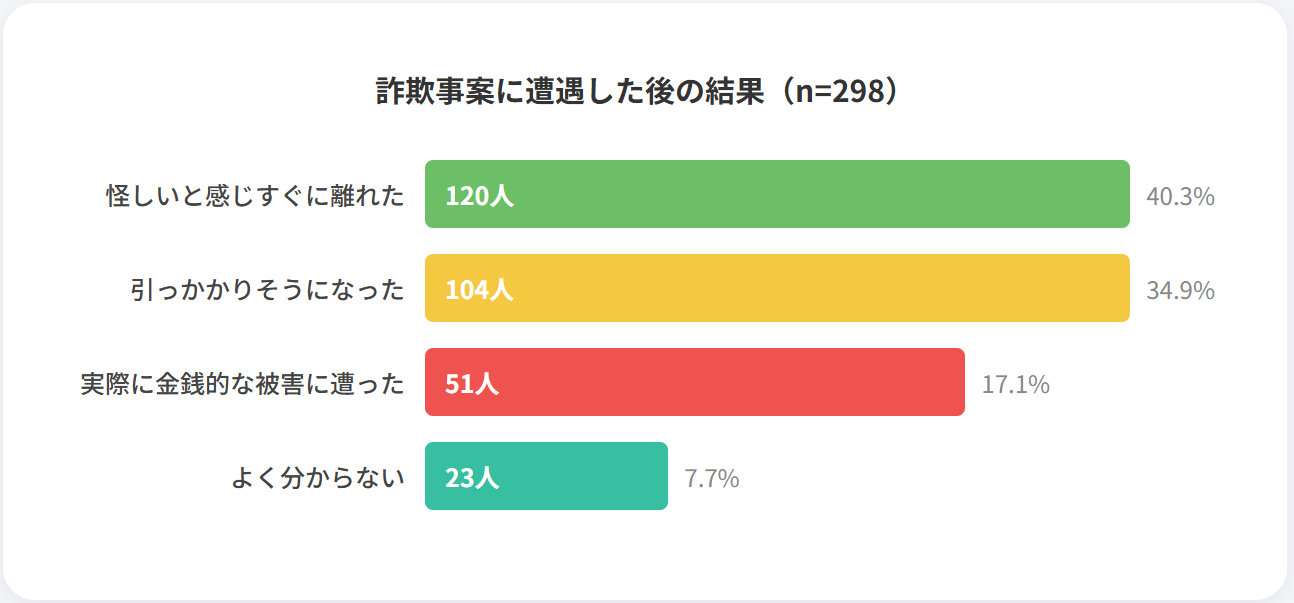
Outcome | Responses | Share |
|---|---|---|
Sensed something was off and left immediately | 120 | 40.3% |
Avoided harm but nearly fell for it | 104 | 34.9% |
Actually suffered financial losses | 51 | 17.1% |
Not sure | 23 | 7.7% |
Asked about the outcome after encountering a suspected scam, 17.1% of respondents said they “actually suffered financial losses.” This points to a shocking reality: roughly one in six crypto asset users has been caught up in trouble involving real harm.
Meanwhile, the most common response was “sensed something was off and left immediately” at 40.3%, followed by “nearly fell for it” at 34.9%. While many users detect an attacker's intent and stop harm before it occurs, the line separating success from failure appears extremely thin.
Those who answered “nearly fell for it” in particular were likely one step away from actual harm, suggesting that the true underlying risk is larger than the tallied figures suggest. Many cases where users avoided financial loss were supported by careful judgment and the use of outside information—meaning that individual security awareness remains the last line of defense.
Checking Public Warnings Is Key to Avoiding Scams
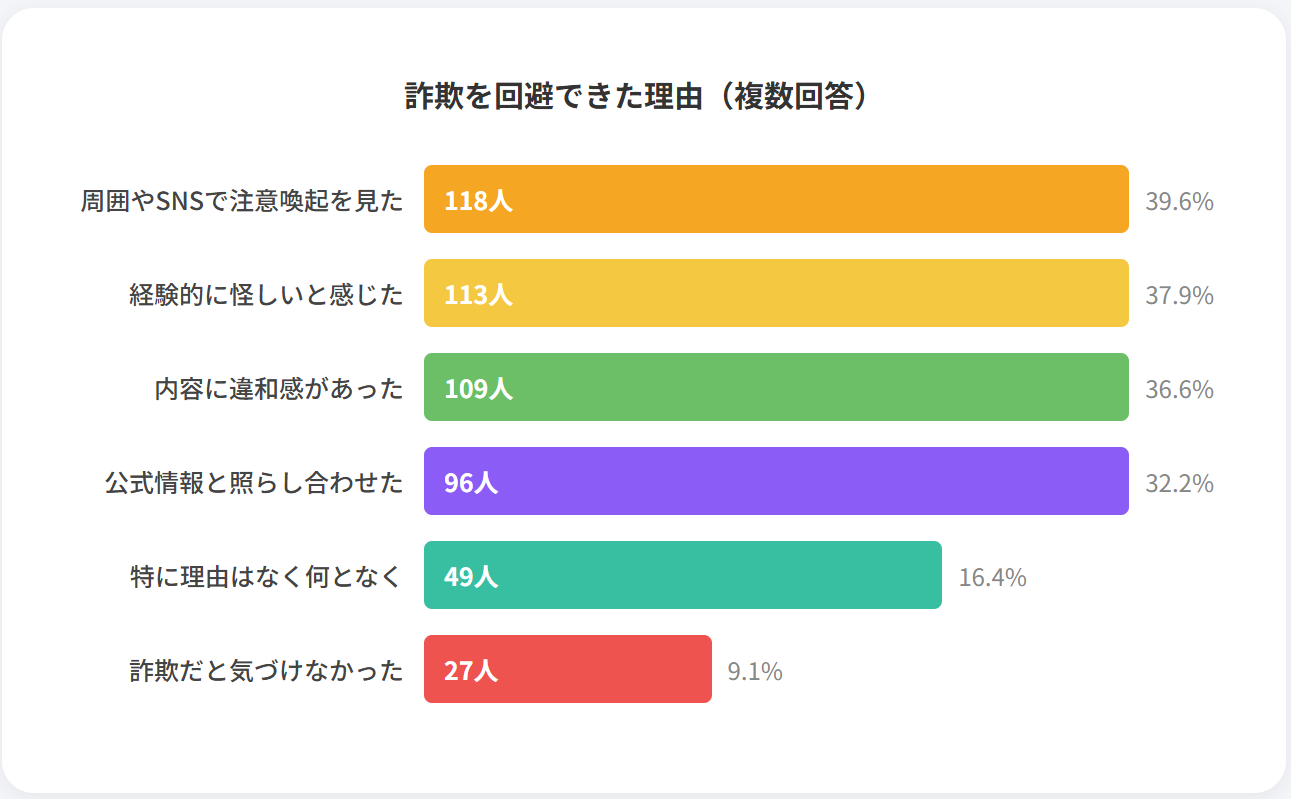
Reason for avoiding harm | Responses | Share |
|---|---|---|
Saw a warning from people around them or on social media | 118 | 39.6% |
Sensed something was off based on experience | 113 | 37.9% |
Felt something was off about the content | 109 | 36.6% |
Checked against official information | 96 | 32.2% |
No particular reason, just a gut feeling | 49 | 16.4% |
Didn't realize it was a scam | 27 | 9.1% |
None of the above | 25 | 8.4% |
The most commonly cited specific reason for avoiding a scam was “saw a warning from people around them or on social media” at 39.6%. This reveals that other people's accounts of being victimized and warning information circulating on platforms function as real-time defenses.
Intuition-based judgments—such as “sensed something was off based on experience” (37.9%) and “felt something was off about the content” (36.6%)—also play a major role. Meanwhile, 32.2% of respondents performed an objective fact check by “checking against official information,” and this evidence-based, cautious stance is one factor behind avoiding harm.
What stands out is that the reasons for avoiding harm are spread across multiple factors. Rather than relying on a single measure, combining the “knowledge” gained from everyday information gathering, the “intuition” to sense suspicious contact, and the “action” of fact-checking appears to be the optimal way to protect oneself from sophisticated scams.
Financial Losses Spike Among Users With Six Months to a Year of Experience
Investment Experience | Financial loss | Left after sensing something was off | Nearly fell for it | Not sure |
|---|---|---|---|---|
Under 6 months | 14 | 17 | 7 | 5 |
6 months–1 year | 20 | 25 | 35 | 1 |
1–3 years | 9 | 32 | 47 | 8 |
3+ years | 7 | 39 | 15 | 3 |
Prefer not to say | 1 | 7 | 0 | 6 |
A cross-analysis of harm by investment experience shows that the “6 months to 1 year” bracket reports the highest number of financial losses (20 respondents). This period—when users are just becoming comfortable with crypto asset operations and starting to gain confidence—appears to create the opening scammers can exploit most easily.
In contrast, once experience exceeds one year, the number of financial losses drops sharply, while “sensed something was off and left immediately” and “nearly fell for it” rise instead. Among veterans with three or more years of experience in particular, immediate judgment to “leave right away” becomes the norm, and the risk-detection ability built up over years clearly helps prevent harm before it happens.
Beginners with under six months of experience also reported 14 cases of harm, underscoring the need for thorough security education from the earliest stage. However, risk peaks around the six-month to one-year mark, when users begin to see themselves as “no longer beginners”—suggesting that users in this window may need to revisit the basics.
People in Their 20s Prioritize “Official Information”
Age Group | Checked official information | Saw a warning | Intuition/sensed something off | Felt content was off |
|---|---|---|---|---|
20s | 28 | 24 | 27 | 15 |
30s | 30 | 39 | 26 | 28 |
40s | 23 | 24 | 35 | 30 |
50s | 12 | 21 | 19 | 25 |
60+ | 3 | 10 | 6 | 11 |
Breaking down avoidance reasons by age group, people in their 20s most often cited “checked against official information,” with 28 respondents—the highest among all age groups. This suggests that digitally literate younger users have made it a habit to immediately check official sources to verify suspicious information.
Among people in their 40s, on the other hand, “sensed something was off based on experience” was most common (35 respondents), with social experience and risk sense built up over the years serving as the core defense. While the approach to detecting risk differs by generation, the fact that people in their 30s rely most heavily on “warnings from those around them” (39 respondents) reflects the strength of this generation's peer networks.
The fact that “warnings from those around them” is an effective avoidance method across all age groups underscores the importance of sharing accurate information throughout the community. Combining the verification methods your own generation is best at with the objective verification techniques used by other generations can help build a stronger defense against scams.
News Sites Are the Top Information Source; Over 40% Want to Know How to Spot Scams
An Information-Gathering Style That Combines Social Media and Official Notices
Information source | Responses | Share |
|---|---|---|
News sites | 161 | 54.0% |
Social media (X, YouTube, TikTok, etc.) | 146 | 49.0% |
Notices from exchanges or official services | 114 | 38.3% |
Specialized crypto media | 110 | 36.9% |
Friends/acquaintances | 72 | 24.2% |
Don't actively gather information | 22 | 7.4% |
Asked where they get information about crypto assets and investing, respondents most often cited “news sites” at 54.0%. “Social media” followed closely at 49.0%, painting a picture of users who draw on both objective mass-media reporting and real-time information from social media.
Notably, only 38.3% referred to “notices from official services” such as crypto asset exchange service providers. While “checking against official information” is an effective way to avoid scams, external media is currently prioritized as the go-to source for everyday information.
Social media, where an unspecified number of people post content, is convenient but also prone to becoming an entry point for scams, so an imbalanced information diet directly increases risk. Building a multi-pronged information-gathering approach—anchored in reliable news sites and specialized media, with official notices used as a final fact check—is key to preventing scam damage.
43.0% Want to Know the Warning Signs to Spot Scams
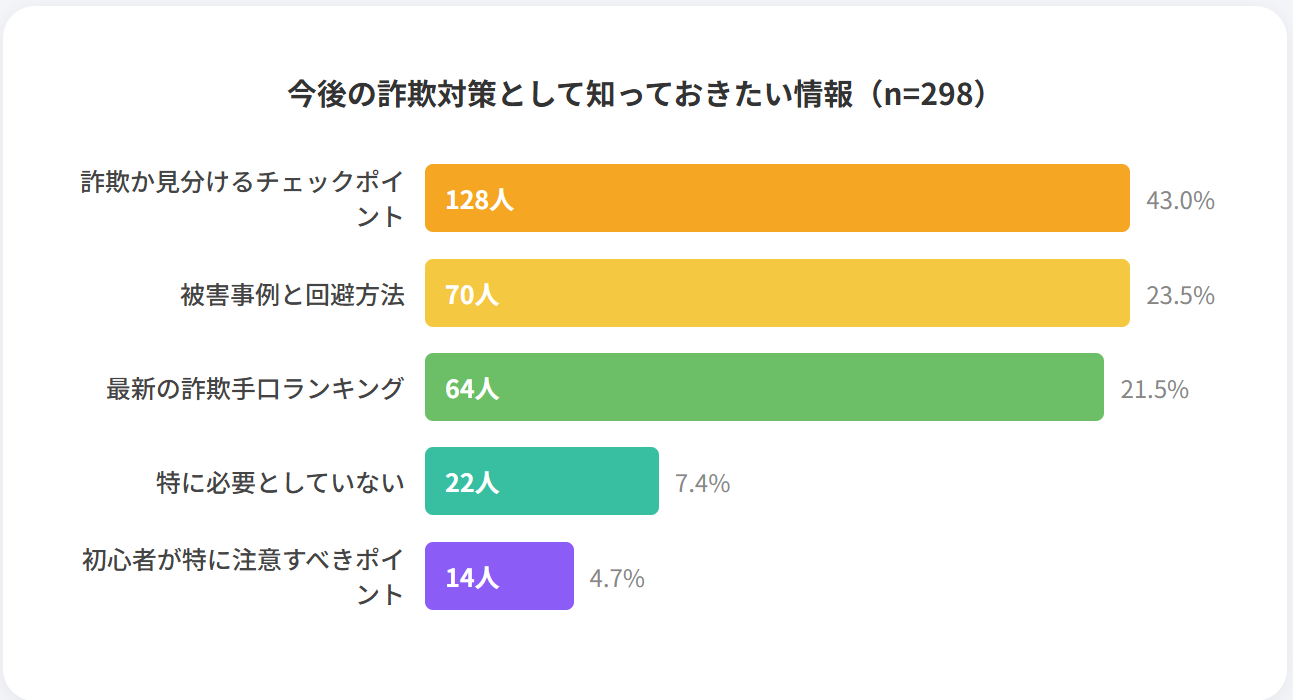
Information wanted going forward | Responses | Share |
|---|---|---|
Checkpoints for identifying a scam | 128 | 43.0% |
Case studies of harm and how to avoid it | 70 | 23.5% |
Rankings of the latest scam tactics | 64 | 21.5% |
Not particularly needed | 22 | 7.4% |
Points beginners should be especially careful about | 14 | 4.7% |
Asked what information they especially want going forward as a scam countermeasure, respondents most often cited “checkpoints for identifying a scam,” which stood out at 43.0%—the highest level of interest recorded. Users want concrete, practical criteria for judging whether their own situation involves a scam, not just examples of past cases.
“Case studies of harm and how to avoid it” (23.5%) and “rankings of the latest scam tactics” (21.5%) also ranked highly, showing a persistent demand for updates on evolving tactics. Meanwhile, “points beginners should be especially careful about” was low at 4.7%, suggesting that users with a certain amount of experience place greater emphasis on how to handle the specific risks they themselves might face.
Most users are aware that the threat of scams is close at hand and are seeking proactive, self-directed defenses rather than a passive stance. Meeting this need requires not only coverage of regulatory trends and technical explanations, but also information that helps users cultivate the discernment to connect intuition and fact in their everyday transactions.
60% of Financial Loss Victims Referred to News Sites
Outcome | News sites | Social media | Specialized media | Official notices |
|---|---|---|---|---|
Actually suffered financial losses | 32 | 19 | 17 | 27 |
Sensed something was off and left immediately | 62 | 76 | 47 | 40 |
Nearly fell for it | 58 | 38 | 42 | 46 |
Not sure | 9 | 13 | 4 | 1 |
A cross-analysis of information source and scam outcomes found that, of the 51 respondents who suffered financial losses, 32 said they referred to “news sites.” This shows that even users relying on seemingly reliable news sources can still be lured into sophisticated traps via ads or search results, underscoring the importance of questioning the “content” of information, not just its “entry point.”
In contrast, among those who avoided harm by “leaving immediately,” reliance on social media was very high at 76 respondents, the highest figure of any information source. Users who actively gather information on social media likely have more opportunities to come across scam warnings, allowing them to immediately raise their guard against a suspicious approach.
Even among those who referred to “exchange or official notices,” 46 said they “nearly fell for it,” indicating that scam tactics have grown sophisticated enough to cause hesitation even when users are aware of official information. Because the outcome ultimately hinges on an individual's own judgment no matter which information sources are used, it is important to treat information gathering as just one input for decision-making rather than something to over-rely on.
People in Their 20s and 30s Prioritize “Checkpoints”
Age Group | Checkpoints | Tactic rankings | Cases and avoidance methods | Not particularly needed |
|---|---|---|---|---|
20s | 33 | 6 | 8 | 6 |
30s | 36 | 22 | 20 | 5 |
40s | 28 | 14 | 22 | 4 |
50s | 22 | 16 | 13 | 7 |
60+ | 9 | 6 | 7 | 0 |
Breaking down desired information by age group, people in their 20s show extremely high interest in “checkpoints for identifying a scam,” with this option accounting for a majority of their responses. This reflects a generational trait: precisely because they are accustomed to digital transactions, they want clear criteria for drawing a definitive line.
Meanwhile, from the 30s through the 50s, the share choosing “rankings of the latest scam tactics” and “case studies of harm and how to avoid it” tends to rise. This may reflect a growing hedging mindset as people age and accumulate assets—wanting to understand the range of specific attack variations and take multi-pronged defensive measures.
The fact that demand for “checkpoints” is highest across all age groups shows that current security information has not yet fully dispelled users' anxiety. Sharing criteria that let people confidently say “no” to specific situations, regardless of generation, should contribute to the market's healthy growth and to eliminating scam-related harm.
Summary
This survey on crypto asset scams revealed an extremely serious reality: 73.2% of users have encountered a suspected scam. The encounter rate among people in their 30s approaches 80%, and even among beginners with under six months of investment experience, over 40% reported encountering scams “many times”—confirming that users are exposed to sophisticated traps from the moment they enter the market.
“Impersonation via social media/DMs” accounts for roughly half of scam tactics, and the leading contact route is “email/SMS,” so users need to stay alert even in the communication tools they use every day. In fact, 17.1% of users have suffered financial losses, and most of the cases where users avoided harm were supported by a combination of defenses—“warnings from those around them,” “a gut sense that something was off,” and “checking against official information.”
The information users want most going forward is “checkpoints for identifying a scam,” making it urgent to share more practical decision-making criteria that go beyond simply understanding past cases. To secure the crypto asset market, it is essential that every generation and experience level thoroughly practice the basics: continually updating their knowledge of the latest tactics and immediately checking official sources whenever they encounter suspicious contact.
These survey results serve as a reminder that, even as crypto assets have become part of everyday life, individual security awareness and information literacy remain among the most important tools for protecting one's assets. Beyond focusing on convenience and profit potential, pausing to question the authenticity of information is the single greatest key to protecting yourself from increasingly sophisticated crypto asset scams.
This article is for informational purposes only and does not constitute financial or investment advice. Please consult a qualified professional before making investment decisions.
Survey Overview
Survey date: February 24, 2026
Survey method: Internet survey
Survey population: Men and women residing in Japan (people currently investing in, or who have previously invested in, crypto assets)
Valid responses: 298
Conducted by: Clabo Inc.
Survey Questions
- Have you ever used virtual currency (crypto assets)?
- Have you ever encountered something you believed to be a scam related to virtual currency?
- Which scam tactics have you encountered or heard about? Please select all that apply.
- Which routes did you mainly encounter the above scam tactics through? Please select all that apply.
- Regarding the scam you encountered, which outcome best describes what happened afterward?
- What helped you realize it was a scam or avoid it? Please select all that apply.
- Which best describes your experience investing in virtual currency?
- Which range best describes your current investment amount in virtual currency?
- Where do you mainly get information about virtual currency and investing?
- Regarding virtual currency scams, which best describes the information you would most like to know going forward?


