


When managing crypto assets (also known as virtual currencies), "revoke" — canceling smart contract approval permissions — is an essential defense for protecting your holdings.
However, this survey revealed that more than 60% of respondents do not properly understand or practice this defense.
This awareness gap runs deep, cutting across not only less experienced investors but also more seasoned investors and those who primarily use exchange-only wallets.
Why do so many investors put off taking steps to protect their valuable assets?
This article takes a close look at the current state of revoke awareness from multiple angles.
Let's examine the security fundamentals you should review right now to protect your own assets.
The Big Picture on Revoke Awareness — 61.1% Effectively Unprotected
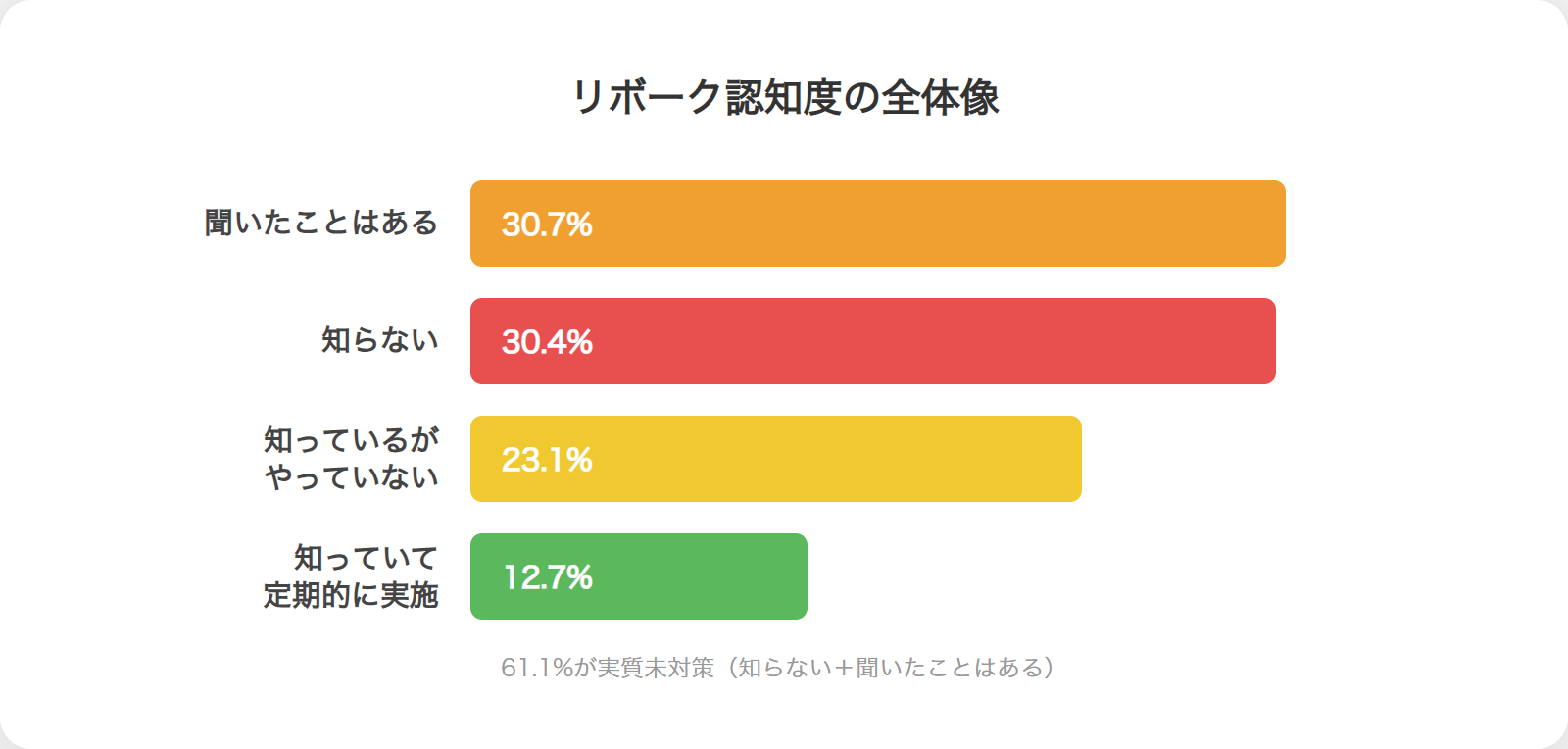
Smart contracts make crypto asset management more convenient, but many investors overlook the unique security risks lurking behind them.
In particular, the concept of "revoke" — canceling a previously granted approve permission — remains a high hurdle for many users.
This survey takes a thorough look at crypto investors' awareness of revoke and their actual security practices.
Awareness | Share |
|---|---|
Heard of it | 30.7% |
Don't know | 30.4% |
Know it but haven't done it | 23.1% |
Know it and do it regularly | 12.7% |
Awareness Distribution: The Unaware Make Up the Majority
Crypto investors' awareness of revoke isn't simply split down the middle — rather, the "unaware" group makes up a large share of the total.
Those who answered "don't know" account for 30.4% of all respondents.
Add in those who said "heard of it," and more than 60% of people do not properly understand revoke as a defensive measure.
For newcomers who have just started investing, a technical term like "revoke" can be unfamiliar and hard to grasp.
Meanwhile, even investors with a fair amount of experience are often careless about their wallet security settings.
This low level of awareness points to a major challenge for security education in the market going forward.
The Real Rate of Non-Protection Comes Into Focus
What's particularly concerning in this survey data is the sheer size of the group that isn't effectively practicing revoke.
Combining "don't know" (30.4%) and "heard of it" (30.7%) shows that as many as 61.1% of investors likely aren't taking appropriate protective measures.
Many investors may feel reassured simply by keeping their assets in a wallet.
However, if approval permissions granted to DApps and similar services in the past remain active, the risk of having crypto assets drained always remains.
This 60%-plus figure is not something to take lightly.
If revoke — a last line of defense — isn't in place when something goes wrong, it leaves investors' own assets continually exposed and unprotected.
Regular Practice Remains a Minority
On the other hand, only a small number of investors understand the importance of revoke and actually practice it on a regular basis.
Those who "know about it and do it regularly" account for only 12.7% — roughly 1 in 8 investors, a low share.
Notably, 23.1% of respondents said they "know about it but haven't done it."
This suggests a meaningful number of people recognize the need for revoke and the risks involved in crypto assets, yet still haven't taken action — held back by the hassle involved or a false sense of security that "I'll be fine."
When it comes to security, there's a wide gulf between knowing and doing.
Beyond simply raising awareness, turning safe crypto asset management into a habit is set to become an essential skill for investors themselves.
The Wide Gap Between Awareness and Action
Regular Implementation Stays at Just 12.7% Overall
Knowing the importance of revoke could be considered the single most critical issue for protecting crypto assets.
However, that awareness doesn't necessarily translate into immediate action. Looking at the survey results, only 12.7% of all crypto investors "know about revoke and practice it regularly."
Meanwhile, including the 23.1% who said they "know about it but haven't done it," fewer than half of the investors who understand revoke as knowledge have actually put it into practice.
This figure illustrates that for many crypto investors, a high hurdle stands between awareness and action.
There is a genuinely hard-to-close gap between understanding a risk intellectually and turning it into a habitual practice.
This strongly suggests that having correct knowledge alone does not add up to complete protection.
Ideally, every investor would correctly understand the risks and take regular protective measures.
The current state of affairs, however, shows that security awareness is still at a developing stage. Going forward, the crypto asset market will need not only to spread awareness of revoke's necessity but also to simplify the concrete steps involved.
What's Behind the Over 20% Who Delay Taking Action
Notably, 23.1% of respondents said, "I know about revoke, but I haven't done anything yet."
This shows that more than 1 in 5 investors are consciously delaying protective action despite recognizing the risk.
So what psychological or situational factors are holding these investors back?
The biggest likely factors are the gas fees incurred when performing a revoke and the psychological hurdle of operating the necessary tools.
How each investor views the cost of protecting their assets is ultimately a personal choice.
That said, given the potential scale of losses if something goes wrong, choosing to delay protective measures is too dangerous a gamble.
It's hard to rule out that an unfounded sense of security — "I won't be targeted" — is dulling this group's judgment.
When venturing into the still-unfamiliar territory of crypto assets, this kind of complacency can become the single biggest risk factor for losing your assets. Investors need, now more than ever, a strong resolve to protect their own assets by their own hand.
Toward Deeper Security Awareness
This survey vividly reveals the current state of crypto investors' security awareness.
Even investors who are generally seen as security-conscious show a real gap in how they handle revoke.
Closing this awareness gap and deepening security consciousness across the board is precisely what the crypto asset market needs most right now.
We should treat the revoke process not as a mere technical task, but as an essential routine of asset management.
Regularly canceling approvals should feel as natural as locking your front door.
Without this shift in mindset, genuine adoption and stable management of crypto assets cannot be achieved.
As investors continue managing crypto assets going forward, how they approach revoke will serve as an important gauge of their literacy.
A growing number of highly literate investors who properly protect their assets is exactly what will raise the industry's overall credibility.
Now is the time for us to turn knowledge into action and shore up our defenses.
The Awareness Cliff: Regular Implementation Surges at the 3-Year Mark
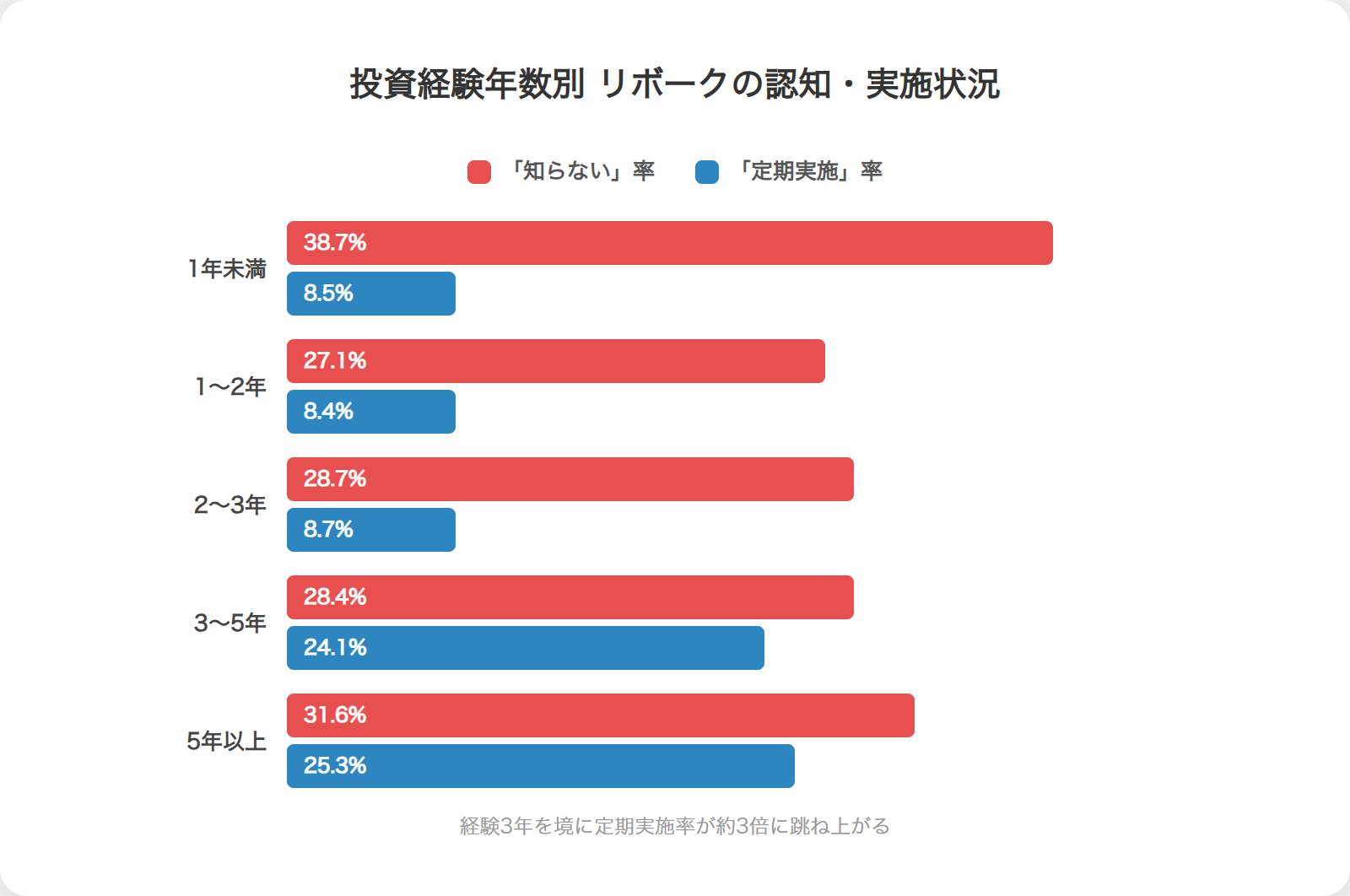
In crypto asset management, does accumulating investment experience directly translate into a higher level of risk management?
This survey cross-analyzed years of investment experience against revoke awareness and implementation to clarify how investors' security consciousness develops over time.
Years of Experience | "Don't know" rate | "Regular implementation" rate |
|---|---|---|
Under 1 year | 38.7% | 8.5% |
1–2 years | 27.1% | 8.4% |
2–3 years | 28.7% | 8.7% |
3–5 years | 28.4% | 24.1% |
5+ years | 31.6% | 25.3% |
Experience Level Reveals Clear Differences in Defensive Awareness
The survey found that the less crypto investment experience someone has, the higher the share who don't even know the term "revoke."
Among investors with under one year of experience in particular, 38.7% answered "don't know," showing they are still just at the entry point of gathering information.
Meanwhile, as experience accumulates, the "don't know" response rate tends to converge within a certain range.
What's worth noting here, though, is that longer experience does not necessarily mean knowledge improves across the board.
Even with a short investment history, users who stay on top of the latest crypto asset information can very well put security measures in place early on.
Ultimately, years of experience are just one rough indicator.
How proactively investors raise their own awareness of protecting their assets is arguably the biggest factor shaping their growth as crypto investors.
Revoke Implementation Rates Jump After the 3-Year Mark
Looking at investors with under three years of experience, the rate of regular revoke implementation stays flat at a low level in the 8% range.
By contrast, among those with three or more years of experience, the implementation rate jumps to over 24%, confirming a clear divide.
The three-year mark is likely a turning point for many crypto investors.
It may be the period when a sense of urgency starts to feel real — after hearing news of actual hacking incidents or witnessing trouble among people around them.
There is much to learn from failure, but this figure vividly reflects the lesson that it's too late once you've already lost your assets.
The challenge going forward is how quickly this trigger for a mindset shift can be offered to less experienced investors.
Maintaining a safe environment requires not relying on the passage of years, but rather adopting the attitude of turning others' past mistakes into your own wisdom.
Even Veterans Aren't Immune to the Awareness Gap
Surprisingly, even among veteran investors who have been in the crypto asset market for five years or more, 31.6% answered that they "don't know" about revoke.
This is a harsh reality: having a long track record does not mean comprehensive security knowledge.
It may reflect investors clinging to past successes or established habits.
The crypto asset market evolves extremely quickly — it's a world where yesterday's common sense no longer applies.
Without constant updating, even veteran investors risk continuing to invest while carrying unaddressed vulnerabilities.
To protect your own portfolio, it's worth pausing to review your security settings.
Letting go of the overconfidence that "I've been doing this a long time, so I'll be fine" and staying flexible enough to adopt the latest protective measures may well be the secret to managing crypto assets over the long term.
Wallet Environment Creates a 2.6x Gap in Awareness
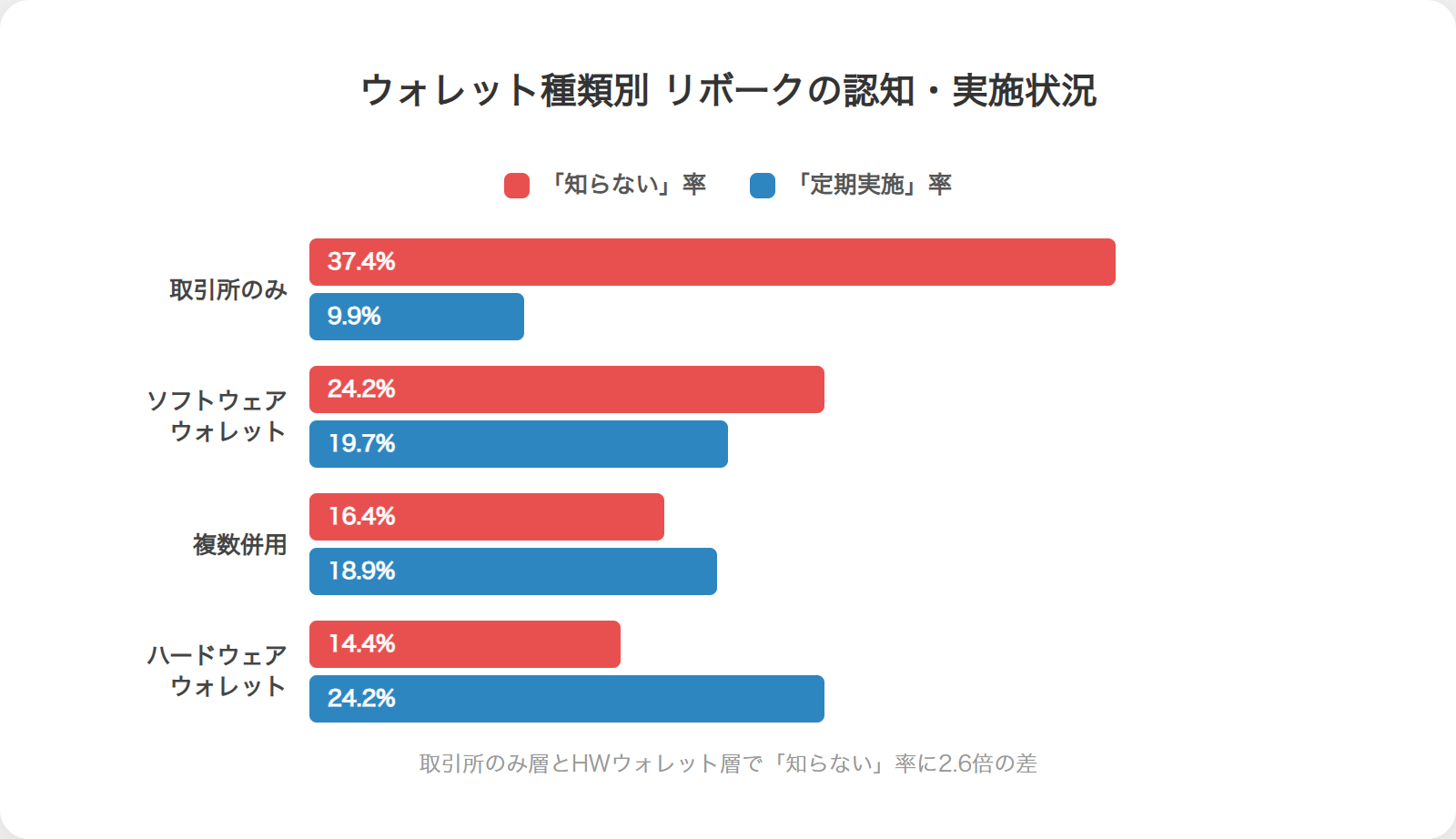
The type of wallet an investor uses is an important indicator of their level of interest in security.
This survey analyzed revoke awareness and implementation rates by storage environment.
The results revealed a significant divide in security awareness depending on how crypto assets are managed.
Wallet Type | "Don't know" rate | "Regular implementation" rate |
|---|---|---|
Exchange only | 37.4% | 9.9% |
Software wallet | 24.2% | 19.7% |
Multiple wallets combined | 16.4% | 18.9% |
Hardware wallet | 14.4% | 24.2% |
A Security Blind Spot Widespread Among Exchange-Only Users
Users who manage their crypto assets using only an exchange wallet show particularly weak awareness of revoke.
The survey results show that 37.4% of this group answered "don't know" when asked about the concept of revoke.
Exchange services are highly convenient and serve as an excellent gateway for beginners entering the world of crypto assets.
However, that very convenience seems to work against them, with attention rarely reaching the finer details of security.
Many users mistakenly believe their assets are safe simply because they're held on an exchange.
But continuing to operate without a deep understanding of how wallets work is effectively the same as carrying an invisible risk indefinitely.
Hardware Wallets Foster a Defensive Instinct
By contrast, investors who use hardware wallets show extremely high levels of revoke awareness and implementation.
Only 14.4% are unaware, and roughly 1 in 4 practice revoke on a regular basis.
This group has a strong sense of responsibility for independently managing their own crypto assets.
The act of protecting assets with a physical device likely naturally raises their security awareness in itself.
Adopting more advanced management methods naturally increases opportunities to recognize the need for measures like revoke.
This is a good example of how setting up the right environment ultimately leads to acquiring the right knowledge.
Wallet Environment Shapes the Future of Security
Depending on the type of wallet used, the "don't know" rate varies by as much as 2.6 times.
In crypto asset investing, it's no exaggeration to say that the choice of storage environment directly determines one's level of defense.
When management is left entirely to an exchange, these advanced security measures tend to fall in priority.
Hardware wallet users who manage their own assets, on the other hand, actively strengthen their defenses.
How an investor chooses to hold crypto assets is a mirror of their security literacy.
Going forward, security education tailored to each storage environment will only become more important.
Holdings Size Creates a Twofold Gap in Awareness — Asset Scale and Security Consciousness
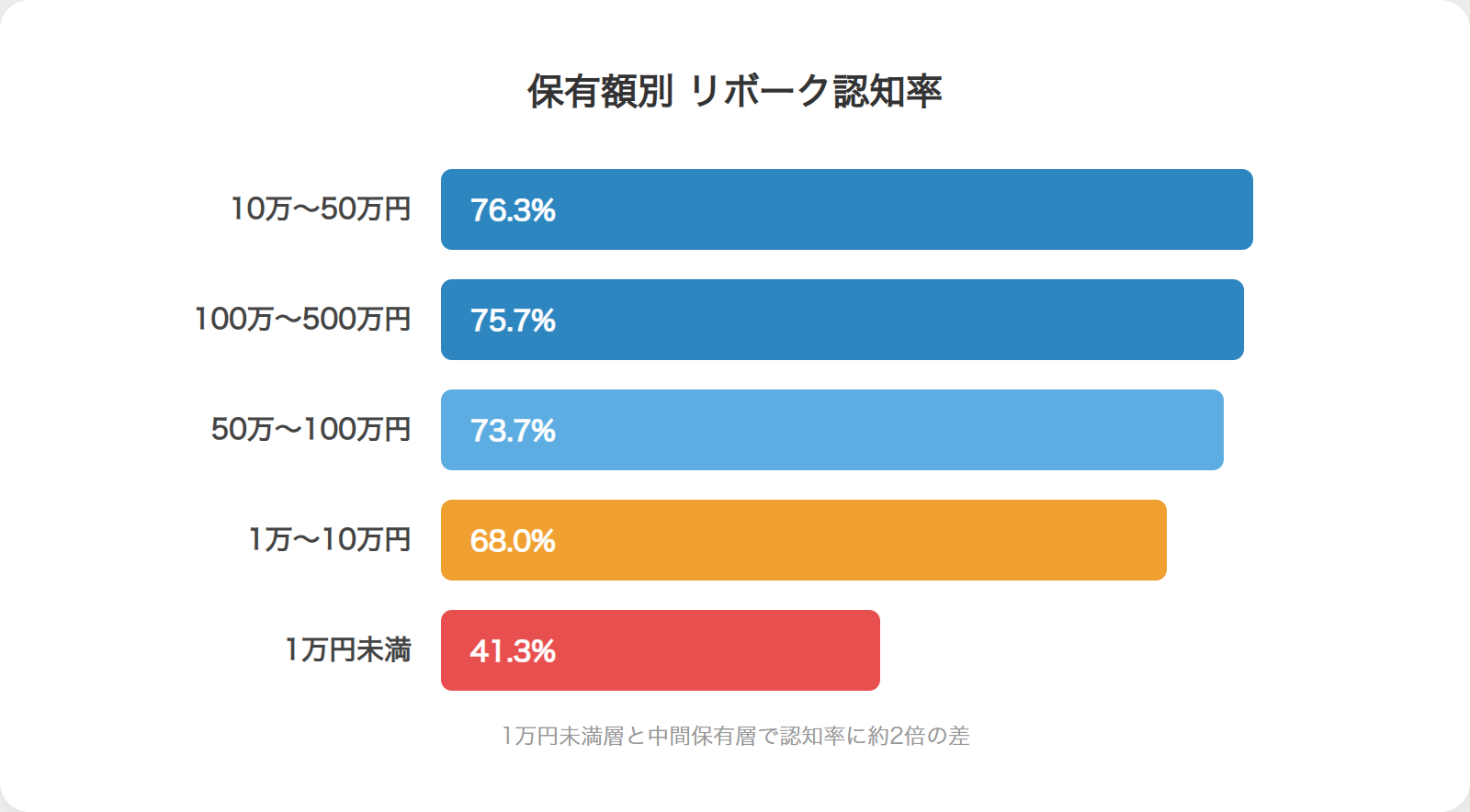
The amount an investor puts into crypto assets can be seen as a reflection of their seriousness and sensitivity to risk.
This survey analyzed revoke awareness by holdings size.
The results reveal a clear correlation: the larger an investor's total crypto asset holdings, the higher their awareness of security measures.
Holdings | Awareness rate (excluding "don't know") |
|---|---|
¥100,000–¥500,000 | 76.3% |
¥1,000,000–¥5,000,000 | 75.7% |
¥500,000–¥1,000,000 | 73.7% |
¥10,000–¥100,000 | 68.0% |
Under ¥10,000 | 41.3% |
The Hidden Gap Between Asset Scale and Awareness
Among investors with holdings under ¥10,000, revoke awareness stays as low as 41.3%.
This suggests that investors with smaller crypto asset holdings may be more exposed to security risks.
When holdings are small, investors may assume that even if they fall victim to hacking, the impact would be limited.
However, in the world of Web3, a single approval permission can become the trigger for losing every asset in a wallet.
Regardless of asset scale, anyone dealing in crypto assets needs at least a minimum level of defense.
The fact that smaller investors, in particular, tend to underestimate this basic security knowledge points to an urgent need for improvement.
Awareness Rises a Notch Past the ¥100,000 Mark
Among investors with holdings of ¥10,000 to ¥100,000, awareness jumps sharply to 68.0%.
And once holdings exceed ¥100,000, the rate climbs into the 70% range, suggesting that ¥100,000 functions as a kind of psychological threshold for investors.
Once users build up a meaningful amount of crypto assets, they tend to adopt a more defensive posture.
To protect the assets they've carefully built up, their antenna for gathering information naturally sharpens.
This shift is evidence that investors' mindset is moving from "operating" crypto assets to "managing" them.
As the amount under management grows, it seems to trigger a greater awareness of risk.
Mid-Tier Holders Show a High Level of Defense
Among the mid-tier group holding ¥100,000 to ¥5,000,000, awareness holds steady in the 70% range, and most investors are aware of revoke.
Notably, the ¥100,000–¥500,000 range reaches 76.3%, and the ¥1,000,000–¥5,000,000 tier maintains a similarly high 75.7%.
This group has likely been exposed to a variety of trouble cases and risk information over time.
For them, security measures are probably understood not merely as knowledge, but as a necessary cost of maintaining their assets.
The data shows that a high level of literacy in protecting one's assets is correlated not only with experience but also with holdings size.
Every investor aiming to reach this level is exactly what will shape a safer crypto asset market.
Conclusion
This survey revealed clear divides in revoke awareness and implementation across the crypto asset market, shaped by investment experience, holdings size, and wallet type.
The fact that more than 60% of investors dealing in crypto assets are not effectively taking protective measures shows that raising security awareness is an urgent priority.
Even among those who know about revoke as knowledge, only 12.7% of all investors go on to practice it regularly.
Elevating security measures from merely "knowing" to a genuine "habit" is arguably the decisive step toward protecting one's assets.
Regardless of years of experience or investment style, every investor needs to actively take responsibility for protecting their own assets.
Correctly understanding both the convenience and the risks of crypto assets, and building appropriate defensive measures into your daily routine.
This small, consistent accumulation is the only path to safe and reliable crypto asset management.
Survey Overview
Survey date: April 10, 2026
Survey method: Internet survey
Survey population: Men and women residing in Japan (people currently investing in crypto assets, or with past investment experience)
Valid responses: 746
Conducted by: Clabo Inc.
Survey Questions
- Do you have experience investing in crypto assets?
- How many years of experience do you have investing in crypto assets?
- What is the total value of the crypto assets you currently hold?
- Which wallet(s) do you use?
- Are you aware of revoke (canceling approvals)? Do you practice it?
This article is for informational purposes only and does not constitute financial or investment advice. Please consult a qualified professional before making investment decisions.


