


"I sent it, but it never arrived."
"The fees were higher than expected."
When it comes to sending crypto assets (also known as virtual currencies), these are troubles that many investors have experienced at least once.
In this article, we take a deep dive into the frequency and causes of these troubles, based on the results of our original survey of crypto asset users.
Why do certain age groups and levels of investment experience see more trouble than others?
And how does investment style affect the size of the damage incurred?
By analyzing the data, we explain the "transfer risk management" practices needed to protect your assets.
56.0% Have Experienced Transfer Trouble — Unexpected Fees Are the Top Issue
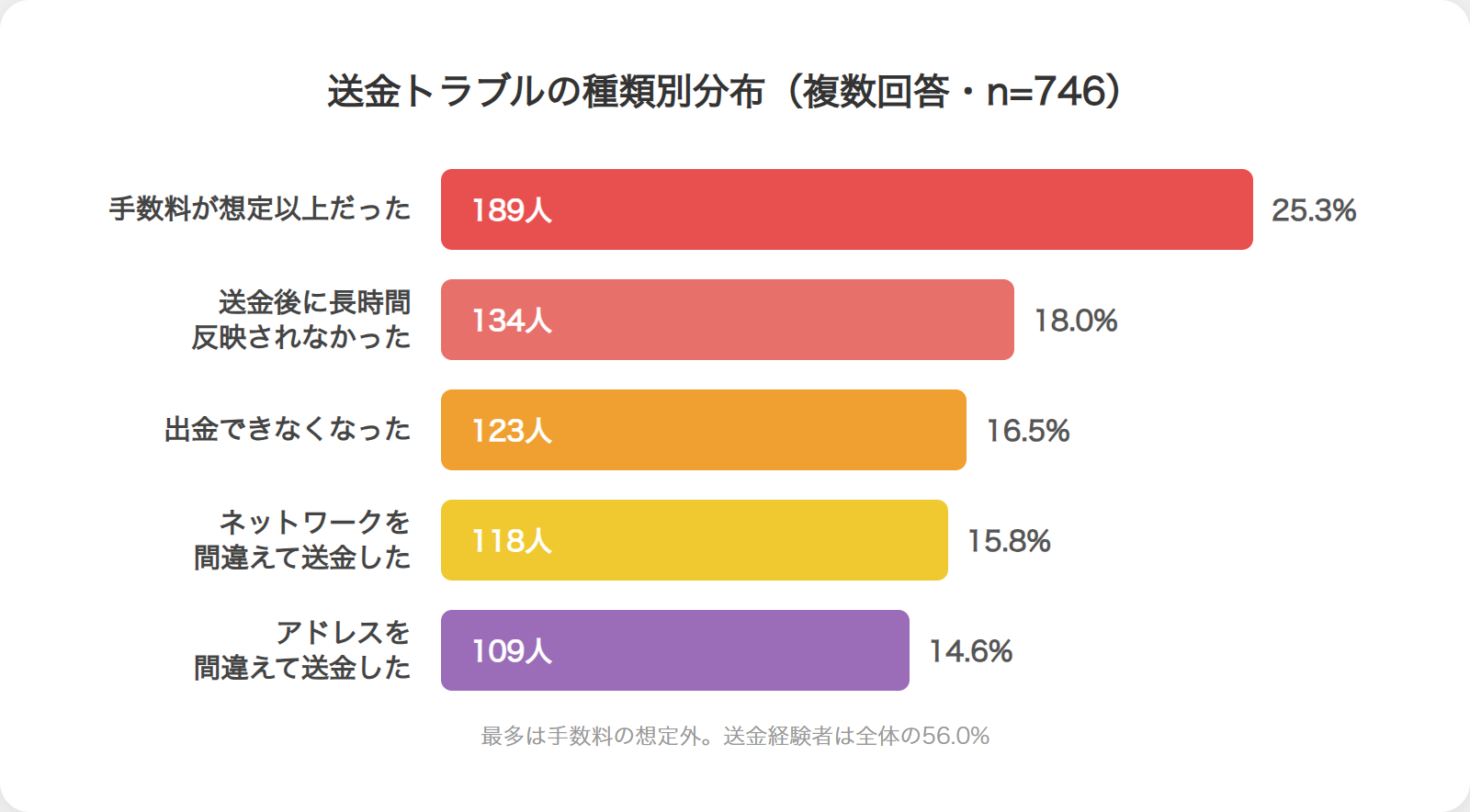
Many users have faced unexpected trouble when sending crypto assets.
Our survey found that 56.0%, or 418 of the crypto asset users surveyed, had experienced some kind of transfer trouble.
Transferring funds is a critical operation for moving assets, and it comes with inherent risk.
The types of trouble users encountered are shown below.
Type of Trouble | Responses | Share |
|---|---|---|
Fees were higher than expected | 189 | 25.3% |
Transfer wasn't reflected for a long time after sending | 134 | 18.0% |
Became unable to withdraw funds | 123 | 16.5% |
Sent funds on the wrong network | 118 | 15.8% |
Sent funds to the wrong address | 109 | 14.6% |
The Full Picture: Who Experiences Transfer Trouble
Among the crypto asset users surveyed, more than half — 56.0% — had experienced trouble when transferring funds.
This figure vividly illustrates just how much care crypto transfers require.
Notably, 172 users experienced multiple different types of trouble, accounting for 23.1% of all respondents.
Sending crypto involves several checks that users must carry out themselves, such as entering the address and selecting the network.
Failing to carefully complete each of these steps can lead to unexpected problems.
Since a single mistake can directly result in the loss of assets, the frequency of these troubles should never be taken lightly.
44.0% of users reported no trouble at all.
Even so, the reality is that a large share of users run into some kind of obstacle during the transfer process.
For anyone who handles crypto assets regularly, recognizing that trouble can happen to anyone is the first step toward staying safe.
The Most Common Trouble: Unexpectedly High Fees
The most common type of transfer trouble was "fees were higher than expected," cited by 25.3% of respondents.
This stems from the fact that transfer fees (gas fees) fluctuate depending on how congested the blockchain network is.
Many users end up paying more than the fee displayed at the time of the transfer, leaving them confused and frustrated.
Fee fluctuations depend on network usage. It's not uncommon for the fee shown at the moment you hit "send" to diverge from the fee actually charged by the time the transaction is confirmed. Especially during active market conditions, costs can end up far higher than expected.
This data suggests that a lack of understanding around fees is lowering user satisfaction.
Cost-conscious transfer strategies, along with the literacy to time transfers for when fees settle down, are essential for managing crypto assets.
Fee-related trouble is less a matter of user error than a result of the underlying complexity of the system itself.
Delayed Confirmations: A Problem That Shouldn't Be Underestimated
The next most common issue was "the transfer wasn't reflected for a long time," cited by 18.0% of respondents.
The fact that delayed confirmations occur more frequently than operator errors like wrong addresses is not something to ignore.
The waiting period until receipt of funds is confirmed creates significant psychological stress for users.
Why do such delays occur? The causes are varied — network congestion, processing delays at exchanges, or insufficient node synchronization, among others.
Because these factors are largely outside the user's control, once a transfer is initiated, all a user can do is wait.
To ease this anxiety, it's important to develop the skill of checking a transaction's status using a block explorer or similar tool.
"I sent it, but it never arrived" is the kind of trouble that can drive beginners away from crypto assets altogether.
Confirmation delays can be seen as a challenge unique to crypto assets, which remain in a systemic transitional period.
75.2% of People in Their 20s Have Experienced Trouble — Transfer Risk by Age Group
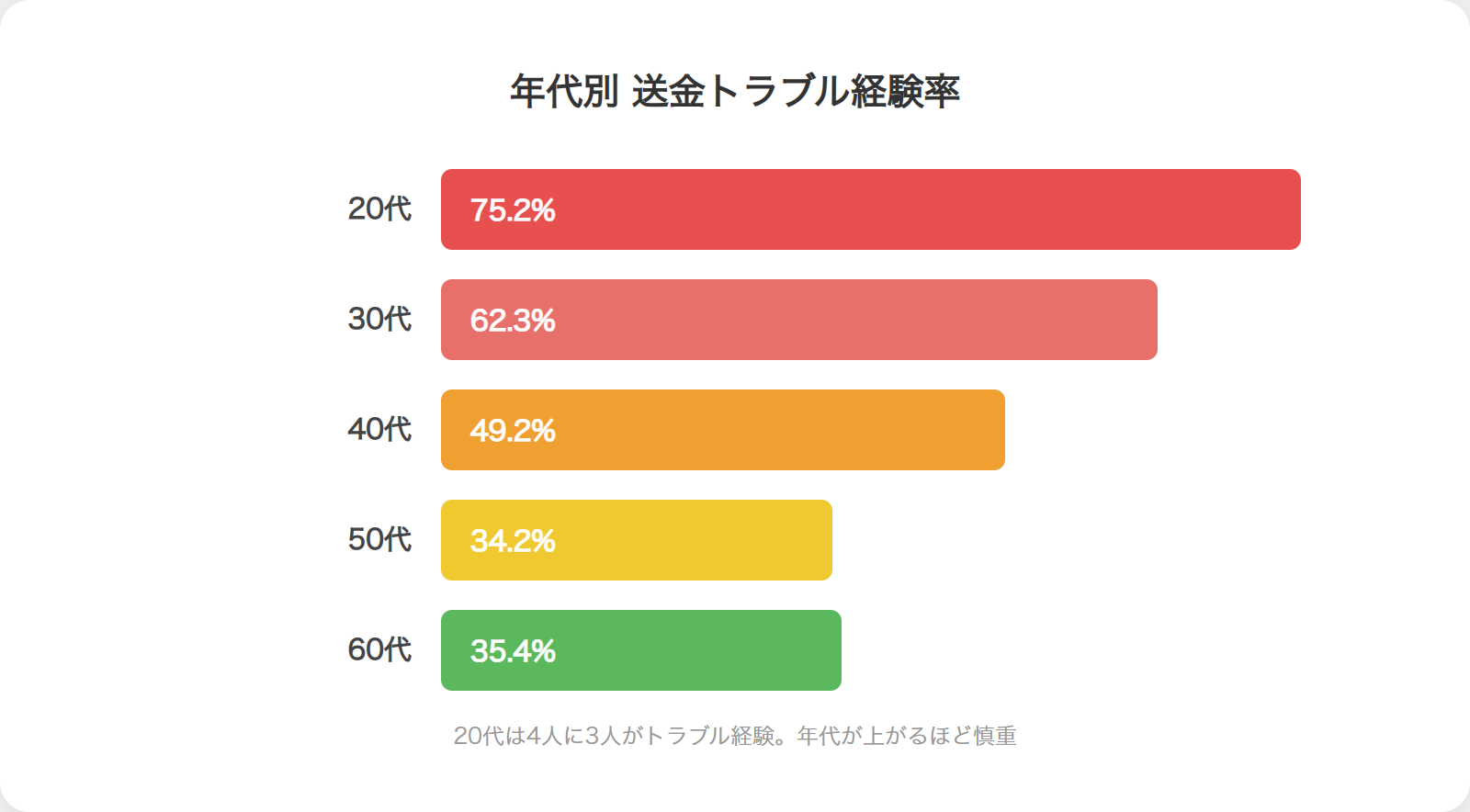
Age Group | Trouble Experience Rate |
|---|---|
In their 20s | 75.2% |
In their 30s | 62.3% |
In their 40s | 49.2% |
In their 50s | 34.2% |
In their 60s | 35.4% |
High Transfer Risk Concentrated Among Younger Users
The survey results show that the trouble experience rate among people in their 20s is a striking 75.2% — meaning roughly three out of every four have made some kind of mistake.
This suggests that while younger users are quick to adopt new services, they haven't fully come to grips with the complexity of transfer infrastructure.
There may be a gap between curiosity about new technology and actual operational proficiency.
Younger users are adept at using smartphones day-to-day, but sending crypto assets is a completely different matter.
Mistakes like a copy-and-paste error on an address or selecting the wrong chain show just how much tension there is around a single lapse leading to lost assets — likely more than most people imagine.
While there's value in learning from mistakes, given the risk of loss, an educational approach is urgently needed.
This high trouble rate may also be influenced by younger users' active engagement in short-term trading and trading styles that involve frequent transfers.
This active investment behavior results in more transfers, which in turn drives up the rate of encountering trouble.
The key will be how deeply this age group can come to appreciate the importance of risk management.
Wrong-Network Errors Concentrated Among Users in Their 20s and 30s
Among younger and mid-career users, "sent funds on the wrong network" is a particularly frequent type of trouble.
Selecting the correct network is currently one of the easiest mistakes to make when transferring crypto assets.
Even for the same currency, multiple networks — such as Ethereum, its Layer 2s, or BSC — coexist, making it difficult for beginners to tell them apart.
Many users end up executing transfers based purely on convenience, without fully understanding cross-chain compatibility.
The high rate of network errors also reflects a lack of proper education on the topic.
Helping users understand the basic concept of which chain a given network designation actually refers to is the most direct way to prevent this kind of trouble.
There's an ironic reality here: the more the technology advances, the higher the level of literacy demanded of users.
Trouble Rates Decline With Age
By contrast, the trouble experience rate tends to decline among users in their 50s and older.
At 34.2% for those in their 50s and 35.4% for those in their 60s — both less than half the rate for those in their 20s — the results reflect a greater degree of caution when transferring funds.
As people age, they appear to place greater emphasis on certainty, and this tendency to avoid risky operations seems to help them steer clear of trouble.
Differences in trouble rates across generations can also be attributed to accumulated investment experience and differing levels of risk tolerance.
Older users tend to be more wary of losing their assets and may have developed the habit of double- and triple-checking every transfer.
By contrast, younger users tend to prioritize efficiency and speed, often at the expense of careful checking.
This data suggests that crypto transfer trouble isn't simply a matter of "getting used to it."
Rather, the strongest defense against trouble is a disciplined mindset — one committed to following careful procedures every time.
Regardless of investment style, there's a lesson here that every generation can learn from.
Trouble Peaks at 2–3 Years of Investment Experience
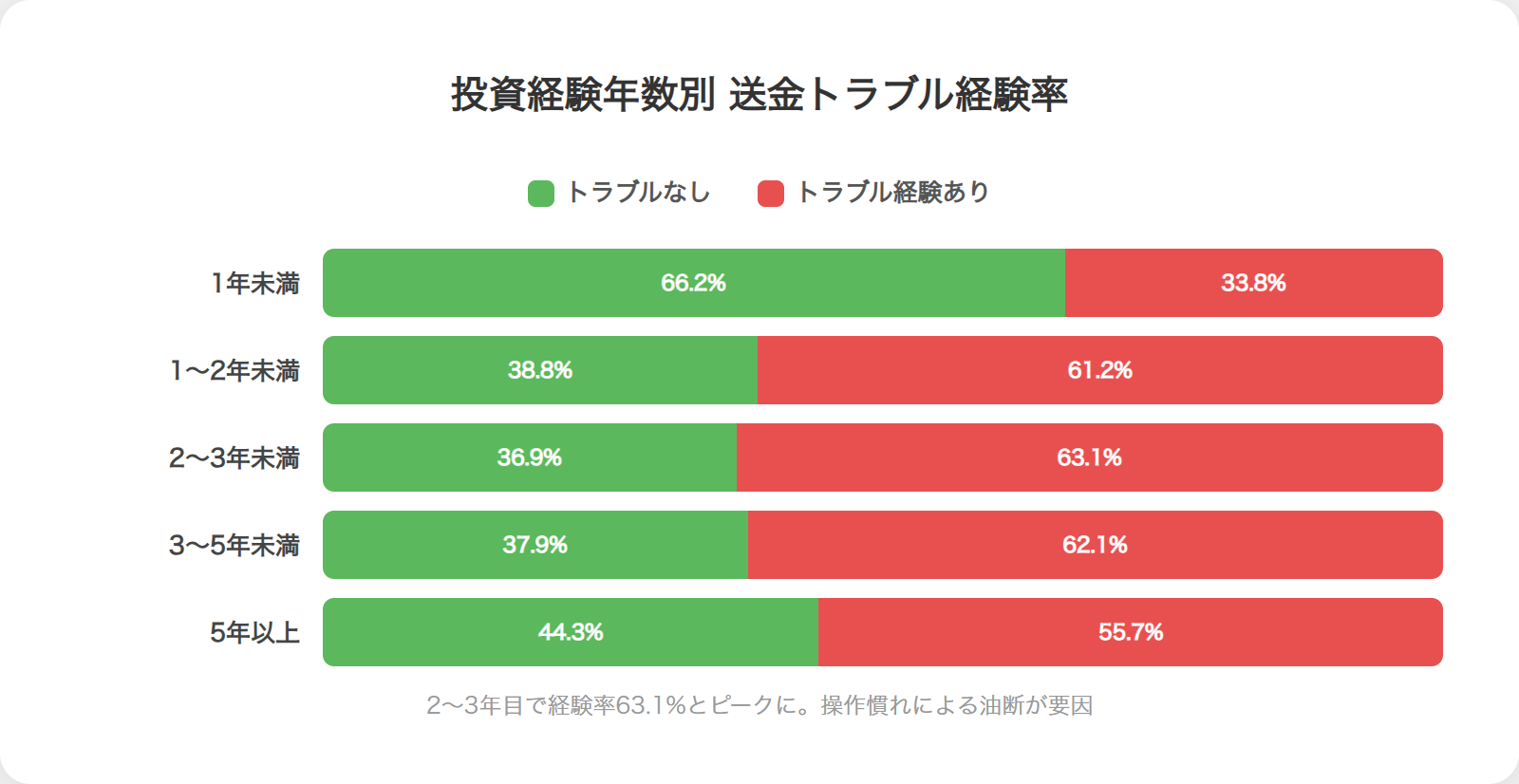
Years of Experience | No Trouble | Experienced Trouble |
|---|---|---|
Less than 1 year | 66.2% | 33.8% |
1–2 years | 38.8% | 61.2% |
2–3 years | 36.9% | 63.1% |
3–5 years | 37.9% | 62.1% |
5+ years | 44.3% | 55.7% |
Transfer Mistakes Spike at Year 2–3
Users who have been investing for two to three years face a particularly elevated risk.
Our survey data shows this group's trouble experience rate reaching 63.1%, the highest peak among all experience brackets.
Why do mistakes concentrate during this period? It's likely that as users grow accustomed to the process, they lose the caution they exercised early on.
Transferring funds is a critical procedure where a single mistake can be fatal.
The confidence that comes with becoming an intermediate user may, ironically, be leading people into unexpected pitfalls.
Fee Dissatisfaction Grows With Experience
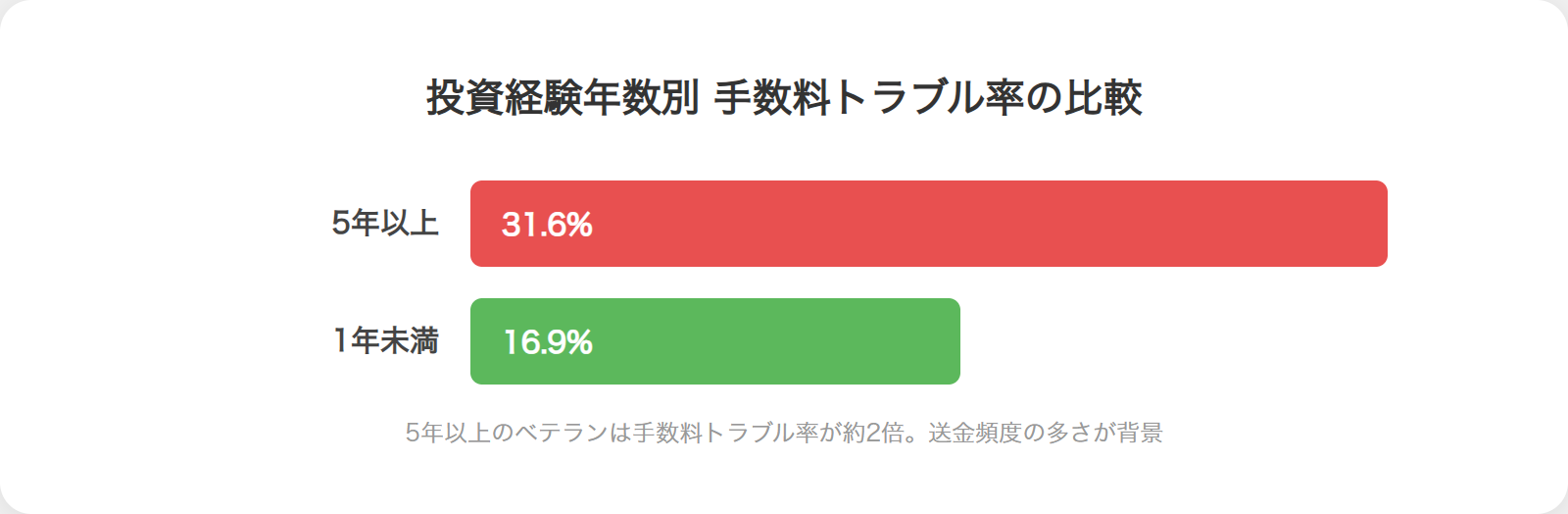
Years of Experience | Fee Trouble Rate |
|---|---|
Less than 1 year | 16.9% |
5+ years | 31.6% |
An interesting trend emerged: the longer someone has been investing, the more likely they are to run into fee-related trouble.
Fee trouble nearly doubles, from 16.9% among users with less than one year of experience to 31.6% among those with five or more years.
Long-term users transfer funds more often, which naturally means more exposure to network congestion and fluctuating fees.
This is, in a sense, the price of engaging with the market so frequently.
Experienced investors tend to move their assets around frequently.
As a result, they likely hold the system to a higher standard, making them more prone to feeling frustrated.
Familiarity Breeds Carelessness When Transferring Funds
When it comes to sending crypto assets, the most dangerous thing is the carelessness that comes with familiarity.
Many users who experienced trouble later reflected that they had skipped checks they knew they should have done from the start.
No matter how many times you've done it, verifying the address and network selection never becomes entirely risk-free.
That's because this is a final approval step performed by a human, one that cannot be automated.
The period when you've settled into your investment style and gained confidence is precisely the danger zone.
Going back to basics and treating every transfer with the same care as your very first one is the only way to protect your own assets.
Long-Term Holders See Smaller Losses, But Combining Short- and Long-Term Trading Increases Damage
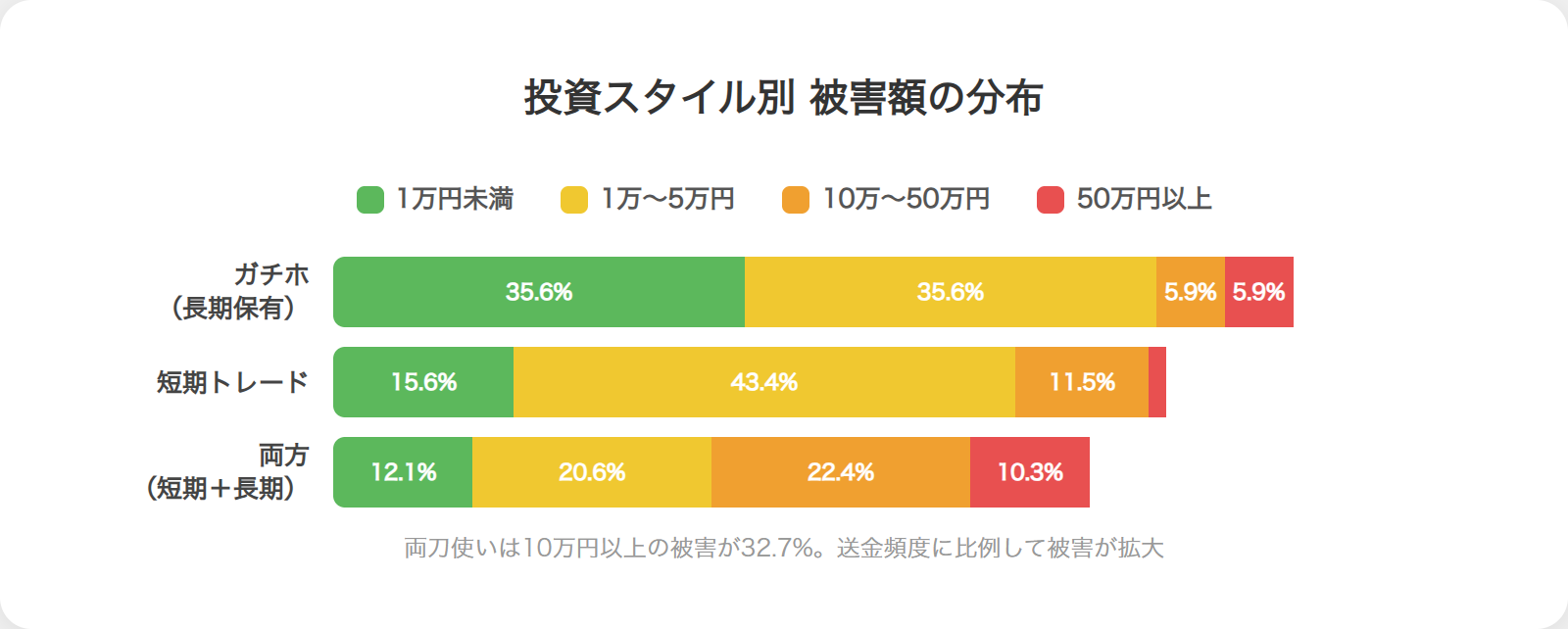
Investment Style | Under ¥10,000 | ¥10,000–¥50,000 | ¥100,000–¥500,000 | ¥500,000+ |
|---|---|---|---|---|
HODL (long-term holding) | 35.6% | 35.6% | 5.9% | 5.9% |
Short-term trading | 15.6% | 43.4% | 11.5% | 1.6% |
Both | 12.1% | 20.6% | 22.4% | 10.3% |
Long-Term Holding Tends to Limit Losses
There is a clear correlation between crypto investment style and the size of losses incurred.
Among users whose primary strategy is long-term holding, losses under ¥10,000 were the most common at 35.6%, and total losses tend to stay contained.
Their behavior of not moving assets frequently naturally reduces the opportunities for transfer mistakes.
Once a transfer is complete, long-term holders leave their assets in a wallet for extended periods.
Because the number of transfer operations itself is far lower, the probability of encountering human error is also lower.
As a result, even if trouble does occur, the scale of the damage is kept to a minimum.
This data vividly shows just how much risk is inherent in the act of transferring funds.
The fact remains that not touching your assets frequently is the single most powerful defense for protecting them. The stability of long-term holders' portfolios is underpinned by exactly this kind of careful distance.
Combining Both Strategies Puts You at Risk of Larger Losses
By contrast, users who combine both short-term trading and long-term holding are, in reality, more prone to large losses.
Combined losses of ¥100,000 or more reached 32.7%, revealing a high risk of serious financial harm.
The main reason is that combining multiple investment styles inflates the number of transfers.
Users who take the "both" approach frequently move assets between exchanges and wallets in response to market fluctuations.
A higher trading frequency means more opportunities for operational error.
While this may look like a flexible investment strategy on the surface, from a security standpoint it forces users to remain constantly on guard.
When large amounts are moved frequently, each individual transaction carries greater weight.
In a busy market environment, it's likely that many users end up rushing their transfers.
Not a few users, in the pursuit of convenience, end up stepping into unexpected pitfalls.
Frequency Drives Operational Mistakes
This analysis revealed a positive correlation between transfer frequency and the size of losses.
Among users focused primarily on short-term trading and those who combine both styles, losses of ¥10,000 or more accounted for more than half of all cases.
As both the amount moved and the frequency of transfers increase, the financial losses from human error rise proportionally.
Among the short-term trading-focused group in particular, losses of ¥10,000–¥50,000 stand out at 43.4%.
Users may let their guard down because the amounts seem small, but these losses can add up to something significant.
Transfer trouble is a serious event that, with a single mistake, can wipe out tens of thousands of yen in assets.
When it comes to sending crypto assets, familiarity should be recognized once again as the greatest enemy.
Regardless of investment style, thorough, careful checking is required every single time.
We recommend taking a fresh look at just how much risk your own investment behavior carries.
23.1% of Users Have Experienced Multiple Types of Trouble
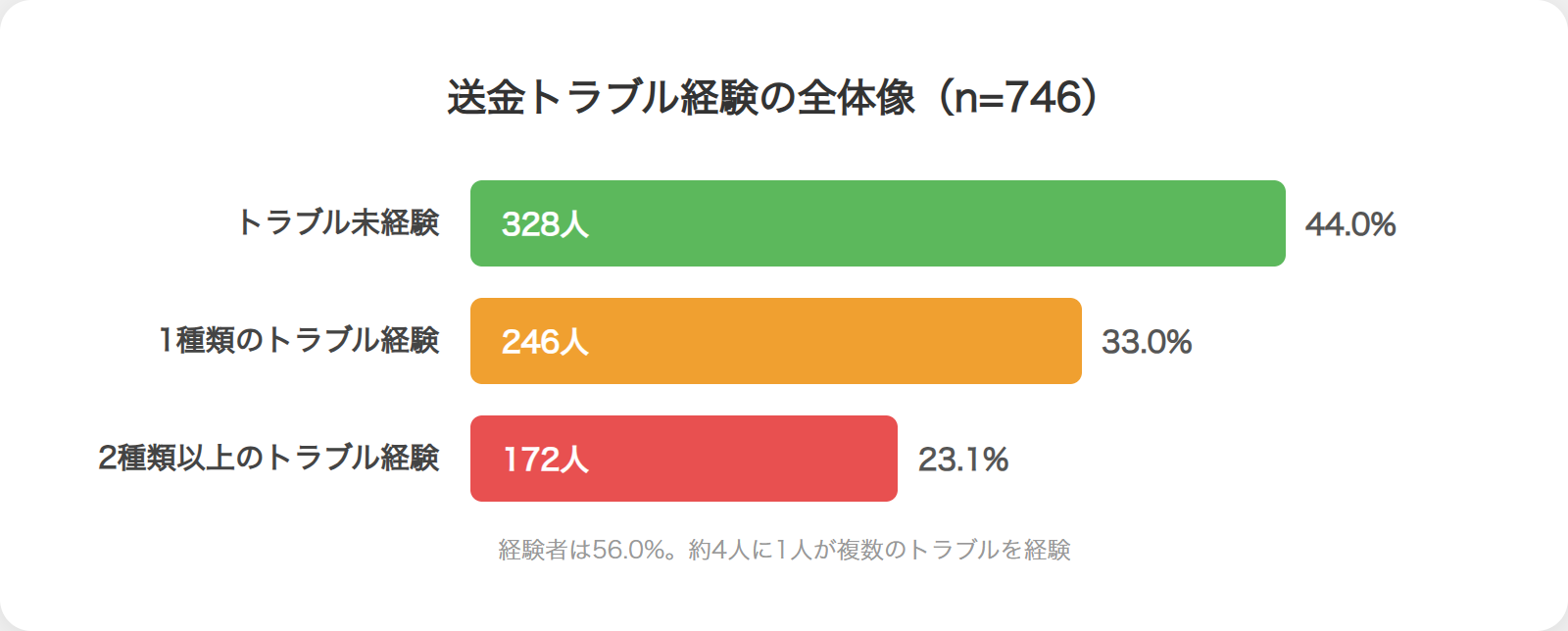
Experience | Responses | Share |
|---|---|---|
No trouble experienced | 328 | 44.0% |
Experienced 1 type of trouble | 246 | 33.0% |
Experienced 2 or more types of trouble | 172 | 23.1% |
172 Users Faced Compound Trouble
Our survey found that, among the 418 users who experienced some form of trouble, 172 had experienced two or more different types.
That equates to 23.1% of all crypto asset users surveyed.
This highlights a sobering reality: even after learning from one mistake, it's not uncommon for users to run into an entirely different kind of trouble.
The act of transferring funds carries multiple risks simultaneously — fluctuating gas fees, network selection, address accuracy, and more.
Even after clearing one hurdle, there's always the possibility of stumbling over another.
It's important not to dismiss trouble as "just one instance of bad luck," but instead to view it as a compound risk.
Whether the same type of mistake repeats or an entirely new type occurs isn't entirely clear from the data.
Still, it's natural for users who've already experienced trouble once to worry that "something else might happen."
The fact that as many as 172 users share this experience is a reality that can't be ignored when managing crypto assets.
What's Behind the Negative Spiral of Repeated Mistakes
Why do so many users end up experiencing trouble more than once? It's likely that many failed to resolve the underlying cause after their first incident and never improved their operating habits or management practices.
Treating trouble as "something that just happened" without revisiting fundamental risk management is what invites a second or third mistake.
Sending crypto assets safely isn't something you pick up naturally — it has to be learned.
The moment you make a mistake is precisely your biggest opportunity to review your entire transfer process.
However, if that opportunity is missed and users continue trading under the same conditions, running into trouble again is essentially inevitable.
In addition, users who favor active trading tend to transfer funds more frequently.
This naturally increases the number of times they encounter trouble, so statistically they're more likely to experience it multiple times.
This may point not just to individual carelessness, but to a structural issue in an investment environment that forces frequent movement of funds.
Why Those Who've Been Through It Should Build a Double Layer of Defense
In a sense, users who have experienced trouble multiple times understand "crypto transfer risk" better than anyone.
They should turn their past mistakes into lessons and put stronger safeguards in place going forward.
Rather than checking just once, build a habit of double- and triple-checking every transfer.
For example, registering the destination address to avoid manually typing it each time is basic best practice.
You should also always follow the process of sending a small test transfer first and confirming receipt before sending the full amount.
Following these steps should prevent the majority of trouble before it happens.
Those who can learn from their failures grow stronger for it.
If you've already experienced two or more types of trouble, take that as a sign that it's time to overhaul your transfer process.
Use your past mistakes as fuel for better asset management, and take the next step toward more careful, more reliable crypto investing.
Summary
This survey revealed that 56.0% of crypto asset users have experienced trouble when transferring funds.
The most common complaint was fees being higher than expected, pointing to a lack of understanding of the system and difficulty coping with fluctuating costs as key challenges.
The high experience rate among users in their 20s, along with the sharp rise in trouble at the two-to-three-year mark, can largely be attributed to the carelessness that comes with growing accustomed to the process.
The scale of losses from transfer mistakes varies significantly depending on investment style and frequency.
Investors who favor short-term trading, or who combine multiple styles, carry a higher risk of substantial losses due to the frequent movement of funds.
To protect your assets, thoroughly following basic checks is essential, regardless of your investment style.
Taking these findings to heart and establishing a careful transfer process is the single most important risk-management step for long-term crypto asset investing.
Survey Overview
Survey date: April 10, 2026
Method: Internet survey
Respondents: Men and women residing in Japan (people currently or previously investing in crypto assets)
Valid responses: 746
Conducted by: Clabo Inc.
Survey Questions
- Do you have experience investing in crypto assets (also known as virtual currencies)?
- How many years have you been investing in crypto assets?
- What is your primary investment style?
- Have you experienced trouble when transferring crypto assets?
- How much financial loss have you incurred due to transfer trouble?
This article is for informational purposes only and does not constitute financial or investment advice. Please consult a qualified professional before making investment decisions.


