


"I thought the transfer went through. But the address was wrong."
A single moment of carelessness like this can lead to an irreversible outcome for crypto assets (also known as virtual currencies) investors.
A survey of people with crypto asset experience found that 56.0% had experienced some kind of transfer-related trouble.
Furthermore, 17.8% had given up on assets lost to misplacement or a failed transfer, and recovery succeeded for only 28.7% of those affected — a harsh reality laid bare by the data.
In addition, 20.1% of investors lost assets due to wallet-related trouble when switching phones — meaning one in five has been through this.
This article draws on the data to break down the types of transfer errors, the resulting losses, and the odds of recovery, painting a full picture of the transfer risks investors face.
Let go of the assumption that "I'm careful, so this won't happen to me," and use these survey results as a chance to review your own transfer process.
56.0% of Investors Have Faced Transfer Trouble — Fees, Delays, and Withdrawal Failures Are the Top Three Pain Points
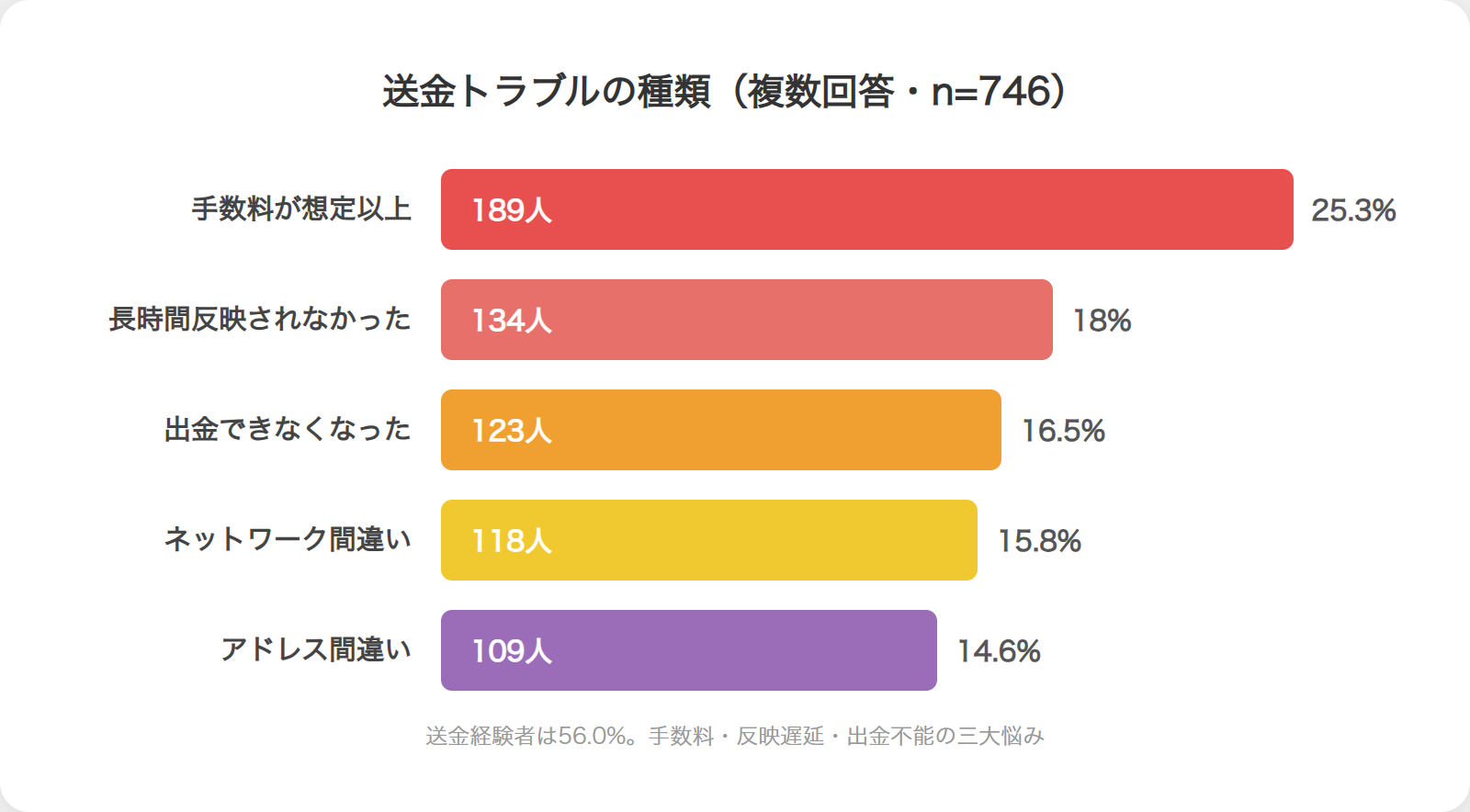
Type of transfer trouble | Responses | Share |
|---|---|---|
Fees were higher than expected | 189 | 25.3% |
Transfer took a long time to be reflected | 134 | 18.0% |
Became unable to withdraw | 123 | 16.5% |
Sent on the wrong network | 118 | 15.8% |
Sent to the wrong address | 109 | 14.6% |
"Fees Were Higher Than Expected" at 25.3% — The Trap of Gas Fees and Rate Swings
The most common type of transfer trouble, experienced by 25.3% of respondents, was "fees were higher than expected."
The fact that more than one in four investors has run into unexpectedly high gas fees or transfer fees speaks to how difficult crypto's cost structure can be to navigate.
On networks such as Ethereum in particular, gas fees can swing by the second depending on congestion.
It's not unusual for fees to differ significantly between the moment right before you tap "send" and the moment you actually do, and without a feel for prevailing rates, investors can end up shouldering unexpectedly high costs.
Even for small transfers, fees can end up exceeding the amount sent during periods of network congestion.
Making a habit of checking current gas fees before transferring, and timing transactions to avoid congestion, is the first step to cutting unnecessary costs.
"Wrong Network" at 15.8% and "Wrong Address" at 14.6% — One Mistake Can Be Fatal
Especially serious are the 15.8% who sent funds on the wrong network and the 14.6% who sent funds to the wrong address.
These two are known as the most typical, and typically the most difficult to recover from, mistakes in crypto assets.
An operational error such as sending something meant for ERC-20 over BEP-20 instead, or sending to a similar-looking address, generally cannot be undone because of the blockchain's irreversibility.
The moment the send button is pressed, the transaction is finalized — and even if the destination was wrong, the funds do not come back automatically. This mechanism is harsh, especially for beginners.
Combined, these come to 30.4% — nearly one in three investors has experienced this kind of "fatal-error" mistake.
It is essential to always do a final check before transferring, and to make it a habit to visually compare the first and last characters of an address after copying and pasting it.
"Became Unable to Withdraw" at 16.5% — Trouble Originating on the Exchange Side
The 16.5% who said they "became unable to withdraw" experienced trouble that originated not from user error but from the exchange or platform itself.
Causes range widely — requests for additional identity verification, account freezes over suspected unauthorized access, or maintenance and outages at the exchange.
In the worst case, the exchange itself can fail, and assets can effectively never come back.
Looking back at past cases involving overseas exchanges shows that the assumption "I can withdraw whenever I want" is not necessarily guaranteed.
As a basic defensive measure, assets intended for long-term holding should not be left sitting on an exchange — they should be moved to your own wallet.
Rather than operating on the assumption that "withdrawals are always available," investors should manage their asset allocation with the mindset that "withdrawals could stop at any time."
Losses from Transfer Mistakes — 22 People Suffered Major Losses of ¥500,000 or More (~$3,300)
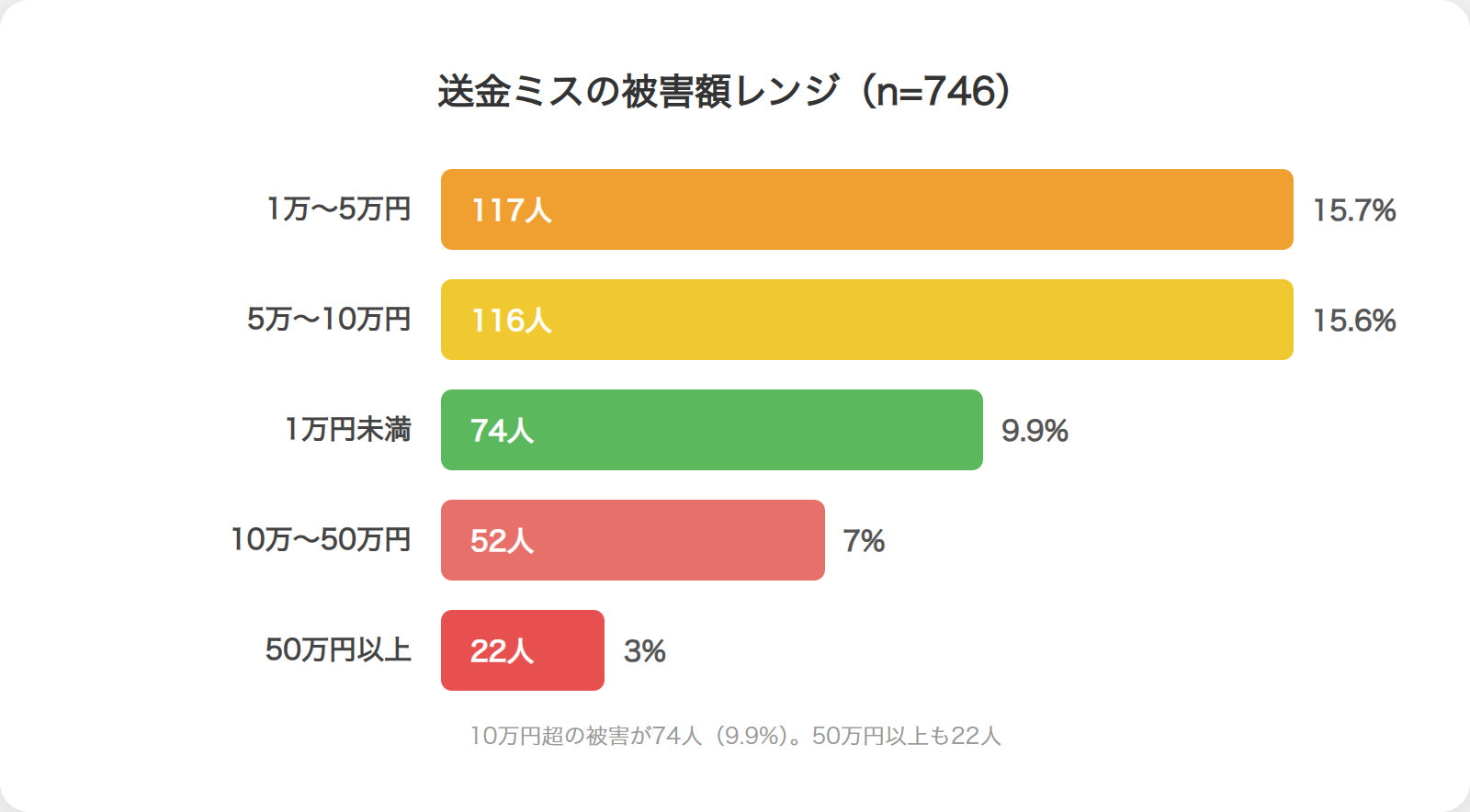
Loss range | Responses | Share |
|---|---|---|
¥10,000 to under ¥50,000 | 117 | 15.7% |
¥50,000 to under ¥100,000 | 116 | 15.6% |
Under ¥10,000 | 74 | 9.9% |
¥100,000 to under ¥500,000 | 52 | 7.0% |
¥500,000 or more | 22 | 3.0% |
Around 30% of Losses Fall Between ¥10,000 and ¥100,000 — More Than Just "Tuition"
Losses from transfer mistakes are concentrated in the ¥10,000-to-¥100,000 range.
¥10,000 to under ¥50,000 accounts for 15.7% and ¥50,000 to under ¥100,000 for 15.6%; combined, that's 31.3% — roughly three in ten investors have suffered real losses in this bracket.
Some investors treat losses of a few thousand to a few tens of thousands of yen as "tuition," but in practice this is by no means a trivial amount.
For those who started with a side income or a small investment in particular, losing ¥50,000 or ¥100,000 can be a serious blow to motivation.
As losses accumulate, they can end up canceling out gains that would otherwise have been realized.
To avoid repeating small transfer mistakes, investors need to adopt the unglamorous but reliable practice of following the same check process every single time.
Losses Over ¥100,000 Hit 74 People (9.9%) — Territory You Can't Take Back
For investors whose losses exceeded ¥100,000, 7.0% fell in the ¥100,000-to-¥500,000 range and 3.0% lost ¥500,000 or more, for a combined 74 people (9.9%).
That means roughly one in ten investors overall has suffered a major transfer loss in the six-figure-yen range or higher.
The existence of 22 people who lost ¥500,000 or more is especially serious.
At this scale, the loss is large enough to shake up an investor's life plans and investment strategy as a whole — this goes well beyond a simple "mistake."
High-value losses are, in most cases, the result of a single error such as sending on the wrong network or to the wrong address.
The larger the transfer amount, the more important it becomes to run a test transfer first and to build in multiple rounds of confirmation — risk management scaled to the size of the transaction.
17.8% "Gave Up" — The Reality That Crypto Assets Often Can't Be Recovered
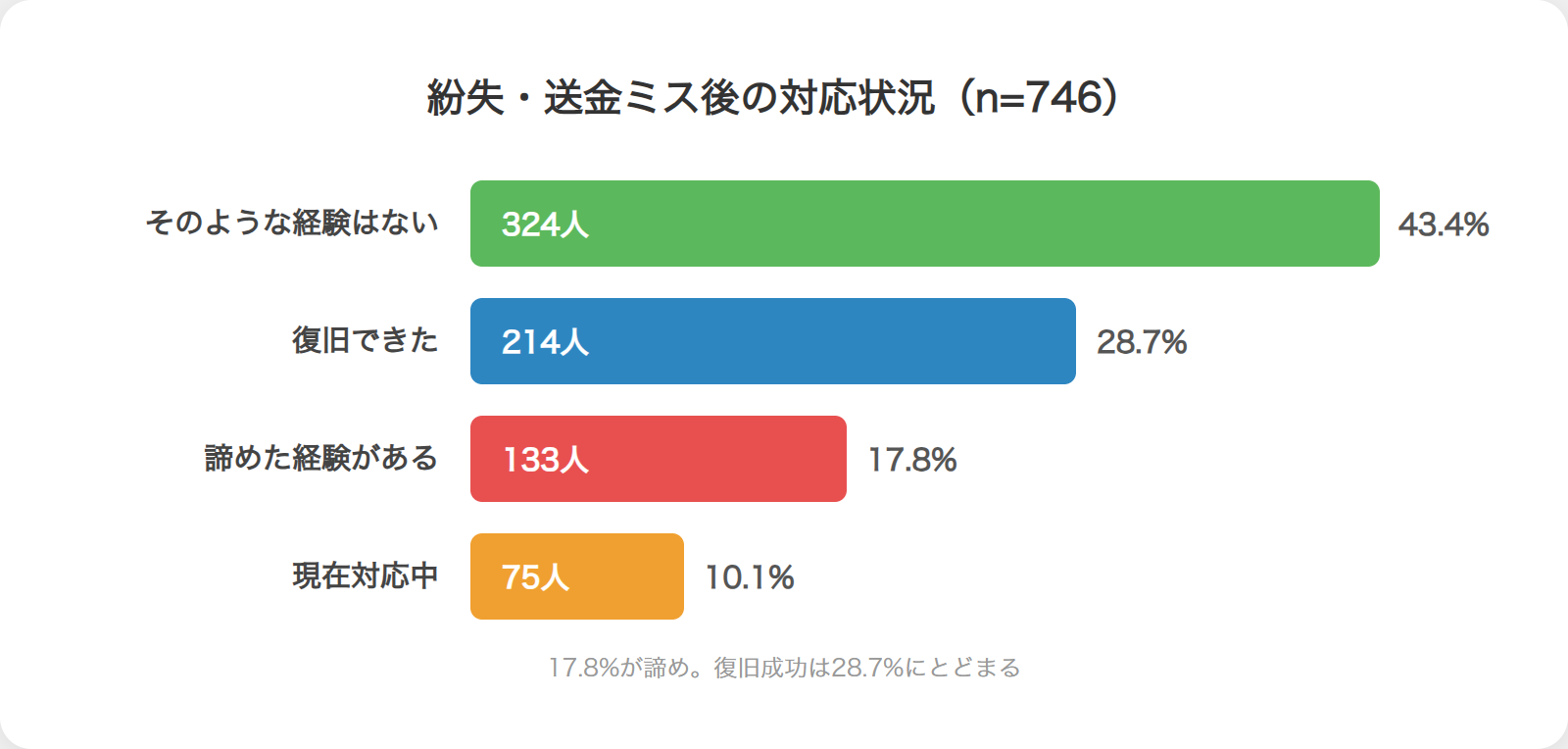
Status | Responses | Share |
|---|---|---|
No such experience | 324 | 43.4% |
Successfully recovered | 214 | 28.7% |
Gave up | 133 | 17.8% |
Currently working on it | 75 | 10.1% |
Successful Recovery Tops Out at 28.7%
Among investors who experienced a loss or a failed transfer, only 28.7% succeeded in recovering their funds, while 17.8% reported having given up at some point.
The data makes clear that not everyone who suffers a loss is made whole — a reflection of crypto's principle of self-responsibility.
Whether recovery succeeds depends heavily on the type of mistake and the nature of the destination.
A simple operational error between exchanges may be resolved by contacting support, but an address mix-up between two self-custody wallets is essentially unrecoverable.
"Giving up" is not always simply resigning oneself to a loss — in some cases it's a rational economic decision that weighs the cost of recovery against the size of the loss.
When legal fees or the time investment would exceed the amount lost, choosing to give up becomes, for a good number of investors, the rational choice they're left with.
The Long Fight Behind the 10.1% "Currently Working on It"
Notably, 10.1% of investors reported that they are "currently working on it."
Responding to a loss or a failed transfer doesn't necessarily wrap up in a matter of days or weeks — in some cases it can drag on for months or even years.
The process can involve exchanges dealing with support, consulting police or lawyers, and tracing transactions on the blockchain — a wide range of steps.
Between the incident and its resolution, investors carry an ongoing psychological burden, which can also interfere with their broader investment activity.
Adding the 17.8% who "gave up" to the 10.1% who are "currently working on it" comes to 27.9%.
In other words, a meaningful share of those who have been affected remain unresolved to this day.
Knowing this reality, prevention should be the top priority.
Lost Assets When Switching Phones — One in Five Have Faced This Overlooked Risk
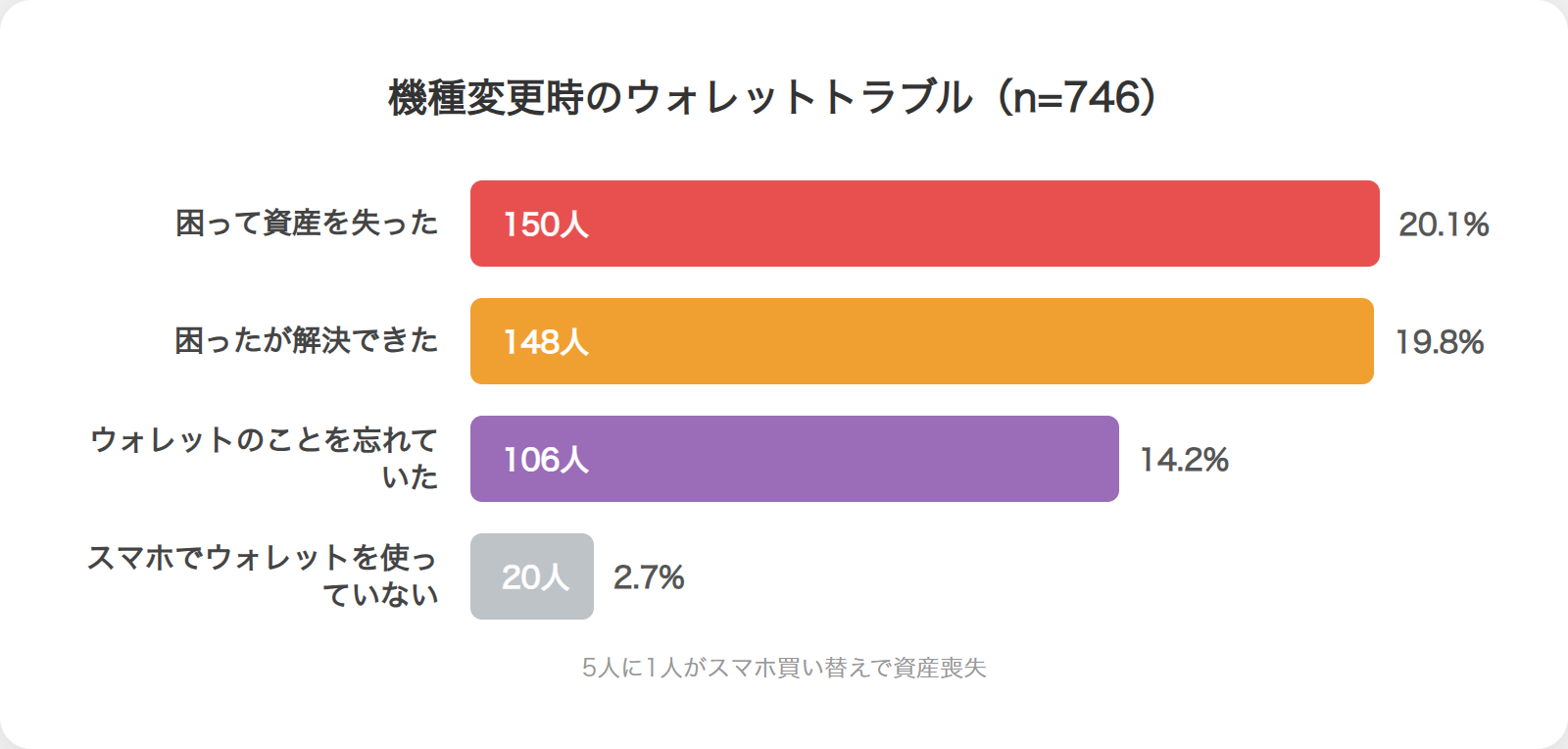
Status | Responses | Share |
|---|---|---|
Ran into trouble and lost assets | 150 | 20.1% |
Ran into trouble but resolved it | 148 | 19.8% |
Forgot about the wallet | 106 | 14.2% |
Don't use a wallet on their phone | 20 | 2.7% |
"Ran Into Trouble and Lost Assets" at 20.1% — The Pitfall of Switching Phones
Among wallet-related troubles that occurred when switching phones, 20.1% of investors reported having lost assets as a result.
It's a striking figure: one in five people has lost crypto assets through the everyday act of replacing their smartphone.
Hot-wallet apps are built on the assumption that the user manages their seed phrase and private key.
Restoring the same wallet on a new device requires entering the seed phrase correctly, but many people either never recorded it or have since lost it — a problem that comes up frequently.
Since switching phones is an event that can be anticipated well in advance, in principle this kind of loss is preventable.
Before replacing a smartphone, always confirm that the seed phrase is safely stored and test the restoration process — this is the only reliable way to prevent this kind of trouble.
"Forgot About the Wallet" at 14.2% — Another Face of Self-Responsibility
14.2% of respondents said they "forgot about the wallet" when switching phones.
In the busyness of migrating data during a device switch, the existence of the crypto wallet itself can simply slip the user's mind.
Investors holding small amounts of crypto assets tend to have fewer occasions to think about their wallet day-to-day, and this makes it more likely to go unnoticed and be left behind during a phone switch.
The fact that people "forgot" also reflects how crypto assets have yet to become fully integrated into everyday financial life for many holders.
Combined with the 19.8% who "ran into trouble but resolved it," a total of 54.1% of investors faced some kind of difficulty when switching phones.
With more than half running into trouble, switching phones should be recognized as a "high-risk event" for crypto investors.
Trouble Rates Roughly Double After the One-Year Mark — Trends by Holdings and Age Group
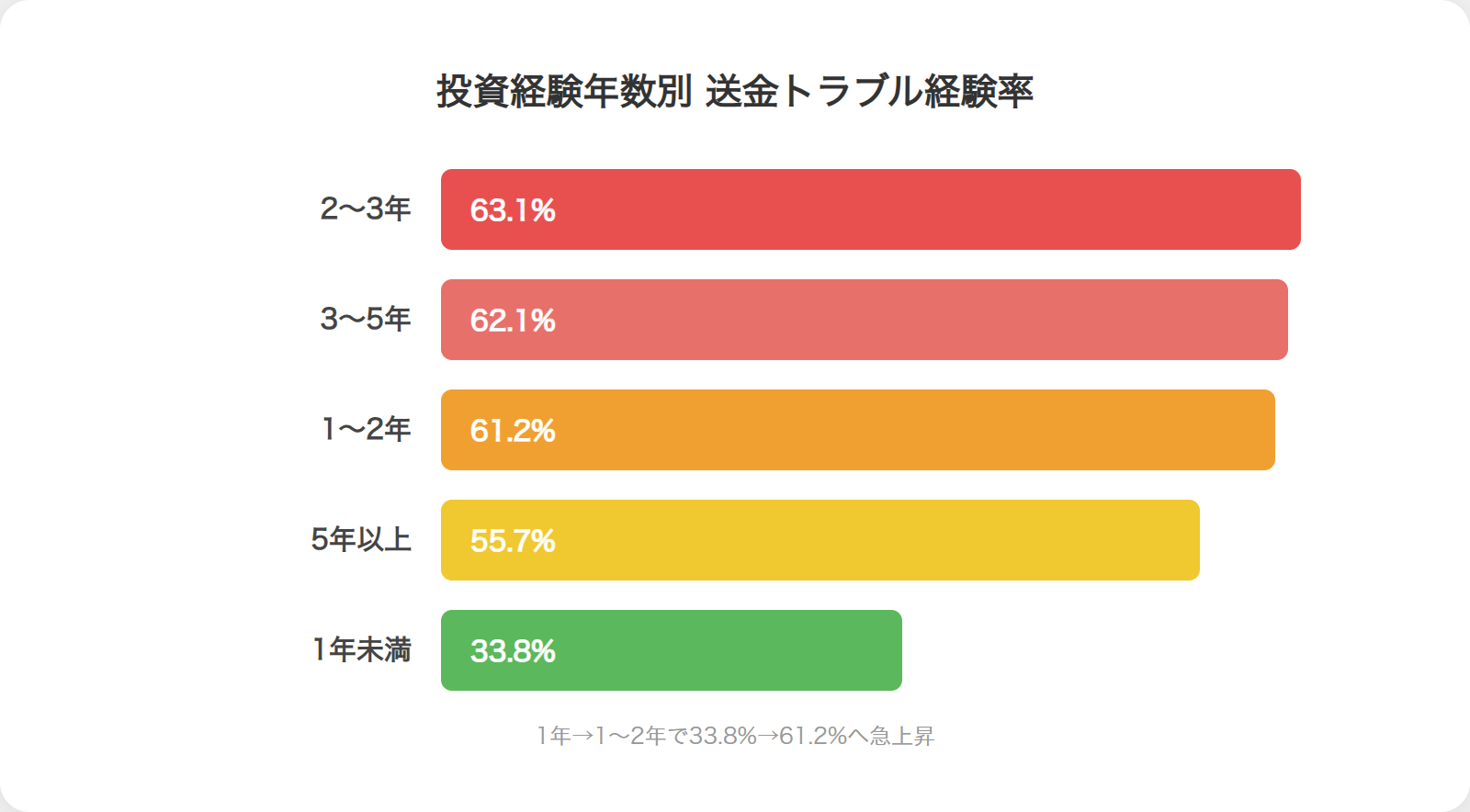
Years of investing experience | n | Trouble rate |
|---|---|---|
Under 1 year | 142 | 33.8% |
1 to under 2 years | 214 | 61.2% |
2 to under 3 years | 195 | 63.1% |
3 to under 5 years | 116 | 62.1% |
5 years or more | 79 | 55.7% |
33.8% Under One Year vs. 61.2% at One to Two Years — Where Familiarity Meets Complacency
Looking at the transfer-trouble rate by years of investing experience, the rate jumps from 33.8% for those with under one year of experience to 61.2% for those with one to two years — an abrupt leap.
The fact that the trouble rate nearly doubles right around the one-year mark suggests that the period when investors start becoming comfortable with the process is precisely when the risk is highest.
Everyone tends to be careful with transfers right after starting out, but as investors go through dozens or hundreds of transactions, the confirmation process tends to get skipped.
Assumptions like "same steps as always" or "my usual destination" are what lead to fatal mistakes such as sending on the wrong network or to the wrong address.
Even among veterans with five or more years of experience, 55.7% have experienced some form of trouble — a sign that risk can never be fully eliminated, no matter how experienced an investor becomes.
Precisely when a task starts to feel routine is when it's most important to return to the checklist you first learned.
76.7% of Investors in Their Twenties or Younger Have Experienced Trouble — The Flip Side of Active Trading
Age group | n | Trouble rate |
|---|---|---|
20s or younger | 163 | 76.7% |
30s | 207 | 62.3% |
40s | 187 | 49.2% |
50s | 120 | 34.2% |
60s or older | 69 | 44.9% |
Broken down by age group, investors in their twenties or younger had the highest trouble rate of any generation, at 76.7%.
More than three in four have experienced transfer-related trouble — a sign that the active trading habits of younger investors and the risks that come with them go hand in hand.
Younger investors, who tend to use multiple platforms across DeFi, NFTs, and overseas exchanges, far more often run into situations requiring them to switch networks or handle different address formats.
The more transactions someone makes, the higher the probability of running into trouble — a simple structural pattern that shows up clearly in the data.
The 50s age group posted the lowest figure at 34.2%, which likely reflects differences in trading frequency and investment style.
For investors looking to reduce risk, reconsidering trading frequency itself can be an effective strategy.
76.0% Among Holders of ¥5 Million or More (~$33,000) — A Fate That Comes With Being a Large Investor
Holdings | n | Trouble rate |
|---|---|---|
Under ¥10,000 | 155 | 27.7% |
¥10,000 to under ¥100,000 | 203 | 50.7% |
¥100,000 to under ¥500,000 | 152 | 70.4% |
¥500,000 to under ¥1,000,000 | 137 | 67.9% |
¥1,000,000 to under ¥5,000,000 | 74 | 71.6% |
¥5,000,000 or more | 25 | 76.0% |
A clear relationship was also confirmed between the size of an investor's holdings and their trouble rate — the larger the holdings, the higher the rate of trouble.
Among investors holding ¥5 million or more, 76.0% — three in four — have experienced trouble.
This should be read not as the size of holdings itself driving risk, but as a reflection of how active the trading is.
Investors with larger holdings tend to have more trading opportunities and to use multiple exchanges and wallets, which inevitably increases the number of chances for a mistake to occur.
That said, as holdings grow larger, the amount lost to a single mistake grows proportionally as well.
When familiarity, complacency, and the pressure of handling large sums combine, that's when fatal mistakes tend to happen.
High-value holders in particular need to make test transfers and multiple rounds of confirmation an absolute, non-negotiable part of their routine.
Summary
This survey revealed a harsh reality: 56.0% of crypto assets investors have experienced some kind of transfer-related trouble, and 17.8% have given up on assets lost through misplacement or a failed transfer.
Especially notable is that 20.1% of investors — one in five — lost assets when switching phones.
The fact that this much damage occurs from a foreseeable life event shows that thorough seed-phrase management remains a challenge for the industry as a whole.
The trouble rate roughly doubles, from 33.8% to 61.2%, right around the one-year mark of investing experience, and 76.0% of those holding ¥5 million or more in assets have experienced trouble.
There are three checks that should always be performed before a transfer.
First, always visually confirm the first and last characters of the destination address.
Second, always confirm that the correct network (chain) has been selected.
Third, always run a small test transfer before sending a large amount.
In addition, before switching phones, confirm that your seed phrase is safely stored and test the restoration process beforehand.
Letting go of the assumption that "I'm experienced, so I'll be fine," and instead following the same check process every single time, is the only way to protect your assets in the irreversible world of crypto assets.
Survey Overview
Survey date: April 10, 2026
Method: Internet survey
Respondents: Men and women residing in Japan (people currently investing in crypto assets, or who have invested in the past)
Valid responses: 746
Conducted by: Clabo Inc.
Survey Questions
- Do you have experience investing in crypto assets?
- How many years of experience do you have investing in crypto assets?
- What is the total value of the crypto assets you currently hold?
- Have you experienced wallet-related trouble when switching phones?
- Have you experienced trouble with a transfer?
- What was the amount of loss from transfer trouble?
- Have you had an experience of giving up on assets lost or misplaced through a failed transfer?
This article is for informational purposes only and does not constitute financial or investment advice. Please consult a qualified professional before making investment decisions.


