


We conducted an independent survey of 733 crypto assets (also known as virtual currencies) investors on the timing of profit-taking and their overall investment style.
Among investors who said they have "clearly defined" profit-taking rules, 87.5% reported experiencing regret over their decisions—compared to just 59.1% among those with "no rules" at all, a striking paradox.
This article examines the relationship between having rules and the rate of regret, breaking down the criteria behind profit-taking decisions and trends across different investment styles.
We also found that 84% of investors focused on short-term trading reported regret—rising to 88% among rule-setters within that group—while one in three investors who "go by feel" have never taken profits at all.
From this unexpected relationship between rules and regret, we draw out tips for improving profit-taking decisions.
The More Rules You Set, the More Regret You Feel: An Unexpected Inverse Correlation
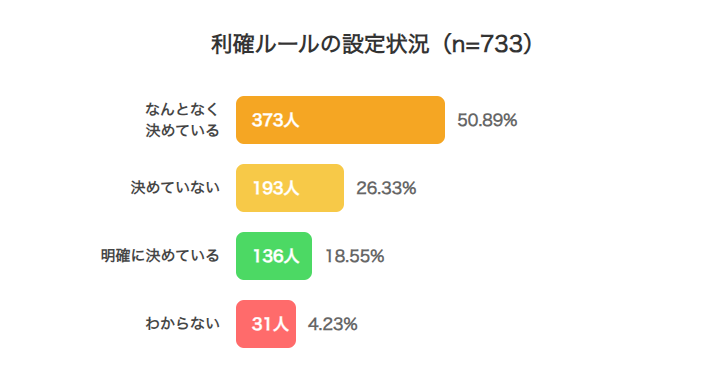
"Going by Feel" Is the Majority: The State of Rule-Setting
Answer | Responses | Share |
|---|---|---|
Loosely defined | 373 | 50.89% |
No rules | 193 | 26.33% |
Clearly defined | 136 | 18.55% |
Not sure | 31 | 4.23% |
Only 18.55% of investors said they had "clearly defined" profit-taking rules.
"Loosely defined" was the most common response at 50.89%, suggesting that many investors make sell decisions under vague, informal guidelines.
Combining "clearly defined" and "loosely defined" respondents, about 69% of investors have some form of rule in place, showing that the intention to set a standard is widespread.
Meanwhile, 26.33% reported having "no rules" at all—meaning more than one in four investors approach profit-taking with no guideline whatsoever.
The following data reveals how the presence or absence of rules affects investment outcomes and psychology.
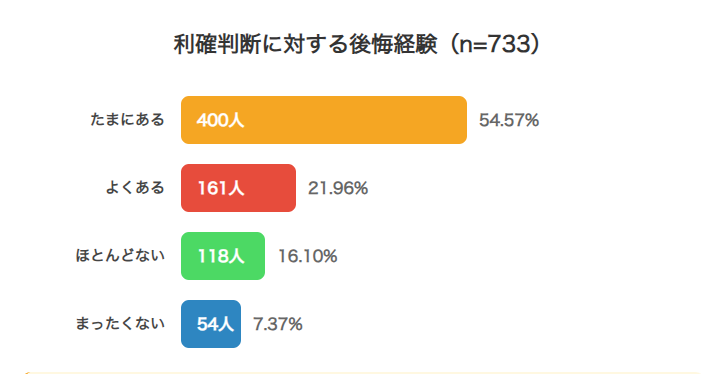
76.5% Report Regret, With "Sometimes" the Most Common Answer
Answer | Responses | Share |
|---|---|---|
Sometimes | 400 | 54.57% |
Often | 161 | 21.96% |
Rarely | 118 | 16.10% |
Never | 54 | 7.37% |
When asked about regret over profit-taking decisions, "sometimes" was the most common response at 54.57%. Combined with "often" at 21.96%, 76.53% of respondents had experienced regret.
That works out to more than three in four crypto investors harboring regret over the timing of their profit-taking.
"Rarely" accounted for 16.10% and "never" for just 7.37%, meaning only about 23% of investors are free from this kind of regret.
In the highly volatile crypto market, feelings like "I should have sold then" or "I should have waited a bit longer" tend to arise on a regular basis.
The data shows that regret over profit-taking decisions is a common challenge shared by investors regardless of experience level or investment size.
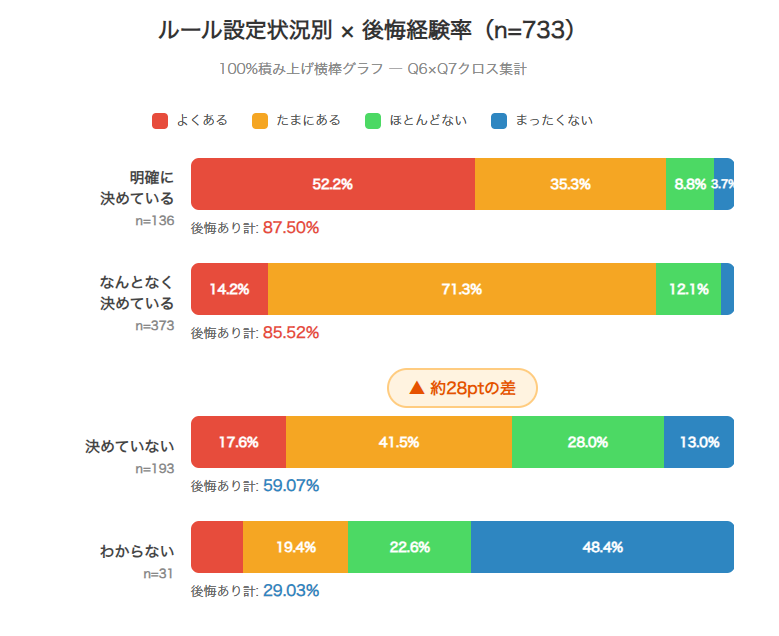
Rule-Setters Report 87.5% Regret—28 Points Higher Than Non-Rule-Setters
Rule Status | n | Often | Sometimes | Rarely | Never | Total With Regret |
|---|---|---|---|---|---|---|
Clearly defined | 136 | 71 (52.21%) | 48 (35.29%) | 12 (8.82%) | 5 (3.68%) | 119 (87.50%) |
Loosely defined | 373 | 53 (14.21%) | 266 (71.31%) | 45 (12.06%) | 9 (2.41%) | 319 (85.52%) |
No rules | 193 | 34 (17.62%) | 80 (41.45%) | 54 (27.98%) | 25 (12.95%) | 114 (59.07%) |
Not sure | 31 | 3 (9.68%) | 6 (19.35%) | 7 (22.58%) | 15 (48.39%) | 9 (29.03%) |
Cross-tabulating regret rates by rule status revealed a paradoxical trend: investors with rules reported higher regret rates than those without.
The "clearly defined" group had a total regret rate of 87.50%, more than 28 points higher than the 59.07% recorded for the "no rules" group.
Particularly notable is the strikingly high proportion of "often" responses within the "clearly defined" group—52.21%, meaning more than half of this group frequently regretted failing to follow their own rules.
It's likely that the clearer a rule is, the more specific the regret it produces—thoughts like "I should have stuck to my rule in that moment" or "I broke my rule and sold too early."
Among the "loosely defined" group, "sometimes" accounted for 71.31%, suggesting that vague rules leave more room to second-guess whether a decision was right.
Having a rule appears to improve the quality of investment decisions while also raising self-scrutiny and sensitivity to regret.
Regret Peaks at 82.6% Among Investors in Their 20s, Declining From Their 50s Onward
Age Group | n | Often | Sometimes | Rarely | Never | Total With Regret |
|---|---|---|---|---|---|---|
20s | 149 | 38 (25.50%) | 85 (57.05%) | 18 (12.08%) | 8 (5.37%) | 123 (82.55%) |
30s | 203 | 43 (21.18%) | 104 (51.23%) | 46 (22.66%) | 10 (4.93%) | 147 (72.41%) |
40s | 186 | 43 (23.12%) | 104 (55.91%) | 21 (11.29%) | 18 (9.68%) | 147 (79.03%) |
50s | 139 | 24 (17.27%) | 76 (54.68%) | 24 (17.27%) | 15 (10.79%) | 100 (71.94%) |
60s | 34 | 4 (11.76%) | 20 (58.82%) | 7 (20.59%) | 3 (8.82%) | 24 (70.59%) |
70s and older | 22 | 9 (40.91%) | 11 (50.00%) | 2 (9.09%) | 0 (0.00%) | 20 (90.91%) |
The age-group breakdown showed that investors in their 20s had the highest regret rate at 82.55%.
The pattern suggests that less experienced investors, who haven't yet established clear criteria for profit-taking, are more prone to thinking "I should have sold then."
Regret rates among investors in their 30s through 60s ranged from roughly 70% to 79%, with a slight downward trend as age increases.
This reflects how accumulated investment experience appears to foster a greater sense of composure and acceptance around profit-taking decisions.
Investors aged 70 and older showed an unusually high rate of 90.91%, though this figure should be interpreted with caution given the small sample size (n=22).
Regret rates exceeded 70% across every age group, underscoring that regret over profit-taking is a near-universal feeling regardless of generation.
Gut Feeling Tops the List at About 25%, Revealing a Split in Profit-Taking Criteria
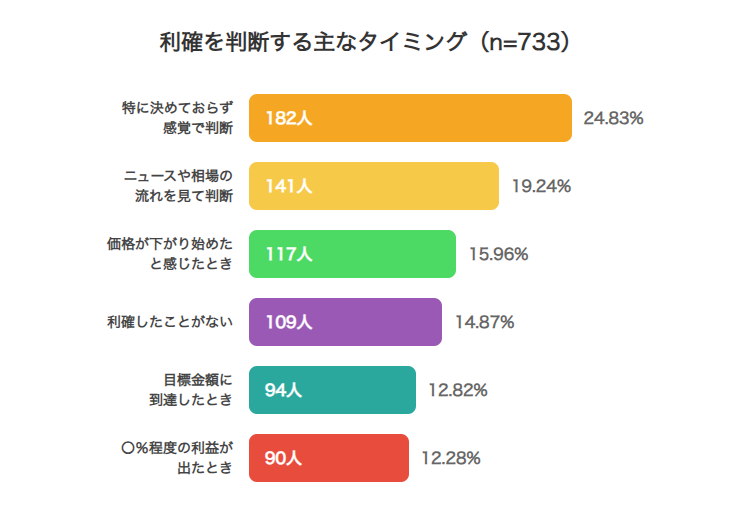
"Going by Feel" Ranks First, With Numerical Criteria at About 25%
Answer | Responses | Share |
|---|---|---|
No specific rule, goes by feel | 182 | 24.83% |
Based on news or market trends | 141 | 19.24% |
When the price starts to drop | 117 | 15.96% |
Never taken profits | 109 | 14.87% |
Reaching a target amount | 94 | 12.82% |
Reaching a target profit percentage | 90 | 12.28% |
The most common answer for when investors decide to take profits was "no specific rule, goes by feel" at 24.83%—meaning roughly one in four investors sell without a clear standard.
"Based on news or market trends" came next at 19.24%, followed by "when the price starts to drop" at 15.96%, with judgment calls based on market sentiment or gut feeling dominating the top responses.
Meanwhile, "reaching a target amount" (12.82%) and "reaching a target profit percentage" (12.28%) together account for roughly 25% of respondents who use numerical criteria to take profits.
Investors appear to be split into two camps: those who rely on gut feeling and those who rely on numbers.
Notably, 14.87% said they had "never taken profits," highlighting a segment of investors who have bought crypto but never once sold.
The results suggest a group of investors sitting on unrealized gains who can't identify the right moment to sell and continue holding instead.
One in Three Investors Without Rules Relies on Gut Feeling
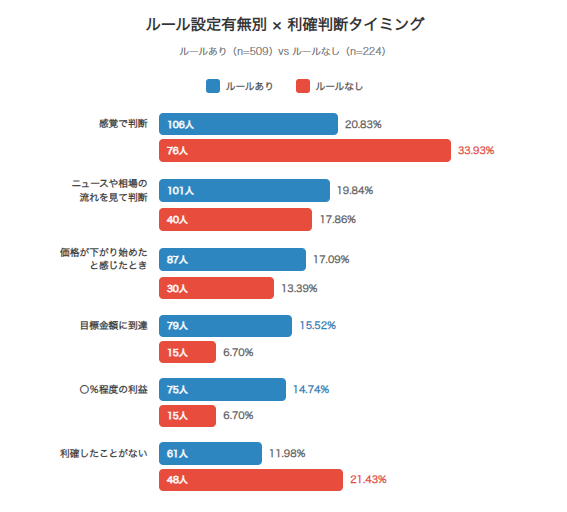
Profit-Taking Trigger | With Rules (n=509) | Without Rules (n=224) |
|---|---|---|
Reaching a target profit percentage | 75 (14.74%) | 15 (6.70%) |
Reaching a target amount | 79 (15.52%) | 15 (6.70%) |
When the price starts to drop | 87 (17.09%) | 30 (13.39%) |
Based on news or market trends | 101 (19.84%) | 40 (17.86%) |
No specific rule, goes by feel | 106 (20.83%) | 76 (33.93%) |
Never taken profits | 61 (11.98%) | 48 (21.43%) |
Comparing profit-taking triggers by rule status reveals a clear structural difference in decision-making criteria.
Among investors without rules, "going by feel" was the most common response at 33.93%—meaning one in three sells with no guiding indicator at all.
Among investors with rules, "reaching a target amount" (15.52%) and "reaching a target profit percentage" (14.74%) were roughly twice as common as among those without rules.
Rule-setters tend to anchor their decisions in quantitative indicators such as price levels or profit margins.
Notably, 21.43% of investors without rules said they had "never taken profits."
Compared with 11.98% among rule-setters, that's a roughly 10-point gap—suggesting that a lack of decision criteria is directly linked to an inability to sell.
The data shows that having numerical criteria influences not just when investors take profits, but whether they can bring themselves to take profits at all.
Short-Term Traders Report the Highest Regret Rate at 84%, With Sharp Contrasts by Investment Style
Short-Term Trading Stands Out at 84%, Long-Term Holding at 74.5%
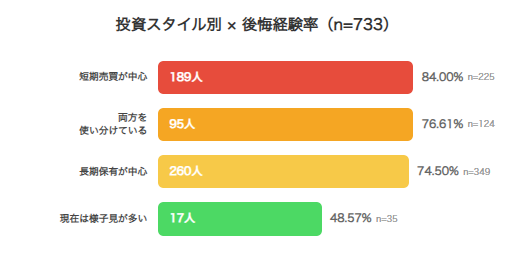
Investment Style | n | Often | Sometimes | Rarely | Never | Total With Regret |
|---|---|---|---|---|---|---|
Mainly short-term trading | 225 | 30 (13.33%) | 159 (70.67%) | 28 (12.44%) | 8 (3.56%) | 189 (84.00%) |
Uses both, depending on the situation | 124 | 28 (22.58%) | 67 (54.03%) | 23 (18.55%) | 6 (4.84%) | 95 (76.61%) |
Mainly long-term holding | 349 | 96 (27.51%) | 164 (47.00%) | 56 (16.05%) | 33 (9.46%) | 260 (74.50%) |
Currently mostly on the sidelines | 35 | 7 (20.00%) | 10 (28.57%) | 11 (31.43%) | 7 (20.00%) | 17 (48.57%) |
Comparing regret rates by investment style, 84.00% of investors focused mainly on short-term trading reported experiencing regret—the highest figure among all styles.
The "sometimes" response was especially prominent at 70.67%, reflecting how frequent trading leads investors to repeatedly second-guess whether their decisions were right.
Investors focused mainly on long-term holding also reported a high regret rate of 74.50%, and notably had the highest share of "often" responses at 27.51% among all styles.
Because long-term holders trade less frequently, each individual decision carries more weight in terms of potential lost profit—likely deepening the intensity of their regret.
Investors "currently mostly on the sidelines" reported the lowest regret rate at 48.57%, the only group to fall below the halfway mark.
While it's natural that limited trading activity leaves less room for regret, the fact that roughly half of this group still reported some regret shouldn't be overlooked.
Rule-Setters Report More Regret Than Non-Rule-Setters Across Every Style
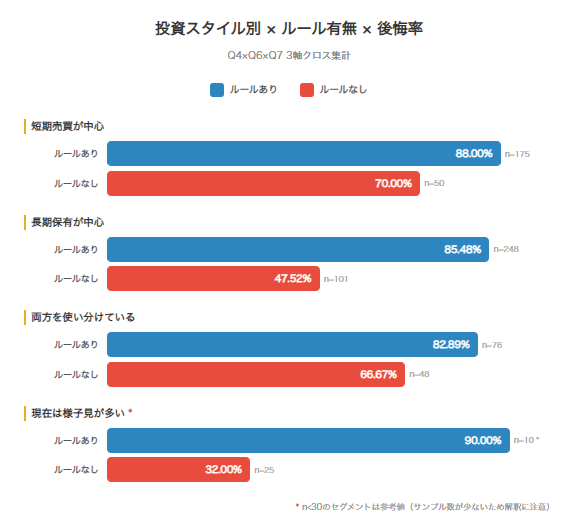
Investment Style | Regret Rate With Rules | With Rules (n) | Regret Rate Without Rules | Without Rules (n) |
|---|---|---|---|---|
Mainly short-term trading | 88.00% | 175 | 70.00% | 50 |
Mainly long-term holding | 85.48% | 248 | 47.52% | 101 |
Uses both, depending on the situation | 82.89% | 76 | 66.67% | 48 |
Currently mostly on the sidelines | 90.00% | 10 | 32.00% | 25 |
Analyzing regret rates along the two axes of investment style and rule status showed that rule-setters reported higher regret rates than non-rule-setters across every single style.
The starkest gap appeared among long-term holders, where regret stood at 85.48% for rule-setters versus 47.52% for non-rule-setters—a difference of roughly 38 points.
Among short-term traders with rules, regret reached 88.00%, illustrating how high-frequency trading combined with the presence of rules accelerates the occurrence of regret.
Even among non-rule-setters, short-term traders showed a high regret rate of 70.00%, reaffirming that frequent-trading styles go hand in hand with regret.
The 90.00% figure for rule-setters "currently on the sidelines" stands out, but should be treated as a reference point only given the small sample size (n=10).
The consistently high regret rate among rule-setters, regardless of investment style, suggests that having rules may cultivate a stronger habit of reflecting on one's own decisions—and, as a result, a greater awareness of regret.
Summary
Investors with "clearly defined" profit-taking rules reported a regret rate of 87.50%, about 28 points higher than the 59.07% reported by those with "no rules."
Rather than "increasing" regret, having rules appears to reflect a stronger habit of reflecting on one's own decisions. The fact that 21.43% of non-rule-setters said they had "never taken profits" also suggests that a lack of criteria contributes to an inability to sell.
What matters more than whether regret occurs is having a system that turns that regret into better future decisions—something directly tied to improving investment outcomes.
Survey Overview
Survey date: February 24, 2026
Survey method: Internet survey
Survey subjects: Men and women residing in Japan (people currently investing in crypto assets, or with past investment experience)
Valid responses: 733
Conducted by: Clabo Inc.
Survey Questions
- Have you ever invested in crypto assets (also known as virtual currencies)?
- Which best describes your current investment style?
- When do you typically decide to take profits (sell)?
- Do you set profit-taking rules in advance?
- Have you ever regretted an actual profit-taking decision?
This article is for informational purposes only and does not constitute financial or investment advice. Please consult a qualified professional before making investment decisions.


