


Phishing scams and fake websites targeting holders of crypto assets — also known as virtual currencies — are posing an increasingly serious threat.
In a survey Clabo conducted, about 68% of respondents with crypto experience said they had encountered a scam email or fake website. The encounter rate among people in their 30s reached as high as 80%, showing that the more actively someone trades, the more likely they are to face sophisticated, targeted attacks.
This survey looks in detail at how holders spot scams and avoid falling into danger. More than half of respondents said they watch for unnatural Japanese phrasing, but the survey also reveals a growing concern: as AI technology improves, visual and linguistic cues are becoming harder to rely on.
Sophisticated Phishing Threats Targeting Crypto Users
Two in Three Holders Have Encountered Phishing
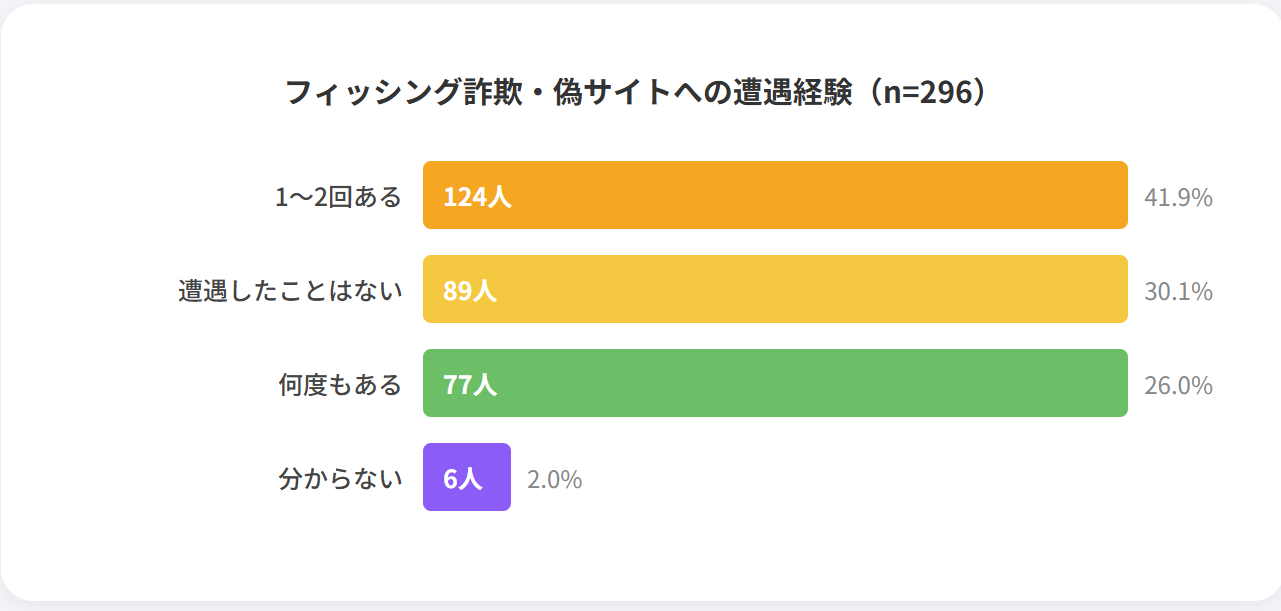
Response | Responses | Share |
|---|---|---|
1–2 times | 124 | 41.89% |
Never encountered | 89 | 30.07% |
Multiple times | 77 | 26.01% |
Not sure | 6 | 2.03% |
About 68% of crypto asset users have encountered phishing scams or fake websites. The share reporting they had been targeted "multiple times" exceeded 26%, highlighting how routine these attacks have become. With two out of every three holders targeted, the data show that this risk is extremely close to home for anyone in the space.
Lures delivered through social media and email blend seamlessly into everyday information gathering. Maintaining constant awareness that "I could be a target too" has become an essential mindset for anyone managing crypto assets today. The first step in protecting your holdings is recognizing that these attacks are not exceptional events but an everyday occurrence.
Even respondents who report no encounters cannot rule out the possibility that they simply failed to notice an attempt. In a world that calls for decentralized self-custody, users need the discipline to treat outside contact with constant suspicion. This gap in awareness may well become the dividing line for who suffers losses in the future.
Active Investors Are Targeted More Often
Age Group | Multiple times | 1–2 times | Never encountered | Not sure |
|---|---|---|---|---|
20s | 22.22% | 40.74% | 37.04% | 0.00% |
30s | 36.47% | 43.53% | 18.82% | 1.18% |
40s | 20.24% | 42.86% | 33.33% | 3.57% |
50s | 25.00% | 40.00% | 31.67% | 3.33% |
60s | 23.08% | 46.15% | 30.77% | 0.00% |
Combined encounter rates for people in their 30s reached roughly 80%, standing out well above every other age group. This cohort tends to invest actively and juggle a wide range of services, and that high level of online activity is likely one reason they end up on attackers' target lists more often.
By comparison, encounter rates for people in their 20s and 40s hover around 63%, showing a clear gap in exposure between generations. The reason people in their 30s are targeted so heavily may be their sensitivity to the latest campaign news and promotions. It is likely that targeted attacks are exploiting the convenience-first habits of this generation.
Even among people in their 60s, about 69% report having encountered an attempt, showing that these threats reach every age group. As long as trading takes place online, no generation can consider itself safe. This data reaffirms the importance of promoting layered, defense-in-depth security practices for every investor.
Households Earning ¥10 Million+ Report the Most Repeat Attacks
Household Income | Multiple times | 1–2 times | Never encountered | Not sure |
|---|---|---|---|---|
Under ¥4 million | 18.99% | 41.77% | 36.71% | 2.53% |
¥4–8 million | 27.68% | 41.07% | 29.46% | 1.79% |
¥8–10 million | 24.14% | 51.72% | 24.14% | 0.00% |
¥10 million or more | 39.02% | 41.46% | 17.07% | 2.44% |
The higher a respondent's income, the more likely they are to report being subjected to repeated, persistent attacks. Among households earning ¥10 million (roughly US $65,000) or more annually, 39.02% reported frequent fraudulent contact — nearly double the rate seen among lower-income respondents. This suggests attackers may be deliberately screening for higher-value targets.
High earners tend to invest larger amounts, so a single successful attack can yield a bigger payoff, which draws concentrated attacker attention. The data hint at the shadow of "whale phishing" — attacks specifically aimed at wealthy targets. As portfolio size grows, generic precautions are no longer sufficient, and more advanced defensive measures become essential.
For households earning ¥8 million or more, the encounter rate tops 70%, meaning this group lives with constant risk. For the market to develop in a healthy way, it is essential to prevent this segment from losing assets and exiting the market altogether. Keeping security literacy updated in line with one's income level will be the deciding factor in sustaining long-term asset growth.
About 70% of Respondents Successfully Avoided the Scam
Holders Show Strong Self-Protective Awareness
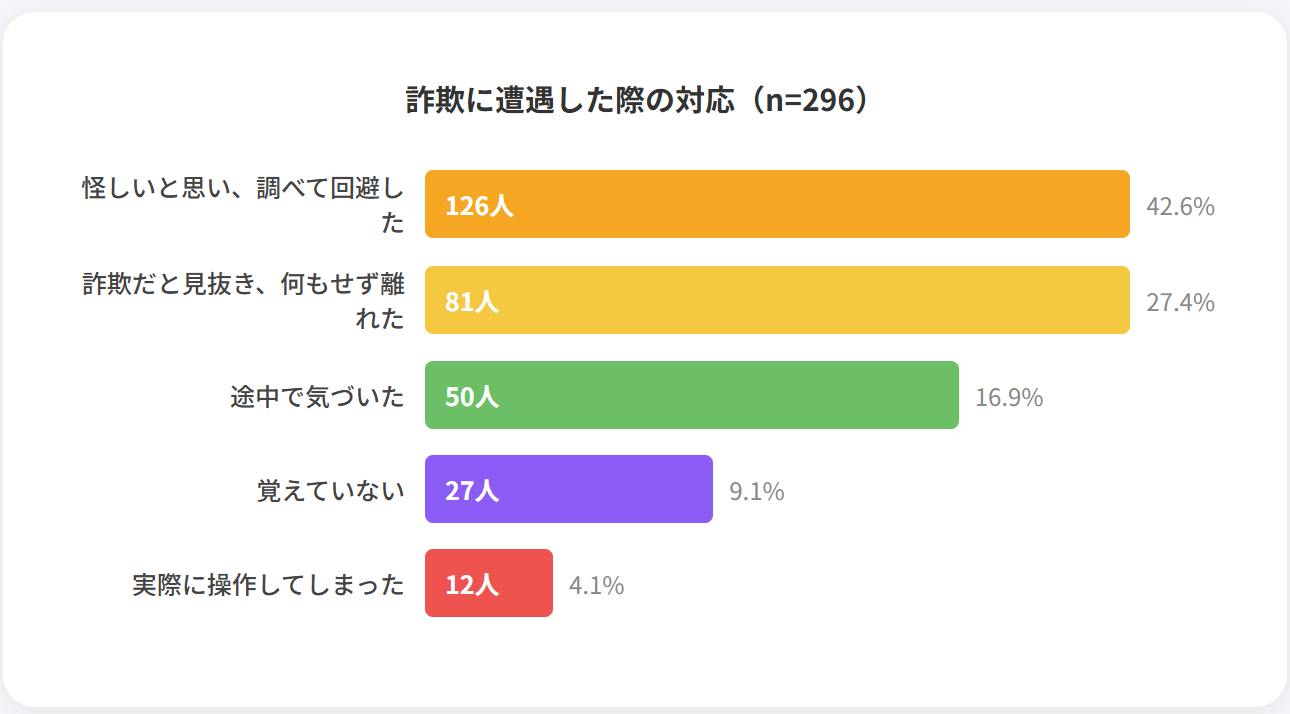
Response | Responses | Share |
|---|---|---|
Grew suspicious, checked, and avoided it | 126 | 42.57% |
Recognized it as a scam and walked away without acting | 81 | 27.36% |
Nearly fell for it but caught on partway through | 50 | 16.89% |
Don't remember | 27 | 9.12% |
Actually went through with the action | 12 | 4.05% |
When it comes to how respondents responded to a scam attempt, the largest group (42.57%) said they grew suspicious, checked, and avoided it. Combined with those who recognized the scam outright and walked away, about 70% of holders fended off the risk on their own. This shows that many users actively verify suspicious contact rather than taking it at face value.
At the same time, 4.05% of respondents said they actually went through with the harmful action, underscoring that real losses remain a genuine possibility. Another 16.89% said they nearly fell for it before catching on partway through, showing how narrow the margin for avoidance can be. Because a single misstep can lead directly to lost assets, users should not grow complacent about this overall avoidance rate and must keep their guard up.
While self-reliance is the dominant pattern, the accuracy of the information one gathers ultimately determines whether an attempt is successfully avoided. In the crypto asset market, the principle that the consequences of self-judgment fall squarely on one's own holdings applies with particular force. Holders need to maintain this high level of self-protective awareness while continually updating themselves on the latest scam patterns.
Experienced Investors Are More Sensitive to Red Flags
Investing Experience | Recognized it and walked away | Grew suspicious and checked before avoiding |
|---|---|---|
Less than 6 months | 20.00% | 40.00% |
6 months to under 1 year | 22.89% | 40.96% |
1 to under 3 years | 28.92% | 42.17% |
3 years or more | 31.94% | 47.22% |
Analyzing the relationship between investing experience and response, the longer someone has been investing, the more likely they are to "spot it immediately." Among respondents with three or more years of experience, 31.94% said they simply walked away without acting, demonstrating strong initial judgment. Spending an extended period in the market appears to build an intuitive sensitivity to suspicious wording and links.
By contrast, among beginners with less than six months of experience, only 20.00% said they spot scams immediately — a clear gap compared with veterans. 40.00% of these beginners said they "checked and then avoided it," showing that reaching a decision takes them meaningfully longer. It's worth noting that the time spent hesitating is itself a risk, since it can give scammers an opening to exploit.
The share who "checked and then avoided it" is also highest among the 3-plus-year group, at 47.22%. Experienced investors have a clear sense of exactly what to verify, allowing them to eliminate risk more reliably. Accumulated literacy may well be the single strongest defense against increasingly sophisticated phishing scams.
Investors Holding ¥500,000+ Report the Highest Rate of Near-Misses
Investment Amount | Nearly fell for it but caught on | Actually went through with it |
|---|---|---|
Under ¥10,000 | 10.99% | 2.20% |
¥10,000 to under ¥100,000 | 22.12% | 5.77% |
¥100,000 to under ¥500,000 | 14.04% | 3.51% |
¥500,000 or more | 24.24% | 6.06% |
Cross-tabulating by investment amount reveals that holders investing ¥500,000 (roughly US $3,300) or more are more likely to end up in a near-miss situation. Within this group, 24.24% said they caught on only partway through — the highest figure across all brackets. This shows that phishing attacks aimed at higher-value holders are built with exceptional sophistication, putting even experienced investors at risk of being fooled.
The share who actually followed through on the harmful action is also elevated in this bracket, at 6.06%, compared with just 2.20% among those investing under ¥10,000 — nearly a threefold difference. Attack success rates appear to rise in proportion to portfolio size, likely reflecting the effectiveness of "custom-tailored" scams aimed specifically at high-income, high-balance investors.
As portfolio size grows, investors often adopt more convenience-focused services, and that convenience frequently becomes a blind spot. Overconfidence — the belief that "I'll be fine" — can be exactly what leads to the most severe losses. The larger the sum being managed, the more important it is to re-recognize the weight of every single action and maintain the humility to carry out basic checks without exception.
Warning Signs — and Growing Concern Over More Sophisticated Scams
Over Half Watch for Unnatural Japanese Phrasing
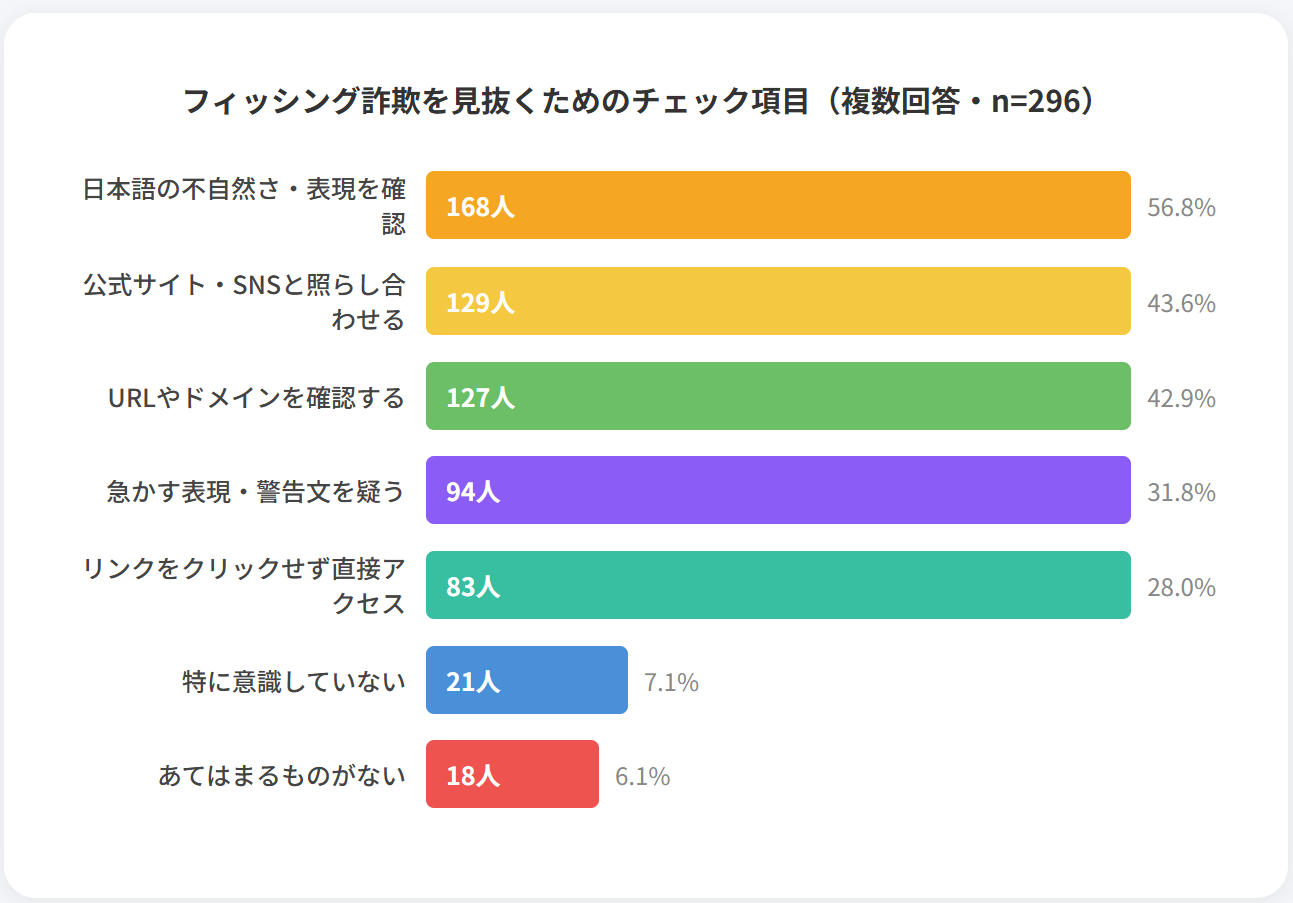
Response | Responses | Share |
|---|---|---|
Check for unnatural Japanese wording or phrasing | 168 | 56.76% |
Cross-check against official websites or social media | 129 | 43.58% |
Check the URL or domain | 127 | 42.91% |
Be suspicious of urgent language or warning messages | 94 | 31.76% |
Avoid clicking links and access sites directly instead | 83 | 28.04% |
Don't pay particular attention to this | 21 | 7.09% |
None of the above apply | 18 | 6.08% |
Asked what they watch for to spot phishing scams, 56.76% cited "unnatural Japanese" as their top signal. "Cross-checking against official information" and "checking the URL" both exceeded 40%, suggesting that respondents weigh multiple angles when judging authenticity. The data show that the telltale awkwardness of machine-translated text and garbled fonts remain a leading indicator that users rely on.
On the other hand, only 28.04% consistently avoid clicking links and navigate to sites directly instead, leaving many still exposed to the risk of prioritizing convenience over caution. Because attackers often copy official site text verbatim, relying on visual comparison alone has real limits. "The Japanese sounds off, so it must be a scam" is a useful signal, but building a defense strategy that depends on it alone is extremely risky.
With recent advances in AI technology in particular, fixing unnatural Japanese phrasing has become increasingly easy for scammers. This intuitive defense — noticing something feels "off" — is likely to stop working before long as attacker technology improves. Beyond visual checks, it is now urgent for users to build concrete defensive habits, such as accessing sites only through saved bookmarks and enforcing two-factor authentication.
40% of Investors in Their 30s Scrutinize Domains
Age Group | Checks the URL or domain | Cross-checks against official site or social media |
|---|---|---|
20s | 37.04% | 31.48% |
30s | 43.53% | 48.24% |
40s | 42.86% | 45.24% |
50s | 45.00% | 43.33% |
60s | 53.85% | 38.46% |
By age group, 43.53% of respondents in their 30s said they check domains, and 48.24% said they cross-check against official information. This is the same generation with the highest encounter rate, and it also shows a high level of literacy in combining multiple defensive methods. It may well be that this group's frequent firsthand brushes with these threats are precisely what sharpens their defensive skills.
By contrast, among respondents in their 20s, only 37.04% check URLs and 31.48% cross-check against official information — both lower than older generations. Because this mobile-first age group has less of a habit of scrutinizing URLs, there is a concern that their judgment skews toward gut instinct. Smartphone browsers also frequently truncate the displayed domain, creating a blind spot that makes visual checks easy to neglect.
Among people 60 and older, 53.85% check URLs — a very high figure that stands out for its caution. Regardless of age, the key to protecting one's assets is layering multiple checks rather than relying on any single method. Because sophisticated impersonation attacks can differ from the real domain by just a single character, it's important to approach every piece of information with an ongoing sense of skepticism.
Nearly 60% of Public-Sector Workers Rigorously Verify Official Sources
Occupation | Cross-checks against official site or social media | Checks for unnatural Japanese wording |
|---|---|---|
Public servants / organization staff | 59.26% | 51.85% |
Company employees | 41.56% | 59.74% |
Freelancers / sole proprietors | 44.12% | 52.94% |
Part-time / temp workers | 36.36% | 54.55% |
Analysis by occupation found that 59.26% of public servants and organization staff never skip cross-checking against official information. This likely reflects how the security training and emphasis on accuracy built into their workplace culture carries over into their investment decisions. Groups who have made a habit of going back to primary sources show notably stronger resistance to phishing scams.
Among company employees, however, 59.74% prioritize spotting "unnatural Japanese," outpacing the 41.56% who cross-check official sources. This suggests that, squeezing information-gathering into busy work schedules, they lean on quick, intuitive judgments. It's worth remembering, though, that "Japanese phrasing" is precisely the element attackers can fake most easily.
Among part-time and temp workers, the rate of cross-checking official sources is also low, at 36.36%, pointing to a gap in security literacy across employment types. Regardless of social or employment status, anyone handling crypto assets should be held to the same baseline level of security. Skipping a check of official sources to save a bit of effort should be recognized for what it is: exposing one's own assets to unnecessary risk.
Over 40% Are Concerned Scams No Longer Feel Suspicious
Fake Sites Now Rival the Real Thing
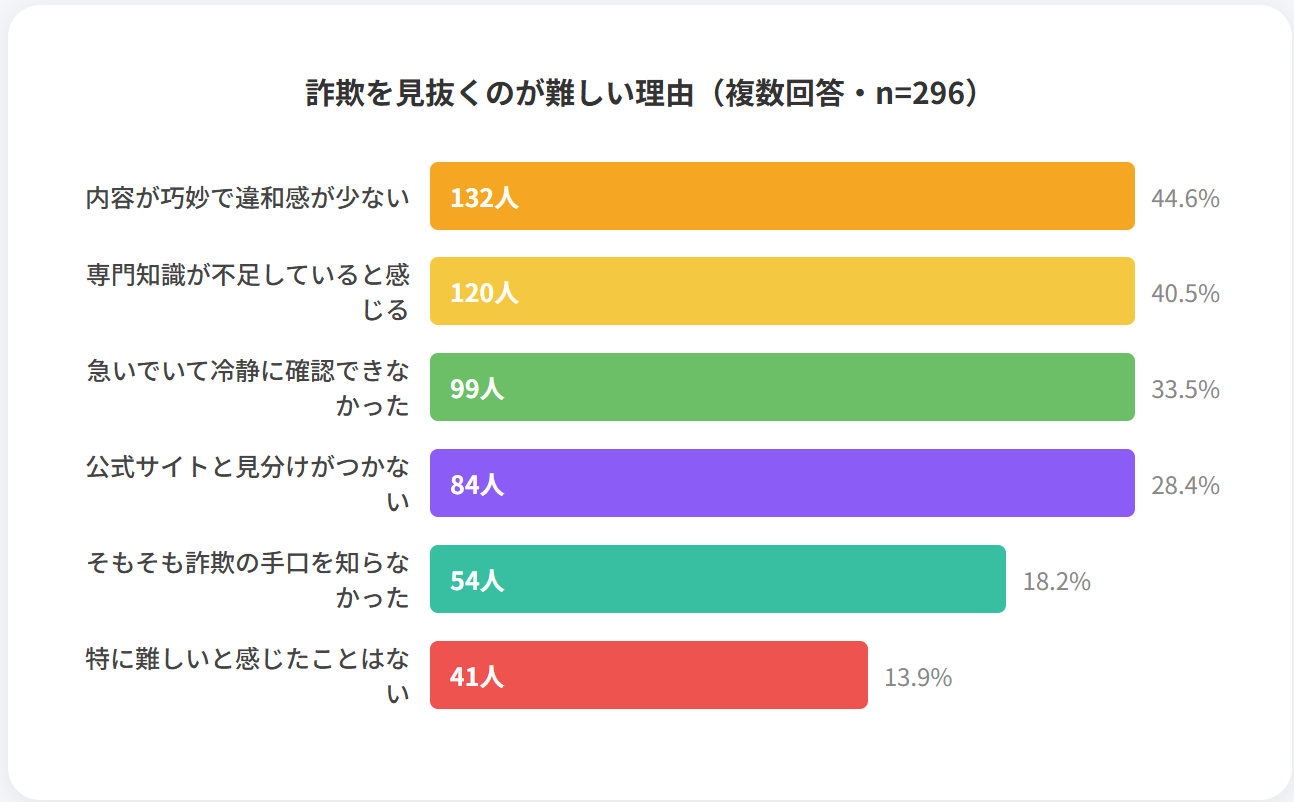
Response | Responses | Share |
|---|---|---|
The content is sophisticated, with little that feels off | 132 | 44.59% |
Feel they lack the specialized knowledge to tell | 120 | 40.54% |
Were rushed and couldn't check calmly | 99 | 33.45% |
Can't tell it apart from the official site | 84 | 28.38% |
Simply didn't know the scam tactics existed | 54 | 18.24% |
Have never found it particularly difficult | 41 | 13.85% |
Asked why phishing scams are hard to spot, 44.59% cited how sophisticated the content is, with little that feels off. "Lack of specialized knowledge" and "couldn't check calmly" also ranked high, showing that individual vigilance is struggling to keep pace with attacker sophistication. About 28% said they simply can't tell a fake apart from the official site, underscoring the limits of visual judgment.
Older phishing attempts could be spotted by an off-looking logo or font, but today's fakes are typically exact design copies. Fraudulent sites that mirror the latest UI achieve a level of polish that can convince a first-time visitor they're on the legitimate service. Regardless of how much a user knows, spotting these on first glance is difficult even for seasoned investors.
In addition, 33.45% cited "being rushed and unable to stay calm" as a reason, confirming just how effective attacks exploiting psychological pressure can be. Tactics that provoke panic with warnings such as "your assets have been frozen" — designed to shut down calm judgment — remain a potent threat. It is this combination of technical sophistication and psychological pressure that makes today's phishing scams so difficult to avoid.
Even Among ¥10 Million+ Earners, Nearly 30% Can't Tell Fakes Apart
Household Income | Can't tell it apart from the official site | Was rushed and couldn't check calmly |
|---|---|---|
Under ¥4 million | 26.58% | 27.85% |
¥4–8 million | 28.57% | 36.61% |
¥8–10 million | 31.03% | 27.59% |
¥10 million or more | 31.71% | 39.02% |
Cross-tabulating by income, 31.71% of respondents earning ¥10 million or more said they "can't tell it apart from the official site" — the highest figure of any income bracket. This confirms just how precisely attacks targeting high-income earners are engineered. Investors with substantial funds are more likely to be facing customized "spear phishing" rather than generic scams.
It is also worth noting that 39.02% of this same group said they couldn't check calmly. Busy high-income professionals often trade during brief windows of downtime, such as while commuting, which creates a blind spot where verification gets skipped. Attackers appear to factor targets' daily routines into their timing, striking at moments most likely to trigger a reflexive, unconsidered action.
Even among households earning under ¥4 million, 26.58% said they can't tell fakes apart, showing that this crisis affects investors regardless of income. The larger a portfolio grows, the more a single misjudgment can lead to losses in the millions or tens of millions of yen, with an immeasurable psychological toll. Whatever the size of one's holdings, it is worth strictly re-examining the risk hidden inside every convenience-driven, quick action.
Cross-Checking Official Information Is the Key to Catching Scams
Over 30% Notice a Discrepancy From Official Information
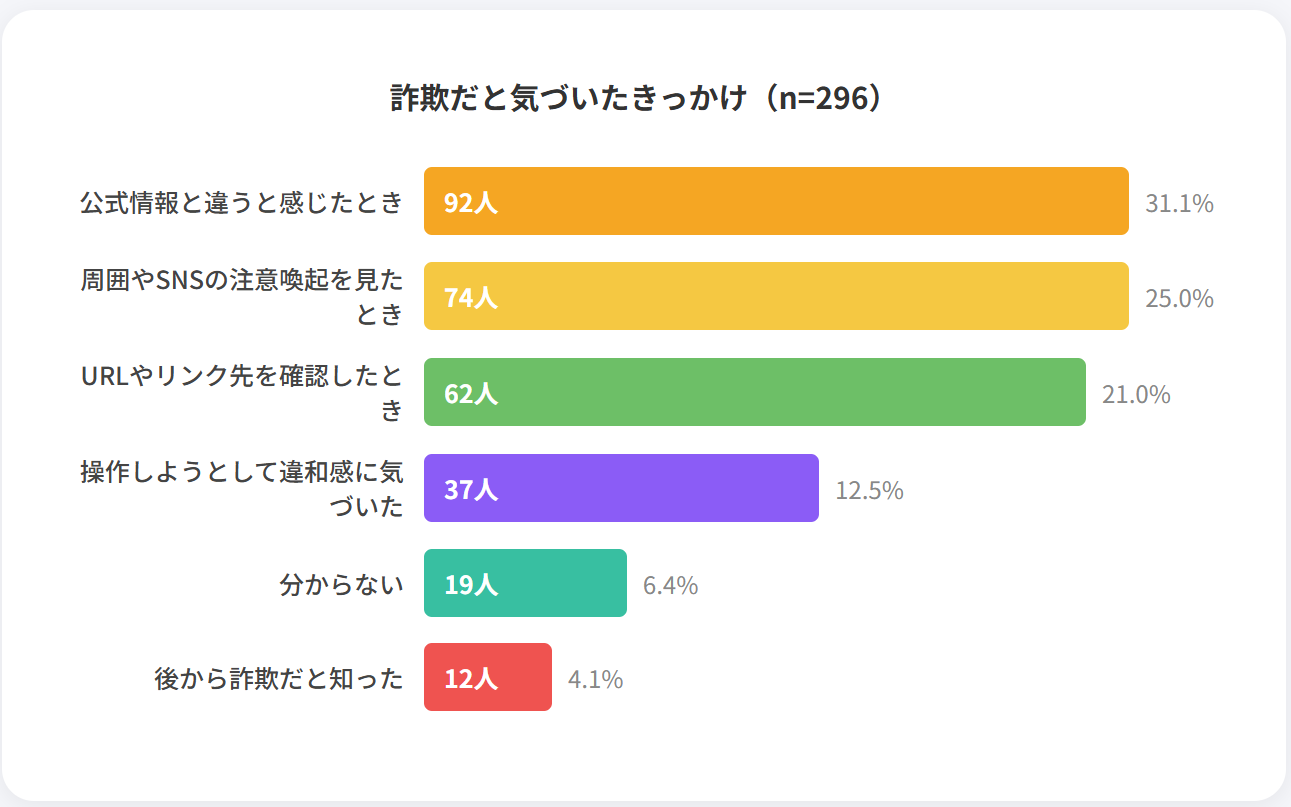
Response | Responses | Share |
|---|---|---|
Noticed it differed from official information | 92 | 31.08% |
Saw a warning from people around them or on social media | 74 | 25.00% |
Checked the URL or link destination | 62 | 20.95% |
Noticed something felt off while about to take action | 37 | 12.50% |
Not sure | 19 | 6.42% |
Only found out it was a scam afterward | 12 | 4.05% |
Asked what tipped them off to a scam, 31.08% cited "noticing a difference from official information" — the top answer. This outpaced checking the URL (20.95%), suggesting a growing emphasis on verifying site design and content consistency. It shows that a defense based on scrutinizing the actual content, rather than mechanically checking the address alone, is proving effective.
At the same time, 25.00% said they caught on thanks to warnings shared by others on social media, showing that community self-policing plays a major role. Because individual judgment has its limits, real-time sharing of incident reports appears to function as a powerful safety net. Social media, where information about suspicious campaigns gets pooled from many angles, has become an indispensable tool for protecting assets today.
Another 12.50% said they held back at the very last moment because something felt off. Practical, in-the-moment intuition — noticing, for example, that a signature request came at an odd time — appears to serve as a final line of defense. Still, about 4% said they only learned it was a scam after the fact, a reminder that the risk of unnoticed real-world losses remains far from negligible.
The Less Experience an Investor Has, the More Value External Information Provides
Investing Experience | Noticed a difference from official information | Saw a warning from others or on social media |
|---|---|---|
Less than 6 months | 22.50% | 35.00% |
6 months to under 1 year | 27.71% | 25.30% |
1 to under 3 years | 34.94% | 22.89% |
3 years or more | 36.11% | 22.22% |
Among beginners with less than six months of experience, 35.00% said a warning from people around them or on social media is what tipped them off. That's more than 10 points higher than the 22.22% among those with three-plus years of experience, showing that beginners lean on others' information more than their own knowledge. At a stage when judging authenticity independently is difficult, alerts from trustworthy sources can be the decisive factor in preventing a loss.
By contrast, 36.11% of respondents with three or more years of experience say they noticed a difference from official information on their own. Years of using legitimate services have made them intimately familiar with normal behavior, giving them the ability to detect even small anomalies. The data show that, as investors gain experience, their defenses evolve toward a more autonomous, self-directed style that identifies risk without waiting for outside warnings.
Even among the mid-experience group with six months to a year of investing, reliance on official information gradually rises, revealing how defensive patterns shift with proficiency. This points to a staged path of literacy building: beginners should first strengthen their ability to gather information on social media, while more experienced investors should keep sharpening their own powers of observation. At every stage, letting go of complacency and continuing to question the source of information is what sustains long-term, successful investing.
Professional Caution Translates Directly Into Risk Avoidance
Occupation | Noticed a difference from official information | Checked the URL or link destination |
|---|---|---|
Public servants / organization staff | 51.85% | 18.52% |
Company employees | 29.87% | 21.43% |
Self-employed / freelance professionals | 23.08% | 23.08% |
Stay-at-home spouses | 33.33% | 18.75% |
By occupation, 51.85% of public servants and organization staff say a difference from official information tipped them off to a scam — vastly outpacing the 18.52% who cited checking the URL. This makes clear their strict, verification-first attitude toward posted content. The workplace habit of prioritizing accurate procedures and information consistency becomes a powerful weapon for managing crypto asset risk as well.
Among company employees, only 29.87% cited catching a difference from official information — a large gap compared with public servants. Making investment decisions amid a busy workload tends to push people toward simpler methods, such as visually checking the URL (21.43%), rather than detailed information cross-checks. Still, skipping careful scrutiny leaves one vulnerable to attacks that skillfully spoof a URL, and this is a risk employees should recognize.
Among self-employed and freelance professionals, checking URLs and cross-checking official information were tied at 23.08% each, indicating that their judgment criteria are spread across methods. This suggests a distinctive caution: not relying too heavily on any single information source and instead assessing risk from multiple angles. Whatever one's occupation, making it a habit to compare against the "ground truth" of official information is the surest route to reliably filtering out fake content.
Conclusion
This survey makes clear that for anyone handling crypto assets, phishing scams are an extremely everyday threat. About 68% of respondents overall have experienced some form of fraudulent contact, and the fact that active investors in their 30s and high-income holders with substantial funds are being persistently targeted cannot be ignored. Attack tactics have grown sophisticated enough to be indistinguishable from official sites, with a clear intent to neutralize users' visual judgment through copied design and text.
At the same time, it is encouraging that many holders take self-protective measures — noticing unnatural Japanese, cross-checking official information — and about 70% successfully prevent harm before it happens. However, as AI technology continues to advance, the "unnatural Japanese" heuristic is likely to eventually stop working, making more concrete, systematic defenses essential going forward. Given that less experienced investors tend to lean on external sources such as social media, it is now urgent to both raise community-wide awareness and level up literacy around verifying primary sources across the board.
Ultimately, the only way to protect one's assets from increasingly sophisticated scams comes down to abandoning overconfidence in convenience and maintaining a constant habit of questioning the source of information. Just as high-balance investors are especially eager to learn the latest tactics, it is essential to treat security knowledge as something to keep updating continuously, rather than a lesson learned once and set aside.
This article is for informational purposes only and does not constitute financial or investment advice. Please consult a qualified professional before making investment decisions.
Survey Overview
Survey date: February 24, 2026
Method: Internet survey
Respondents: Men and women residing in Japan who currently invest, or have previously invested, in crypto assets
Valid responses: 296
Conducted by: Clabo Inc.
Survey Questions
- Have you ever used cryptocurrency (crypto assets)?
- Have you ever encountered a phishing email or fake website related to cryptocurrency?
- When you encountered a phishing scam or fake website, what was the eventual outcome?
- What do you normally keep in mind to spot phishing scams or fake websites? (Select all that apply)
- Even so, what makes it difficult to spot these scams? (Select all that apply)
- What tipped you off that it was a phishing scam?
- Which best describes your experience investing in cryptocurrency?
- Which best describes your current investment amount range in cryptocurrency?
- Where do you primarily get information about cryptocurrency and security?
- Going forward, what information about phishing scams and fake websites would you most like to know more about?


