


When you get a new smartphone, is your crypto assets (also known as virtual currencies) wallet on your backup checklist?
An ordinary phone upgrade can turn into the trigger that costs you your assets for good.
In this survey, we dug into what actually happens to crypto asset investors when they switch phones.
The results show that more than half of investors experienced some kind of trouble during the transfer process.
Trouble rates were especially high among people in their 20s and those 70 and older, and among investors whose experience has reached the three-to-five-year mark, the risk that comes from simple "familiarity" stood out clearly.
In some cases, investors forgot their wallet even existed during the phone-switching process, reset the device, and lost access to their assets entirely.
This article breaks down the risk patterns the data reveals by age group, along with the management practices that help you avoid the same mistakes.
54.1% of Respondents Had Trouble When Switching Phones
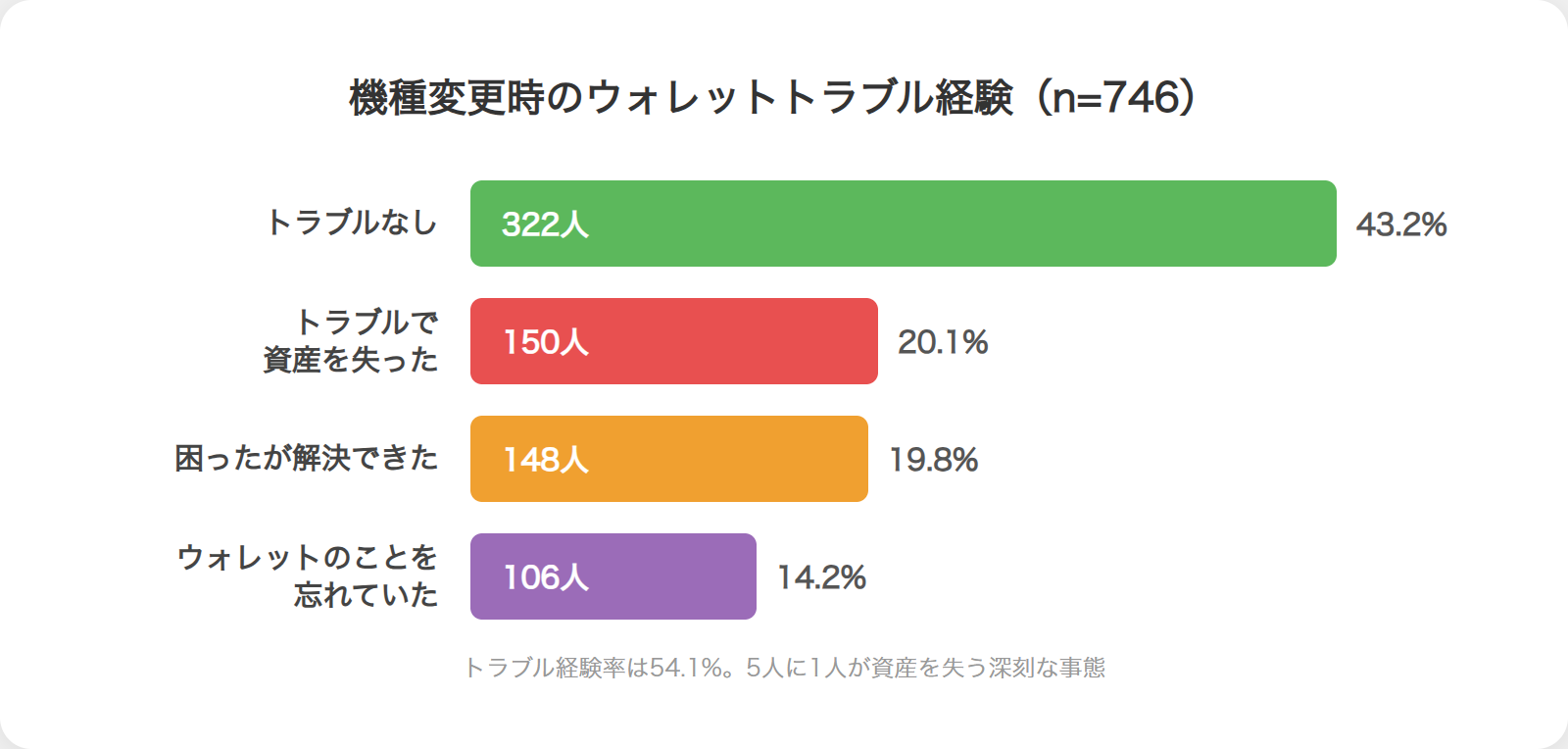
Response | Count | Share |
|---|---|---|
No trouble | 322 | 43.2% |
Lost assets due to trouble | 150 | 20.1% |
Ran into trouble but resolved it | 148 | 19.8% |
Forgot about the wallet | 106 | 14.2% |
Total trouble rate | 404 | 54.1% |
Over Half Struggled With the Transfer
For crypto asset investors, switching to a new smartphone is a moment that calls for real caution.
Unlike the apps and settings you use every day, moving a wallet requires complex steps and a certain level of security knowledge.
When we calculated the share of respondents who experienced wallet-related trouble while switching phones, the figure came in at 54.1%, well over half.
That number makes it plain that a majority of users feel some kind of friction when moving the wallet that sits at the core of their asset management.
What's happening here goes beyond simple "operational difficulty" — it's a real hazard that a large share of investors are running into.
The Severity of Losing Assets Outright
Breaking the trouble down further makes the severity even clearer.
Strikingly, 20.1% of investors said trouble during the transfer actually caused them to lose assets.
The fact that one in five people suffered this kind of critical blow underscores just how much personal responsibility — and risk — comes with managing crypto assets.
Meanwhile, 19.8% of respondents said they ran into trouble but managed to resolve it successfully.
Many of those cases were likely avoidable with the right information and a proper backup in place.
Whether you end up losing assets or avoiding trouble altogether seems to come down to how well you prepared beforehand.
The Unexpected Risk of Simply Forgetting
There's another risk to watch for beyond operational mistakes and setup errors.
In 14.2% of cases, respondents forgot their wallet existed at all during the phone-switching process and ended up resetting the device.
This kind of "memory lapse" means that no matter how strong a wallet's security is, it's worthless if the user themselves doesn't stay aware of it.
Managing crypto asset investments isn't just a technical matter — it also comes down to this kind of "physical awareness" of what you own.
Whether you can immediately think to back up your wallet the moment you get a new device is the first step toward protecting your assets.
Trouble Risk Varies by Age — The Gap Between Younger and Mid-Career Investors
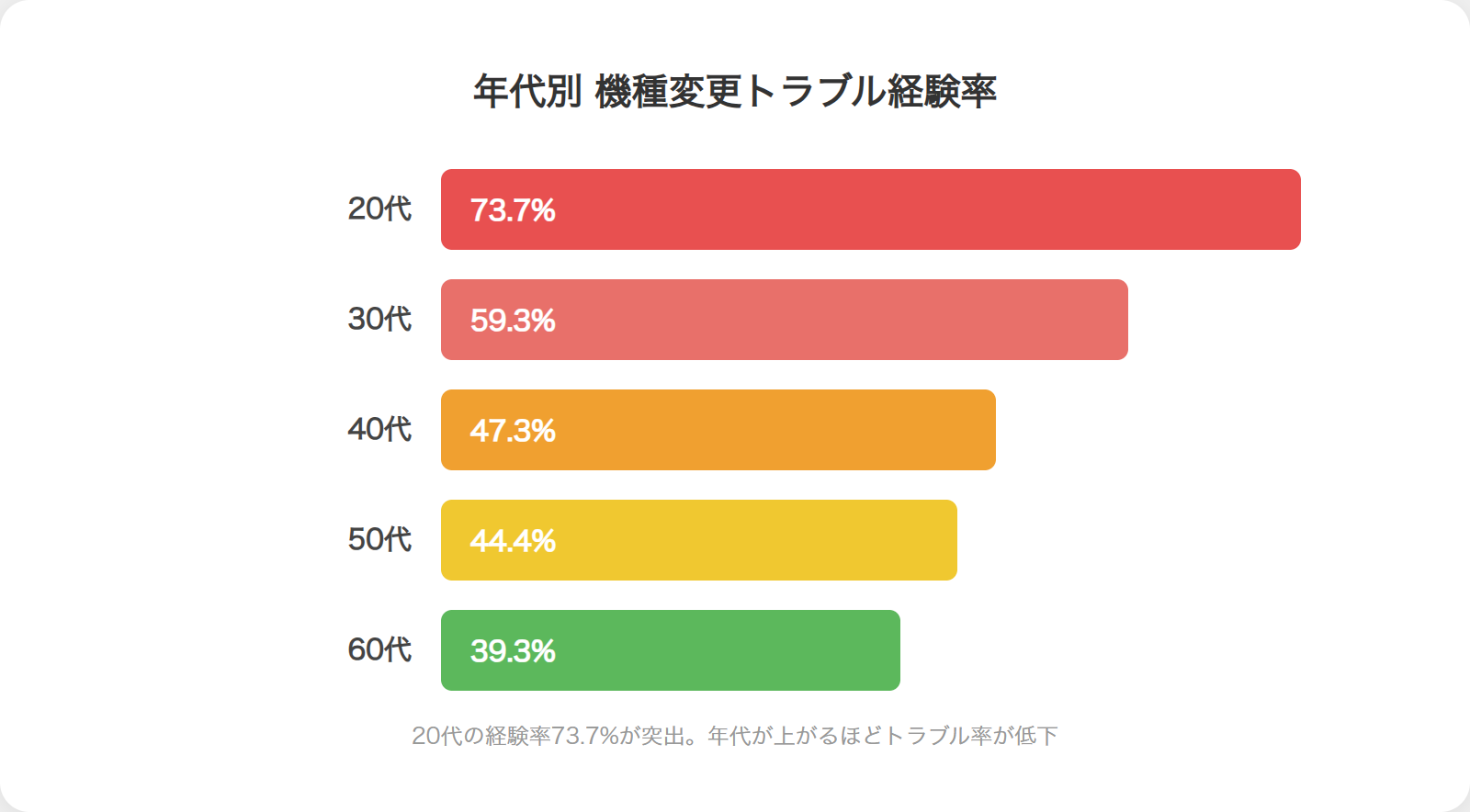
Age group | Count | Trouble rate |
|---|---|---|
20s | 209 | 73.7% |
30s | 322 | 59.3% |
40s | 315 | 47.3% |
50s | 270 | 44.4% |
60s | 122 | 39.3% |
The Transfer Barrier Is Highest Among Younger Investors
Breaking the trouble rate down by age group reveals a particularly striking pattern among younger investors.
Among people in their 20s, 73.7% ran into some kind of trouble, showing that even a digitally native generation doesn't find wallet migration easy.
This high figure suggests there's a real gap between being skilled at using a smartphone and having the more advanced management skills that crypto assets demand.
It's also possible that younger investors, who tend to prioritize convenience and juggle multiple apps, end up managing more wallets — which in turn makes the transfer process more complicated.
Nearly 60% of Investors in Their 30s Also Affected — Mid-Career Rates Stay High
Investors in their 30s and 40s — prime working-age groups — recorded rates of 59.3% and 47.3% respectively, showing that mid-career investors are far from immune either.
For this generation, often stretched thin between work and family, moving a wallet during a phone upgrade can be a real drain on time and mental energy.
The desire to finish the job quickly and reliably may lead to skipped checks and shortcuts in the process, which in turn could be driving up the trouble rate.
Rates Stabilize From the 40s Through 60s
Looking at the middle-aged and older groups — from the 40s through the 60s — the trouble rate drops to around the 40% mark.
It falls steadily as age rises: 47.3% for the 40s, 44.4% for the 50s, and 39.3% for the 60s.
This group may take a more cautious, conservative approach to managing their holdings.
It's also possible that practical habits — switching phones less often, or limiting themselves to a smaller number of wallets — are helping them avoid trouble.
Avoiding unnecessary risk and handling each step carefully appears to be the key to reducing trouble during a transfer.
Investors With 3 to 5 Years of Experience Face the Most Trouble
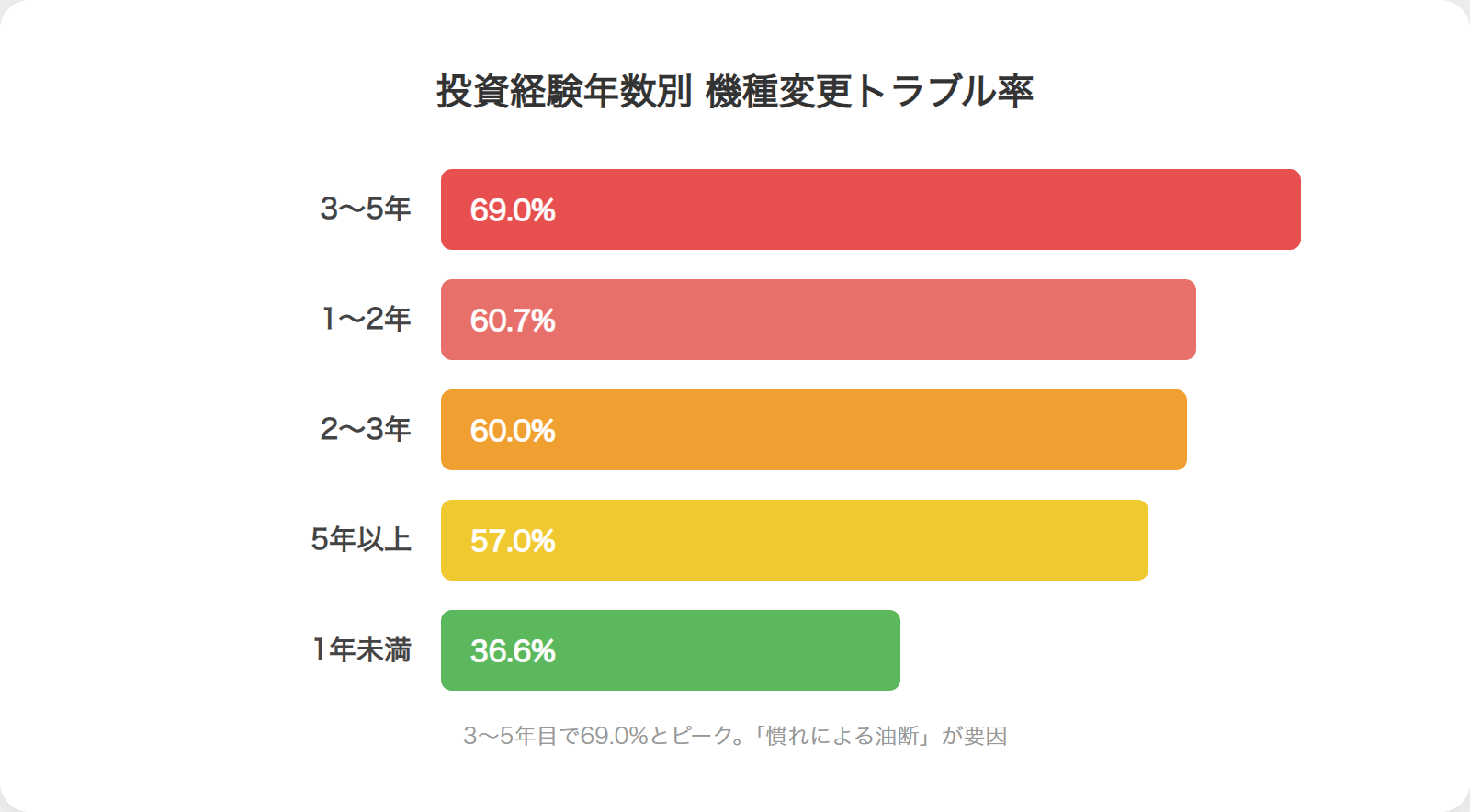
Years of experience | Trouble rate |
|---|---|
Less than 1 year | 36.6% |
1–2 years | 60.7% |
2–3 years | 60.0% |
3–5 years | 69.0% |
5+ years | 57.0% |
The Blind Spot Hiding in Mid-Career Investors
Among investors with three to five years of experience, the trouble rate peaked at 69.0%.
This is likely tied to the fact that this is roughly the point where investors have grown comfortable with crypto asset management and are starting to gain confidence.
Overconfidence in their own knowledge may lead to careless mistakes, such as skipping backup checks.
Even investors who feel they've mastered the basics can be caught off guard, because switching phones involves a distinct set of steps.
Because the process differs from everyday transfers and trades, past successes can actually work against you.
Investors in this stage are, in a sense, at the phase where they most need to watch out for the "trap of familiarity."
Beginners' Caution Protects Them
On the other hand, investors with less than a year of experience had the lowest trouble rate of any group, at 36.6%.
Investors who are still new to the market appear to take a more careful approach to managing their crypto assets.
It's telling that a lack of familiarity with the process actually functions as a strong safeguard.
Driven by the fear of "possibly losing my assets," beginners tend to work through instructions carefully, one step at a time.
That heightened sense of caution appears to be what prevents serious mistakes during a phone switch.
Wariness toward an unfamiliar process turns out to be the strongest weapon for protecting assets in the early stages.
Signs of Complacency Among Veteran Investors
Even among veteran investors with five or more years of experience, the trouble rate remained high, at 57.0%.
This runs counter to the assumption that risk should fall as experience grows, and the persistence of trouble at this level shouldn't be overlooked.
The longer someone has been investing, the more complex their setup may have become — more wallets, more types of assets to manage.
The very complexity built up to protect accumulated assets may, ironically, be what makes the transfer process harder.
It's also conceivable that self-taught management habits based on outdated information no longer match today's updated app environments.
Even veteran investors need to stay humble and regularly double-check the latest transfer procedures rather than assume they already know them.
Why Investors Forget About Their Wallet When Switching Phones
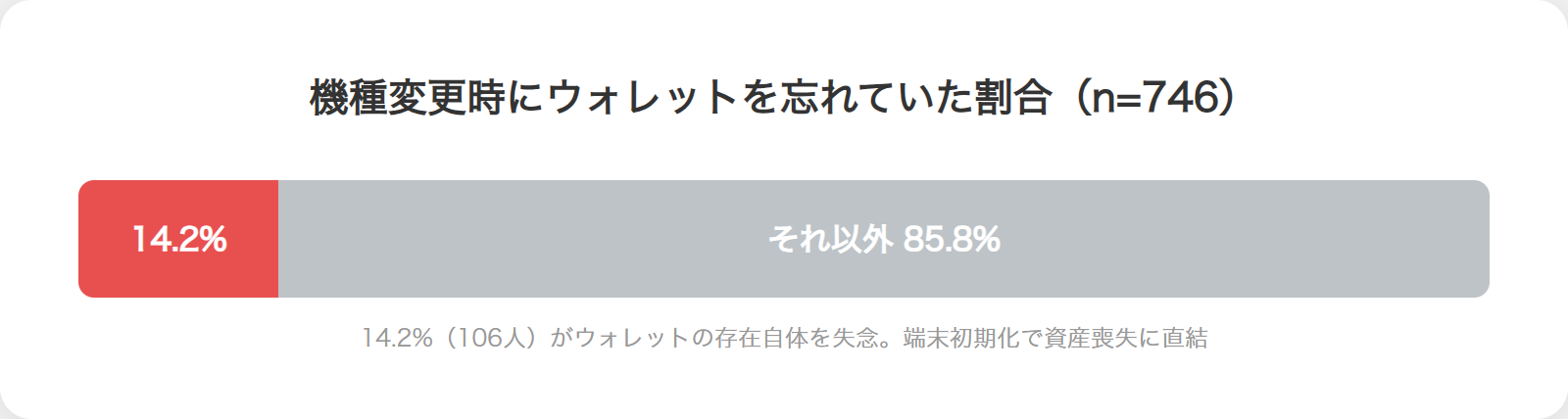
Response | Count | Share |
|---|---|---|
Forgot about the wallet | 106 | 14.2% |
All other responses | 640 | 85.8% |
The Psychology Behind Losing Sight of Your Assets
Unlike social media or messaging apps that you touch every day, a crypto asset wallet — if you're holding for the long term — often goes for extremely long stretches without ever being opened.
That "I rarely use it" quality is likely exactly what turns it into a blind spot in asset management at a crucial moment like a phone upgrade.
The fact that 14.2% of users had forgotten their wallet existed shows a real gap between how seriously people think of themselves as investors and how often they actually open the app.
Investors unconsciously assume, as a given, that their important assets live somewhere inside their smartphone.
But once an actual phone switch is underway, attention shifts entirely to transferring social media and photo data, and the wallet app — a "hidden but important asset" — quietly slips down the priority list.
This likely stems from the fact that assets held in digital form simply feel less tangible than physical assets.
To many users, a wallet is nothing more than "just another app."
But what it holds is, in fact, their own personal assets.
That gap in perception is arguably the biggest factor behind the lapse in awareness that occurs specifically during a phone switch.
Resetting the Device Can Cause Irreversible Loss
Many of the people who said they "forgot" about their wallet likely only realized their mistake after finishing setup on the new device and resetting the old one.
Once you press reset, there's no getting back the private key or data that was stored on the device.
If the recovery phrase wasn't written down somewhere else, the assets are lost the moment that happens — permanently.
What's especially frightening is when a user who had forgotten about their wallet resets the device without ever grasping how important it was.
Instead of the correct order — restoring the wallet on the new device first — the reverse plays out: users wipe the old device and only then realize they needed it.
This sequence of events is a textbook example of a process that leads to irreversible, critical loss.
When switching phones, confirming your wallet backup should, by rights, be the very first priority.
But treating the device reset as "the job is done" can cause that final check to get skipped.
Managing digital assets requires the discipline to confirm that everything is safe before you ever wipe a device.
What You Need Is a Pre-Switch Checklist
Not forgetting about your wallet isn't something you can rely on memory for — it requires a system.
Whenever you switch phones, make a checklist and write "back up wallet app" on it explicitly.
Working through a list mechanically, rather than relying on a gut sense of what's been done, dramatically cuts down on this kind of human error.
It's also critical to keep a physical, written copy of your recovery phrase.
As long as you have the phrase, your assets are safe whether or not your smartphone is in hand.
Rather than scrambling to find your backup on the day you switch phones, the mark of a true investor is keeping a system in place that lets you access your assets at any time.
When you hold crypto assets, the responsibility for managing them rests entirely with you.
Don't treat a phone upgrade as a mere device swap — treat it as a chance to take stock, organize your assets, and reconfirm your security.
Preparing ahead of time is what protects the assets you'll rely on down the road.
Conclusion
For crypto asset investors, switching phones isn't just a routine device update — it's a critical moment that can determine the safety of their assets.
This survey found that 54.1% of users experienced trouble during the transfer, and one in five ended up actually losing assets as a result — a genuinely serious outcome.
The trouble rate was especially pronounced among younger investors in their 20s, showing that even a digitally native generation runs into the specific barriers of wallet migration.
The finding that trouble peaks among investors with three to five years of experience — right around the point where confidence in their own skills builds — also suggests that experience itself can breed overconfidence.
And the fact that 14.2% of users had forgotten their wallet existed at all highlights a broader challenge: raising awareness around digital asset management.
A phone upgrade is a great opportunity to rebuild the systems that protect your assets.
Before you reset your device, always confirm you have a backup and know the recovery process.
Consistent, disciplined management on an everyday basis is the only real safeguard against an unexpected loss of assets.
Survey Overview
Survey date: April 10, 2026
Method: Internet survey
Respondents: Men and women residing in Japan (currently investing in crypto assets, or with past investment experience)
Valid responses: 746
Conducted by: Clabo Inc.
Survey Questions
- Do you have investment experience in crypto assets (also known as virtual currencies)?
- How many years of investment experience in crypto assets do you have?
- Have you experienced wallet-related trouble when switching phones?
This article is for informational purposes only and does not constitute financial or investment advice. Please consult a qualified professional before making investment decisions.


