


When starting to invest in crypto assets (also known as virtual currencies), "what to buy" is a critically important decision.
Yet many investors, once they've actually started investing, look back and think, "I wish I'd known that sooner."
In our own survey of 992 investors, the single most commonly cited knowledge gap that respondents regretted was "when to cut losses."
This article compares multiple-choice and single-choice survey results to reveal both the "breadth" and "depth" of investors' regrets.
At first glance, skills like chart analysis might seem most important — but a closer look at the data shows that "defensive knowledge," the kind that keeps you from losing your assets in the first place, is actually what drives the most severe regrets.
We also analyze how these results shift by investment amount and years of experience, and use the lessons from these investors' experience to propose, in priority order, the "five things beginners should learn first."
We hope the real, candid accounts of failure from these 992 respondents serve as a valuable guide to help steer your own investing toward success.
Top 8 things investors wish they'd known sooner
Trading-skill regrets — stop-losses and chart reading — dominate the top of the list
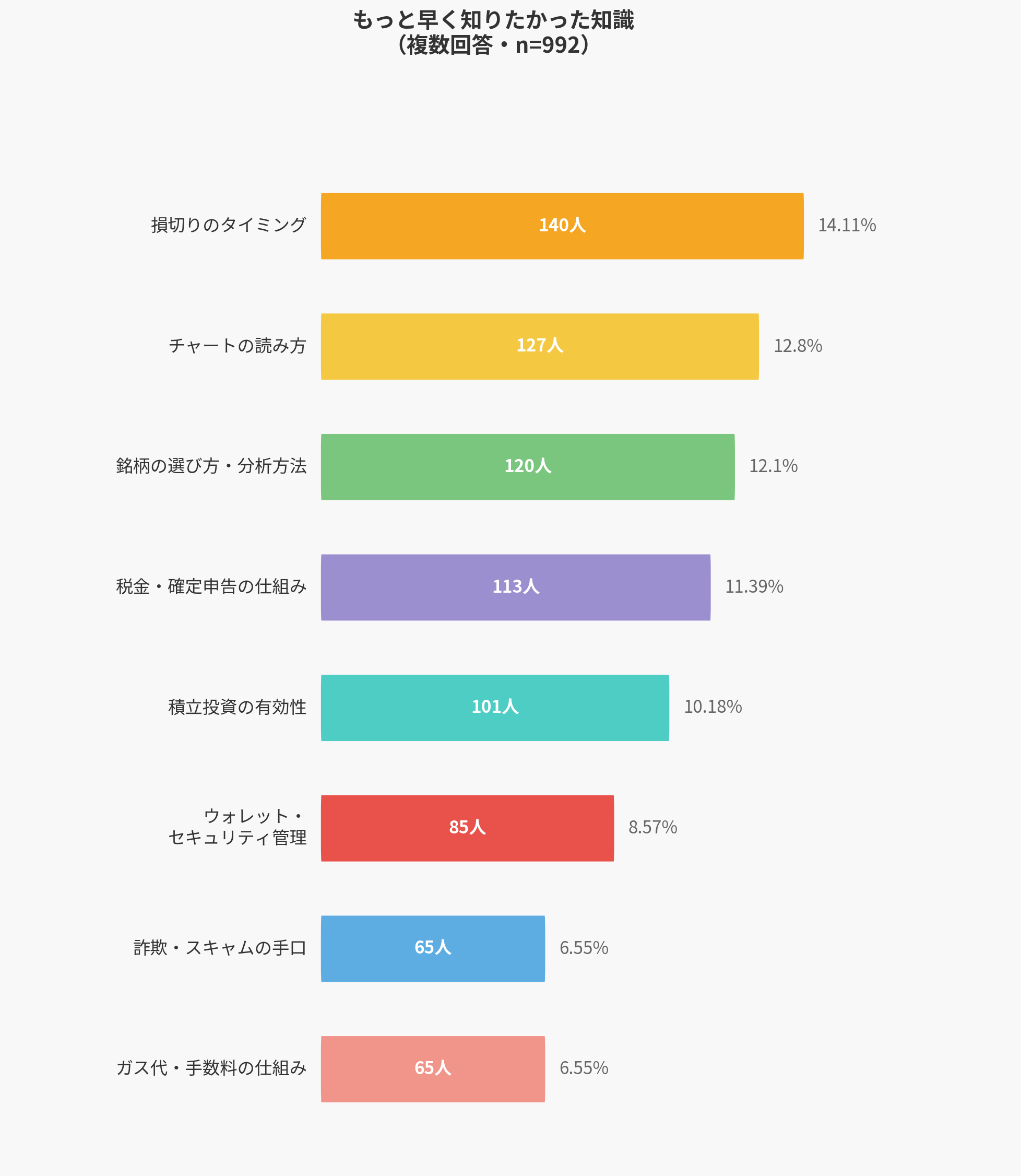
Answer | Responses | Share |
|---|---|---|
When to cut losses (stop-loss timing) | 140 people | 14.11% |
How to read charts | 127 people | 12.80% |
How to choose and analyze coins | 120 people | 12.10% |
Tax and tax-filing rules | 113 people | 11.39% |
The effectiveness of dollar-cost averaging | 101 people | 10.18% |
Wallet and security management | 85 people | 8.57% |
Scam and fraud tactics | 65 people | 6.55% |
How gas fees and other fees work | 65 people | 6.55% |
Other | 176 people | 17.74% |
When we asked respondents (in a multiple-choice format) which knowledge they wished they'd had sooner, items directly tied to trading dominated the top of the list.
"When to cut losses" led at 14.11%, followed closely by a strong desire for the "winning skills" of chart analysis and coin selection.
The data suggests that many investors only came to feel the extent of their own technical shortcomings once they were actually trading.
In the middle of the ranking, knowledge tied to the medium- to long-term efficiency of one's portfolio — taxes and dollar-cost averaging — drew support in the low double digits.
Meanwhile, "defensive" items such as security and fraud prevention stayed in the single digits, suggesting that awareness of risk management before the fact is relatively low.
It appears that, right after starting to invest, interest tends to gravitate toward knowledge that leads directly to profit rather than toward avoiding risk.
These results suggest that crypto investors struggle most with mastering an "exit strategy" and a "feel for the market."
In most cases, it's only after experiencing significant price swings following market entry that investors first grasp how important this knowledge really is.
The fact that responses were spread across such a wide range of items suggests that there is a great deal of ground to cover when learning about crypto investing.
In the single-choice question, stop-losses reach roughly 30% — making the depth of that regret clear
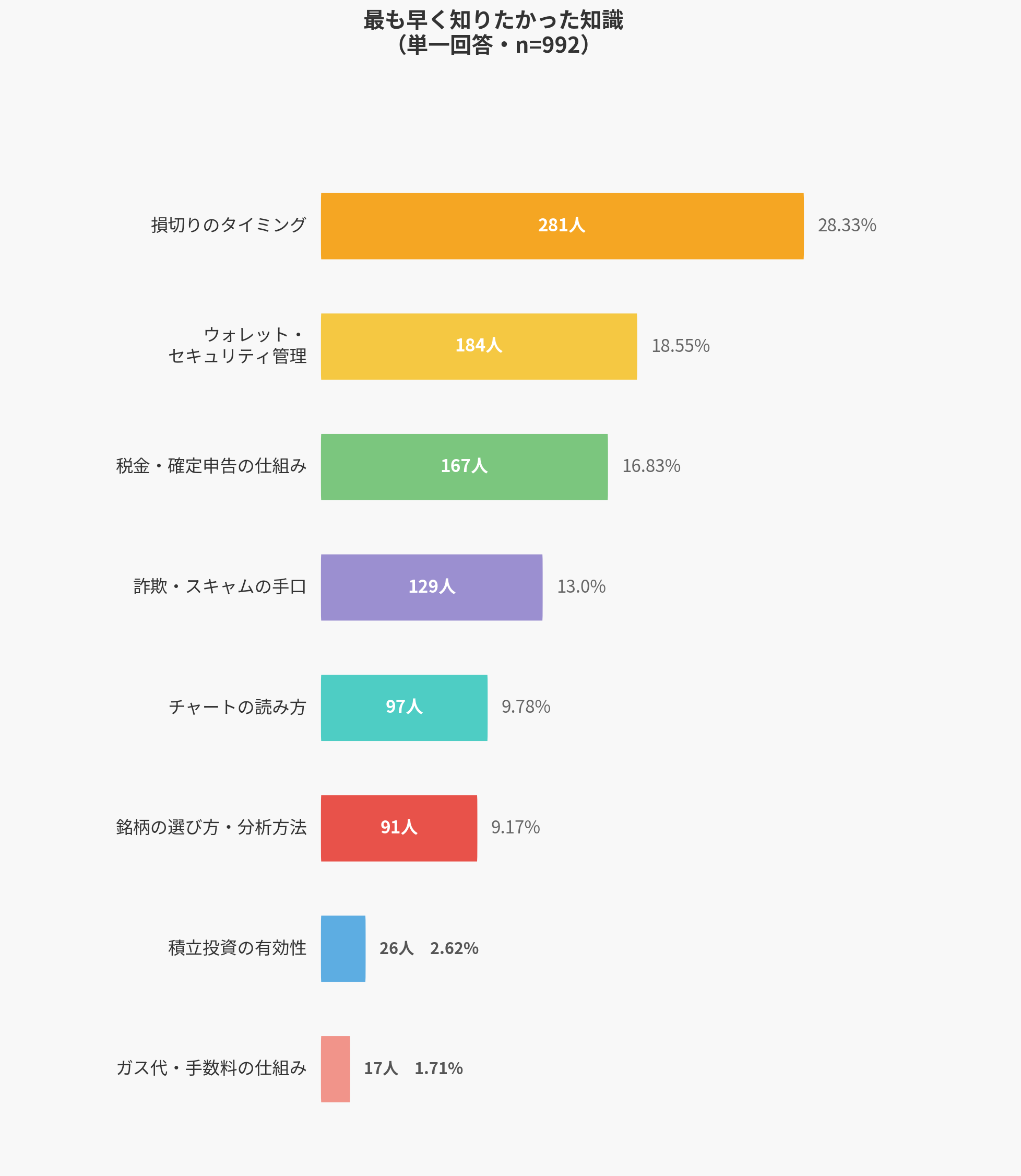
Answer | Responses | Share |
|---|---|---|
When to cut losses (stop-loss timing) | 281 people | 28.33% |
Wallet and security management | 184 people | 18.55% |
Tax and tax-filing rules | 167 people | 16.83% |
Scam and fraud tactics | 129 people | 13.00% |
How to read charts | 97 people | 9.78% |
How to choose and analyze coins | 91 people | 9.17% |
The effectiveness of dollar-cost averaging | 26 people | 2.62% |
How gas fees and other fees work | 17 people | 1.71% |
When respondents were asked to narrow it down to the single thing they wish they'd known soonest, "when to cut losses" took an overwhelming first place at 28.33%.
That's a large jump from the 14.11% it drew in the multiple-choice question, underscoring just how heavy a burden "cutting losses" is for investors.
This figure appears to reflect not mere curiosity but a painful reflection tied directly to actual realized losses.
Notably, "wallet and security management," which ranked 6th in the multiple-choice question, jumped to 2nd place at 18.55% in the single-choice question.
Unlike broad, shallow regret, this must be an extremely important piece of knowledge for the subset of respondents who experienced something as devastating as losing their assets outright.
Similarly, "scam and fraud tactics" also climbed in rank — items tied to more severe harm tend to be chosen more often when respondents can pick only one answer.
By contrast, chart reading and coin selection fell to 5th place and below, ranking lower in the single-choice question than in the multiple-choice one.
These are things investors wish they'd known, but they rarely lead to the kind of decisive regret that comes with losing one's assets entirely.
The data suggests two distinct types of regret: one that shows up as a "desire to learn," and another that shows up as a "sense of survival crisis."
Asset-protection knowledge rises sharply in importance as choices narrow
Knowledge item | Multiple-choice rank (Q11) | Single-choice rank (Q12) | Change in rank |
|---|---|---|---|
When to cut losses | 1st | 1st | Unchanged |
Wallet management | 6th | 2nd | Up 4 ranks |
Scams and fraud | 7th | 4th | Up 3 ranks |
How to read charts | 2nd | 5th | Down 3 ranks |
How to choose coins | 3rd | 6th | Down 3 ranks |
Comparing the two questions shows that "defensive knowledge" items — security and fraud prevention — rise sharply in rank.
The fact that items that barely stood out in the multiple-choice question suddenly surge in the single-choice question symbolizes just how deep crypto-specific risks can run.
This is a visualization of the hard-won lessons of investors who found themselves in an irrecoverable situation after a single mistake.
Conversely, "offensive" knowledge such as chart analysis drops sharply in priority once choices are narrowed down.
Misjudging the market can be recovered from through continued learning, but losing or having assets stolen can make it impossible to keep investing at all.
It becomes clear that the nature of investors' regret shifts — from a lack of skill to a lack of risk management.
This shift in ranking sends a powerful warning to anyone new to crypto investing.
Rather than studying charts to chase short-term profit, beginners should first solidify the security knowledge needed to protect their assets.
Many veteran investors, looking back, say that what mattered most in the end wasn't flashy trading technique but solid, unglamorous defensive knowledge.
Around 30% cite this as their single biggest knowledge gap
Delayed stop-loss decisions are the single biggest obstacle to building wealth
Answer | Responses | Share |
|---|---|---|
When to cut losses (stop-loss timing) | 281 people | 28.33% |
All other knowledge | 711 people | 71.67% |
As the single thing investors wish they'd known soonest, "when to cut losses" drew an outsized 28.33% of responses.
This shows that many investors have felt firsthand, through direct experience, how important it is to have an exit strategy — that is, to sell before an unrealized loss grows too large.
Facing the extreme volatility unique to crypto assets, and struggling with the difficulty of locking in a loss at the right moment, appears to be what makes this regret so strong.
In trading, cutting your losses is an essential defensive tool — one that protects your capital and keeps you positioned for the next opportunity.
In practice, however, the psychological bias of thinking "the price might come back someday" often kicks in, and the decision gets delayed again and again.
The lack of a basic understanding — setting a stop-loss rule "before you buy" — is a major factor that ultimately leads to devastating losses.
The fact that investors ranked this item first suggests that mastering how to "lose well" is harder than mastering any particular technical method.
Roughly 30% of respondents share a common regret: not knowing how to control losses, rather than how to grow profits.
For beginners entering the market, we can say with confidence that the first thing to focus on isn't coin selection — it's thoroughly internalizing stop-loss discipline.
Rules that remove emotion from the equation are the key to staying in the game
Background behind stop-loss regret | Likely cause |
|---|---|
Psychological hurdle | Fear of, and hope against, locking in a loss |
Lack of knowledge | No concrete percentage threshold or rationale |
Lack of preparation | Ad hoc decisions made only after buying |
Behind regret over stop-losses lies a common failure pattern: leaving investment decisions to one's own emotions.
It's extremely hard to make a calm judgment when prices are falling, and without the right knowledge, fear or baseless hope takes over.
The remarkably simple act of deciding your stop-loss line in advance is the one brake capable of stopping an emotional spiral.
The 28.33% figure from the survey is, in a sense, also evidence of how many people started investing without preparing in advance.
Cutting losses isn't just a technique — it's a form of discipline for protecting your own assets, and its importance tends to be understood only after money has actually been lost.
To prevent this kind of regret, investors need to learn the rule of designing their "exit" before price swings even occur.
Many investors give up on investing altogether because they can't bring themselves to cut a loss, making this one of the biggest barriers to staying invested long term.
These results suggest that knowledge of stop-losses isn't just one investing technique among many — it's a "survival strategy" for staying in the market.
Taking a lesson from these investors' regrets, the first thing beginners should do is quantify the amount of loss they can tolerate, and learn the discipline to stick to it.
Establishing rules early helps avoid devastating mistakes
Why stop-loss knowledge matters | Detail |
|---|---|
Protecting assets | Staying in the market without depleting your capital |
Emotional stability | Preventing panic during unexpected drops |
Avoiding missed opportunities | Avoiding a "bag-holding" position so capital can go toward the next investment |
The voices saying "I wish I'd known stop-loss timing sooner" carry an important implication for future investment outcomes.
Had investors picked up this knowledge earlier and built a system to execute it mechanically, many could have avoided seeing their assets shrink dramatically.
Many investors carrying this regret have experienced firsthand how a lack of knowledge translates directly into financial damage.
In the especially volatile crypto market, a single momentary misjudgment can wipe out months' worth of profit.
Rather than viewing "cutting a loss" as a failure, investors need to cultivate a mindset that accepts it as a "necessary cost" on the way to future success.
To do that, it's important to understand, before you even start investing, the concrete calculations and indicators for deciding at what point of price divergence to exit.
In conclusion, the fact that regret over stop-loss timing topped the list clearly shows where investor education should focus first.
Anyone starting out in crypto should thoroughly focus on this "exit strategy" — stop-losses — before anything else.
Keeping the lesson behind that 28.3% figure in mind, and committing to rule-based investing that removes emotion from the equation, is the first step toward investing without regret.
A surprising 2nd and 3rd place: wallets and taxes
Regret over security — where losses are irreversible — surges in the rankings
Answer | Responses | Share |
|---|---|---|
Wallet and security management | 184 people | 18.55% |
All other knowledge | 808 people | 81.45% |
"Wallet and security management," which placed 2nd in the single-choice question, climbed sharply from 6th place in the multiple-choice question.
This shows that incidents like hacking or losing a private (signature) key represent, for investors, an "irreversible, devastating regret."
It isn't broadly wished-for knowledge across the board, but because a single incident can wipe out an investor's entire holdings, responses appear to have concentrated sharply on this one item among those affected.
The self-custody principle unique to crypto assets always carries a risk of asset loss lurking behind its convenience.
A sense of "it won't happen to me" often robs investors of the chance to learn proper management practices, which in turn leads to serious damage.
Before mastering trading technique, first locking down the basic knowledge needed to physically protect one's own assets is a minimum requirement for surviving in this market.
This sharp rise is extremely important data, symbolizing the "depth" of risk in crypto investing.
Offensive knowledge like chart analysis can be picked up later, but losses caused by a lack of security cannot be recovered.
Many veteran investors say that what they most wish they'd known sooner wasn't flashy ways to make money, but the unglamorous, solid discipline of protecting their assets.
16.8% of respondents felt the sting of tax obligations after locking in profits
Answer | Responses | Share |
|---|---|---|
Tax and tax-filing rules | 167 people | 16.83% |
All other knowledge | 825 people | 83.17% |
"Tax and tax-filing rules," which ranked 3rd, was cited by 16.83% of investors as something they wish they'd understood from the start.
In Japan, gains from crypto assets are treated as miscellaneous income and taxed under the aggregate (comprehensive) taxation system rather than the separate self-assessment taxation used for stocks — and investors are often surprised by an unexpectedly high tax rate after they've already locked in a profit. (As of July 2026, gains remain miscellaneous income under aggregate taxation, taxed at Japan's progressive income-tax rates of roughly 5–45% plus a flat 10% resident tax; losses can only be offset against other miscellaneous income, not against employment income or other income categories. Japan's Diet passed a reform to the Financial Instruments and Exchange Act on July 15, 2026, that will reclassify crypto assets as financial instruments under that law; a flat 20% separate self-assessment tax rate is expected to take effect from the year following the reform's implementation, projected around January 2028.)
That "negative surprise" — ending up with far less in hand than expected after cashing out — appears to be a major driver of this strong regret.
For investors realizing a large profit for the first time in particular, the effort of filing a tax return and the complexity of the calculations involved present a high hurdle.
To avoid critical mistakes such as "spending the money without setting aside funds for taxes," it's important to understand the tax system early in one's investing journey.
This 16.8% figure reflects the regret of investors who focused entirely on chasing profit while overlooking the public obligations that come at the exit.
A lack of tax knowledge carries the risk of throwing off an investor's entire strategy.
Reinvesting without accounting for next year's tax bill can lead to a worst-case scenario where paying taxes becomes difficult if the market subsequently falls.
The failure to treat "earning" and "paying tax" as a single package appears to be a common pitfall shared by many investors.
Wariness of fraud pushes this item up sharply in the single-choice results
Answer | Responses | Share |
|---|---|---|
Scam and fraud tactics | 129 people | 13.00% |
All other knowledge | 863 people | 87.00% |
"Scam and fraud tactics" also leapt from 7th place in the multiple-choice question to 4th in the single-choice question.
As with wallet management, this is likely because a single incident can involve a large loss and cause deep psychological shock.
A failure that could have been prevented simply by knowing increasingly sophisticated scam tactics seems to become, for many investors, "the memory they most wish they could erase."
The market is rife with scams disguised as attractive investment opportunities, and inexperienced beginners without the right knowledge are easy targets.
Being lured in by phrases like "high yield" or "limited access," and losing important funds as a result, leaves a regret that is immeasurably heavy.
Building up one's defenses is urgent — both to protect investors and to avoid unwittingly funding criminal activity through one's own investments.
These results redefine what "literacy" should mean for anyone starting to invest in crypto assets.
The fact that so many investors say, in hindsight, that the knowledge that mattered most was concentrated in risk management, regulation, and fraud prevention deserves to be taken seriously.
Rather than knowledge for seizing an opportunity to succeed, it's knowledge for avoiding a forced exit from the game that truly amounts to the lesson investors "wish they'd known sooner."
How regrets change by investment amount and experience level
Investors with under ¥1 million regret stop-losses most; larger investors prioritize defense
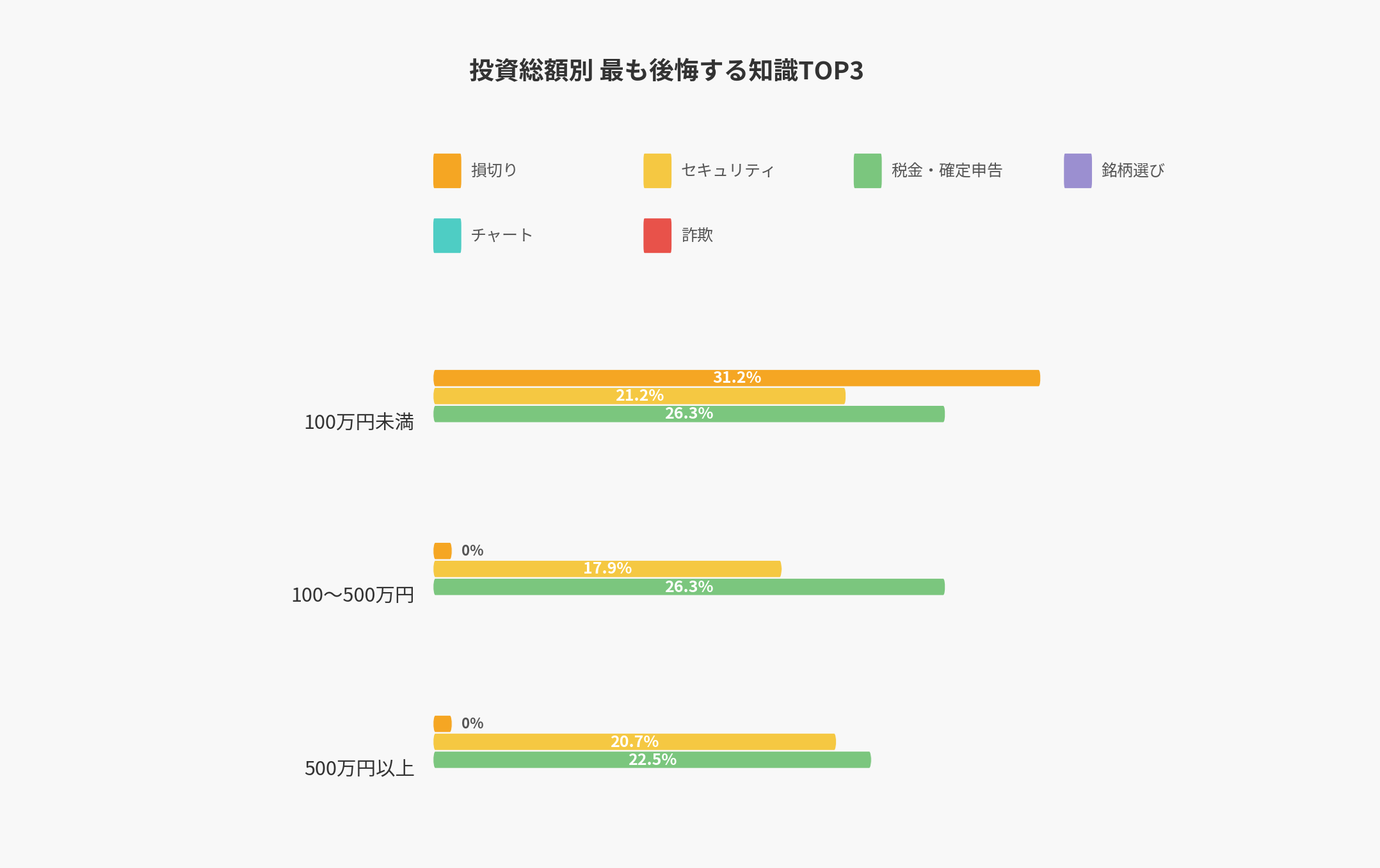
Total invested | n | 1st | 2nd | 3rd |
|---|---|---|---|---|
Under ¥1 million | 733 people | When to cut losses (31.2%) | How to choose coins (11.9%) | How to read charts (11.3%) |
¥1–5 million | 179 people | When to cut losses (21.2%) | Tax and tax-filing rules (20.7%) | Security management (17.9%) |
¥5 million or more | 80 people | Security management (26.3%) | Tax and tax-filing rules (22.5%) | Scams and fraud (18.8%) |
Among respondents who had invested a total of under ¥1 million, stop-loss timing topped the list at over 30%.
Smaller-scale investors tend to be more sensitive to "the loss right in front of them," and are more likely to regret their lack of trading skill.
Once total investment exceeds ¥1 million, however, the share citing stop-losses declines, while regret over a lack of tax knowledge rises sharply instead.
As profits grow larger, public obligations and cost management clearly emerge as issues that can no longer be ignored.
Among investors with ¥5 million or more invested, regret shifts almost entirely toward "defense."
Wallet and security management takes the top spot at 26.3%, with regret over fraud prevention also ranking high.
As the size of one's holdings grows, so does the amount lost to a single mistake — leading investors to conclude, in hindsight, that they should have prioritized defensive knowledge over offensive technique.
This reveals a structure in which the nature of the risk investors face shifts, as they progress through investing stages, from "market volatility" to "asset preservation."
This data carries an important implication for beginners looking ahead to future asset growth.
Even those with a small amount invested today will inevitably run into the wall of taxes and security once their investing gains momentum.
Building up this knowledge ahead of time is the single best hedge against a devastating future mistake.
Adapting one's learning priorities to match one's own investing stage appears to be key to long-term success.
Active investors seek an exit strategy; those who quit regret falling victim to crime
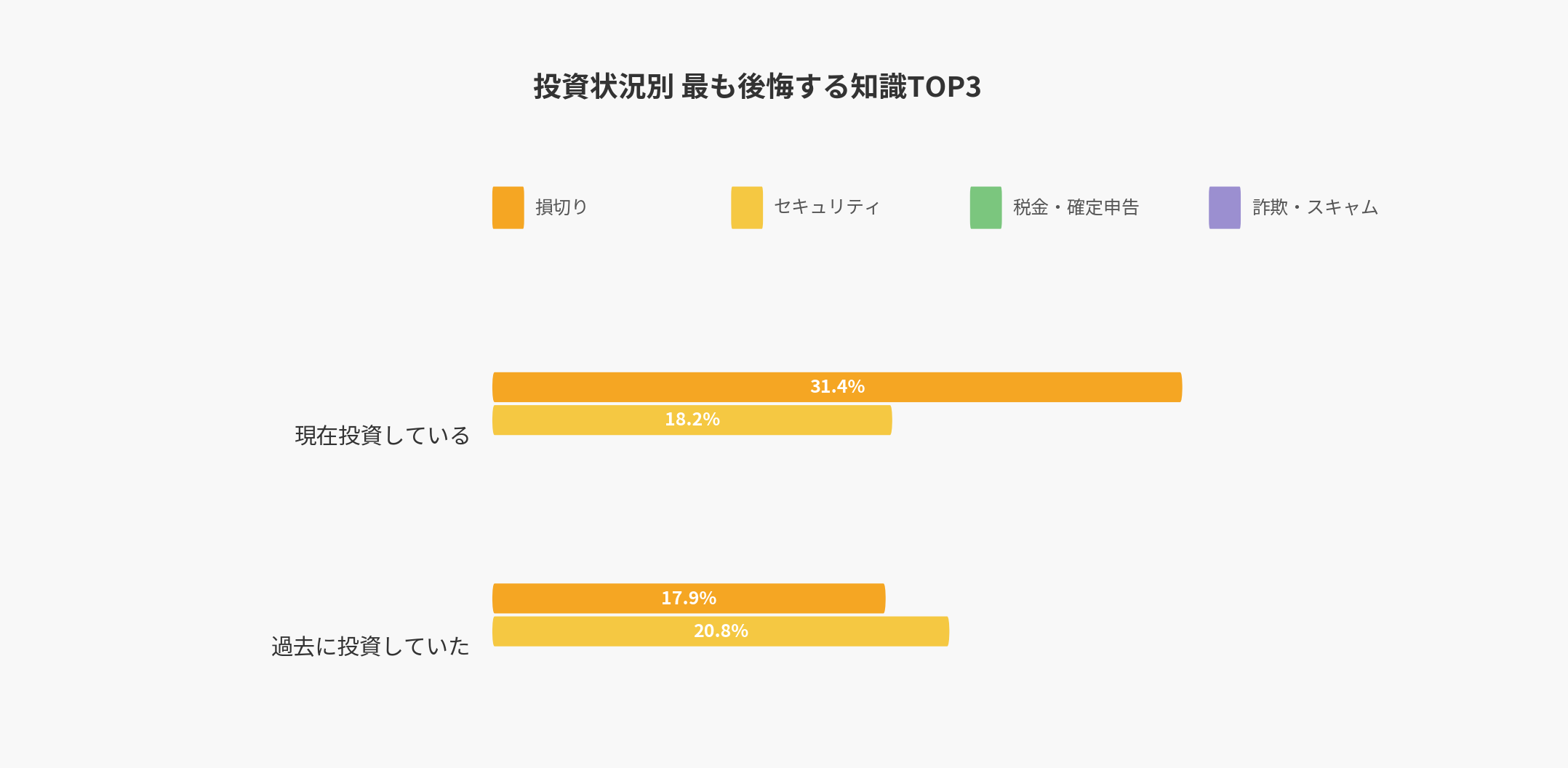
Investment status | n | 1st | 2nd | 3rd |
|---|---|---|---|---|
Currently investing | 761 people | When to cut losses (31.4%) | Tax and tax-filing rules (18.4%) | Security management (17.9%) |
Invested in the past | 231 people | When to cut losses (18.2%) | Security management (20.8%) | Scams and fraud (19.9%) |
Among respondents who are still investing today, regret over stop-loss timing sits at a very high 31.4%.
For those currently riding the waves of the market, it's clear that a proper exit strategy — knowing when to take profits or cut losses — is the most pressing issue.
A high share also cite a lack of tax knowledge, suggesting that ongoing investors keenly feel the burden of tax filing and tax obligations as they continue trading.
By contrast, among those who have already quit investing, regret centers on security management (20.8%) and scams and fraud (19.9%).
These exceed the 18.2% figure for stop-losses, suggesting that a certain share of this group left the market specifically because of asset theft or fraud.
It appears that, even more than losing on the market, an involuntary exit caused by an irreversible loss of assets leaves a particularly deep regret among those who quit.
Regret over stop-losses is common across both groups regardless of experience, but its severity differs depending on whether it's an "ongoing struggle" or a "past, painful mistake."
Active investors are focused on improving performance going forward, while those who quit are left regretting trouble that could have been prevented.
For anyone starting out, or considering resuming investing, this comparison illustrates just how important "defensive strength" is for avoiding being forced out of the market.
Younger investors crave trading skill; more experienced investors prioritize the system
Age group | n | 1st | 2nd | 3rd |
|---|---|---|---|---|
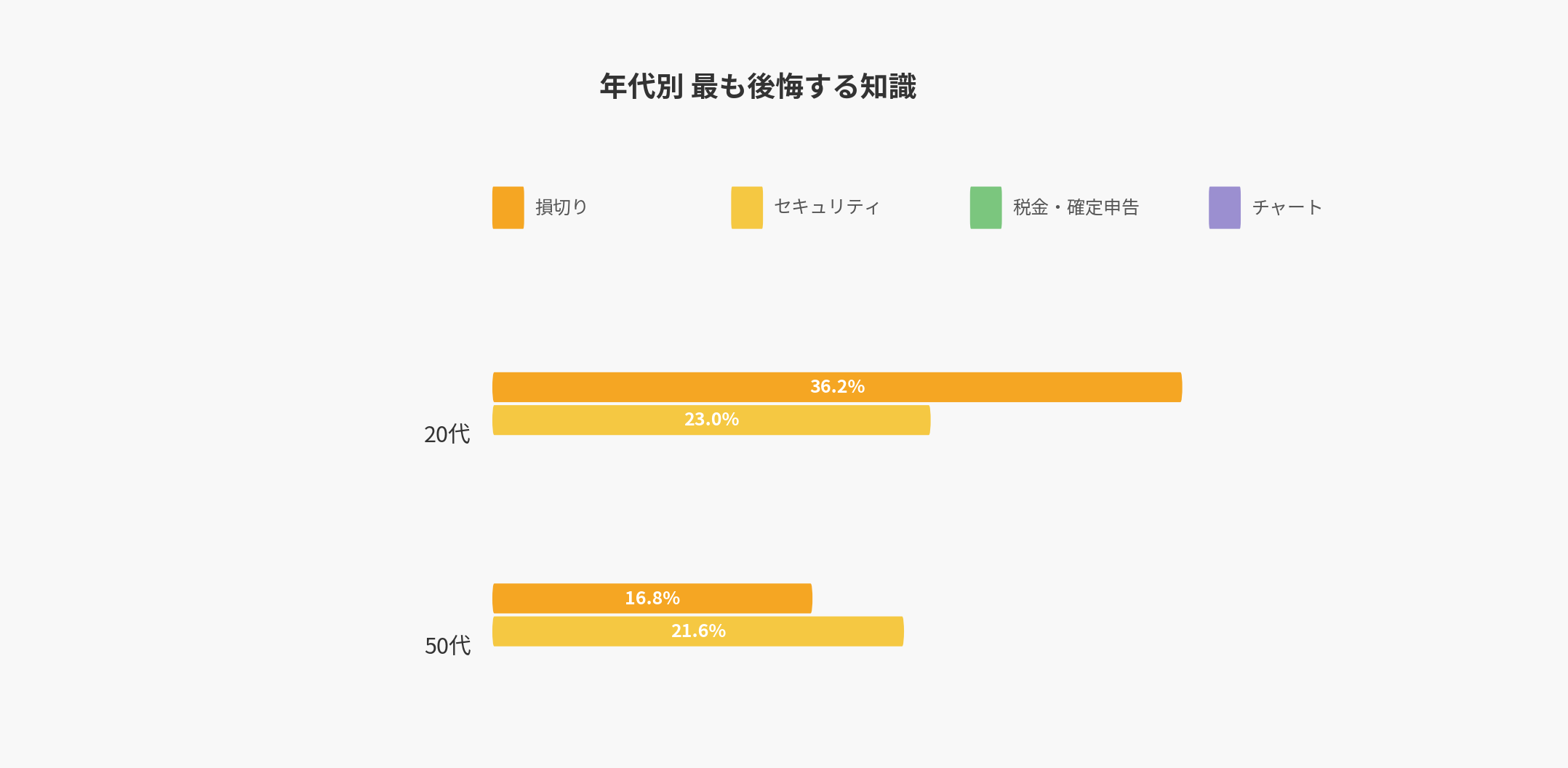
20s | 149 people | When to cut losses (36.2%) | Security management (16.8%) | How to read charts (12.8%) |
50s | 139 people | When to cut losses (23.0%) | Tax and tax-filing rules (22.3%) | Security management (21.6%) |
Broken down by age group, younger respondents showed stronger regret specifically around trading technique.
Among people in their 20s, "when to cut losses" was cited by an especially high 36.2%, followed by "offensive" knowledge such as chart reading.
For younger investors with less experience who want to maximize capital efficiency, losses from misjudging the market deal a heavy psychological and financial blow — which appears to drive their strong desire to have learned more advanced technique sooner.
Among respondents in their 50s and older, on the other hand, regret over taxes and security runs neck and neck with stop-losses, each exceeding 20%.
With age, investors increasingly recognize the importance of "systemic" knowledge — not just chasing profit, but also protecting their assets and fulfilling their social obligations.
This is likely reflected in a more cautious stance, especially among those managing larger capital such as retirement funds, where a surprise tax rate or a security incident could affect their entire life plan.
This difference by age group shows that what investors seek from investing, and the risks they fear, change depending on their stage of life.
Younger investors have more room to learn from failure and hone their skills, while older investors face a "fight they can't afford to lose," placing greater weight on defensive knowledge.
The fact that roughly 30% of every age group regrets not knowing about stop-losses symbolizes a universal challenge in crypto investing.
Across all age groups, establishing an exit strategy early is, without question, the shortest path to reducing regret.
Summary
This survey makes clear that the essence of crypto investors' regret lies not in flashy profit-making techniques, but in a lack of unglamorous, solid "risk management."
In particular, "when to cut losses" came out on top by a wide margin, highlighting the danger of entering the market without an exit strategy.
We also confirmed a tendency for regret over irreversible risks — such as security incidents and fraud, where a single mistake can wipe out one's assets — to deepen the more experience an investor gains and the larger the amount they invest.
The challenges investors face change depending on their stage, but if we sum up the lessons of those who came before, it boils down to one point: "defend first, then go on the offensive."
Following your rules without letting emotion take over, and getting ahead of your legal obligations and security risks, is ultimately the shortest path to protecting your largest gains.
Rather than treating these real voices from 992 respondents as mere statistics, we hope you'll use them as a guide for reviewing your own investment practices and making safer, wiser decisions.
Survey overview
Survey date: March 23, 2026
Method: Internet survey
Respondents: Men and women residing in Japan (people currently investing in crypto assets, or who have invested in the past)
Valid responses: 992
Conducted by: Clabo Inc.
Survey questions
- Have you ever invested in crypto assets (virtual currencies)?
- What is the closest approximation to the total amount you have invested in crypto assets to date?
- Looking back on your crypto investing experience, what knowledge do you wish you'd known sooner? (Select all that apply.)
- Please choose the single thing you wish you'd known soonest.
- Have you ever thought about quitting crypto investing?
This article is for informational purposes only and does not constitute financial or investment advice. Please consult a qualified professional before making investment decisions.


