


The reasons people decide to invest in crypto assets (also known as virtual currencies) vary widely.
Some dream of striking it rich and transforming their lives, while it's equally common to find people steadily building wealth as a nest egg for retirement.
This survey found that differences in investors' underlying "purpose" create dramatic differences not only in actual investment amounts and management styles, but even in the nature of the anxieties investors harbor deep down.
This article analyzes in detail the "surprising realities of investing" that emerged by purpose, drawing on the actual voices of 1,221 respondents.
How much of a gap exists in investment amounts between the "wealth-building" group and the "life-changing windfall" group, and what do they spend their profits on, and what are they afraid of?
By unpacking the real investor profiles the data reveals, we look for hints to help you make investment decisions you can feel confident about.
Wealth Building Tops the List: An Overview of Investment Purposes
Half of Investors Prioritize Preparing for the Future
Response | Respondents | Share |
|---|---|---|
Wealth building (want to grow assets for the future) | 353 | 48.9% |
Short-term profit (aiming for gains in a short period) | 149 | 20.6% |
Realizing a dream (wanting to grow assets significantly and change my life, etc.) | 134 | 18.6% |
Learning & experience (using it to study) | 70 | 9.7% |
Other (free response) | 16 | 2.2% |
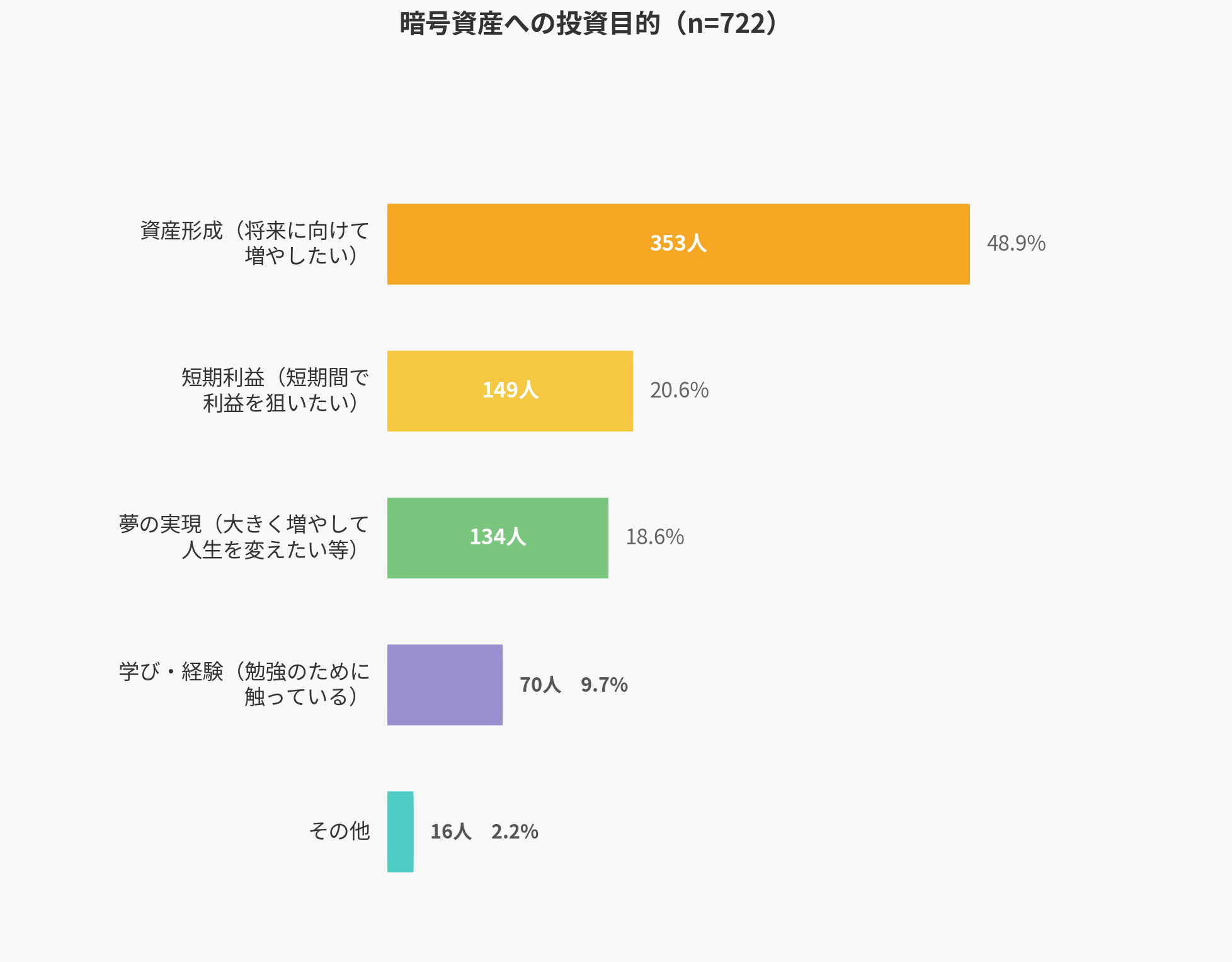
When we surveyed the purposes behind crypto asset investing, 48.9% of respondents — nearly half — cited building wealth for the future.
This reveals that, contrary to crypto's once-speculative image, investors who view crypto assets as a tool for long-term asset management have become the mainstream.
The next most common purpose was earning short-term profit, at 20.6%.
A segment of investors seeking to profit efficiently by taking advantage of market volatility also maintains a notable presence.
Meanwhile, those chasing a life-changing dream accounted for only 18.6%, a result that highlights a generally grounded investment stance.
Roughly one in ten respondents cited learning and experience as their purpose, and it's an interesting point that interest in new technology is itself an investment motivator.
Overall, it could be said that today's crypto asset market has transformed from a venue for chasing a "once-in-a-lifetime windfall" into a venue for "wealth building" grounded in individual life plans.
The "Realizing a Dream" Group Makes Up Two in Ten, With a Notable Windfall-Seeking Contingent
Response | Respondents | Share |
|---|---|---|
Realizing a dream (wanting to grow assets significantly and change my life, etc.) | 134 | 18.6% |
Short-term profit (aiming for gains in a short period) | 149 | 20.6% |
The "realizing a dream" group, seeking returns dramatic enough to change their lives, came in at 18.6%.
Combined with the "short-term profit" group, this reaches roughly four in ten, underscoring that a substantial contingent of investors still expects explosive profit growth from crypto assets.
This reflects an investment culture unique to crypto assets, where investors take on risk in pursuit of large returns.
From a professional standpoint, it's undeniable that this roughly 40% segment serves as a driving force behind market liquidity and vitality.
Especially during bull markets, the entry of these high-expectation investors becomes one factor pushing prices upward.
These aggressive-minded investors, in contrast to the steady wealth-building group, add depth to the market.
However, caution is warranted, as this profit-focused segment tends to be more easily rattled during sudden market swings.
Even when the purpose is realizing a dream, maintaining calm, rational judgment criteria is key to long-term success.
This survey made clear the market's diverse structure, in which dream-chasers and steady wealth-builders coexist.
Investors in Their 30s Chase Short-Term Profit, Revealing a Generational Divide in Purpose
Age Group | Wealth Building | Short-Term Profit | Realizing a Dream | Learning & Experience | Other |
|---|---|---|---|---|---|
In their 20s | 52.7% | 18.9% | 17.6% | 8.8% | 2.0% |
In their 30s | 49.7% | 25.9% | 15.2% | 8.1% | 1.0% |
In their 40s | 51.6% | 17.9% | 17.4% | 8.7% | 4.3% |
In their 50s | 47.5% | 15.8% | 20.9% | 13.7% | 2.2% |
In their 60s | 31.2% | 28.1% | 25.0% | 15.6% | 0.0% |
70 and older | 27.3% | 27.3% | 40.9% | 4.5% | 0.0% |
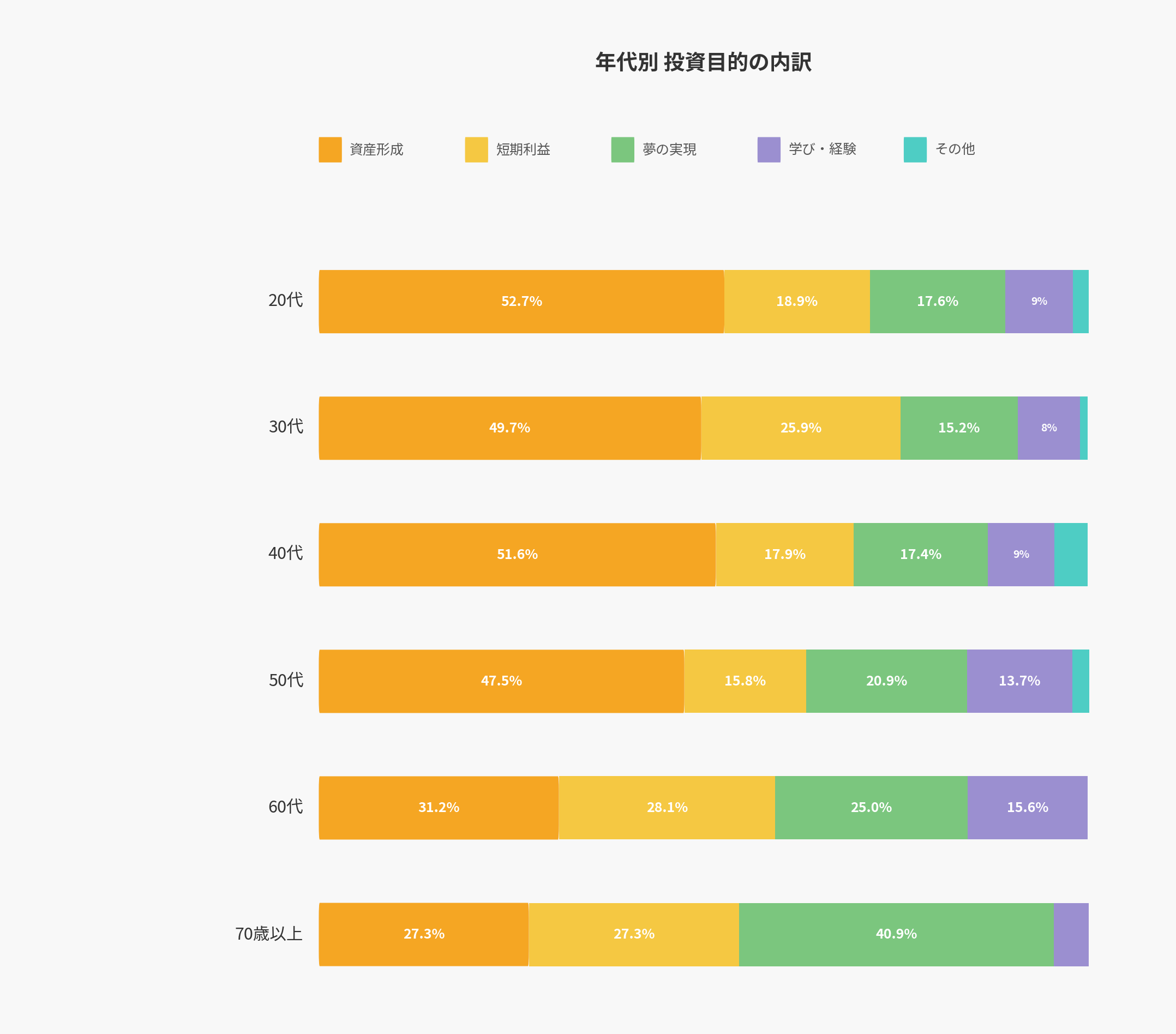
Analyzing investment purpose by age group, we found that among people in their 30s, 25.9% sought "short-term profit" — higher than other working-age generations.
The 30s are a period when financial demands rise in both work and personal life, likely reflecting a desire to quickly grow available funds through crypto assets.
By contrast, across the 20s-to-40s age groups, "wealth building" accounts for roughly half of respondents in each.
The figure reaches 52.7% among people in their 20s in particular, suggesting that younger generations, driven by anxiety about the future, are turning to crypto assets for early wealth building.
For younger investors, crypto assets are no longer a gamble but are becoming a standard vehicle for asset management.
What's striking is the group aged 70 and older, where the share citing "realizing a dream" as their purpose stands out at 40.9%.
Although the sample size is limited, this suggests that a segment of older investors, harboring big dreams, remains highly active in taking on the crypto asset market.
Across all generations, the survey revealed that distinct investment purposes exist depending on life stage.
How Investment Amounts and Fund Allocation Differ by Purpose
The Wealth-Building Group Shows Stability, With a Majority Investing ¥1 Million or More
Purpose | Under ¥10,000 | ¥10,000–under ¥1M | ¥1.01M–under ¥3M | ¥3.01M–under ¥5M | ¥5.01M or more |
|---|---|---|---|---|---|
Wealth building (future) | 24.4% | 53.3% | 16.4% | 2.8% | 3.1% |
Short-term profit (short-term) | 30.2% | 20.8% | 43.0% | 4.7% | 1.3% |
Realizing a dream (life) | 44.0% | 37.3% | 9.7% | 2.2% | 6.7% |
Learning & experience (study) | 57.1% | 17.1% | 7.1% | 14.3% | 4.3% |
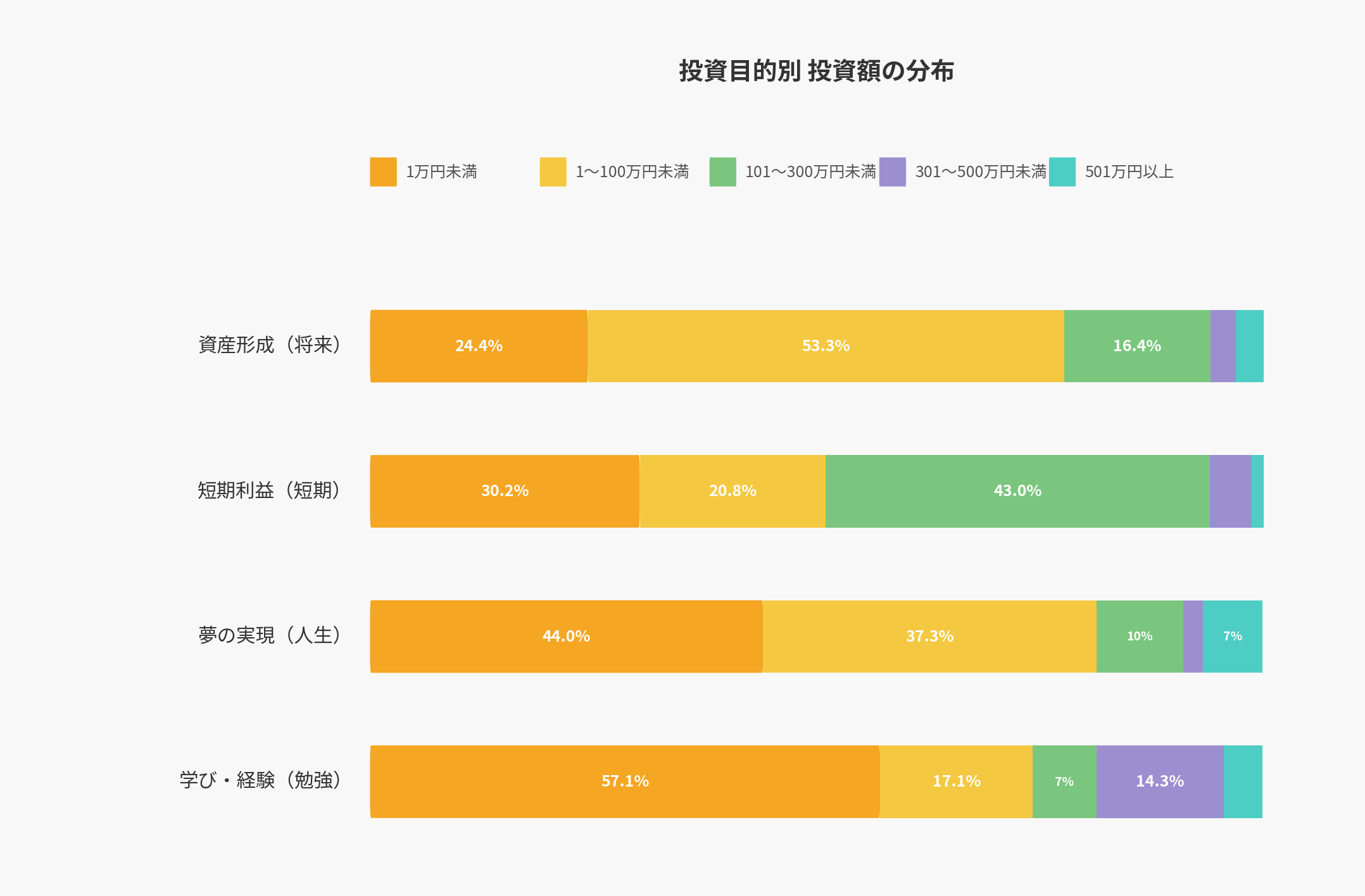
Investors targeting wealth building for the future have put more than half of their combined investment into the ¥1 million to under ¥3 million range.
Rather than taking on a large risk all at once, this group shows a pronounced tendency to deploy a lump sum of surplus funds in anticipation of medium- to long-term growth.
Their prudent approach — incorporating crypto assets as part of a broader portfolio and aiming for stable asset growth — is also reflected in their investment amounts.
Unlike those with a short-term outlook, the wealth-building group appears to allocate funds based on their own life plans, without being swayed by every price fluctuation.
This survey found that, when combining the shares investing ¥1.01 million or more, this group's level is high relative to other groups.
This points to a strategic approach: securing a volume of funds sufficient to expect future results, while staying within a manageable range.
From a professional standpoint, the stability of the wealth-building group's investment amounts can be considered one factor underpinning market resilience.
As a segment that continues to supply funds to the market steadily, unswayed by short-term booms, this group's importance is likely to keep growing.
The distribution of investment amounts serves as evidence that crypto assets have graduated from being a mere speculative object to a credible asset class.
A Paradox: More Than Four in Ten "Dream Realizers" Invest Only Small Amounts
Purpose | Under ¥10,000 | ¥10,000–under ¥1M | ¥1.01M–under ¥3M | ¥3.01M–under ¥5M | ¥5.01M or more |
|---|---|---|---|---|---|
Realizing a dream (life) | 44.0% | 37.3% | 9.7% | 2.2% | 6.7% |
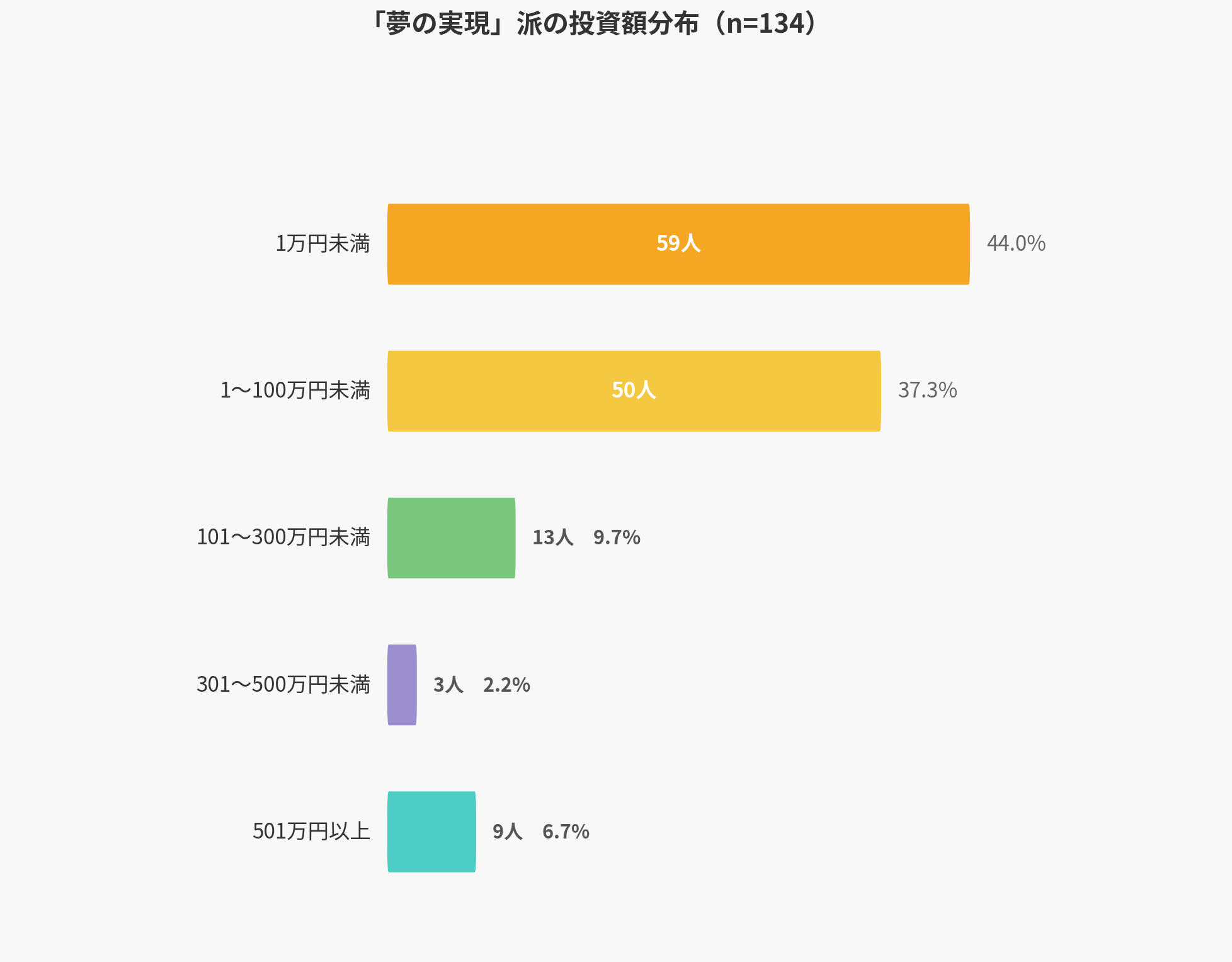
The "realizing a dream" group is chasing a life-changing windfall, yet looking at their investment amounts, the largest share — 44.0% — invests under ¥10,000.
Contrary to their "big dreams," a fascinating and paradoxical reality emerges: the actual funds committed are kept extremely small.
This suggests that a lottery-ticket-style investment behavior — seeking a ten-thousand-fold return from a small stake — is the mainstream approach within this group.
At the same time, 6.7% invest ¥5.01 million or more, showing that investment styles are polarized even within the same purpose.
Still, the reality is that the majority limit their risk to the utmost while pinning their hopes on the explosive upside gains (a "moonshot") unique to crypto assets.
This can be described as a segment that still carries much of the passion of crypto's early days — the spirit of "betting what little money you have on a dream."
This group is likely concentrating their investment in specific altcoins or memecoins.
Approaches that keep principal small while targeting leverage or sudden price spikes are highly speculative, and the odds of success are far from high.
While the impulse to chase a dream deserves respect, the small actual investment amounts starkly illustrate the gap between ideal and reality.
The "Short-Term Profit" Group Prioritizes Agility, With Four in Ten Investing ¥1 Million or More
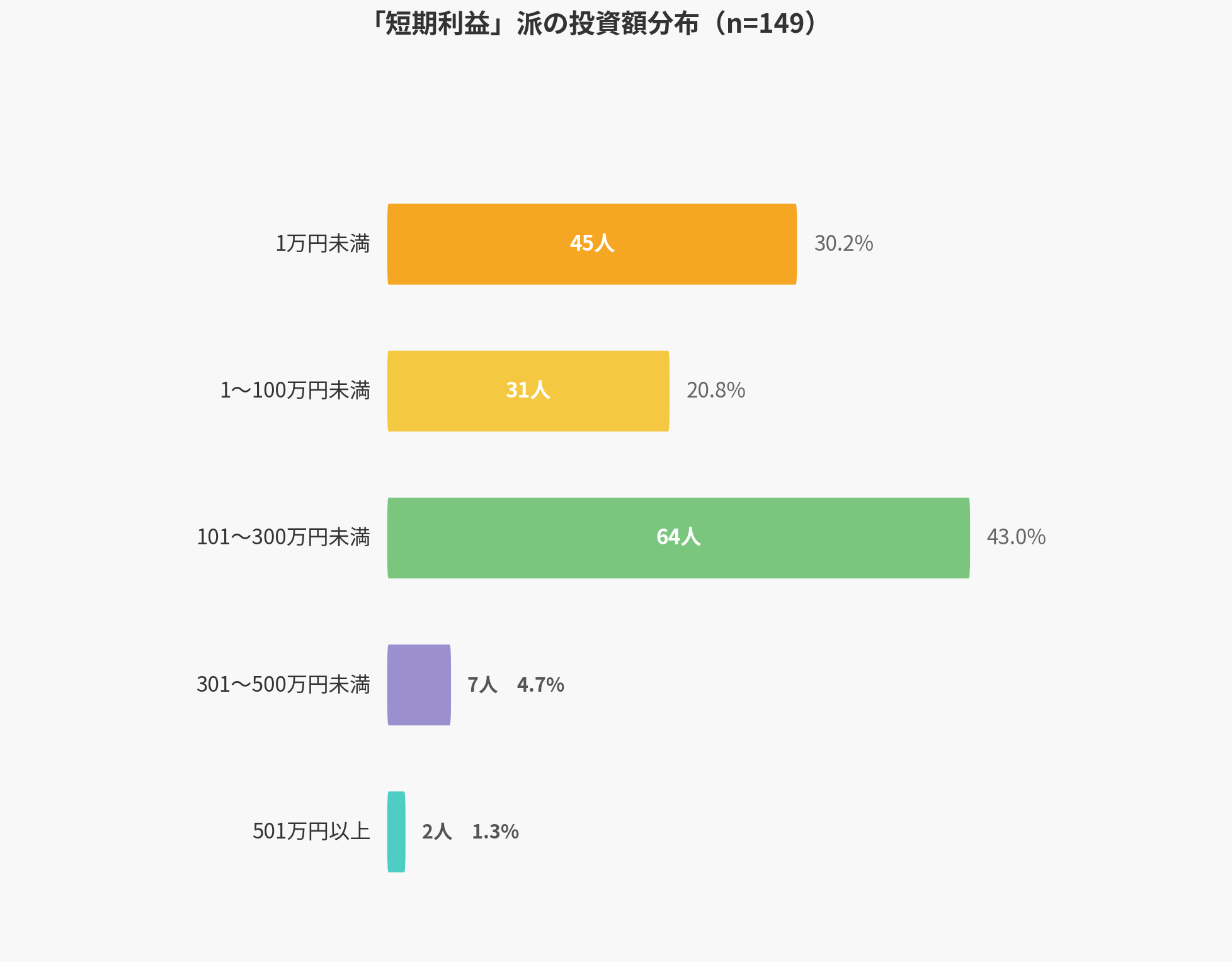
Purpose | Under ¥10,000 | ¥10,000–under ¥1M | ¥1.01M–under ¥3M | ¥3.01M–under ¥5M | ¥5.01M or more |
|---|---|---|---|---|---|
Short-term profit (short-term) | 30.2% | 20.8% | 43.0% | 4.7% | 1.3% |
Among those aiming for short-term profit, 43.0% concentrate in the ¥1.01 million to under ¥3 million range, standing out for their allocation focused on agility.
Because generating efficient profits from short-term trading requires a certain level of margin and trading volume, investment amounts are naturally pushed up.
This reveals a pattern of rotating funds within a range that avoids being too small while still allowing for risk management.
Within this group, 30.2% invest under ¥10,000, indicating that a certain number treat short-term trading as "practice" or a way to earn "pocket money."
Regardless of the amount invested, a defining feature is that they manage their positions with a short time horizon in mind, conscious of compounding effects and turnover rate.
Because their purpose is clear, capital flows in and out actively, making this a group that welcomes market volatility.
The investment amount distribution of the short-term profit group symbolizes the depth of the trader segment in the crypto asset market.
They provide market liquidity and play a major role in price formation, but at the same time can also be a factor triggering sudden price swings.
That investment purpose produces such stark differences in both the "depth" and "use" of capital is one of this survey's most notable findings.
Characteristics by Purpose, as Seen in Investment Style and Use of Profits
Long-Term Holding Dominates Among the Wealth-Building Group, Chosen by More Than Half
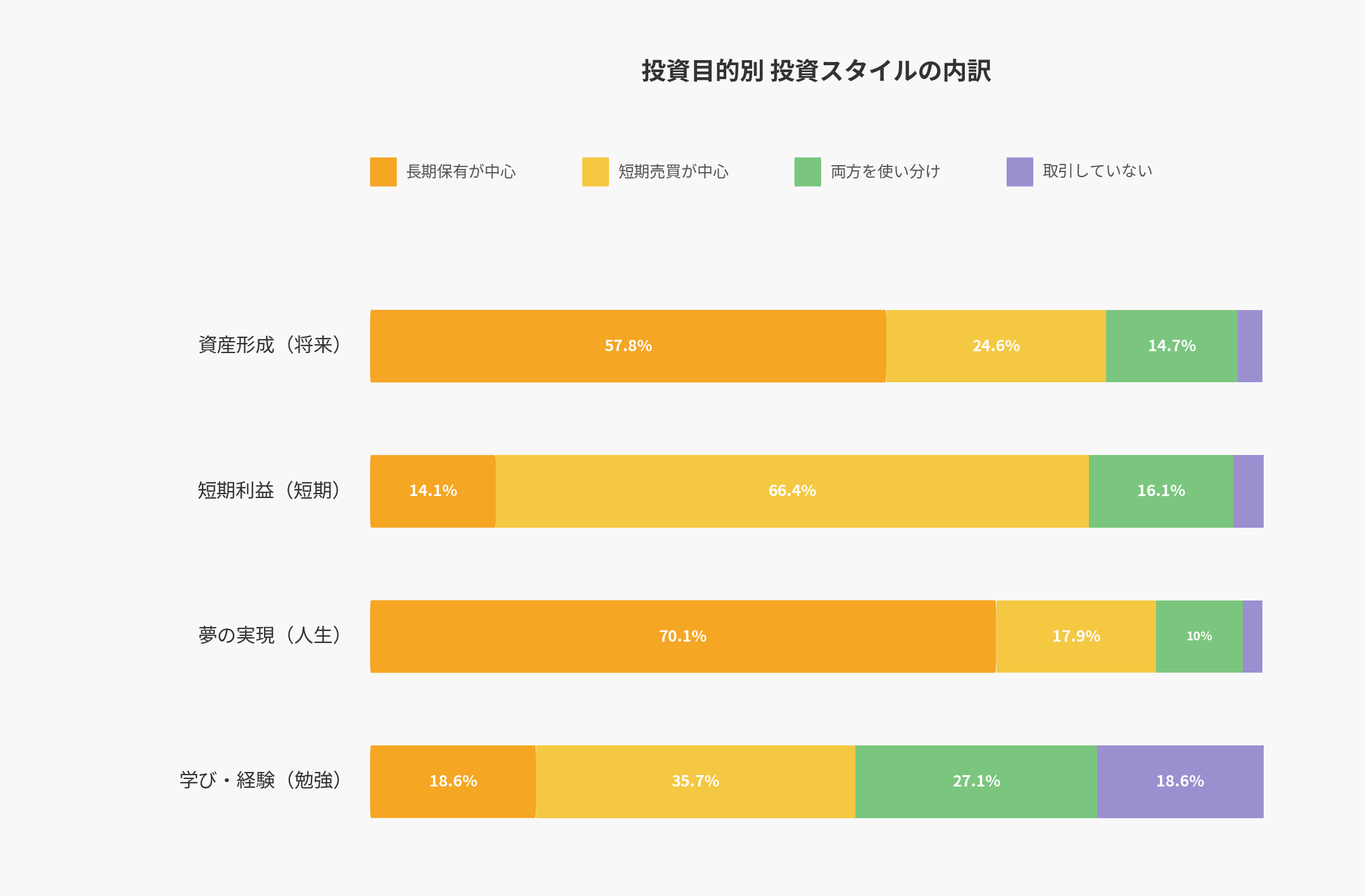
Purpose | Mainly long-term holding | Mainly short-term trading | A mix of both | Not trading |
|---|---|---|---|---|
Wealth building (future) | 57.8% | 24.6% | 14.7% | 2.8% |
Short-term profit (short-term) | 14.1% | 66.4% | 16.1% | 3.4% |
Realizing a dream (life) | 70.1% | 17.9% | 9.7% | 2.2% |
Learning & experience (study) | 18.6% | 35.7% | 27.1% | 18.6% |
Among investors whose purpose is building wealth for the future, 57.8% have adopted long-term holding as their main style.
Their stance is clear: they view crypto assets as a medium- to long-term growth asset and aim to grow their holdings patiently over time, without reacting to every day's small price movements.
Time-tested approaches such as dollar-cost averaging and HODLing (long-term holding) have deeply taken root within the wealth-building group.
Meanwhile, roughly four in ten also combine short-term trading, showing a degree of flexibility to lock in gains on a portion of holdings while taking a fundamentally long-term view.
That said, their core stance remains "holding for the future," and one can see the sensible judgment of keeping trading frequency low to optimize fees and tax burden.
This is high-quality data suggesting that maintaining a long-term perspective results in more stable investment behavior.
Adding a more professional analysis, this group's tendency toward long-term holding functions as a "stabilizer" that eases market volatility.
Precisely because their purpose is clear, they can avoid panic selling during price downturns and continue holding calmly.
The survey revealed that choosing a style by working backward from the goal of wealth building has become a winning pattern shared by many investors.
More Than Six in Ten "Short-Term Profit" Investors Specialize in Short-Term Trading in Pursuit of Gains
Purpose | Mainly long-term holding | Mainly short-term trading | A mix of both | Not trading |
|---|---|---|---|---|
Short-term profit (short-term) | 14.1% | 66.4% | 16.1% | 3.4% |
Among those whose purpose is short-term profit, 66.4% have chosen a style centered on short-term trading.
This is the highest figure among all purpose groups, and it represents a segment specialized in capturing small market distortions and trends to rotate capital efficiently.
One senses a strong resolve to stay constantly aware of "when to sell" and to actively engage in trading in order to generate returns.
Interestingly, even within this group, 16.1% are a "mix-and-match" segment that also uses long-term holding.
Rather than rotating all their capital short-term, some investors take a hybrid approach — leaving a portion parked long-term while earning primarily through short-term trades.
Even so, the majority still prioritize speed above all, and the agility to enter a position the moment an opportunity arises is the essence of this group.
This kind of short-term-specialized investment behavior requires a high degree of expertise and constant attention to the market, so it cannot be recommended for everyone.
The results of this survey vividly illustrate how strongly the purpose of short-term profit drives an extreme choice of style.
This once again confirms the correlation within investor profiles: purpose dictates investment method.
Half Use Their Profits to Prepare for the Future, Reflecting a Prudent Mindset
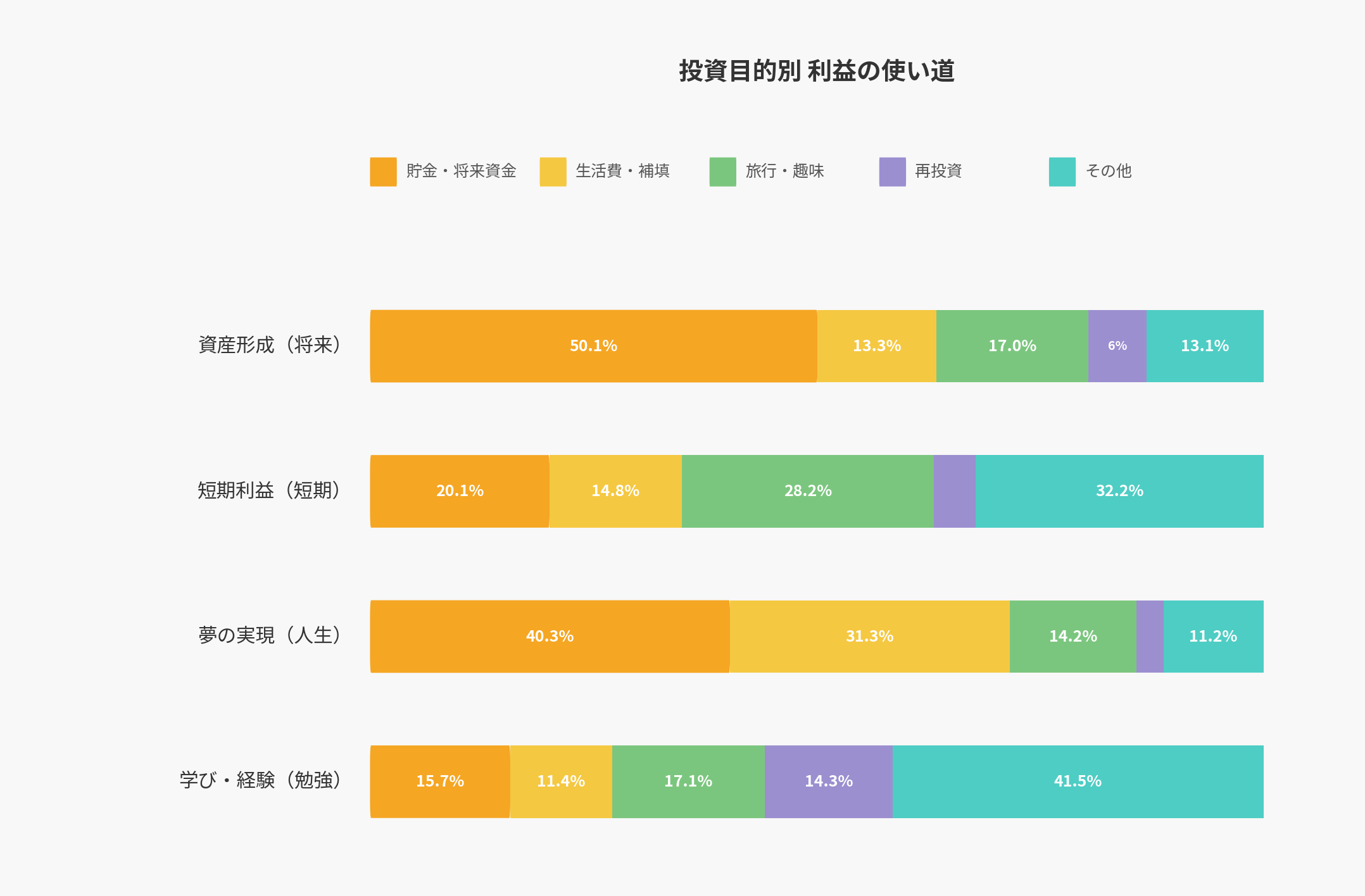
Purpose | Savings / future funds | Living expenses / income supplement | Travel / hobbies | Reinvestment | Other |
|---|---|---|---|---|---|
Wealth building (future) | 50.1% | 13.3% | 17.0% | 6.5% | 13.1% |
Short-term profit (short-term) | 20.1% | 14.8% | 28.2% | 4.7% | 32.2% |
Realizing a dream (life) | 40.3% | 31.3% | 14.2% | 3.0% | 11.2% |
Learning & experience (study) | 15.7% | 11.4% | 17.1% | 14.3% | 41.5% |
*The "Other" column in the table combines the responses "a major purchase," "for my family," and "not decided yet."
Asked what they would do with profits, 50.1% of the wealth-building group answered "put it toward savings or future funds."
This reveals a consistent, prudent financial literacy: rather than spending the fruits of their investment, they redirect it once again toward preparing for the future.
Even in their exit strategy, "growing assets" itself takes priority, reflecting a desire to raise their long-term quality of life.
Notably, even within the group chasing a dream, 40.3% consider putting profits toward future funds, while 31.3% cite "supplementing living expenses or payments."
This exposes a raw reality in which ideal and reality intersect: even while harboring big dreams, they need profit to shore up their immediate living foundation.
The fact that the dream-chasing group is, in reality, in urgent need of cash offers a highly important clue for understanding investor psychology.
Also notable is that within the short-term profit group, spending on "travel or hobbies" stands at 28.2% — higher than in other groups.
This reflects a positive attitude that values balance between consumption and investment, channeling earned profits immediately back into life's enjoyments.
Where an investor sets their investment "exit" can be seen as a mirror reflecting their values and outlook on life.
How Investment Purpose Shapes Risk Perception and Sources of Anxiety
The Wealth-Building Group Is Cautious, Focused on Price Volatility and Security
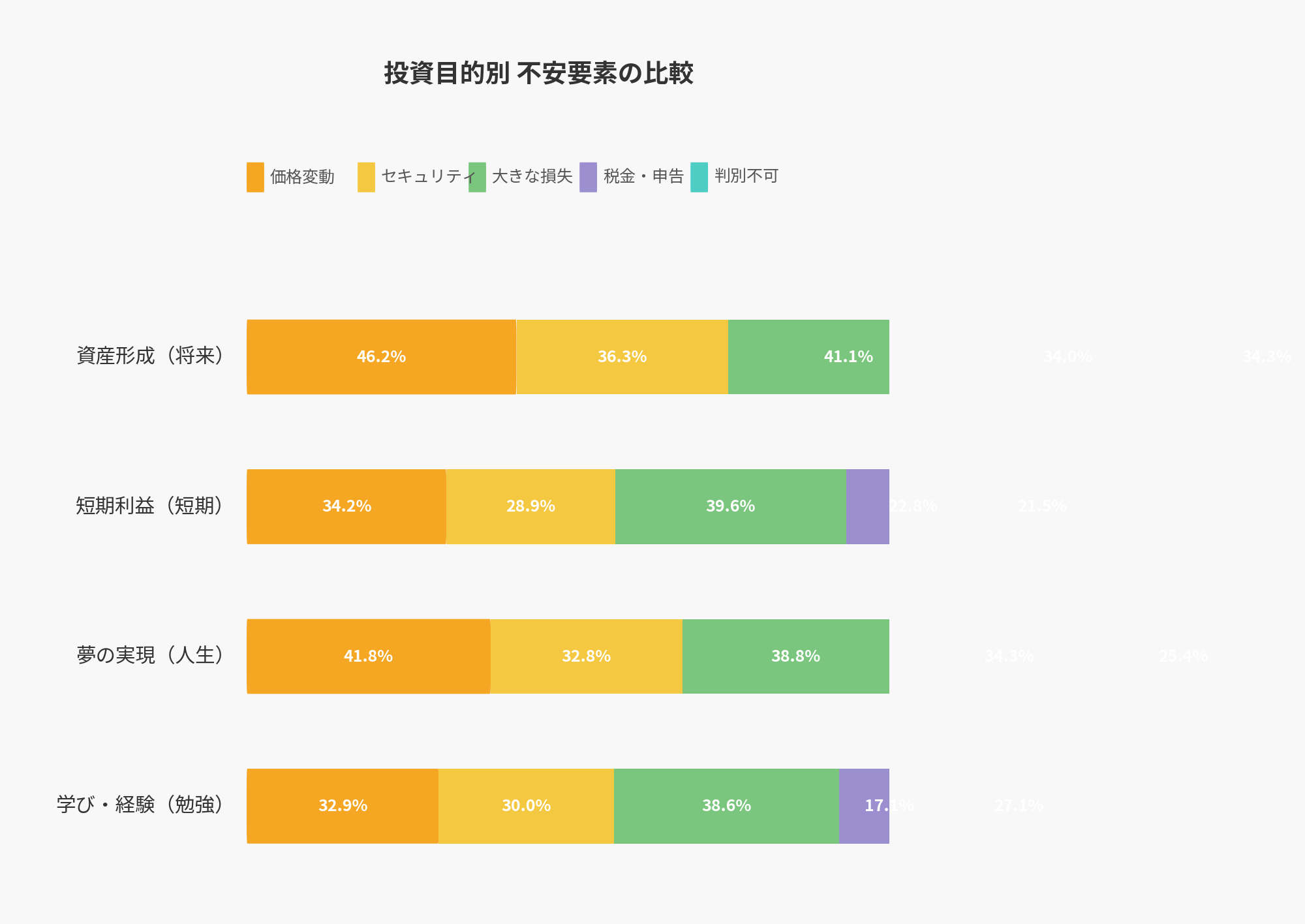
Purpose | Price volatility | Security | Major losses | Taxes and filing | Unable to judge |
|---|---|---|---|---|---|
Wealth building (future) | 46.2% | 36.3% | 41.1% | 34.0% | 34.3% |
Short-term profit (short-term) | 34.2% | 28.9% | 39.6% | 22.8% | 21.5% |
Realizing a dream (life) | 41.8% | 32.8% | 38.8% | 34.3% | 25.4% |
Learning & experience (study) | 32.9% | 30.0% | 38.6% | 17.1% | 27.1% |
Among investors whose purpose is future wealth building, anxiety over "sharp price volatility" (46.2%) ranks highest, revealing a cautious risk-management mindset.
The items "security" (36.3%) and "fear of losing a lot of money" (41.1%) are also at higher levels than in other groups.
This suggests that, precisely because they are managing important funds for the future, their wariness of "losing" assets is especially strong.
For a group premised on long-term holding, a temporary crash can also be an opportunity to buy more, but the psychological burden is by no means small.
The particularly deep-rooted anxiety over "being unable to judge whether information is accurate" (34.3%) illustrates that securing reliable sources of information remains a challenge.
This points to an extremely earnest investment stance: a desire to deepen their understanding of technical security and regulatory matters in order to protect their assets.
From a professional standpoint, this "abundance of anxiety" is itself a sign of high risk sensitivity, a positive factor that raises an investor's odds of survival.
By accumulating knowledge to resolve their anxieties and putting robust security measures in place, they can move closer to long-term success as a result.
The wealth-building group can be analyzed as a group that excels, relative to others, at turning anxiety into action rather than leaving it unaddressed.
Anxiety Over Taxes and Filing Stands Out at Over 30% Among "Dream Realizers"
Purpose | Anxious about taxes and tax filing | Sharp price volatility | Fear of major losses |
|---|---|---|---|
Realizing a dream (life) | 34.3% | 41.8% | 38.8% |
Among those dreaming of a windfall, the fact that "anxious about taxes and tax filing" reaches 34.3% cannot be overlooked.
This is precisely because, in aiming for an explosive profit (becoming what's known in Japan as an "oku-ri-bito," someone whose crypto gains exceed ¥100 million), their attention turns to the substantial taxes and complex calculations that arise at the "exit."
Under current law as of July 2026, gains from selling crypto assets are taxed as miscellaneous income under aggregate taxation; following a financial instruments law amendment enacted on July 15, 2026, crypto assets are set to be reclassified as financial instruments under the FIEA, with a 20% separate self-assessment tax rate expected to take effect from the year after the amended law comes into force (anticipated January 2028).
This reflects a kind of anticipatory anxiety unique to this group — feeling the regulatory hurdles even for profits they haven't yet made.
The anxiety over "fear of major losses" (38.8%) also runs deep, suggesting that even while leaning toward high-risk investing, they privately fear falling below their principal to an extreme degree.
The distribution of anxiety items clearly reflects a psychological state torn between dreams and reality.
Precisely because their expectations are high, it could be said that a defensive instinct is at work — a desire to minimize the shock of facing a negative scenario.
For this group, simulating the situation after locking in profits, and acquiring tax knowledge, are thought to contribute significantly to their psychological stability.
It's essential to dispel anxiety with accurate knowledge so that worrying about "what happens after earning" doesn't put the brakes on their investing.
The data shows that realizing a dream requires not just technical skill but also practical preparation in areas such as legal and tax matters.
Uncertainty Over Buy/Sell Timing Tops the List for the "Short-Term Profit" Group, at Over 30%
Purpose | Uncertain about buy/sell timing | No particular anxiety |
|---|---|---|
Short-term profit (short-term) | 32.2% | 13.4% |
Wealth building (future) | 31.7% | 9.1% |
Among those chasing short-term profit, anxiety over "not knowing buy/sell timing" (32.2%) was the highest figure among all groups.
This shows that, precisely because they trade frequently, the difficulty of judging "when to get in and when to get out" is a constant source of psychological pressure.
Their efforts to grasp the market's rhythm translate directly into their most pressing worry.
Also notable is that "no particular anxiety" (13.4%) is more common in this group than in others, pointing to investors who approach the market with a kind of resolute detachment.
Those who treat short-term trading as a game or a routine, trading mechanically with emotion set aside, may be maintaining a certain psychological stability.
What emerges is a picture of an active investor who, even while carrying anxiety, converts it into energy for trading.
The anxiety of the short-term profit group could be said to be two sides of the same coin as a drive to improve their skills.
Acknowledging the difficulty of timing the market, and then sharpening the precision of their technical analysis and information selection, is the only path to overcoming that anxiety.
How they overcome the wall they face precisely because of their high trading frequency will be a major turning point that shapes their investment results.
Summary
This survey made clear that in crypto asset investing, "purpose" produces dramatic differences — not just in investment amount and style, but even in the nature of the anxieties investors carry.
The "wealth-building" group, accounting for roughly half of all respondents, is characterized by a prudent stance of preparing for the future through a long-term holding style centered on amounts under ¥1 million.
By contrast, the roughly two-in-ten "short-term profit" group stands out for its active behavior — investing ¥1 million or more, wrestling with buy/sell timing, yet channeling profits into hobbies and travel.
Meanwhile, the roughly two-in-ten "realizing a dream" group displayed a raw reality of being torn between ideal and reality — seeking explosive returns from small stakes while also worrying about tax issues at the exit.
Objectively understanding your own investor type and managing risk in a way that fits your purpose is the first step toward investment outcomes you can feel confident about.
Reconfirming the fundamental question of "why am I investing" and holding on to your own set of standards will be key to surviving a turbulent market.
Survey Overview
Survey date: February 24, 2026
Survey method: Internet survey
Survey subjects: Men and women residing in Japan (people currently investing in crypto assets, or who have invested in the past)
Valid responses: 1,221
Conducted by: Clabo, Inc.
Survey Questions
- Have you ever invested in crypto assets (virtual currency)?
- What is your current investment amount in crypto assets?
- Please select the one option that best describes your main purpose for investing in crypto assets.
- If you earn a profit, how would you like to use it (or how do you plan to use it)?
- What concerns do you have about investing in crypto assets?
This article is for informational purposes only and does not constitute financial or investment advice. Please consult a qualified professional before making investment decisions.


