


The crypto assets (also known as virtual currencies) market is entering a new investment phase. Once viewed mainly as a speculative vehicle, it is increasingly seen as a viable option for building wealth. Yet how much profit individual holders actually earn remains largely unclear.
This article presents a detailed analysis of the distribution of annual profits among crypto holders and the investment styles most closely linked to returns, based on an original survey of 307 crypto users conducted by our company.
The survey found that around 75% of users have experienced profits, yet roughly 70% of those profits fell under ¥100,000 (about $650), pointing to a remarkably conservative approach to investing. Using the latest data, this article unpacks what strategies “winning” crypto holders choose and how they gather information to succeed.
Profits Under ¥50,000 Make Up the Majority, Reflecting Small-Scale Investing
Just Over 20% Report Consistent Annual Profits
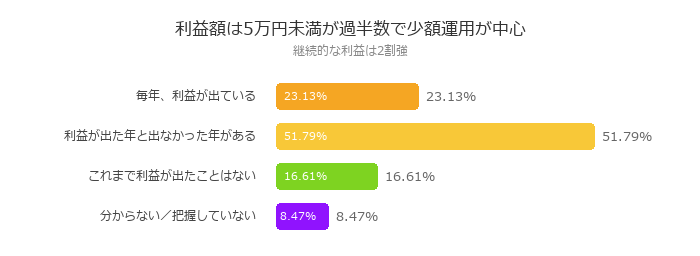
Response | Respondents | Percentage |
|---|---|---|
Profit every year | 71 | 23.13% |
Some years profitable, some not | 159 | 51.79% |
Never made a profit | 51 | 16.61% |
Don’t know / not tracked | 26 | 8.47% |
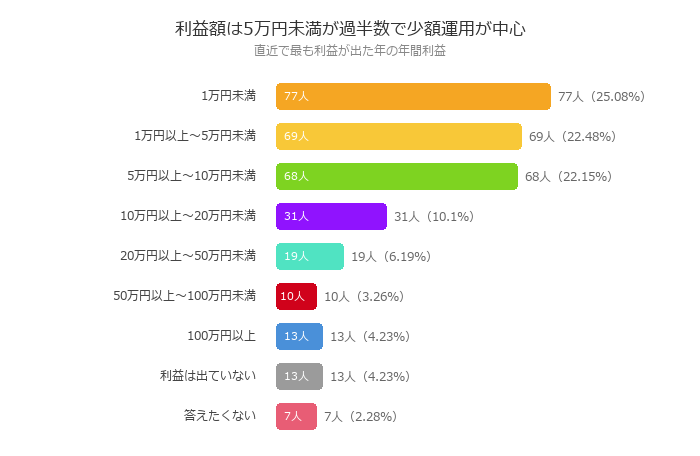
Annual profit in the most profitable recent year | Respondents | Percentage |
|---|---|---|
Under ¥10,000 | 77 | 25.08% |
¥10,000–under ¥50,000 | 69 | 22.48% |
¥50,000–under ¥100,000 | 68 | 22.15% |
¥100,000–under ¥200,000 | 31 | 10.1% |
¥200,000–under ¥500,000 | 19 | 6.19% |
¥500,000–under ¥1,000,000 | 10 | 3.26% |
¥1,000,000 or more | 13 | 4.23% |
No profit | 13 | 4.23% |
Prefer not to answer | 7 | 2.28% |
According to our in-house survey, 23.13% of respondents said they “make a profit every year” trading crypto assets. Combined with the 51.79% who said “some years were profitable and some were not,” roughly 75% of all respondents have achieved profitability at some point. This shows that, despite market volatility, many holders are capturing opportunities as they arise.
Looking at the breakdown of annual profit amounts, the largest share was “under ¥10,000” at 25.08%. Adding “¥10,000–under ¥50,000” (22.48%) and “¥50,000–under ¥100,000” (22.15%) brings the total to 69.71% of respondents whose profits stayed under ¥100,000. This suggests that most individual holders are pursuing steady, small-scale returns rather than chasing massive gains.
On the other hand, only 4.23% of holders achieved high-value profits of ¥1,000,000 or more. While crypto assets are often associated with the idea of striking it rich, the actual data points to a picture of holders steadily accumulating modest gains while keeping risk in check.
This suggests that the crypto market has already begun shifting in holders’ minds from a purely speculative arena to one option among many for building long-term wealth.
Profits Over ¥1,000,000 Are Concentrated Among Households Earning ¥8,000,000+
Household income | Under ¥10K | ¥10K–50K | ¥50K–100K | ¥100K–200K | ¥200K–500K | ¥500K–1M | ¥1M+ | No profit | Prefer not to answer |
|---|---|---|---|---|---|---|---|---|---|
Under ¥2M | 15 | 11 | 8 | 1 | 1 | 0 | 1 | 3 | 3 |
¥2M–4M | 15 | 16 | 18 | 3 | 2 | 3 | 1 | 1 | 1 |
¥4M–6M | 24 | 23 | 13 | 8 | 5 | 2 | 2 | 2 | 2 |
¥6M–8M | 10 | 11 | 13 | 11 | 8 | 3 | 4 | 3 | 1 |
¥8M–10M | 8 | 6 | 7 | 6 | 2 | 1 | 1 | 1 | 0 |
¥10M–12M | 2 | 2 | 6 | 1 | 0 | 0 | 3 | 1 | 0 |
¥12M–15M | 0 | 0 | 1 | 1 | 0 | 1 | 0 | 1 | 0 |
¥15M–20M | 2 | 0 | 2 | 0 | 0 | 0 | 0 | 1 | 0 |
¥20M+ | 1 | 0 | 0 | 0 | 1 | 0 | 1 | 0 | 0 |
An analysis of the correlation between household income and annual crypto profit shows that the likelihood of earning more than ¥100,000 rises with income level. Notably, among households earning ¥6,000,000–8,000,000, 26 respondents reported profits of ¥100,000 or more — about half of all profit-earners in that income bracket. This data underscores a basic principle of investing: the amount of surplus capital available for investment is directly reflected in the absolute size of returns.
Looking at the top profit bracket of ¥1,000,000 or more, respondents in this range are concentrated among households earning ¥8,000,000 or higher. Notably, in the ¥10,000,000–12,000,000 income bracket, about 20% of respondents achieved profits exceeding ¥1,000,000. This suggests that with sufficient investment capital, substantial returns are achievable through spot trading alone, without resorting to aggressive leverage.
At the same time, a common thread across all income levels is that profits “under ¥50,000” remain the most frequent outcome. Even among affluent households earning over ¥10,000,000, most profits stay in the range of a few tens of thousands of yen, indicating that risk-taking behavior — such as putting the bulk of one’s assets into crypto — remains restrained. In short, while higher income does correlate with larger profits, a cautious and sound approach to investing holds across every income bracket.
Investors in Their 40s and 50s Lead in Profitability
Age group (by decade) | Under ¥10K | ¥10K–50K | ¥50K–100K | ¥100K–200K | ¥200K–500K | ¥500K–1M | ¥1M+ | No profit | Prefer not to answer |
|---|---|---|---|---|---|---|---|---|---|
In their 20s | 4 | 18 | 20 | 4 | 4 | 2 | 0 | 2 | 0 |
In their 30s | 25 | 19 | 19 | 10 | 4 | 5 | 2 | 5 | 2 |
In their 40s | 24 | 14 | 9 | 10 | 7 | 3 | 5 | 2 | 1 |
In their 50s | 22 | 10 | 16 | 3 | 2 | 0 | 4 | 2 | 4 |
In their 60s | 1 | 7 | 3 | 2 | 1 | 0 | 0 | 2 | 0 |
70 and older | 1 | 1 | 1 | 2 | 1 | 0 | 2 | 0 | 0 |
A detailed look at profit performance by age group reveals that holders in their 40s and 50s are driving profitability in the crypto market. No respondent in their 20s reported profits exceeding ¥1,000,000, with most of their gains concentrated under ¥100,000. By contrast, five respondents in their 40s and four in their 50s achieved profits of ¥1,000,000 or more, showing that the range of achievable profit widens with age.
Respondents in their 30s also show a meaningful number earning mid-range profits of ¥100,000 or more, suggesting active engagement in building assets. At the same time, the share reporting “no profit” is higher among younger age groups, which may reflect their relative lack of market experience. Many younger holders appear to be starting with small amounts and using this period to get accustomed to market swings.
Interestingly, some respondents aged 70 and older also reported profits of ¥1,000,000 or more. This generation may be applying investment experience built through traditional financial assets to the crypto market as well, executing well-timed exit strategies. Overall, the data suggests that as holders accumulate capital and experience with age, their capacity for sound investment judgment — and larger profits — grows accordingly.
A Steady Investment Style Is Key to Stable Returns
Nearly Half of Holders Choose Long-Term Holding
Investment style | Respondents | Percentage |
|---|---|---|
Mainly long-term holding | 148 | 48.21% |
Combination of short-term trading and long-term holding | 67 | 21.82% |
Mainly short-term trading | 57 | 18.57% |
Low trading frequency | 19 | 6.19% |
Prefer not to answer | 16 | 5.21% |
Our survey found that “mainly long-term holding” was the most common response at 48.21%, roughly 2.6 times higher than “mainly short-term trading” (18.57%). This shows that, even in the crypto market, waiting for long-term value appreciation is the dominant strategy. While crypto assets are known for sharp price swings, most holders appear to stay the course rather than react to short-term fluctuations.
A hybrid group that combines short-term trading with long-term holding accounts for another 21.82%. Including this group, roughly 70% of all respondents incorporate long-term holding into their investment strategy in some form. This tendency — avoiding the stress and fee burden of frequent trading in favor of expected long-term market growth — reflects crypto assets’ evolution into a more mature investment vehicle.
That said, a certain share of respondents trade infrequently or declined to answer, showing that the degree of investment engagement varies by individual. Overall, however, the data clearly show that “medium-to-long-term wealth building” outweighs “short-term speculation,” confirming long-term holding as the prevailing approach to crypto investing.
Over 60% of Long-Term Holders Have Experienced Profits
Trading style / Profit record | Profit every year | Some years profitable, some not | Never made a profit | Don’t know / not tracked |
|---|---|---|---|---|
Mainly long-term holding | 38 | 79 | 24 | 7 |
Combination of short-term trading and long-term holding | 21 | 38 | 4 | 4 |
Mainly short-term trading | 11 | 34 | 8 | 4 |
Low trading frequency | 1 | 5 | 8 | 5 |
Prefer not to answer | 0 | 3 | 7 | 6 |
Cross-analyzing trading style with profit outcomes shows that long-term holders significantly outperform in terms of profit stability. Among the 148 respondents who mainly hold long-term, 117 — about 79% of that group — reported either “profit every year” or “some years profitable.” This suggests that by disregarding short-term volatility and continuing to hold, many investors end up exiting positions at favorable moments.
Among those who combine short-term trading with long-term holding, about 88% have experienced profits, indicating an especially efficient investment approach. Within this group, 31% reported “profit every year” — higher than the 25% seen among pure long-term holders — suggesting that flexibly adapting to market conditions may be paying off. Letting part of one’s portfolio sit while locking in gains on another part is a rational way to balance risk management with return-seeking.
By contrast, only about 31% of respondents who trade infrequently reported having experienced profits, and a majority said they have “never made a profit.” This dormant style of investing may cause holders to miss out on opportunities to lock in gains. For stable returns, it appears important to either commit clearly to a long-term holding strategy or stay engaged enough to respond to market changes.
Over 80% of Female Holders Center Their Approach on Long-Term Holding
Gender / Trading style | Mainly long-term holding | Combination of short-term and long-term | Mainly short-term trading | Low trading frequency | Prefer not to answer |
|---|---|---|---|---|---|
Male | 96 | 48 | 44 | 10 | 11 |
Female | 52 | 19 | 13 | 9 | 5 |
An analysis of trading style by gender reveals an interesting difference in investment approach. Male respondents center their approach on long-term holding (about 45%) but also actively engage in short-term trading (about 21%) and a mix of both (about 23%). A notable share of men actively pursue profits through hands-on trading, contributing to market liquidity.
Among female respondents, long-term holding accounts for about 53% — a majority — and rises to over 70% when combined with the hybrid approach. Only about 13% of women said they mainly trade short-term, a markedly more conservative tendency than seen among men, aimed at steadily growing assets while minimizing risk. This suggests that many women view crypto assets through the lens of household financial planning and preparing for the future, favoring a more safety-oriented investment style.
This difference may also reflect variation in how much time and effort each group devotes to gathering information. Men appear more likely to enjoy frequent price-checking and technical analysis, while women tend to favor a “set-and-forget” style that fits more naturally into daily life. While long-term holding is the dominant approach across both genders, men appear to combine a wider range of methods when engaging with the market.
Steady Growth: Starting Small and Building Assets Over Time
Over 70% Started With Less Than ¥100,000
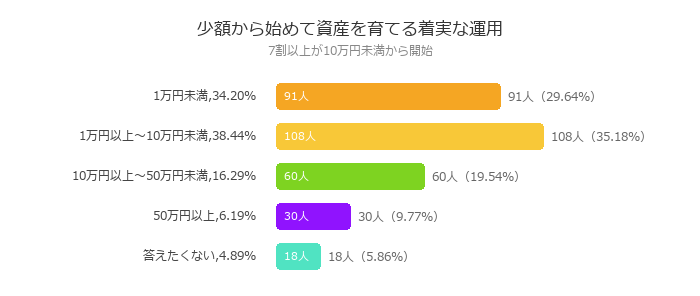
Change in investment amount | Initial investment (Q5) | Current investment size (Q6) |
|---|---|---|
Under ¥10,000 | 105 (34.20%) | 91 (29.64%) |
¥10,000–under ¥100,000 | 118 (38.44%) | 108 (35.18%) |
¥100,000–under ¥500,000 | 50 (16.29%) | 60 (19.54%) |
¥500,000 or more | 19 (6.19%) | 30 (9.77%) |
Prefer not to answer | 15 (4.89%) | 18 (5.86%) |
Our survey found that a combined 72.64% of respondents began crypto investing with “under ¥100,000.” The largest single group was “¥10,000–under ¥100,000” (38.44%), showing that most holders enter the market with amounts that won’t strain their daily finances. Given the widely understood volatility of crypto assets, there is a clear tendency to avoid committing large sums of money upfront.
Current investment size shows a similar overall pattern, but the share investing “¥100,000 or more” has grown steadily compared to the initial figures. The “¥100,000–under ¥500,000” bracket rose from 16.29% to 19.54%, and “¥500,000 or more” rose from 6.19% to 9.77%. This suggests that holders who started small have gradually increased their investment as they gained a better understanding of the market, expanding their overall asset scale.
At the same time, it’s worth noting that “under ¥10,000” (29.64%) and “¥10,000–under ¥100,000” (35.18%) still together account for roughly two-thirds of respondents today. Maintaining investment within a manageable range, rather than aggressively scaling up, appears to be the majority approach among individual crypto holders in Japan. This reaffirms that crypto assets’ appeal as something “you can start with a small amount” continues to resonate with a broad range of investors.
Among Investors With ¥500,000+ Committed, About Half Earned Over ¥200,000
Current investment size / Recent profit | Under ¥100K | ¥100K–under ¥500K | ¥500K or more | No profit / Other |
|---|---|---|---|---|
Under ¥10,000 | 84 | 3 | 1 | 3 |
¥10,000–under ¥100,000 | 93 | 9 | 2 | 4 |
¥100,000–under ¥500,000 | 29 | 25 | 4 | 2 |
¥500,000 or more | 2 | 12 | 14 | 2 |
Prefer not to answer | 6 | 1 | 2 | 9 |
Cross-tabulating current investment size with annual profit reveals a striking correlation: the likelihood of earning a large profit rises dramatically as the invested amount increases.
Among those investing under ¥10,000, profits overwhelmingly stay under ¥100,000. By contrast, among those investing ¥500,000 or more, 26 out of 30 respondents earned annual profits of ¥200,000 or more — a rate of about 86.7%.
Notably, 14 respondents investing ¥500,000 or more also earned profits of ¥500,000 or more. This suggests that securing sufficient investment capital is a decisive factor in raising the absolute size of returns in the crypto market. With a larger principal, even a modest price change translates into a larger profit in absolute terms, enabling efficient wealth building without resorting to risky trades.
That said, even holders investing under ¥100,000 frequently earn steady profits in the ¥50,000–100,000 range. This suggests that small-scale holders who lock in gains at the right moments can achieve very high returns relative to their principal. While the size of achievable profit naturally scales with investment size, the data shows that holders across all investment levels can achieve solid results by managing their own capital appropriately.
Long-Term Holding Is the Leading Source of Profit
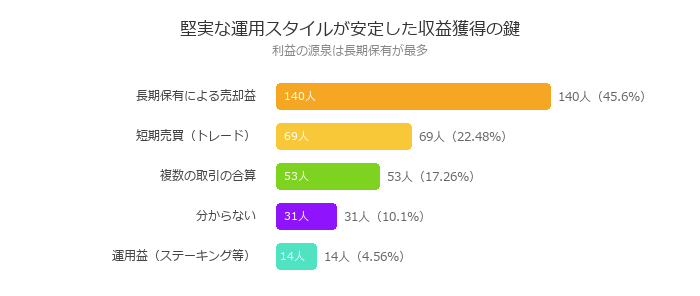
Main source of profit | Respondents | Percentage |
|---|---|---|
Capital gains from long-term holding | 140 | 45.60% |
Short-term trading | 69 | 22.48% |
Combined gains from multiple trades | 53 | 17.26% |
Don’t know | 31 | 10.10% |
Yield income (e.g., staking) | 14 | 4.56% |
An analysis of what kind of trading generated respondents’ profits found that “capital gains from long-term holding” was the leading source at 45.60%. This data confirms that the “long-term holding” style discussed earlier is, in practice, the strongest engine of profitability. Waiting for asset value to grow, rather than reacting to every daily price swing, appears to be paying off for many holders.
Profits from “short-term trading” (22.48%) also exist but amount to roughly half the share attributed to long-term holding. Since short-term trading demands significant skill and time, it appears less reproducible as a profit source for the average individual holder than long-term holding. The “combined gains from multiple trades” response (17.26%) also points to holders spreading risk by mixing holding and trading strategies.
Meanwhile, holders relying mainly on “yield income” such as staking or lending (4.56%) remain a minority for now. However, since this income-generating model rewards holders simply for holding assets, interest in it may grow as the market matures further. At present, the “winning strategy” in crypto investing appears to center on pursuing capital gains from rising prices while holding assets with a long-term perspective.
Half of Holders Say Their Profits Were “Within Expectations”
Over 50% Rely on News Sites for Information
Information source | Respondents | Selection rate |
|---|---|---|
News sites | 169 | 55.05% |
Social media (X, YouTube, TikTok, etc.) | 147 | 47.88% |
Specialized crypto media | 128 | 41.69% |
Exchange or official service announcements | 121 | 39.41% |
Friends and acquaintances | 87 | 28.34% |
Do not actively gather information | 16 | 5.21% |
Our survey found that “news sites” were the top information source for crypto trading, cited by 55.05% of respondents, followed by “social media” (47.88%) and “specialized media” (41.69%). This shows that holders combine multiple digital channels to gather information from various angles. News sites taking the top spot reflects how closely crypto prices track macroeconomic conditions and regulatory developments.
Looking at trends by investment style, long-term holders use news sites (81 respondents) and social media (79 respondents) at almost equal rates. Among those who combine short-term trading with long-term holding, news sites were the most-used source, suggesting this group values both accuracy and timeliness of information. Official announcements from exchanges are also relied on by roughly 40% of respondents, pointing to a hybrid information-gathering style that combines trustworthy primary sources with a read on market sentiment via social media.
Notably, about 28% of respondents also cite “friends and acquaintances” as an information source, showing that word of mouth within personal networks still carries meaningful influence. That said, only 5.21% of respondents said they “don’t actively gather information,” meaning the vast majority of crypto holders are engaged in some form of ongoing learning. There appears to be a shared understanding among holders that staying well-informed is essential to navigating a highly uncertain market.
About Half of Long-Term Holders Say Their Profits Matched Expectations
Investment style / Perception of profit | Within expectations | Less than expected | More than expected | No particular impression |
|---|---|---|---|---|
Mainly long-term holding | 79 | 51 | 10 | 8 |
Combination of short-term trading and long-term holding | 41 | 11 | 8 | 7 |
Mainly short-term trading | 22 | 25 | 2 | 8 |
Low trading frequency | 7 | 6 | 1 | 5 |
Prefer not to answer | 1 | 0 | 2 | 13 |
Asked about their subjective perception of the profits they earned, the most common response overall was “within the expected range” (48.86%). This suggests that many holders understand market volatility going in and set reasonable expectations from the start. Among long-term holders in particular, about 53% said their profits were “within expectations,” suggesting that a patient, unhurried approach contributes to psychological ease and well-managed expectations.
Interestingly, among those who mainly trade short-term, more respondents said their profits were “less than expected” (25) than “within expectations” (22). While many people turn to short-term trading hoping for high returns, the data reflects the difficulty of matching expectations to reality once market swings and fees come into play. Only 7.49% of all respondents reported profits that were “more than expected,” underscoring that a stroke of unexpected luck is far from the norm in crypto investing.
Among the hybrid group that mixes short-term trading with long-term holding, a very high share reported profits “within expectations,” suggesting a strong sense of satisfaction with their results. Holders who have found an approach that works for them tend to accept their outcomes calmly, which may in turn support their motivation to keep investing over the long run. Overall, the data suggests that holders who can view their actual returns as “expected” — rather than being swept up by emotional expectations — are the ones building the most stable position in the market.
40% Are Seeking a More Efficient Investment Style
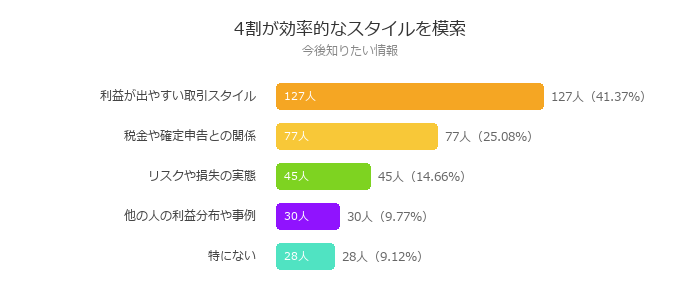
Information wanted going forward | Respondents | Percentage |
|---|---|---|
Trading styles that generate profit more easily | 127 | 41.37% |
How it relates to taxes and tax filing | 77 | 25.08% |
The realities of risk and loss | 45 | 14.66% |
Other people’s profit distributions and case examples | 30 | 9.77% |
Nothing in particular | 28 | 9.12% |
Asked what information they want going forward, “trading styles that generate profit more easily” was the overwhelming top choice at 41.37%. This reflects the ambition of holders who, despite already earning some profit under their current approach, are looking for more efficient or stable ways to generate returns. This was the top response across every investment style, confirming a strong, consistent desire to keep refining one’s approach in a market that evolves quickly.
The next-highest area of interest was “taxes and tax filing” (25.08%). Given Japan’s complex crypto tax system, holders clearly recognize that handling tax obligations is an unavoidable part of the exit strategy once profits are realized. Demand was especially strong among long-term holders and the hybrid group, reflecting a desire for knowledge that helps protect the “actual take-home amount” after securing gains.
A notable share of respondents also want to know more about “the realities of risk and loss” (14.66%), reflecting a cautious mindset that goes beyond surface-level success stories to understand the risks involved. Crypto holders are not simply chasing profit uncritically — they show a high degree of literacy in weighing institutional challenges and potential risks. These findings offer a clear signal of the kind of information media outlets and services should be providing going forward.
Summary
This survey paints a clear picture of today’s crypto holders. Unlike the speculative image of the past, the data reveals a healthy market in which many holders are steadily building assets while managing risk.
The survey also found that while about 75% of holders have experienced profits, roughly 70% of those profits fall into the conservative range of under ¥100,000 per year. Long-term holding is the dominant investment style, and about 46% of profits come from capital gains at sale. Over 70% of holders started with less than ¥100,000, gradually increasing their investment as they gained experience.
In summary, the key to achieving stable results in the crypto market appears to lie in starting with an amount you can comfortably afford, gathering information from reliable sources, and holding assets with a long-term perspective.
Survey Overview
Survey date: February 24, 2026
Survey method: Internet survey
Survey population: Men and women residing in Japan who are currently investing, or have previously invested, in crypto assets
Valid responses: 307
Conducted by: Clabo Inc.
Survey Questions
- Have you ever used virtual currency (crypto assets)?
- In your crypto trading, have you ever had a year with an annual profit?
- What was your annual profit from crypto trading in your most profitable recent year? Please choose the closest amount.
- What kind of trading mainly generated the profit above?
- What was your initial investment amount when you started crypto trading? Please choose the closest amount.
- What is your current investment size in crypto assets? Please choose the closest amount.
- Which trading style best describes your approach to crypto trading?
- Where do you mainly get information about crypto trading?
- Regarding your annual profit from crypto trading, which best describes your personal impression?
- Regarding profits from crypto trading, what information would you most like to know going forward?
This article is for informational purposes only and does not constitute financial or investment advice. Please consult a qualified professional before making investment decisions.


