


When investors in crypto assets (also known as virtual currencies) are uncertain about a trade, having someone trustworthy to consult can change the decision they make.
An original survey of 992 people conducted by Clabo found that roughly three in ten investors are managing their portfolios in isolation, with no one to turn to for advice.
More than half of that group also said the absence of a confidant affects their investment decisions, suggesting that isolation is directly linked to hesitation and anxiety in decision-making.
This article uses the latest survey data to take a close look at how having (or not having) someone to consult affects investment continuation rates and the psychological pull toward quitting.
From the striking fact that around 40% of people who have quit investing in the past were isolated, to the surprising reversal in which people with confidants report more worries, we break it all down from a professional perspective.
Here are the insights that can help you move beyond being a "lonely investor" and make more confident decisions.
Nearly 30% Have No One to Consult, and Only 7.4% Turn to Experts
No One to Consult Tops the List at 28.4%
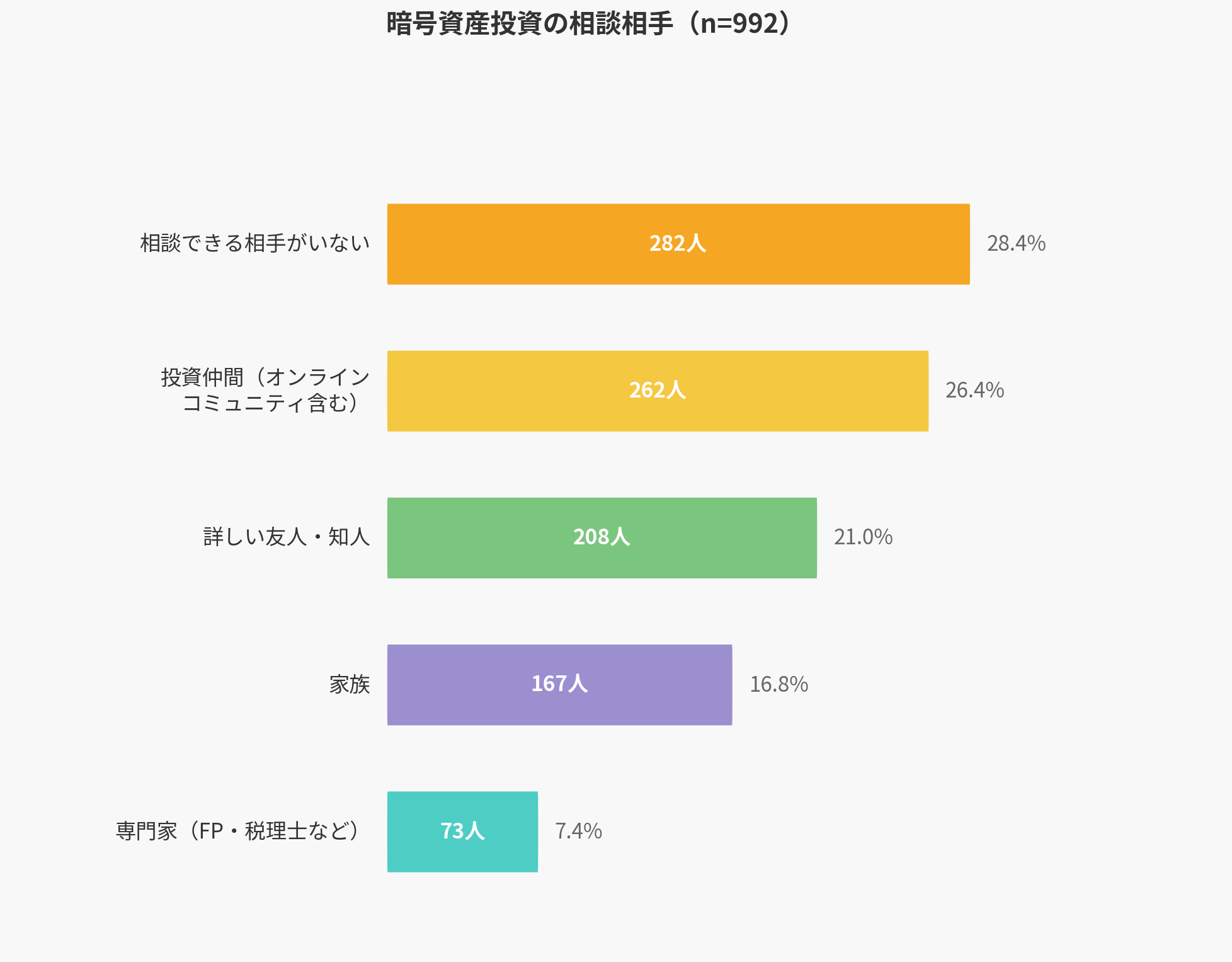
Answer | Respondents | Share |
|---|---|---|
No one to consult | 282 | 28.4% |
Investing peers (including online communities) | 262 | 26.4% |
Knowledgeable friends or acquaintances | 208 | 21.0% |
Family | 167 | 16.8% |
Experts (financial planners, tax accountants, etc.) | 73 | 7.4% |
When we surveyed who crypto investors consult, "no one to consult" was the most common answer at 28.4%.
This means roughly one in three investors is making decisions entirely alone in a market known for its sharp price swings.
The next most common answer was "investing peers (including online communities)" at 26.4%, showing that connections formed through social media and chat tools play an important role.
Meanwhile, only 16.8% consult "family," suggesting a tendency to prioritize online relationships over those closest to them.
Notably, only 7.4% of investors are able to consult an "expert." Despite the field's complex tax and regulatory landscape, fewer than one in fifteen investors receive professional advice.
Households Earning ¥10 Million or More Consult Experts More Often
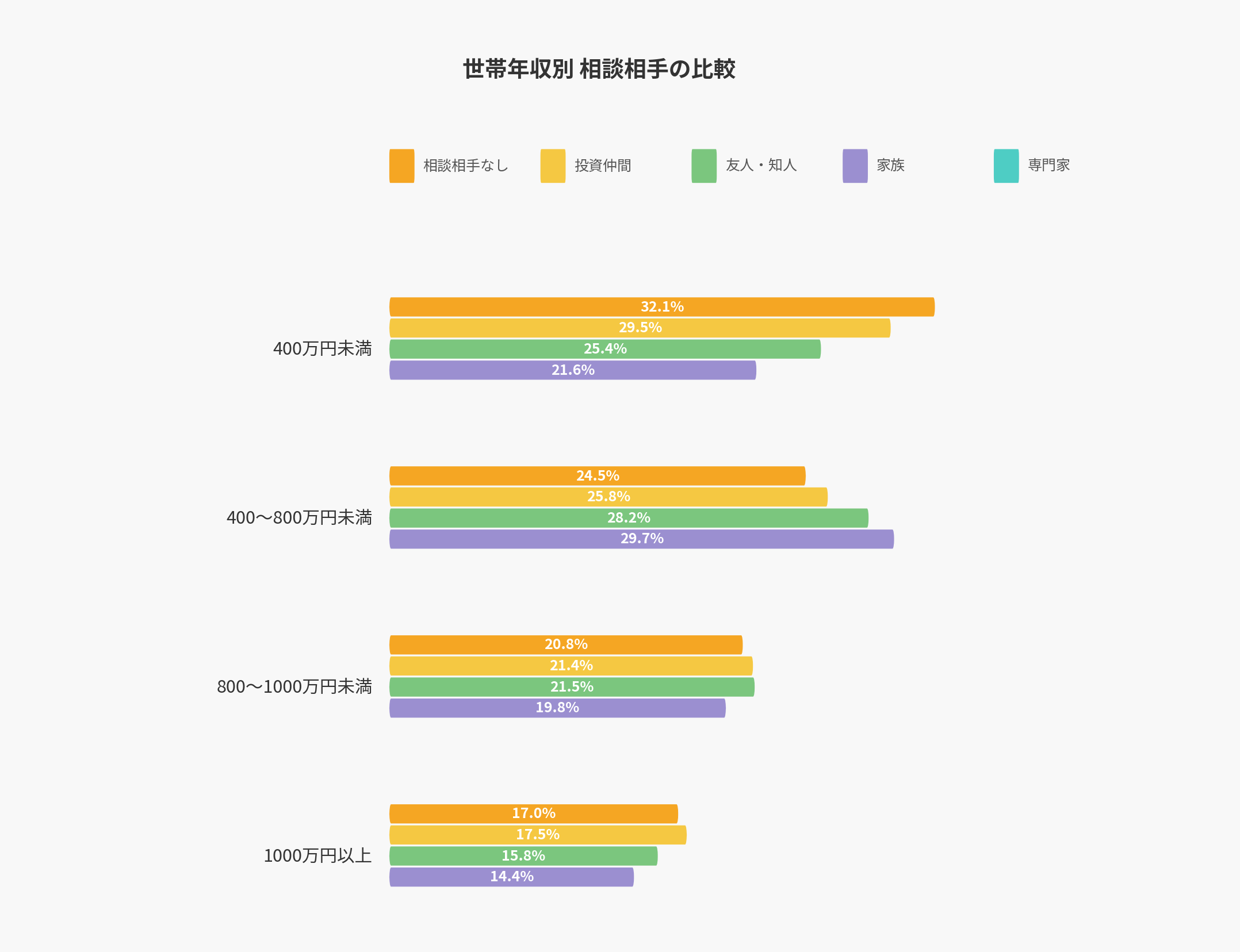
Household Income | No One to Consult | Investing Peers | Friends/Acquaintances | Family | Experts |
|---|---|---|---|---|---|
Under ¥4 million | 32.1% | 24.5% | 20.8% | 17.0% | 5.6% |
¥4M to under ¥8M | 29.5% | 25.8% | 21.4% | 17.5% | 5.8% |
¥8M to under ¥10M | 25.4% | 28.2% | 21.5% | 15.8% | 9.1% |
¥10 million or more | 21.6% | 29.7% | 19.8% | 14.4% | 14.5% |
Breaking the data down by household income shows a clear trend: as income rises, so does the share of investors who consult an "expert."
Among households earning ¥10 million or more, 14.5% consult an expert, more than 2.5 times the rate seen among households earning under ¥4 million (5.6%).
Higher-income investors appear to have a stronger awareness of protecting their assets and are more proactive about accessing professionals such as tax accountants and financial planners.
Conversely, the share with "no one to consult" is highest among lower-income households at 32.1%, which may point to an information gap that also affects the quality of their decisions.
Higher-income households are also more likely to have "investing peers," at 29.7%, indicating that they build multiple channels for gathering information.
The data suggests that financial flexibility is directly linked to broader and higher-quality advisory networks.
35.1% of Civil Servants Have No One to Consult
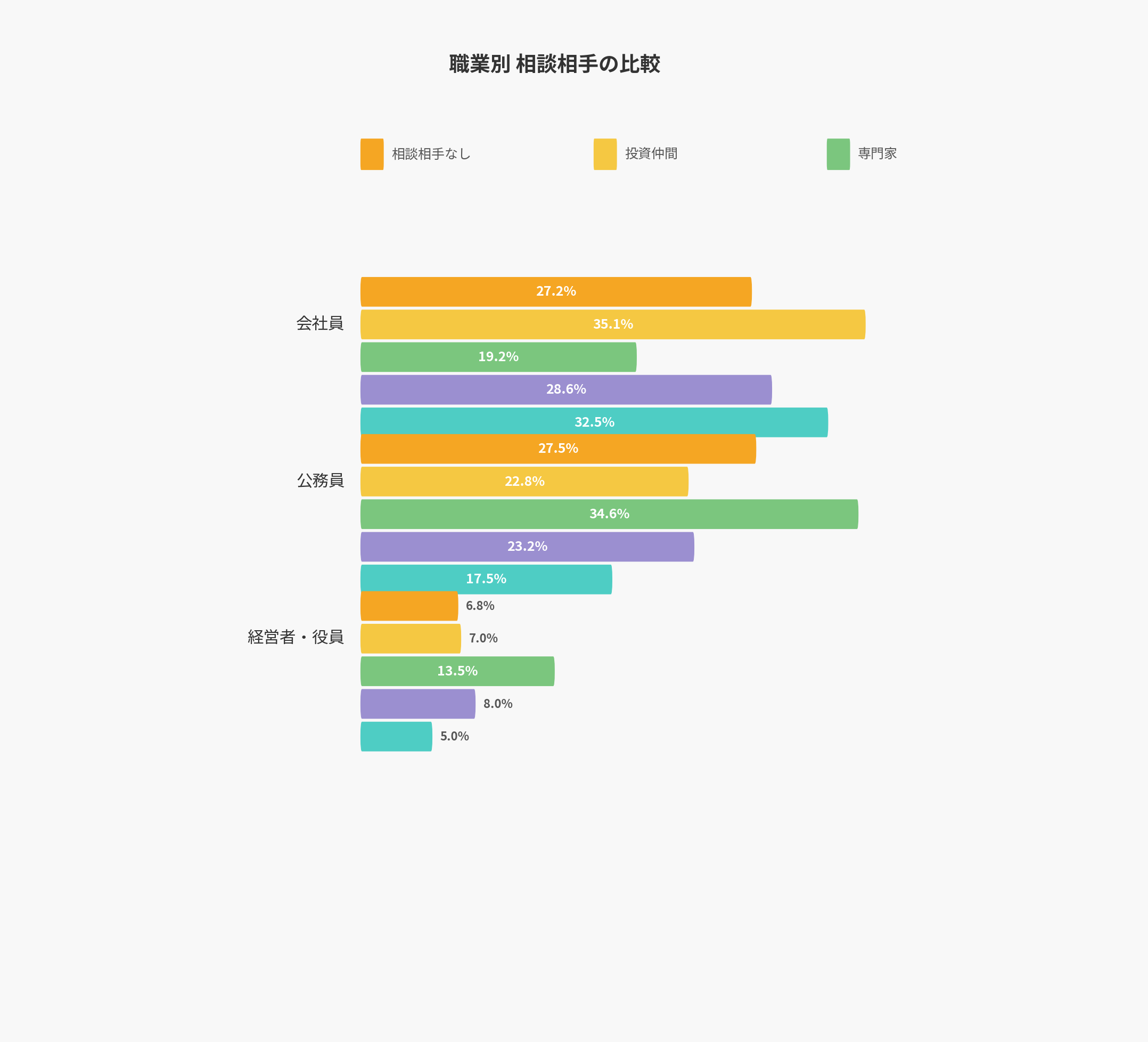
Occupation | No One to Consult | Investing Peers | Friends/Acquaintances | Family | Experts |
|---|---|---|---|---|---|
Company employee | 27.2% | 27.5% | 21.6% | 16.9% | 6.8% |
Civil servant | 35.1% | 22.8% | 19.3% | 15.8% | 7.0% |
Business owner / executive | 19.2% | 34.6% | 19.2% | 13.5% | 13.5% |
Self-employed / freelance | 28.6% | 23.2% | 22.3% | 17.9% | 8.0% |
Homemaker | 32.5% | 17.5% | 21.3% | 23.7% | 5.0% |
By occupation, "no one to consult" was highest among civil servants at 35.1%, showing that this group is particularly prone to isolation compared with other occupations.
This may reflect a psychological barrier to discussing investing openly given the nature of civil-service work, as well as the influence of the workplace environment.
By contrast, "business owners and executives" had the lowest share with no one to consult, at 19.2%, and maintained strong ties to both investing peers and experts.
In particular, this group had the highest share with investing peers of any occupation, at 34.6%, reflecting their position within highly information-rich communities.
Among homemakers, 23.7% consult "family," the highest rate of any group, indicating that household communication forms the basis for their decisions.
These results show that how easy it is to "consult someone" about this new asset class, crypto, varies significantly depending on one's occupational environment.
How the Absence of a Confidant Affects Investment Decisions
Over Half Say the Lack of a Confidant Affects Their Decisions
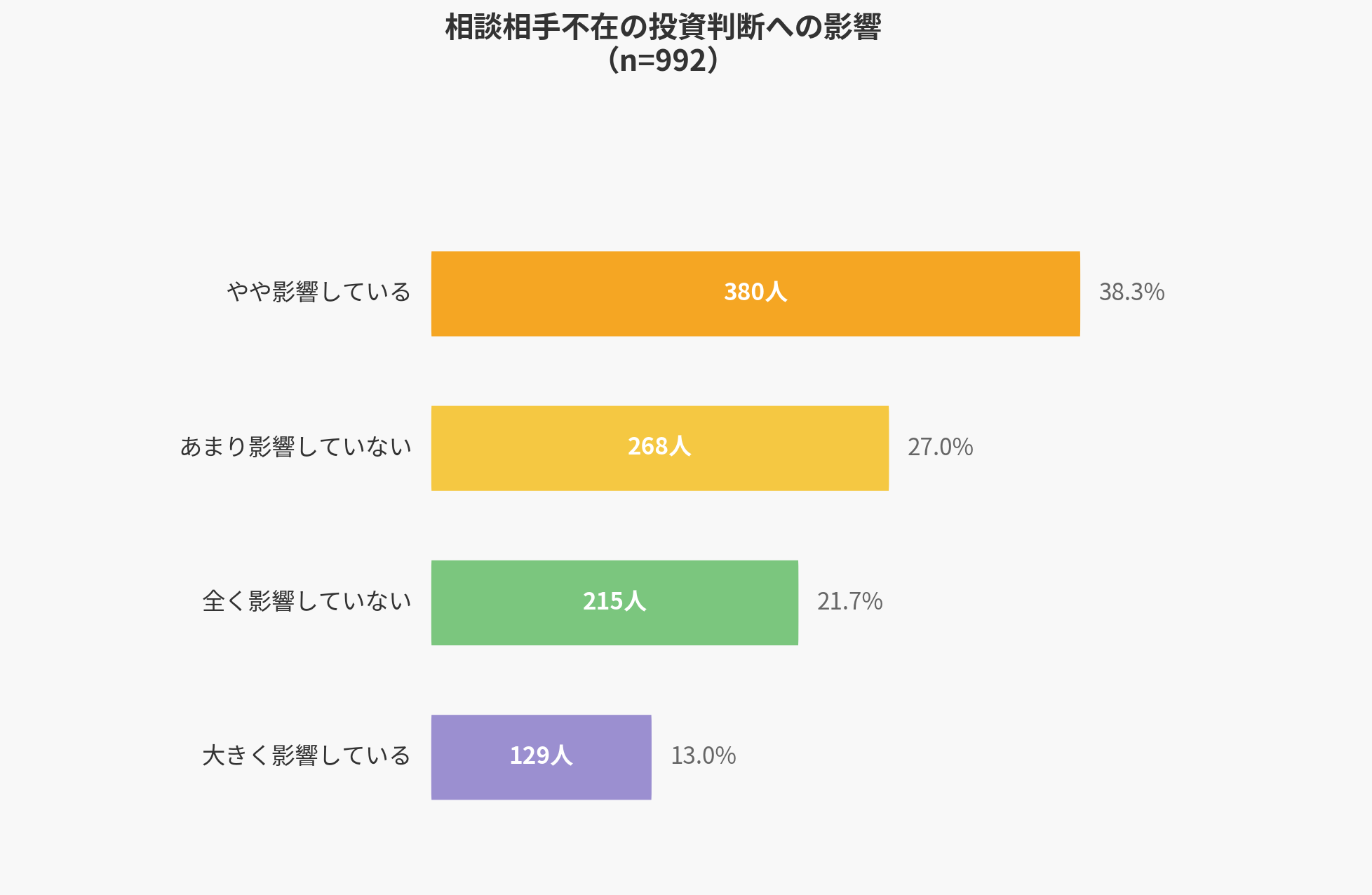
Answer | Respondents | Share |
|---|---|---|
Significantly affects it | 129 | 13.0% |
Somewhat affects it | 380 | 38.3% |
Barely affects it | 268 | 27.0% |
Does not affect it at all | 215 | 21.7% |
When asked how the absence of a confidant affects their investment decisions, the combined total of "significantly affects it" and "somewhat affects it" reached 51.3%.
This means more than half of investors feel some degree of anxiety or hesitation when making decisions in isolation.
The largest single group, at 38.3%, chose "somewhat affects it," suggesting that while it may not be a decisive obstacle, many investors cannot fully trust their own judgment.
Since information in the crypto market updates extremely quickly, this figure likely reflects the limits of trying to review all available information alone.
Meanwhile, only 21.7% can confidently say it "does not affect it at all," a minority of roughly one in five.
For many investors, having a third party who can offer an objective opinion appears to be an important factor in maintaining psychological stability and decision-making accuracy.
Nearly 60% of Investors in Their 20s Feel the Effects of Having No Confidant
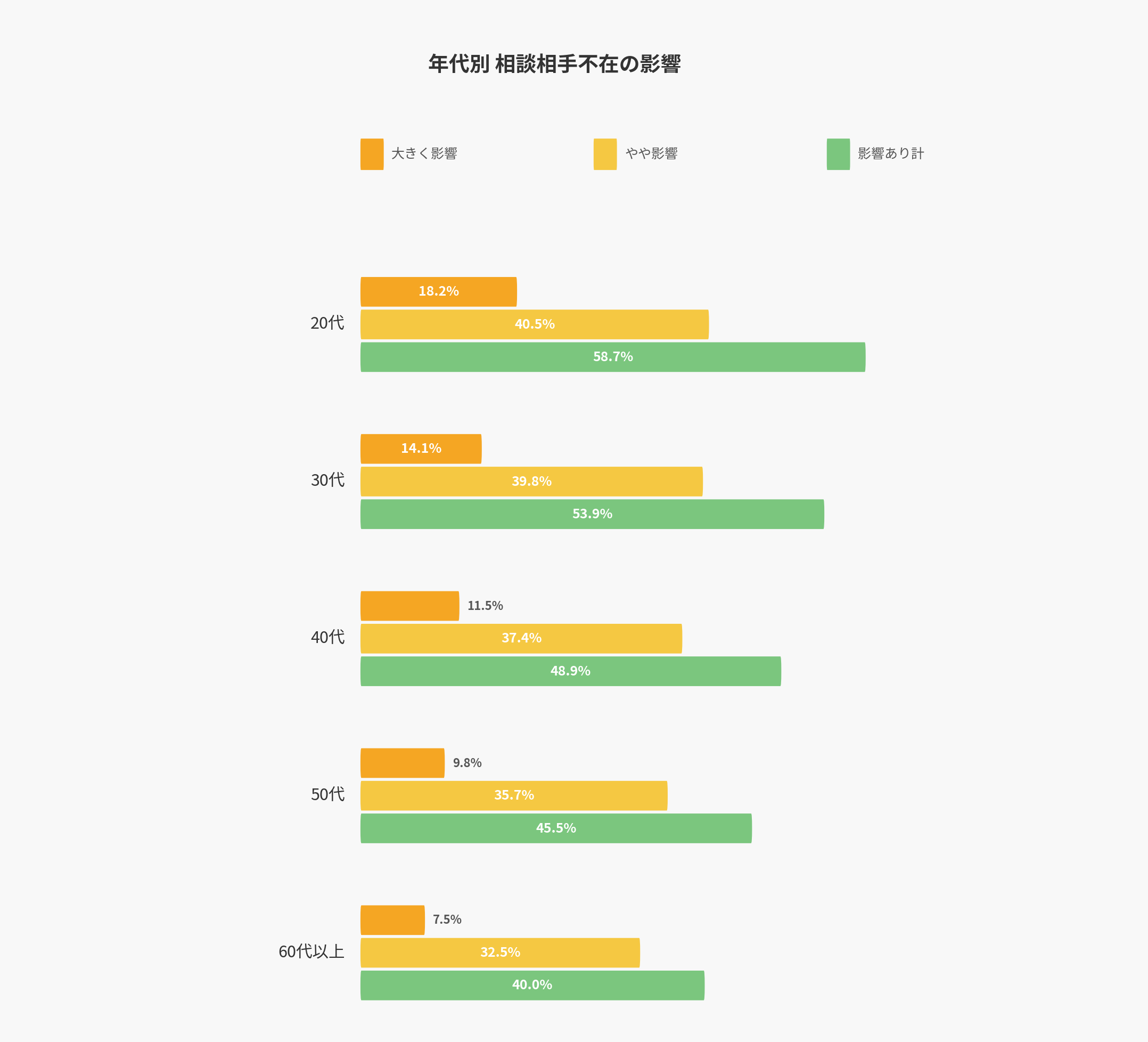
Age Group | Significantly Affects | Somewhat Affects | Total Affected |
|---|---|---|---|
20s | 18.2% | 40.5% | 58.7% |
30s | 14.1% | 39.8% | 53.9% |
40s | 11.5% | 37.4% | 48.9% |
50s | 9.8% | 35.7% | 45.5% |
60s and older | 7.5% | 32.5% | 40.0% |
Looking at the data by age group, younger investors are more strongly affected by having no one to consult.
Among people in their 20s, the combined "affected" total reached 58.7%, the highest of any age group.
For younger investors, who tend to have relatively little investing experience, having no one to turn to during sudden market swings appears to be a major factor that clouds their judgment.
This "affected" share declines steadily with age, settling at 40.0% among people in their 60s and older.
As people accumulate more life and investing experience with age, they appear to develop the composure and self-sufficiency needed to make decisions independently.
This suggests that securing appropriate channels for advice is even more important for younger investors than for older generations if they are to keep investing over the long term.
Women Are More Likely Than Men to See the Lack of a Confidant as a Concern
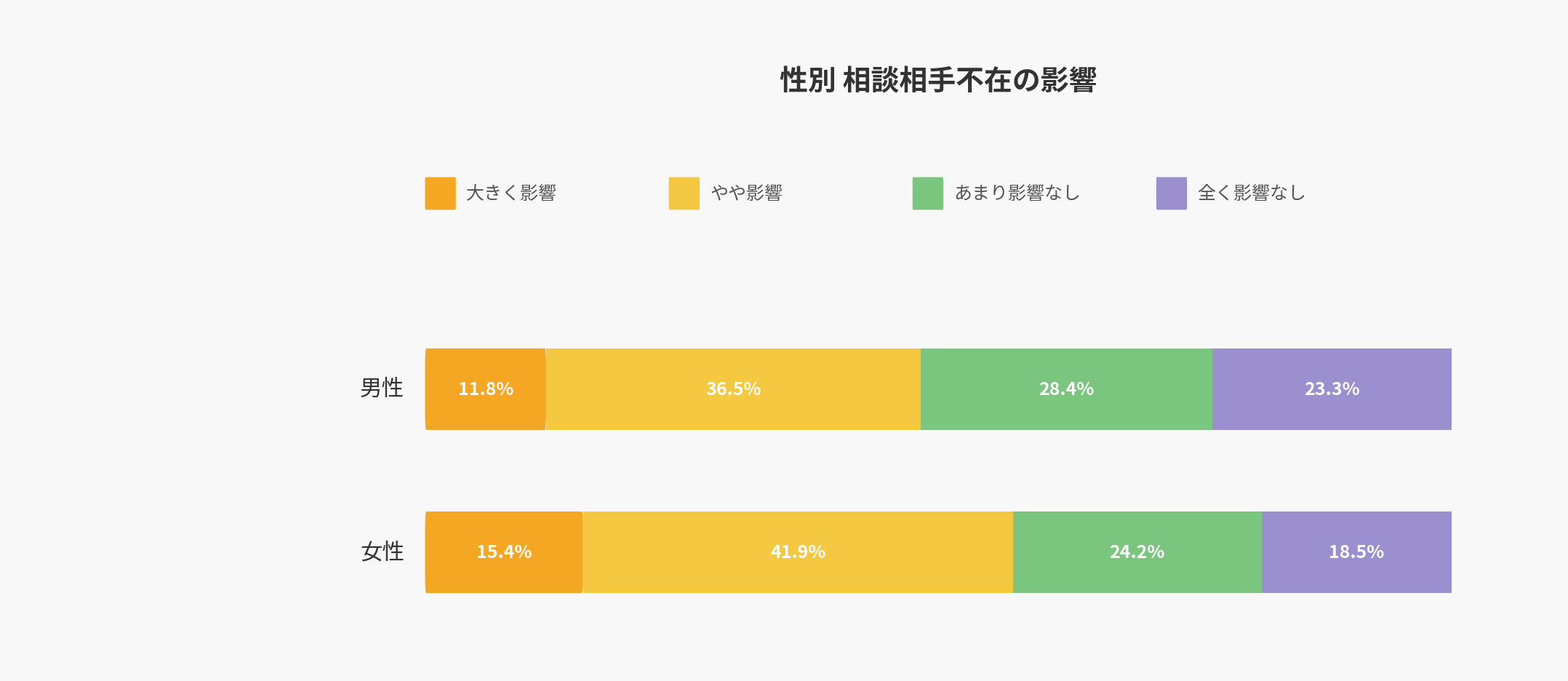
Gender | Significantly Affects | Somewhat Affects | Barely Affects | Does Not Affect at All |
|---|---|---|---|---|
Men | 11.8% | 36.5% | 28.4% | 23.3% |
Women | 15.4% | 41.9% | 24.2% | 18.5% |
Comparing the results by gender, women are more likely than men to link the absence of a confidant directly to their investment decisions.
The combined "affected" total for women reached 57.3%, nine points higher than the 48.3% recorded for men.
Women investors tend to place greater weight on the reliability of information and on consensus within their community, and this figure appears to reflect a cautious approach to checking whether their own judgment has become one-sided.
Men, meanwhile, showed a stronger tendency toward self-reliance, with roughly one in four saying it "does not affect it at all," reflecting less hesitation about making decisions independently, based on a principle of personal responsibility.
There is a clear gender gap in how seriously people take the risk of having no one to consult, with women appearing more sensitive to the risks of isolation.
The data supports the idea that an investing style built on communication and shared understanding is more prevalent among women.
Traits of Investors With No Confidant, and Their Urge to Quit
Nearly Half of Investors With Investing Peers Have Repeatedly Wanted to Quit
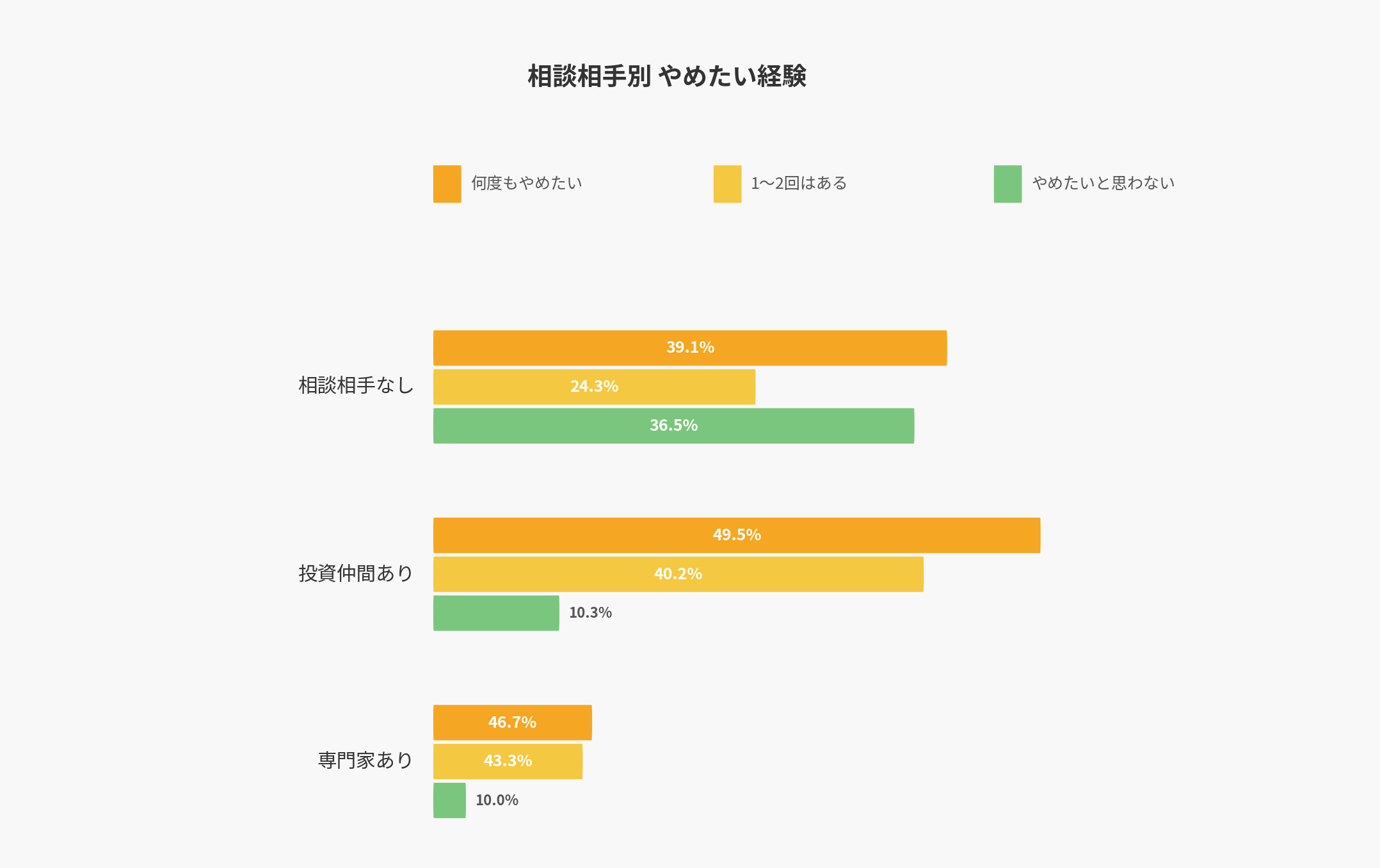
Confidant | n | Wanted to Quit Many Times | Wanted to Quit Once or Twice | Never Wanted to Quit |
|---|---|---|---|---|
No one to consult | 282 | 110 (39.1%) | 69 (24.3%) | 103 (36.5%) |
Has investing peers | 262 | 130 (49.5%) | 105 (40.2%) | 27 (10.3%) |
Has an expert | 73 | 34 (46.7%) | 32 (43.3%) | 7 (10.0%) |
Breaking down "experience of wanting to quit investing" by type of confidant reveals a surprising result: 49.5% of those with investing peers said they had "wanted to quit many times."
By comparison, only 39.1% of the "no one to consult" group gave the same answer, suggesting that investors who are connected to others outside their household are more prone to strong urges to withdraw.
This is likely because being part of a community increases exposure to negative information and other people's reported losses, making investors more psychologically vulnerable to being shaken.
Meanwhile, 36.5% of the "no one to consult" group said they "never wanted to quit," suggesting that, in some cases, making decisions entirely alone can actually eliminate hesitation.
However, the fact that isolated investors "never wanted to quit" could also reflect an "unaware neglect," in which they are not correctly recognizing the risks involved.
Having a confidant is not necessarily a cure that keeps investors from quitting; it may instead be a trigger that produces genuine conflict as investors confront their own decisions seriously.
Investors Who Consult Experts Face the Most Serious Doubts About Quitting
Confidant | Has Experience Wanting to Quit (Total) | Never Wanted to Quit |
|---|---|---|
Experts (FPs, tax accountants, etc.) | 90.0% | 10.0% |
Investing peers | 89.7% | 10.3% |
No one to consult | 63.4% | 36.5% |
Among investors who consult an expert such as a financial planner or tax accountant, 90.0% have wanted to quit investing at least once in the past.
This data suggests a possible "reversal of causation," in which turning to an expert is itself the result of facing losses or tax issues that are difficult to resolve on one's own.
Even when receiving professional advice, an investor's worries do not simply disappear; in fact, the data suggests they more often face situations that require high-stakes decisions.
Only 10.0% of those connected to an expert said they "never wanted to quit," the lowest figure of any group.
By contrast, 63.4% of investors with no one to consult have experienced wanting to quit, which on the surface may look like greater psychological stability.
If the quality of information and the accuracy of judgment are set aside, isolated investing may function as one way to keep worries from surfacing, an ironic dynamic revealed by this data.
Household Income and the "Wanted to Quit" Rate Among Isolated Investors
Household Income | n | Share of "No One to Consult" Group That Has Wanted to Quit |
|---|---|---|
Under ¥4 million | 106 | 67.9% |
¥4M to under ¥8M | 342 | 64.2% |
¥8M to under ¥10M | 181 | 61.3% |
¥10 million or more | 111 | 58.6% |
Focusing only on investors with no one to consult and breaking the results down by household income shows that lower-income investors are more likely to consider quitting.
Among isolated investors earning under ¥4 million, 67.9% have wanted to quit, nearly 10 points higher than among those earning ¥10 million or more (58.6%).
For lower-income investors, a single loss has a greater impact on daily life, and without anyone to consult, that anxiety translates directly into a stronger urge to withdraw.
This figure clearly reflects how psychologically demanding it is to continue investing in crypto entirely on one's own when financial flexibility is limited.
Even among higher-income investors, roughly 60% of those with no confidant said they had wanted to quit, showing that isolation threatens continued investing regardless of asset size.
Having "no one to consult" appears to be a common factor that wears down investors' mental resilience, regardless of income level.
How to Make the Most of Communities, Experts, and Media
About 80% of Investors With Peers Are Still Investing, Using Information to Their Advantage
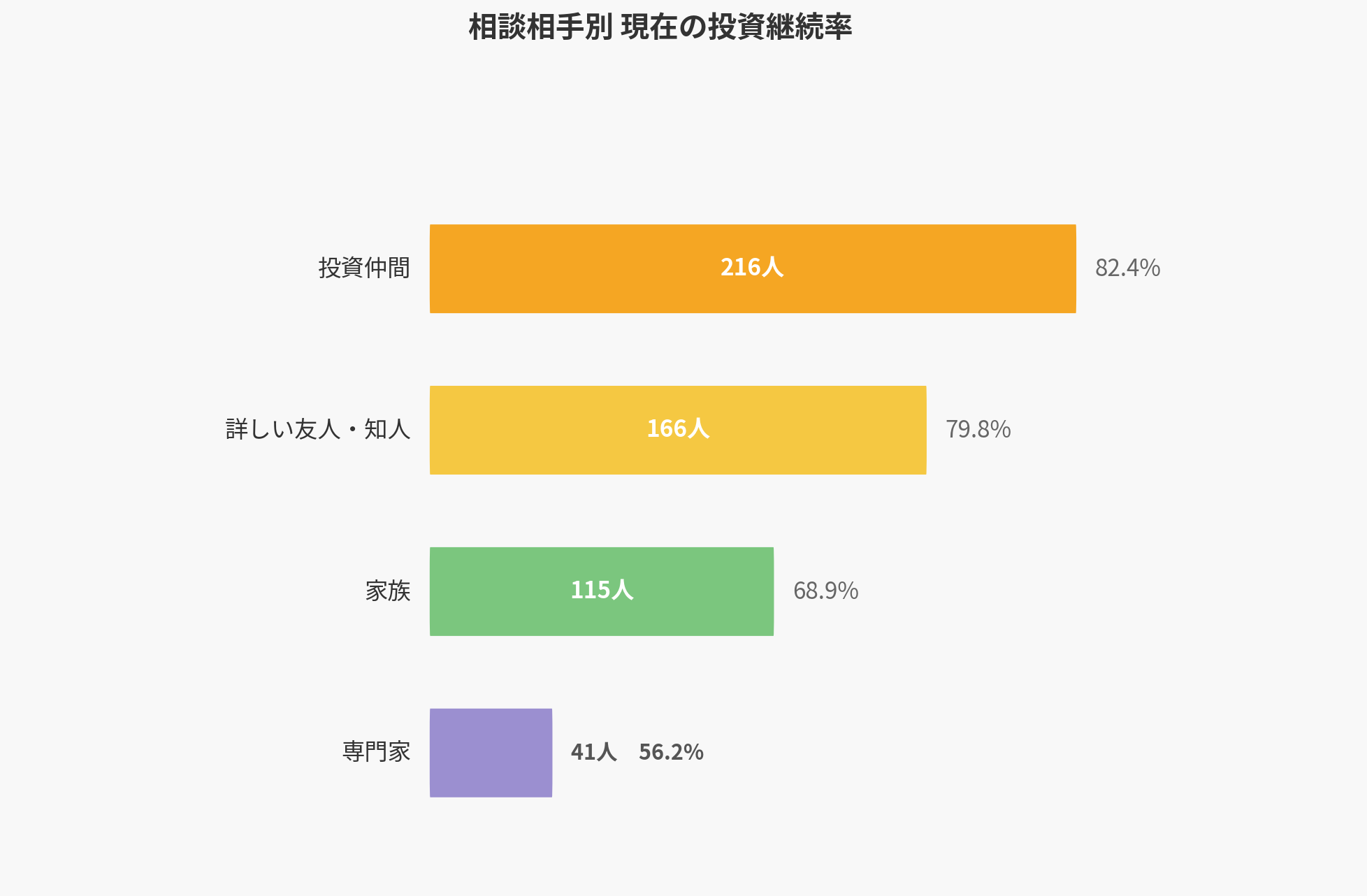
Confidant | n | Currently Investing | Share |
|---|---|---|---|
Investing peers (including online communities) | 262 | 216 | 82.4% |
Experts (FPs, tax accountants, etc.) | 73 | 41 | 56.2% |
Knowledgeable friends or acquaintances | 208 | 166 | 79.8% |
Family | 167 | 115 | 68.9% |
Comparing the type of confidant with current investing status shows that 82.4% of investors with "investing peers," such as online communities, are still investing today.
This is a high continuation rate compared with the "no one to consult" group, showing that connections with peers act as a strong support system in the fast-moving crypto market.
Meanwhile, the continuation rate among those who consult "experts" is only 56.2%, suggesting that by the time investors turn to a professional, they may already be seriously considering withdrawal.
While having peers helps investors continue, community information always carries the risk of being a "mixed bag" of accurate and inaccurate claims.
In closed environments such as social media and Discord in particular, excessive optimism or unfounded hype around specific tokens can spread easily, potentially clouding objective judgment.
Rather than accepting others' opinions at face value, it is essential to critically evaluate the information you receive and base your final decisions on your own investing principles, a process of "selecting and filtering information."
Only 7.4% Use Experts, Making Professional Advice a Rare Resource
Confidant | Respondents | Share |
|---|---|---|
Experts (FPs, tax accountants, etc.) | 73 | 7.4% |
All other sources | 919 | 92.6% |
This survey found that only 7.4% of investors have access to an "expert" such as a financial planner or tax accountant.
Despite the complex tax treatment and legal status of crypto assets, fewer than one in fifteen investors are able to draw directly on professional expertise.
The current situation, in which many investors must rely on self-study or unverified information from social media, is one factor amplifying hesitation and the anxiety that comes from having no one to consult.
The limited access to experts likely reflects both the still-small number of professionals with crypto expertise and the psychological hurdle of consultation costs.
However, as portfolios grow larger, tax risk and estate planning become areas where an amateur's judgment can lead to irreversible mistakes.
Building a system that supplements foundational knowledge through trustworthy media while seeking professional input at key moments is essential to the defensive side of long-term asset building.
Separating Consultation From Decision-Making to Build Your Own Investing Principles
Confidant | Wanted to Quit Many Times | Wanted to Quit Once or Twice | Has Experience Wanting to Quit (Total) |
|---|---|---|---|
Has investing peers | 49.5% | 40.2% | 89.7% |
Has an expert | 46.7% | 43.3% | 90.0% |
The finding that around 90% of investors with a confidant have wanted to quit suggests that outside input does not necessarily bring peace of mind.
Hearing about other people's successes or pessimistic market takes can instead shake an investor's own judgment and cause psychological fatigue, a kind of "information noise."
Having a confidant can help ease isolation, but whether it actually improves investment outcomes depends on the quality of that consultation and how the investor engages with it.
What matters is using "consultation" as an input of information while excluding other people's emotions from the "decision" itself, the output.
Using data gathered from trustworthy media and communities to reaffirm your own trading rules and risk tolerance is the shortest path out of lonely investing.
Treating other people's opinions not as "answers" to follow but as a "mirror" for sharpening your own judgment is the key to building a sustainable investing practice.
Conclusion
This survey found that 28.4% of crypto investors have "no one to consult," and more than half of that group feels this isolation affects their investment decisions.
Among people who have quit investing in the past, the share with no one to consult rises to 39.2%, suggesting that isolation is a serious factor driving people to leave the market.
At the same time, the data also revealed a paradox: investors with someone to consult are more likely to struggle with the urge to quit.
This can also be interpreted as a sign that exposure to outside information leads investors to reflect more deeply on their own decisions.
What matters is not simply relying on someone else, but establishing your own "decision-making principles" for making the final call while maintaining access to trustworthy sources of information.
Easing isolation while learning to judge the quality of information is the key to surviving a volatile market.
Survey Overview
Survey date: March 23, 2026
Survey method: Internet survey
Survey population: Men and women residing in Japan (people currently investing in crypto assets, or who have invested in the past)
Valid responses: 992
Conducted by: Clabo Inc.
Survey Questions
- Have you ever invested in crypto assets?
- How satisfied are you with the outcomes of investment decisions based on that information source?
- Have you ever wanted to "quit" investing in crypto assets?
- When you want to consult someone about crypto assets, do you have anyone to turn to?
- Do you think "having no one to consult" affects your investment decisions?
This article is for informational purposes only and does not constitute financial or investment advice. Please consult a qualified professional before making investment decisions.


