


Amid persistent risks of crypto assets (also known as virtual currencies) being stolen or lost, hardware wallets—which manage private keys via a physical device—are gaining prominence. Yet despite offering top-tier security, not every holder is satisfied with how they work in practice.
This article presents a detailed analysis of the 48.6% usage rate based on Clabo's own latest survey. While about 60% of adopters report satisfaction, the survey also reveals that more than half struggle with a critical pain point: the hassle of ongoing management.
The findings shed light on holders' candid opinions rarely covered by existing media, including how satisfaction dramatically shifts depending on asset size and years of investing experience.
Hardware Wallet Usage Rate Stands at 48.6%
Including Past Users, 80% Have Tried a Hardware Wallet
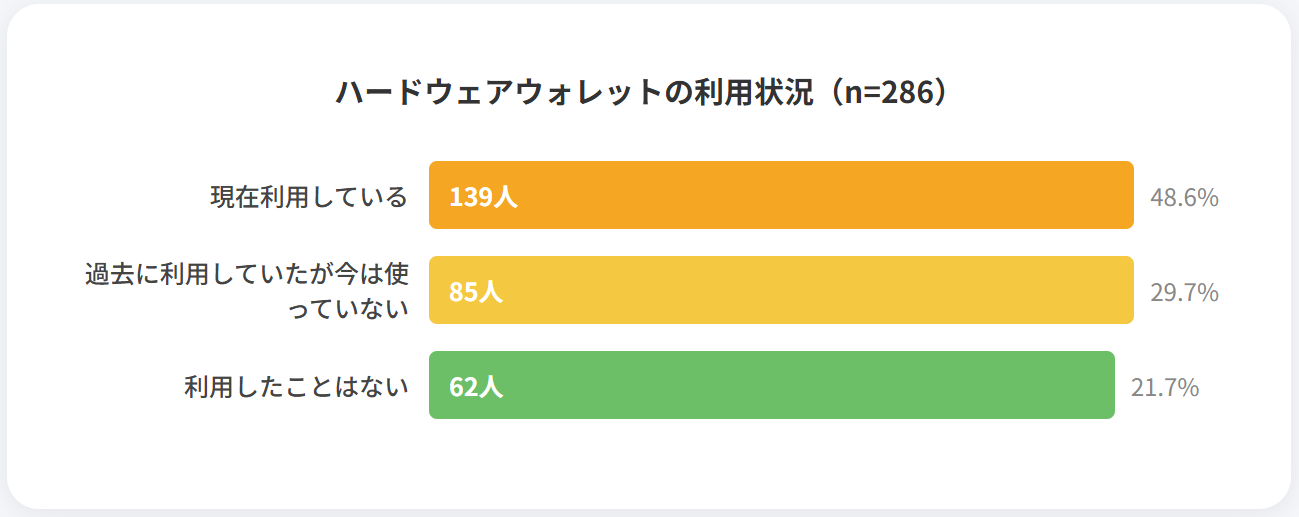
Response | Respondents | Share |
|---|---|---|
Currently using | 139 | 48.6% |
Used in the past, not now | 85 | 29.7% |
Never used | 62 | 21.7% |
We surveyed 286 crypto asset holders about their hardware wallet usage. 48.6% said they currently use one, showing that roughly half of holders are actively using a hardware wallet on an ongoing basis. Adding those who used one in the past (29.7%), about 80% of all respondents have tried a hardware wallet at some point.
This figure suggests that the concept of self-custody has become widely established among domestic holders. At the same time, the fact that roughly 40% of those with experience have since stopped using a hardware wallet points to a challenge in sustaining usage over time. The data paints a picture of holders who recognize the importance of security but continue to wrestle with the trade-off against convenience.
The fact that many holders choose to keep custody of their own assets rather than leaving them entirely with a Crypto Asset Exchange Service Provider reflects the market's growing maturity. Lessons from recent hacking incidents, in particular, appear to be steadily raising individual holders' security awareness. Going forward, how the remaining 20% who have never tried a hardware wallet eventually enter the market will be key to further adoption.
Usage Rate Surges Once Investment Exceeds ¥100,000
Current Investment Amount | Never Used | Currently Using | Used in the Past, Not Now |
|---|---|---|---|
Under ¥10,000 | 29.3% | 32.9% | 37.8% |
¥10,000–under ¥100,000 | 19.6% | 51.0% | 29.4% |
¥100,000–under ¥500,000 | 11.7% | 68.3% | 20.0% |
¥500,000 or more | 19.2% | 65.4% | 15.4% |
Prefer not to say | 37.5% | 12.5% | 50.0% |
Cross-tabulating current investment amount with usage status confirmed a clear trend: the larger a holder's asset size, the higher their hardware wallet usage rate tends to be.
Usage remains high among holders with ¥100,000–under ¥500,000 invested (68.3%) and those with ¥500,000 or more (65.4%). Holders who stand to lose more are making the rational choice to pay for a dedicated device.
By contrast, among holders investing under ¥10,000, only 32.9% said they currently use a hardware wallet—the lowest figure of any bracket. For small-scale investors, the cost of the device likely eats into investment returns, leading many to conclude that an exchange (order-book exchange) wallet is sufficient. This points to a clear pattern in the early stages of building crypto holdings: convenience and cost-effectiveness take priority.
Notably, the churn rate—holders who used a hardware wallet in the past but have since stopped—drops sharply once investment amounts reach ¥100,000 or more. This suggests that as holdings grow, security measures shift from a "one-time trial" to an "essential routine." The process by which protecting one's assets becomes indispensable as investment size increases is clearly visible in the data.
Younger Generations Show Higher Security Awareness
Age Group | Never Used | Currently Using | Used in the Past, Not Now |
|---|---|---|---|
20s | 4.0% | 62.0% | 34.0% |
30s | 23.0% | 50.6% | 26.4% |
40s | 23.9% | 46.3% | 29.9% |
50s | 33.3% | 38.3% | 28.3% |
60s | 15.4% | 38.5% | 46.2% |
70s and older | 22.2% | 55.6% | 22.2% |
By age group, holders in their 20s had the highest usage rate of any bracket at 62.0%, underscoring the strong security awareness of younger holders. Only 4.0% of those in their 20s said they had never used a hardware wallet—an extremely low figure—suggesting that many adopt a device almost as soon as they start investing. For a digitally native generation, managing assets through a physical device appears to be a low-friction choice.
By contrast, usage among holders in their 50s stood at just 38.3%, a wide gap compared with those in their 20s. In this age group, 33.3% said they had never used a hardware wallet, reflecting a stronger tendency to continue relying on exchange-based custody. The high barrier posed by device setup and seed phrase management is likely one factor discouraging adoption among middle-aged and older holders.
What's striking is that among holders in their 60s, the churn rate reaches a very high 46.2%. This suggests many gave the device a try but later abandoned it due to the hassle of ongoing management and operation. Achieving broader adoption across all generations will likely hinge on how far usability can be simplified while security performance is preserved.
Long-Term Holding Is the Top Motivation, But Referral-Based Adopters Remain Unsatisfied
Satisfied Users Total About 60% Overall
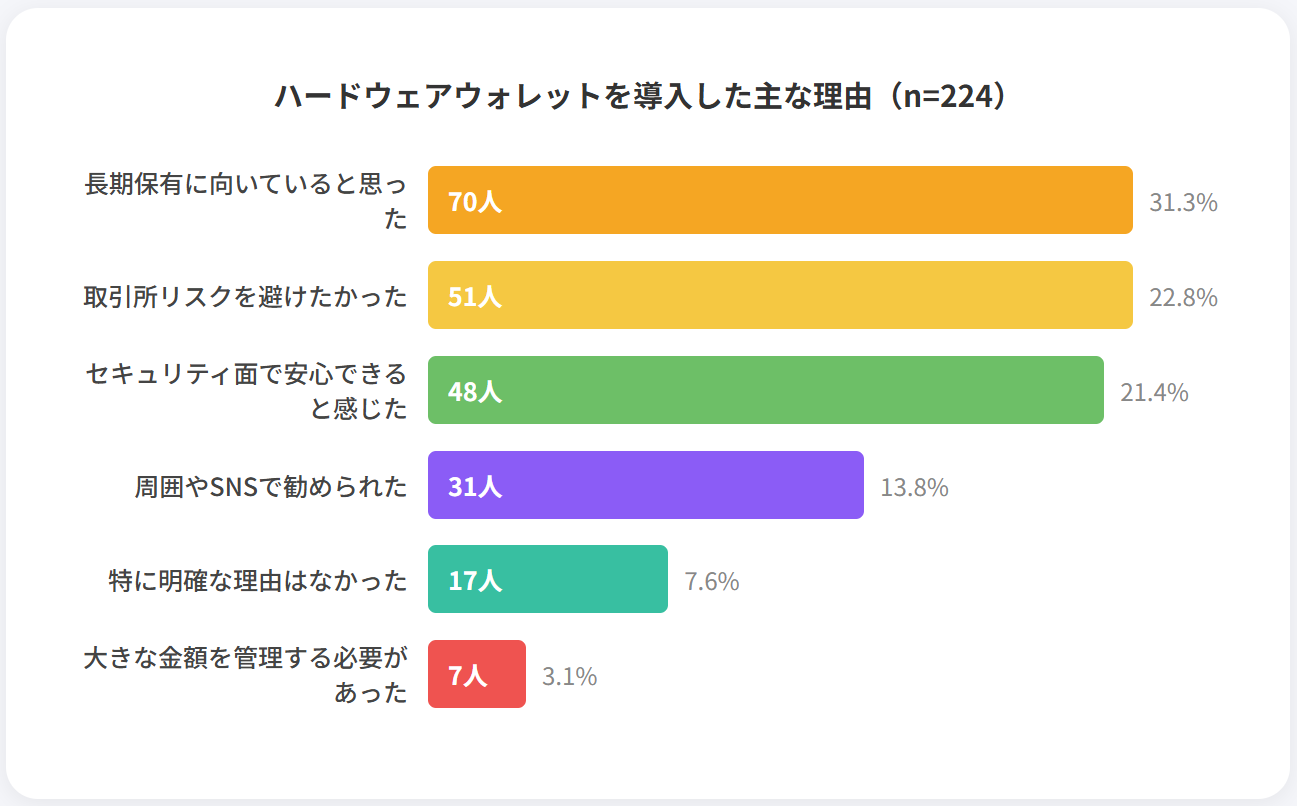
Reason | Respondents | Share |
|---|---|---|
Thought it suited long-term holding | 70 | 31.3% |
Wanted to avoid exchange risk | 51 | 22.8% |
Felt reassured by the security | 48 | 21.4% |
Recommended by friends or on social media | 31 | 13.8% |
No particular reason | 17 | 7.6% |
Needed to manage a large sum | 7 | 3.1% |
Satisfaction Level | Respondents | Share |
|---|---|---|
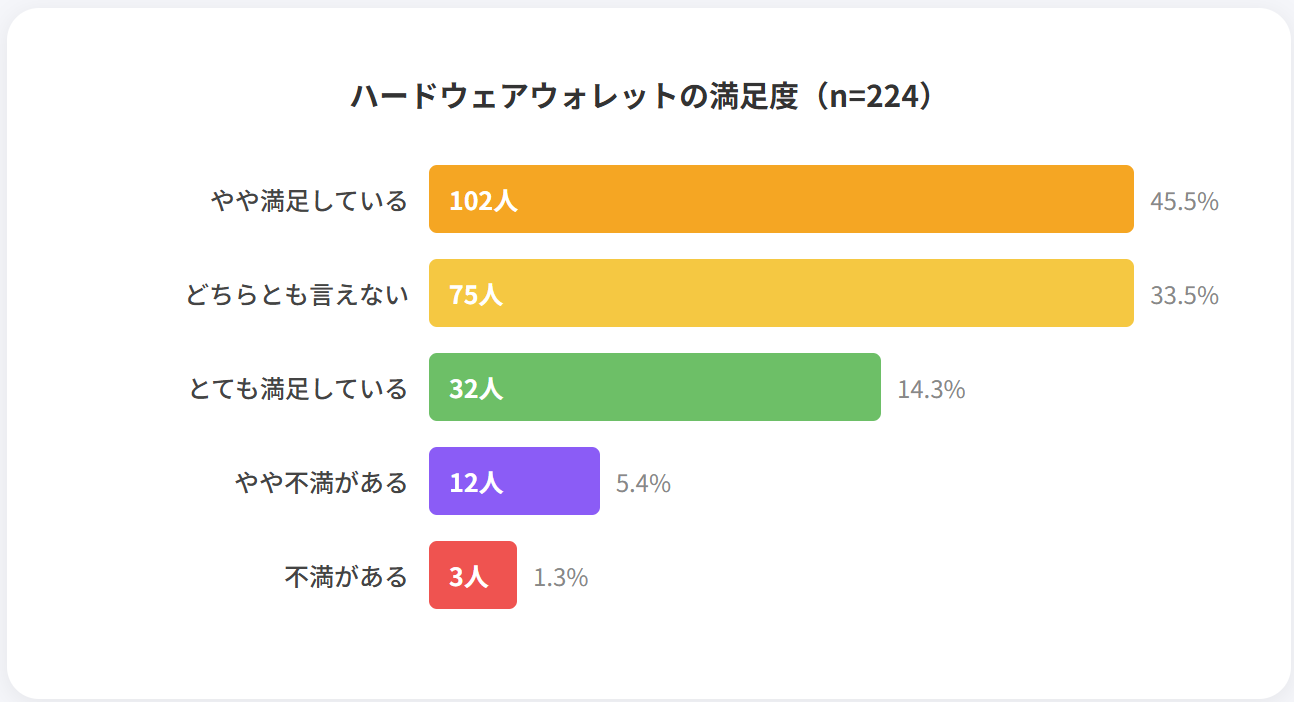
Very satisfied | 32 | 14.3% |
Somewhat satisfied | 102 | 45.5% |
Neutral | 75 | 33.5% |
Somewhat dissatisfied | 12 | 5.4% |
Dissatisfied | 3 | 1.3% |
Asked about their reasons for adopting a hardware wallet, respondents most often cited "suited to long-term holding" (31.3%), followed by "wanted to avoid exchange risk" (22.8%). The core need behind crypto investing—protecting one's assets over the medium to long term—is the single biggest driver of adoption. On satisfaction, "very satisfied" and "somewhat satisfied" combined reach about 60%, showing that many users feel the device delivers real value.
At the same time, the "neutral" group (33.5%) exceeding 30% cannot be overlooked. A meaningful share of holders don't feel the convenience or benefit fully matches the effort of buying and setting up a physical device. Converting the intangible value of security into a tangible sense of satisfaction is a challenge for device makers and service providers alike.
Overall, holders who adopted a hardware wallet with a clear goal of protecting their assets tend to report higher satisfaction. In particular, the desire to avoid over-reliance on exchanges is a major incentive for individual holders today—one that is expected to provide a solid foundation for the continued growth of the self-custody market.
Holders Seeking Peace of Mind Rate Devices Highly
Reason for Adopting | Very Satisfied | Somewhat Satisfied | Neutral | Somewhat Dissatisfied | Dissatisfied |
|---|---|---|---|---|---|
Reassured by security | 37.5% | 47.9% | 14.6% | 0.0% | 0.0% |
Avoiding exchange risk | 3.9% | 52.9% | 39.2% | 2.0% | 2.0% |
Recommended by others/social media | 3.2% | 29.0% | 45.2% | 22.6% | 0.0% |
Managing a large sum | 14.3% | 57.1% | 14.3% | 14.3% | 0.0% |
No particular reason | 0.0% | 17.6% | 64.7% | 5.9% | 11.8% |
Suited to long-term holding | 14.3% | 51.4% | 31.4% | 2.9% | 0.0% |
Cross-referencing adoption reason with satisfaction reveals that a clear motive translates directly into satisfaction. Among holders who "felt reassured by the security," a combined 85.4% reported satisfaction, and not a single respondent reported dissatisfaction. A self-driven commitment to securing one's assets appears to turn the hardware wallet experience into a positive one.
By contrast, among holders who adopted a device because of a recommendation from friends or social media, satisfaction stayed at around 30%, while "somewhat dissatisfied" (22.6%) was the highest across all reason categories. It appears that when external opinion outweighs one's own perceived need, the difficulty of operation and hassle of management can end up exceeding expectations. Adopting a hardware wallet passively risks leaving a more negative impression of the technology overall.
Among those who adopted a device with no particular reason, more than 70% rate their experience "neutral" or lower. Without a clear purpose, holders may struggle to see the point of owning an expensive device, effectively leaving it underused. Clarifying exactly what one is trying to protect—tailored to one's own investing style—appears to be the most direct path to higher satisfaction.
Earlier Adoption Correlates with a More Positive Experience
Years of Investing Experience | Very Satisfied | Somewhat Satisfied | Neutral | Somewhat Dissatisfied | Dissatisfied |
|---|---|---|---|---|---|
Under 6 months | 23.1% | 53.8% | 23.1% | 0.0% | 0.0% |
6 months–under 1 year | 17.1% | 61.4% | 14.3% | 5.7% | 1.4% |
1–under 3 years | 12.7% | 33.3% | 46.0% | 6.3% | 1.6% |
3 years or more | 9.1% | 36.4% | 50.9% | 3.6% | 0.0% |
Prefer not to say | 0.0% | 0.0% | 60.0% | 20.0% | 20.0% |
Analyzing the relationship between years of investing experience and satisfaction produced a surprising, almost paradoxical finding: the less experienced a holder is, the higher their satisfaction tends to be. Among those with 6 months to under 1 year of experience, a combined 78.5% reported satisfaction, showing that adopting a device early on tends to become a positive experience. This suggests that newer investors, who are highly attuned to the latest information, gain a sense of security by equipping themselves with the right tools early.
Among veteran investors with 3 or more years of experience, by contrast, only 45.5% reported satisfaction, and about half answered "neutral." Having weathered the market's ups and downs, these longer-term holders likely judge the burden of device management and firmware updates more harshly. As experience accumulates, the security benefits seem to be taken for granted, while sensitivity to the operational cost grows relatively stricter.
This shift in what holders expect from a hardware wallet depending on when they adopted it is highly instructive. Beginners find value simply in "being protected," while more advanced holders have moved on to a stage where what matters is "how efficiently" they are protected. Raising satisfaction across the entire user base will require support and interface improvements tailored to each level of proficiency.
Management Hassle Is the Top Complaint, Cited by Over Half
Failure Risk and Unsupported Assets Also Drive Dissatisfaction
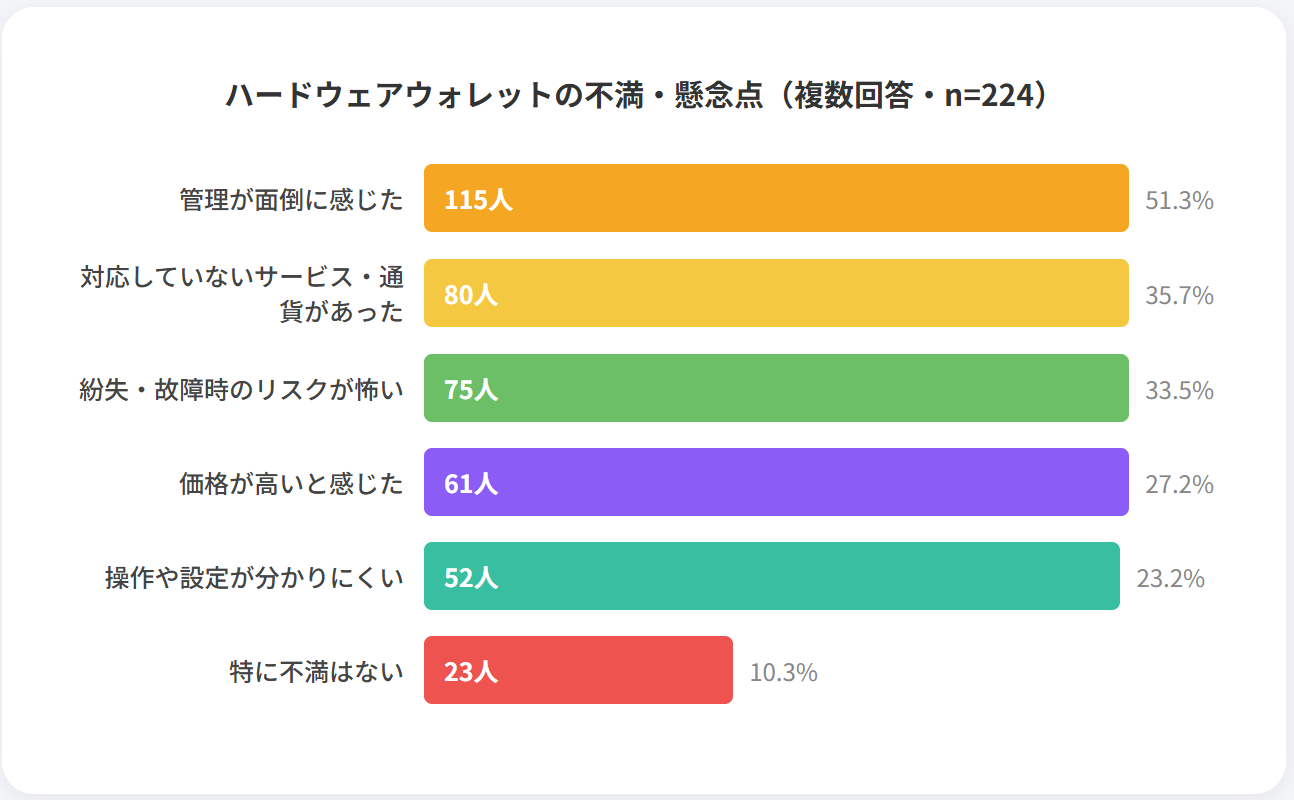
Source of Dissatisfaction (Multiple Choice) | Respondents | Share |
|---|---|---|
Found management a hassle | 115 | 51.3% |
Some services or currencies weren't supported | 80 | 35.7% |
Afraid of the risk of loss or failure | 75 | 33.5% |
Found it too expensive | 61 | 27.2% |
Operation and setup were confusing | 52 | 23.2% |
No particular complaints | 23 | 10.3% |
Asking holders with hardware wallet experience about specific complaints, "management is a hassle" (51.3%) topped the list, cited by more than half. The findings show that in exchange for improved security, the operational burden of storing the physical device, connecting it, and updating firmware weighs on holders. Lack of support for certain currencies or DeFi services (35.7%) came next, with these usability limits further fueling dissatisfaction.
Fear of physical risks like loss or failure was also high at 33.5%, reflecting the weight of personal responsibility that comes with self-custody. Even though hardware wallets offer the safest way to store crypto assets, using one carries a mental and physical cost. With only 10.3% saying they have "no particular complaints," it's clear that current devices still leave plenty of room for improvement.
These challenges suggest that a fundamental UI/UX overhaul is needed, not just better device performance. At present, while hardware wallets deliver the value of "peace of mind," they still fall short of holders' expectations for everyday usability. For adoption to spread to a broader user base, the key question going forward will be how to overcome this biggest barrier: the hassle of ongoing management.
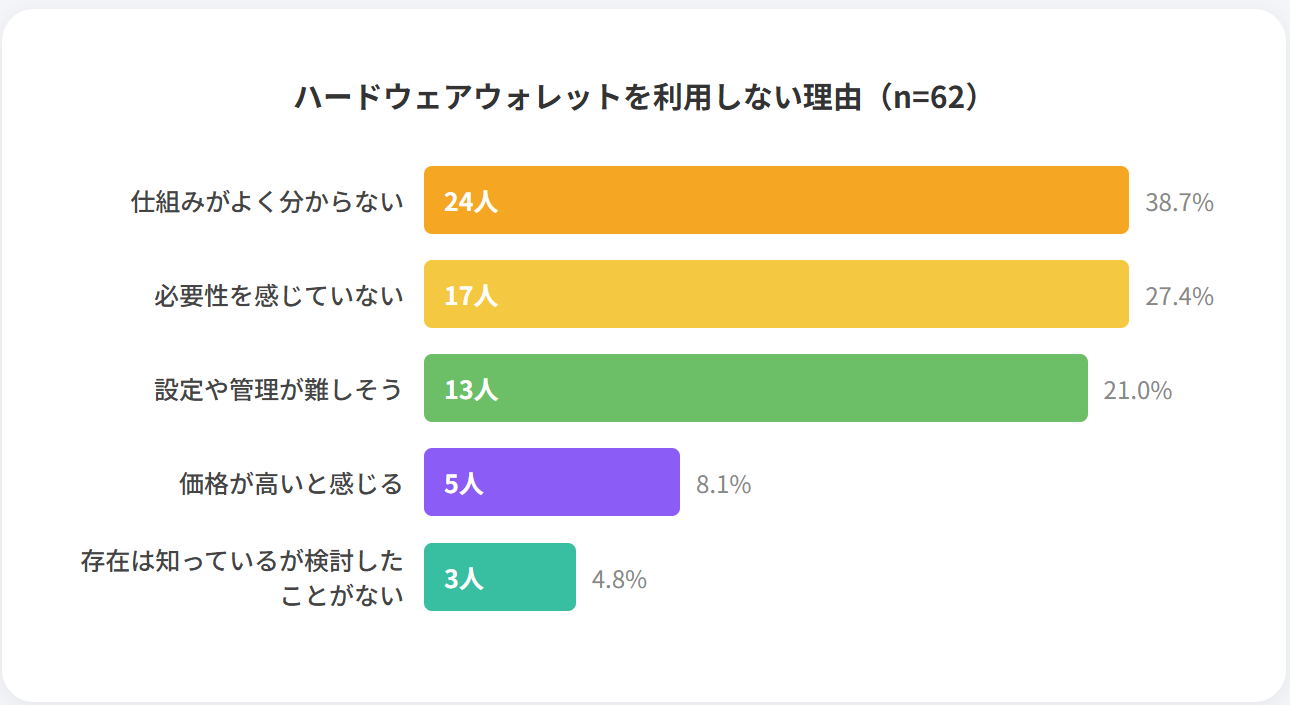
40% of Non-Users Say They Don't Understand How It Works
Reason for Not Using | Respondents | Share |
|---|---|---|
Don't really understand how it works | 24 | 38.7% |
Don't feel the need for one | 17 | 27.4% |
Setup and management seem difficult | 13 | 21.0% |
Feel it's too expensive | 5 | 8.1% |
Know it exists but have never considered it | 3 | 4.8% |
Among holders who have never used a hardware wallet, "I don't really understand how it works" (38.7%) was the top reason cited. Even when aware the product exists, a lack of information on specifically how it protects assets and why it's safer than an exchange is holding back adoption. This makes clear that a knowledge gap is a major hurdle blocking the first step toward better security.
The response "I don't feel the need for one" (27.4%) accounted for nearly 30%, reflecting either a lack of risk-management awareness or satisfaction with current custody methods. For small-scale holders in particular, the benefits of taking on a dedicated device likely haven't been effectively communicated. Preconceptions that "setup and management seem difficult" (21.0%) also serve to keep non-users away.
These results show that reaching non-users requires more than a simple product pitch; careful education on how these devices work and why they matter is essential. As long as complicated terminology and complex procedures dominate the conversation, ordinary holders are unlikely to feel motivated to consider adoption on their own. Awareness efforts are needed to help hardware wallets be recognized as standard infrastructure rather than a niche tool.
Above ¥500,000 Invested, Failure Risk Becomes the Top Concern
Current Investment Amount | Management Hassle | Unsupported Currency | Confusing Operation | Failure Risk |
|---|---|---|---|---|
Under ¥10,000 | 53.4% | 25.9% | 25.9% | 34.5% |
¥10,000–under ¥100,000 | 57.3% | 39.0% | 24.4% | 32.9% |
¥100,000–under ¥500,000 | 52.8% | 50.9% | 17.0% | 34.0% |
¥500,000 or more | 33.3% | 19.0% | 38.1% | 47.6% |
Breaking down complaints by investment amount reveals an interesting trend: the nature of holders' concerns shifts with the scale of their holdings. Among those with ¥500,000 or more invested, concern over "the risk of loss or failure" (47.6%) is the highest of any bracket. This shows that holders with larger sums are more sensitive to the physical risk of concentrating high-value assets in a single device.
This high-investment bracket also reports notably higher levels of "operation and setup are confusing" (38.1%) than other groups. This likely reflects the psychological pressure of handling a large sum, where even a small operational mistake could lead to a catastrophic loss. Precisely because there's no room for error, these holders hold the device's interface to a stricter standard.
Among holders with ¥100,000–under ¥500,000 invested, "unsupported services or currencies" (50.9%) stands out as the leading complaint. This bracket likely spreads mid-sized holdings across DeFi and a variety of assets, and appears frustrated by the device's limited scope. As investing style becomes more active, holders increasingly demand not just robust security but also flexible support for diverse portfolios.
The Keys Going Forward: "Purchase Cost" and "Convenience"
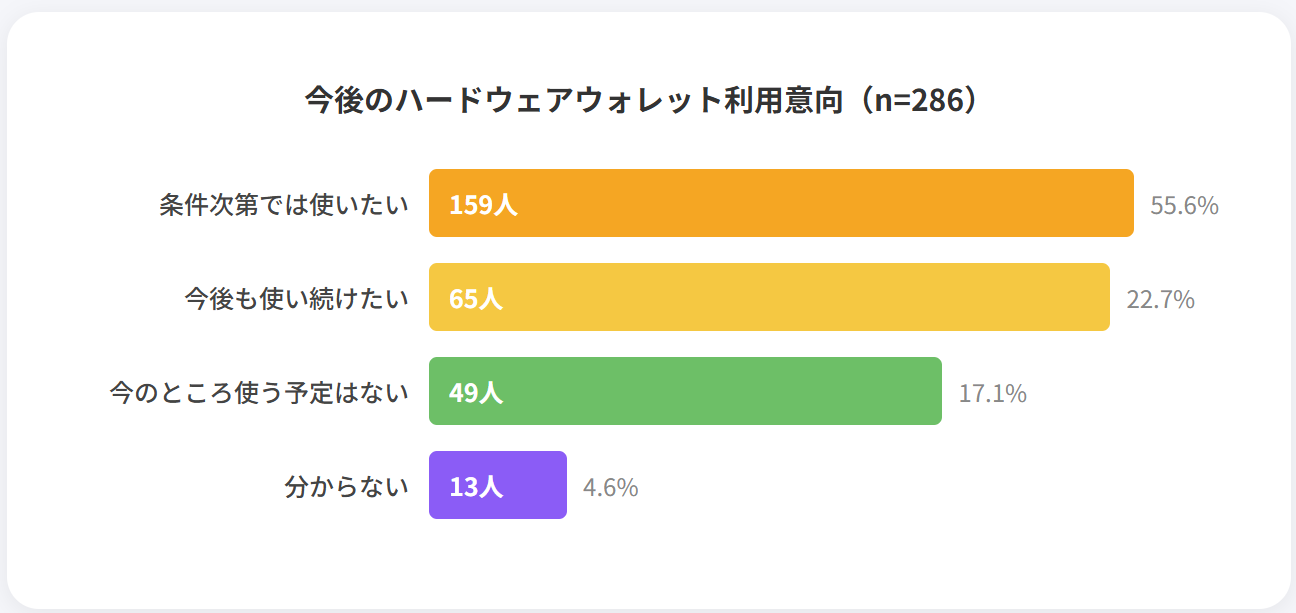
Nearly 80% Take a Positive Stance
Response | Respondents | Share |
|---|---|---|
Would use one depending on conditions | 159 | 55.6% |
Want to keep using it | 65 | 22.7% |
No plans to use one for now | 49 | 17.1% |
Not sure | 13 | 4.6% |
Asked about their future intent to use a hardware wallet, "would use one depending on conditions" was the top response at 55.6%, a majority. Adding those who "want to keep using it," a combined 78.3% expressed a positive outlook toward future use. This shows that even while grappling with current complaints and challenges, holders broadly share the view that a hardware wallet is essential as a means of protecting their assets.
At the same time, 17.1% said they "have no plans to use one for now," showing that a certain share of holders either don't feel the need for self-custody or prioritize a different management approach. Unpacking exactly what "conditions" would sway usage intent is a decisive factor in predicting the future pace of adoption. Holders are not simply seeking safety—they are also rigorously weighing the cost and ease of use that would justify it.
This result suggests there is still substantial room for market growth. The fact that "depending on conditions" is by far the largest group indicates that improvements to the hardware wallet itself and its surrounding services could translate directly into higher adoption. What additional value providers can offer beyond the core promise of security will be the deciding factor in setting the next standard.
60% of Salaried Employees Would Use One Conditionally
Occupation | Want to Keep Using | Would Use Depending on Conditions | No Plans to Use | Not Sure |
|---|---|---|---|---|
Company/organization employee | 20.3% | 61.0% | 15.3% | 3.4% |
Executive/business owner | 25.9% | 51.9% | 18.5% | 3.7% |
Self-employed/freelance | 27.8% | 33.3% | 22.2% | 16.7% |
Civil servant/educator | 20.0% | 40.0% | 40.0% | 0.0% |
Temp/contract staff | 28.6% | 42.9% | 14.3% | 14.3% |
Part-time/casual worker | 36.4% | 36.4% | 27.3% | 0.0% |
Student | 30.0% | 60.0% | 10.0% | 0.0% |
Full-time homemaker | 11.1% | 66.7% | 11.1% | 11.1% |
Analyzing usage intent by occupation, 61.0% of company/organization employees said they'd use one "depending on conditions," a cautious but notably positive stance. For this group, busy with day-to-day work, the hassle of management and the learning curve are major barriers to adoption, and they appear eager to see these issues resolved. The fact that this group with stable income is waiting for "conditions" to be met underscores the market's growth potential through product improvements.
Among executives and business owners, on the other hand, ongoing usage intent is relatively high at 25.9%, suggesting a tendency to treat risk management with the same seriousness as business decisions. Holders more likely to have larger asset sizes appear more willing to accept device purchase and management costs as a "necessary expense." By contrast, among civil servants and educators, "no plans to use one" (40.0%) stands out, suggesting the benefits of hardware wallets may not be fully reaching holders who prefer a conservative approach to managing their assets.
Full-time homemakers also show an extremely high figure for "depending on conditions" (66.7%), indicating very strong interest from the perspective of protecting household assets. For this group, the core "conditions" likely include pricing that doesn't strain the household budget and intuitive operation that doesn't require specialized knowledge. Offering the right solution tailored to a target group's lifestyle and financial circumstances holds the key to broader adoption.
Higher Household Income Correlates with Stronger Intent to Continue
Household Income | Want to Keep Using | Would Use Depending on Conditions | No Plans to Use | Not Sure |
|---|---|---|---|---|
Under ¥2 million | 18.8% | 50.0% | 18.8% | 12.5% |
¥2–4 million | 20.0% | 52.0% | 20.0% | 8.0% |
¥4–6 million | 18.4% | 60.5% | 19.7% | 1.3% |
¥6–8 million | 26.2% | 53.8% | 18.5% | 1.5% |
¥8–10 million | 24.3% | 62.2% | 10.8% | 2.7% |
¥10–12 million | 41.7% | 41.7% | 8.3% | 8.3% |
¥12–15 million | 30.0% | 60.0% | 10.0% | 0.0% |
Cross-tabulating household income with usage intent reveals that financial capacity is directly linked to attitudes toward protecting one's assets. Among households earning ¥10–12 million, "want to keep using it" reached 41.7%, the highest of any income bracket. Higher-income holders tend to have a larger absolute amount of assets to protect and are less sensitive to the cost of buying and maintaining a hardware wallet, making them more inclined to continue using one.
In the ¥8–10 million income bracket, "would use one depending on conditions" is very high at 62.2%, while "no plans to use one" is just 10.8%. This group appears to invest actively while remaining highly cost-conscious, waiting for the moment when the balance between features and price is optimized.
The tendency for "no plans to use one" to decline as income rises shows hardware wallets are shifting from a "luxury for the wealthy" toward becoming an "essential tool for the middle class."
Conversely, among households earning under ¥4 million, "no plans to use one" runs around 20%, above the overall average. For holders mainly building up small, regular investments, a device costing several tens of thousands of yen weighs relatively heavily against their principal, suggesting cost-effectiveness hasn't yet reached a comfortable balance. Expanding entry-level models and exploring affordable subscription-style services could be effective strategies for reaching every income bracket.
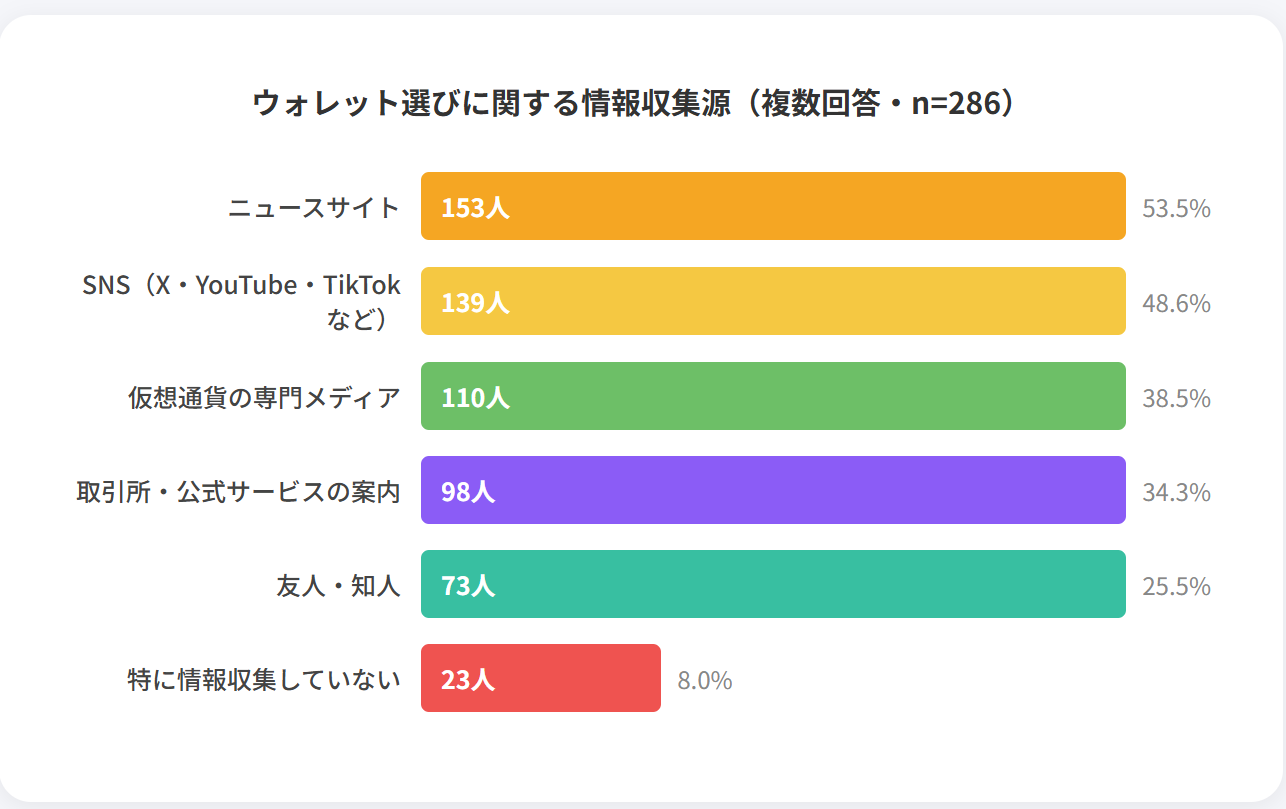
News Sites Are the Top Information Source, Cited by a Majority
News Sites Lead at 53%
Information Source (Multiple Choice) | Respondents | Share |
|---|---|---|
News sites | 153 | 53.5% |
Social media (X, YouTube, TikTok, etc.) | 139 | 48.6% |
Specialized crypto media | 110 | 38.5% |
Exchange or official service announcements | 98 | 34.3% |
Friends or acquaintances | 73 | 25.5% |
Don't actively gather information | 23 | 8.0% |
Asked where they get information about crypto assets and choosing a hardware wallet, "news sites" (53.5%) came out on top, followed by "social media" (48.6%). Fast-breaking online news and social media—where influencers and experienced users share firsthand accounts—form the two dominant streams shaping investment decisions. Notably, even for a technical product choice like a hardware wallet, holders appear to value real-world, usage-based information as much as official sources.
38.5% rely on "specialized media," showing that a meaningful share of holders seek deeper technical understanding and comprehensive information. Exchange or official-site announcements (34.3%) are also used, but the preference for third-party comparisons and reviews is clear. 25.5% cite "friends or acquaintances" as a source, showing that word of mouth within a trusted community still carries significant influence.
This distribution reaffirms that information flow in the crypto asset market is overwhelmingly digital. Holders appear to draw on multiple channels at once as they try to keep up with a fast-moving market environment. With the difficulty of judging accurate information remaining a persistent challenge, securing trustworthy sources has become a make-or-break issue for holders.
40% of Active Users Turn to Specialized Media
Usage Status | Social Media | Specialized Media | News Sites | Exchange/Official | Friends/Acquaintances | Not Collecting Info |
|---|---|---|---|---|---|---|
Currently using | 45.3% | 43.9% | 57.6% | 38.1% | 25.2% | 6.5% |
Used in the past | 40.0% | 31.8% | 49.4% | 31.8% | 28.2% | 5.9% |
Never used | 67.7% | 35.5% | 50.0% | 29.0% | 22.6% | 14.5% |
Breaking things down by usage status, current users and non-users show clearly different information-gathering habits. Among holders currently using a hardware wallet, reliance on specialized media stood at 43.9%, the highest of any group. Holders managing their assets more rigorously appear to place greater weight on systematic expertise and detailed product specifications.
Among those with no hardware wallet experience, on the other hand, social media usage stands out at 67.7%, far exceeding specialized media (35.5%). While social media has a low barrier to entry and makes intuitive information easy to access, it's also a source prone to fragmented or inaccurate information. Non-users' reliance on social media likely reflects a psychological hurdle in parsing specialized information, as well as a desire to casually keep up with trends.
Among holders who used a device in the past, social media usage drops to 40.0%, with news sites (49.4%) becoming the dominant source. This suggests that having once adopted a device, holders became more selective about information and shifted toward more objective news sources. The data shows a clear pattern: as holders progress through usage stages, they begin to question the "quality" of information and converge toward more trustworthy channels.
Larger Holders Prioritize the Accuracy of Their Information
Investment Amount | Social Media | Specialized Media | News Sites | Exchange/Official | Friends/Acquaintances | Not Collecting Info |
|---|---|---|---|---|---|---|
Under ¥10,000 | 58.5% | 35.4% | 54.9% | 22.0% | 29.3% | 12.2% |
¥10,000–under ¥100,000 | 55.9% | 45.1% | 51.0% | 38.2% | 17.6% | 2.0% |
¥100,000–under ¥500,000 | 25.0% | 35.0% | 58.3% | 43.3% | 26.7% | 10.0% |
¥500,000 or more | 57.7% | 42.3% | 65.4% | 38.5% | 38.5% | 0.0% |
Analyzing the relationship between current investment amount and information sources, holders with more than ¥500,000 invested show a news-site usage rate of 65.4%. As asset size grows, holders increasingly seek to accurately grasp fact-based information such as price movements and regulatory developments. In this bracket, "not collecting information" scored a flat 0.0%, making clear a thorough commitment to daily information updates in order to protect a substantial sum.
By contrast, among small-scale investors with under ¥10,000 invested, social media usage runs high at around 55–58%, reflecting a priority on speed and buzz. Since their investment amount is limited, these holders seem more willing to accept risk in exchange for channels rich in buzzy content that hint at big returns. Depending on income and investment amount, holders seeking the same "crypto information" appear to split into two camps—those valuing "accuracy" and those valuing "trends."
Notably, among mid-sized investors with ¥100,000–under ¥500,000, social media usage drops sharply to 25.0%. Having reached a certain asset scale, this bracket may be growing more cautious about the accuracy of information and accelerating a shift away from social media's uncertain content. In its place, exchange or official announcements (43.3%) gain weight, suggesting a move toward a more stable information base.
Conclusion
This original survey shows that self-custody via hardware wallets is steadily taking hold among crypto asset holders. Nearly half of respondents are currently using one, and awareness of the need to physically protect one's own assets is especially high among younger holders and those with larger investment amounts. Holders are keenly attuned to exchange risk and are strategically adopting dedicated devices as a defensive tool to support long-term asset building.
Yet satisfaction after adoption stays at around 60%, exposing a gap between expectation and reality. Ironically, the root of that dissatisfaction is "management hassle"—the flip side of the very security these devices provide. Analog steps such as connecting and updating the device and physically storing the seed phrase place a significant burden on today's busy holders—a fact that cannot be ignored.
The fact that roughly 30% of holders adopted a device but have since stopped using it also points to the difficulty of ongoing operation. In some cases, a device adopted to avoid the risk of losing assets ends up creating a different kind of stress or risk because of its operational complexity. Larger holders also tend to fear loss or failure more strongly, and how to secure that sense of psychological safety will be a major challenge going forward.
When it comes to gathering information, holders skillfully switch between news sites and social media to stay current with the latest developments. Active hardware wallet users, in particular, show a disciplined commitment to pursuing accurate information through specialized media. Protecting one's assets is not just about owning a device—it means continuously seeking accurate information and keeping one's knowledge up to date.
Looking ahead, the fact that nearly 80% of holders express a positive outlook on hardware wallet use is an encouraging sign for the market. Many are considering adoption "depending on conditions," and those conditions boil down to "lower purchase costs" and "a dramatic improvement in convenience." If an environment emerges where anyone can operate a device intuitively while robust security is preserved, self-custody should become standard equipment for all holders, not just a niche practice for enthusiasts.
Survey Overview
Survey date: February 24, 2026
Method: Internet survey
Respondents: Men and women residing in Japan who currently invest, or have invested, in crypto assets
Valid responses: 286
Conducted by: Clabo Inc.
Survey Questions
- Have you ever used crypto assets (virtual currencies)?
- Are you currently using a hardware wallet?
- What is the closest reason for why you adopted a hardware wallet?
- What best describes your level of satisfaction with your hardware wallet?
- What points of dissatisfaction or concern apply to you?
- What is the closest reason for why you don't use a hardware wallet?
- What best describes your future intent to use a hardware wallet?
- What best describes your years of experience investing in crypto assets?
- What best describes your current investment amount in crypto assets?
- Where do you mainly get information about crypto assets and choosing a wallet?
This article is for informational purposes only and does not constitute financial or investment advice. Please consult a qualified professional before making investment decisions.


