


To examine the safety of self-custody for crypto assets (also known as virtual currencies), we conducted an original survey of 292 experienced users on "wallet hijacking and recovery trouble."
The survey found that more than 60% of holders had experienced some kind of wallet trouble, with many facing human error or sophisticated phishing scams. Particularly concerning is the recovery rate: once trouble occurs, cases of full recovery are limited, and the risk is especially pronounced among less experienced beginners.
This article analyzes the survey data in detail, from the rate of unauthorized access and its causes to the specific actions holders took on the road to recovery. It offers insight into the defensive measures needed to protect assets, how to prepare for worst-case scenarios, and how to overcome the "management wall" that holders face. Since crypto asset management operates on a principle of self-responsibility, we hope this survey's findings help improve your literacy in protecting your own assets.
Over 60% of Users Have Experienced Wallet Trouble
Real Damage from Unauthorized Access and Lockouts Comes to Light
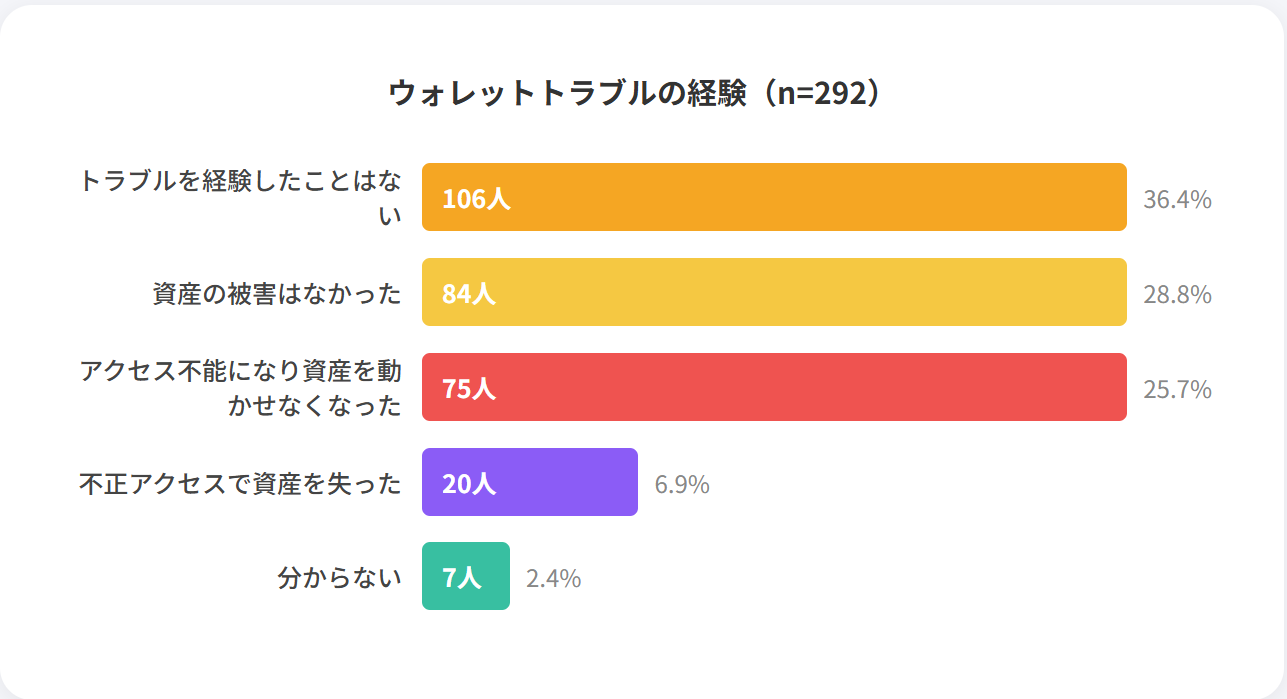
Response | Responses | Percentage |
|---|---|---|
Never experienced trouble | 106 | 36.35% |
Had trouble but no asset loss | 84 | 28.77% |
Lost access to wallet and could not move assets | 75 | 25.68% |
Assets stolen via unauthorized third-party access | 20 | 6.85% |
Don't know | 7 | 2.40% |
Wallets are indispensable for self-custody of crypto assets, but the survey revealed that operating one still comes with significant hurdles. Among the 292 survey respondents, more than 60% reported experiencing some kind of trouble. Particularly serious are cases involving "real damage" — directly losing assets or becoming unable to move them.
The share who lost assets entirely to unauthorized access stands at about 7% of the total, while those who lost access altogether reaches 25.68%. Combined, this shows that roughly 1 in 3 holders faces the risk of losing their assets. The scale of damage varies, but in an industry built on the principle of self-responsibility, a management mistake can lead to fatal consequences.
In addition, 28.77% experienced trouble but fortunately suffered no asset loss, suggesting the potential risk is even higher than the numbers show. For crypto assets to become more widely adopted, resolving these technical barriers and the uncertainty around self-management will remain an important challenge going forward. Improving one's literacy to protect one's own assets is a proposition that no holder can afford to ignore.
Lost Devices and Forgotten Passwords Are the Leading Causes of Trouble
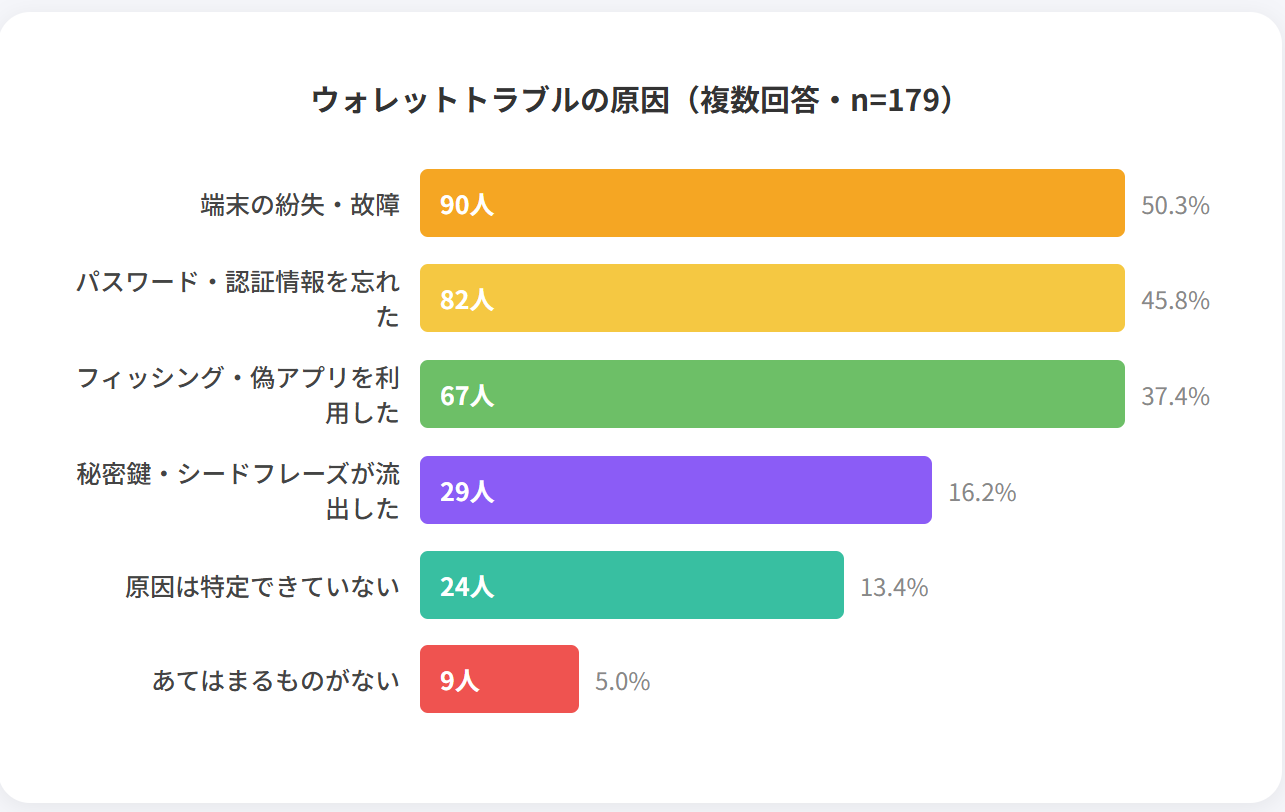
Response | Responses | Percentage |
|---|---|---|
Lost access due to a lost or broken device | 90 | 50.28% |
Forgot password or authentication credentials | 82 | 45.81% |
Used a phishing site or fake app | 67 | 37.43% |
Had a private key or seed phrase discovered by a third party | 29 | 16.20% |
Cause could not be identified | 24 | 13.41% |
None of the above apply | 9 | 5.03% |
Digging into the specifics of the trouble reveals that human error, rather than technical attacks, is the leading cause. The most common issue was "lost or broken device," cited by 50.28% — more than half — of those who experienced trouble. This was followed by "forgotten password or authentication credentials" at 45.81%, highlighting the difficulty of physical and memory-based management.
Meanwhile, damage from external malicious actors via "phishing sites and fake apps" also registered a high 37.43%. Sophisticated scam techniques spread through social media and search engines are rampant, and disguises indistinguishable from legitimate services are expanding the damage. Once a seed phrase is stolen, recovering assets becomes extremely difficult no matter how much technical knowledge one has.
Private key leakage itself accounts for 16.20%, but this is presumed to be closely linked to phishing damage and improper management. Redundancy of physical devices and strict offline management of backup information remain essential measures for protecting crypto assets. How to maintain the balance between convenience and security will be the deciding factor for safe operation.
Unauthorized Access Rate for People in Their 20s Is Twice That of Other Age Groups
Age Group | Unauthorized Access Rate | Lockout Rate | No Trouble Experienced |
|---|---|---|---|
In their 20s | 13.21% | 41.51% | 22.64% |
In their 30s | 7.06% | 25.88% | 31.76% |
In their 40s | 7.04% | 22.54% | 35.21% |
In their 50s | 3.28% | 16.39% | 55.74% |
In their 60s | 0.00% | 16.67% | 33.33% |
70 and older | 0.00% | 30.00% | 40.00% |
Cross-tabulating by age group revealed a clear tendency: younger holders are more likely to be caught up in serious trouble. The rate of asset loss from unauthorized access among people in their 20s reached 13.21%, roughly double the level seen among those in their 30s and 40s (about 7%). Furthermore, more than 40% reported having lost access to their wallet, a figure that stands out as the highest across all age groups.
This is likely rooted in the digital-native generation's characteristic reliance on doing everything from a mobile device, and the gap in security awareness that comes with it. Prioritizing easy smartphone operation may be leading to inadequate two-factor authentication and careless link clicks that invite damage. It should not be overlooked that an excessive pursuit of convenience is, ironically, putting assets at risk.
By contrast, among those aged 50 and older, a majority reported "no trouble experienced," suggesting that a cautious approach to operation helps curb damage. As younger holders come to form the core of crypto asset investment, it is urgent that they not over-rely on technical familiarity and instead rebuild a robust management system. Regardless of asset size, promoting risk management education tailored to each generation is essential for the healthy development of the market.
The Reality of "Frozen Assets" Caused by Incomplete Recovery
Partial Recovery Is the Most Common Outcome, at About 39%
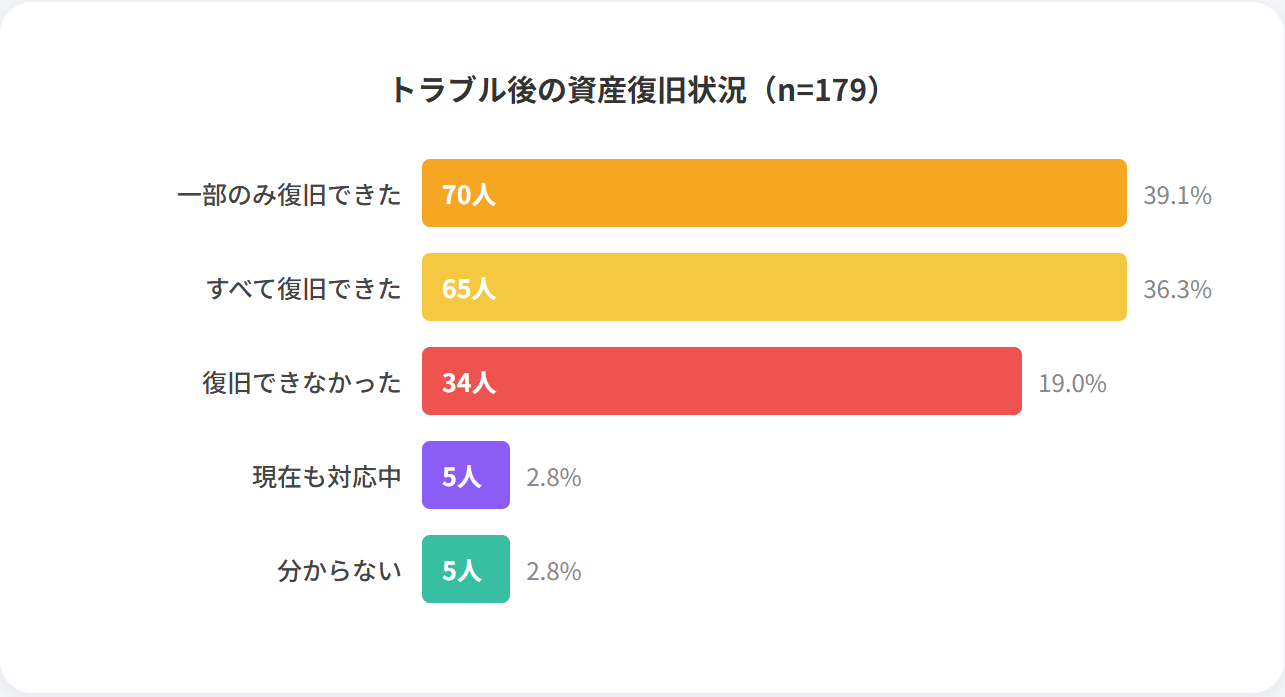
Response | Responses | Percentage |
|---|---|---|
Recovered only part of the assets | 70 | 39.11% |
Recovered all assets | 65 | 36.31% |
Could not recover | 34 | 18.99% |
Still working on it | 5 | 2.79% |
Don't know | 5 | 2.79% |
Investigating what happened to assets after trouble struck, the survey found that about 75% in total achieved some form of recovery. However, breaking this down, only 36.31% answered that they had "recovered all" their assets, while "partial" recovery was the most common response at about 39%. This result illustrates just how difficult it is to fully restore the original state once trouble occurs.
Especially in cases involving a lost private key or unauthorized transfers, the irreversible nature of the blockchain hampers recovery. The fact that about 58% combined either only partially recovered or could not recover at all is sobering data for holders. Assets that can no longer be retrieved remain on the network as a kind of "lost property," effectively meaning a permanent loss.
A certain share still reported being "in the process" or "don't know," pointing to the prolonged and uncertain nature of resolution. Because recovery efforts demand significant psychological cost and time, relying on after-the-fact recovery must be considered an extremely high-risk approach. Establishing a thorough backup system at the initial setup stage is the only reliable way to ultimately protect one's assets.
Self-Directed Resolution Is the Most Common Approach, at About 51%
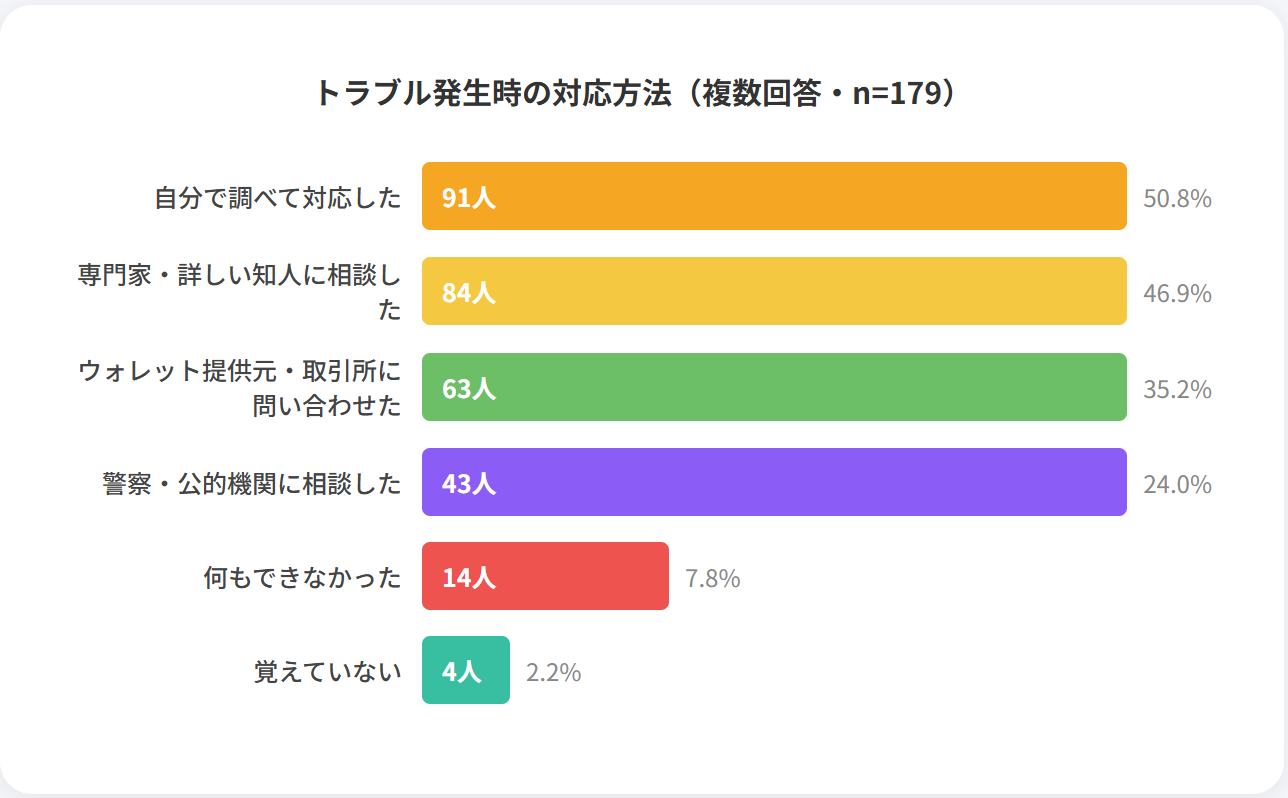
Response | Responses | Percentage |
|---|---|---|
Researched and handled it themselves | 91 | 50.84% |
Consulted an expert or knowledgeable acquaintance | 84 | 46.93% |
Contacted the wallet provider or exchange | 63 | 35.20% |
Consulted police or a public authority | 43.0 | 24.02% |
Could do nothing | 14 | 7.82% |
Don't remember | 4 | 2.23% |
The most common response toward recovery was "researched and handled it themselves," accounting for 50.84% of those who experienced trouble. This is because, when using a decentralized wallet with no central administrator, self-resolution inevitably becomes the first option. The survey highlighted holders tackling difficult tasks by relying on online documentation and community information.
Meanwhile, "consulted an expert or knowledgeable acquaintance" also showed a very high figure of about 47%. This reflects both advanced technical problems that cannot be solved by individual knowledge alone, and a search for psychological support amid panic. However, because there is also a risk of secondary damage from people who pretend to help but instead steal more assets, choosing whom to consult requires caution.
Consultation with police or public authorities remains at about 24%, suggesting many feel the limits of legal intervention and public support. The fact that inquiries to operators also remain at about 35% likely reflects an understanding of the nature of self-custody wallets. Ultimately, the reality is that one's "survival rate" when trouble strikes depends heavily on individual research ability and access to a trustworthy network.
Recovery Abandonment Rate Among Beginners Is About 4 Times That of Veterans
Investment Experience | Could Not Recover | Recovered Only Part | Recovered All |
|---|---|---|---|
Less than 6 months | 40.00% | 33.33% | 20.00% |
6 months to less than 1 year | 21.13% | 40.85% | 35.21% |
1 year to less than 3 years | 13.73% | 37.25% | 47.06% |
3 years or more | 11.54% | 46.15% | 34.62% |
Cross-tabulating years of investment experience with recovery outcomes revealed that less experienced holders face a higher risk of losing assets entirely. Among beginners with less than six months of experience, the share who answered "could not recover" reached 40%, about four times the gap compared with veterans of three years or more (11.54%). This result underscores just how fatal it can be to face trouble at a stage when knowledge and preparation are still insufficient.
By contrast, among those with a year or more of experience, more than 40% reported having "recovered all" their assets, suggesting they possess adequate recovery capability. Veteran holders are likely to have already grasped seed phrase management anticipating trouble, and recovery procedures for unforeseen events. Because losing assets at an early stage means early exit from the investment market, this gap is an extremely serious problem.
The share of "partial recovery" also rises with years of experience, suggesting that as operations grow more complex, some degree of partial loss becomes unavoidable. Beginners should start with small amounts and thoroughly practice "defensive learning," such as simulating trouble scenarios in advance. In crypto asset investing, technical proficiency may be an even more important factor than profitability when it comes directly to the survival of one's assets.
Uncertainty Over Information Accuracy Hinders Literacy Improvement
Only Just Over 30% Refer to Official Guidance
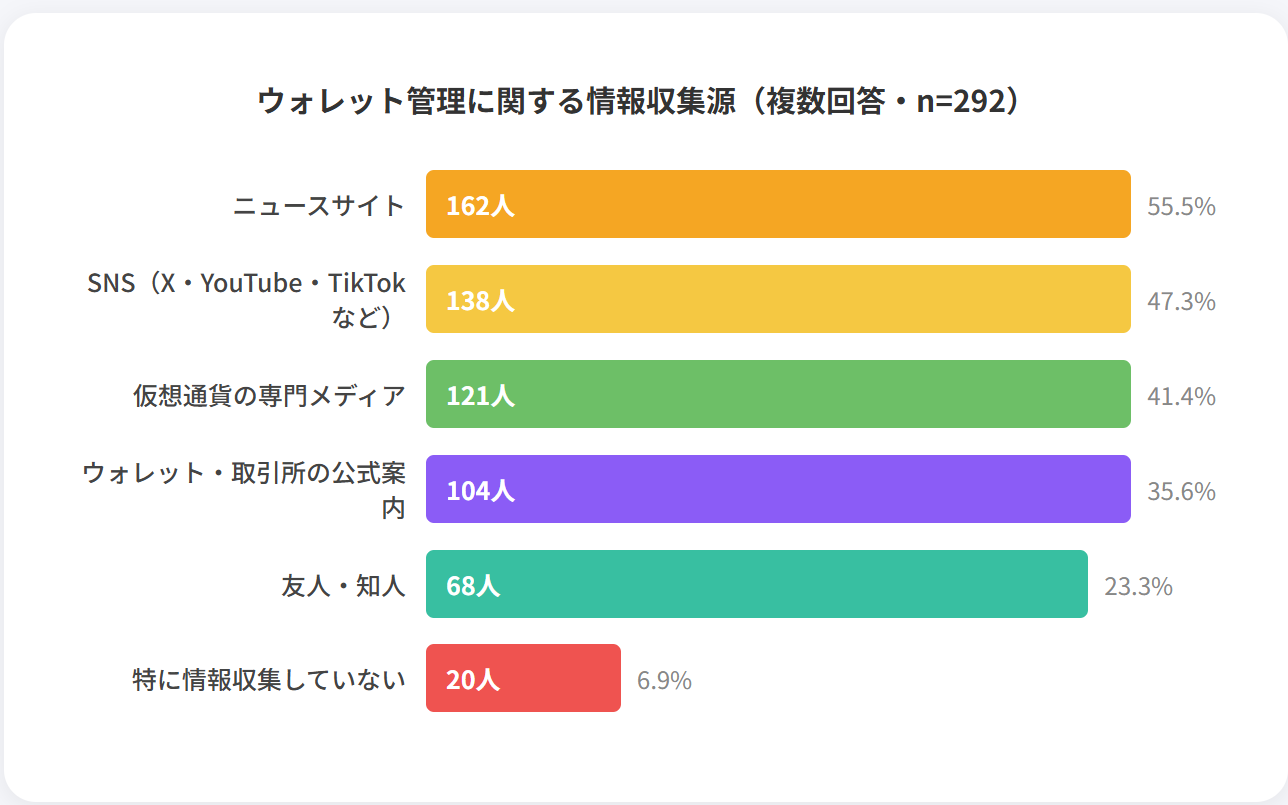
Response | Responses | Percentage |
|---|---|---|
News sites | 162 | 55.48% |
Social media (X, YouTube, TikTok, etc.) | 138 | 47.26% |
Specialized crypto media | 121 | 41.44% |
Official guidance from wallets or exchanges | 104 | 35.62% |
Friends and acquaintances | 68 | 23.29% |
Did not actively gather information | 20 | 6.85% |
Surveying sources of information for using crypto assets and wallets, "news sites" were found to be the most used, at 55.48%. This was followed by "social media" at 47.26% and "specialized media" at 41.44%, reflecting a strong tendency to value timeliness and diverse perspectives. The survey highlighted that many holders obtain daily market trends and new technical information from these general and specialized media outlets.
Meanwhile, only 35.62% referred to "official guidance from wallets or exchanges," which should be the most accurate source. While official documentation is highly accurate, it is likely that people gravitate toward more convenient secondary information because such documentation is often full of technical terms and takes time to understand. However, given the high level of phishing damage confirmed in this survey, an attitude that downplays official information inevitably carries a certain degree of risk.
About 23% also rely on information from "friends and acquaintances," and information exchange within closed communities is also active. Continuing to operate without a clear source of information can become a gateway to mistaken operations or scam damage, so caution is needed. Making it a habit to access trustworthy primary sources of information will be the first step toward preventing trouble before it happens.
Holders Investing ¥500,000 or More Show the Strongest Interest in Preventive Measures
Investment Amount Range | Specific Preventive Measures | Difference Between Recoverable and Non-Recoverable Cases | Correct Initial Response When Trouble Occurs |
|---|---|---|---|
Under ¥10,000 | 31.82% | 36.36% | 20.45% |
¥10,000 to under ¥100,000 | 34.85% | 28.79% | 24.24% |
¥100,000 to under ¥500,000 | 36.36% | 25.00% | 27.27% |
¥500,000 or more | 56.25% | 18.75% | 18.75% |
Analyzing the relationship between investment amount and the information holders want to know next, it became clear that interest in "preventive measures" rises markedly as the scale of holdings grows. Among holders investing ¥500,000 (roughly $3,300) or more, more than half — 56.25% — cited "specific measures to prevent trouble in advance" as the information they most want to know. As asset size grows, a single incident of trouble translates directly into a more critical loss, so it is only natural that a more defensive posture strengthens.
By contrast, among small-amount holders investing under ¥10,000, interest in "the difference between recoverable and non-recoverable cases" is highest of all groups, at 36.36%. This likely reflects a psychology of first wanting to confirm, for small amounts, whether recovery is possible after the fact if something goes wrong. However, as noted earlier, achieving full recovery is difficult, so ideally holders would shift their focus toward prevention even while investment amounts are still small.
Among the mid-tier group investing ¥100,000 to ¥500,000, interest in "initial response" is also high at about 27%, showing they are beginning to prepare for the possibility of trouble. Overall, as investment amounts increase, holders' focus appears to shift from "responding after the fact" to "measures to prevent it from happening." Acquiring the skills to protect one's assets could be described as one indicator of maturity as a holder.
About 67% of Holders Who Use Multiple Strategies Face a "Wall of Credibility"
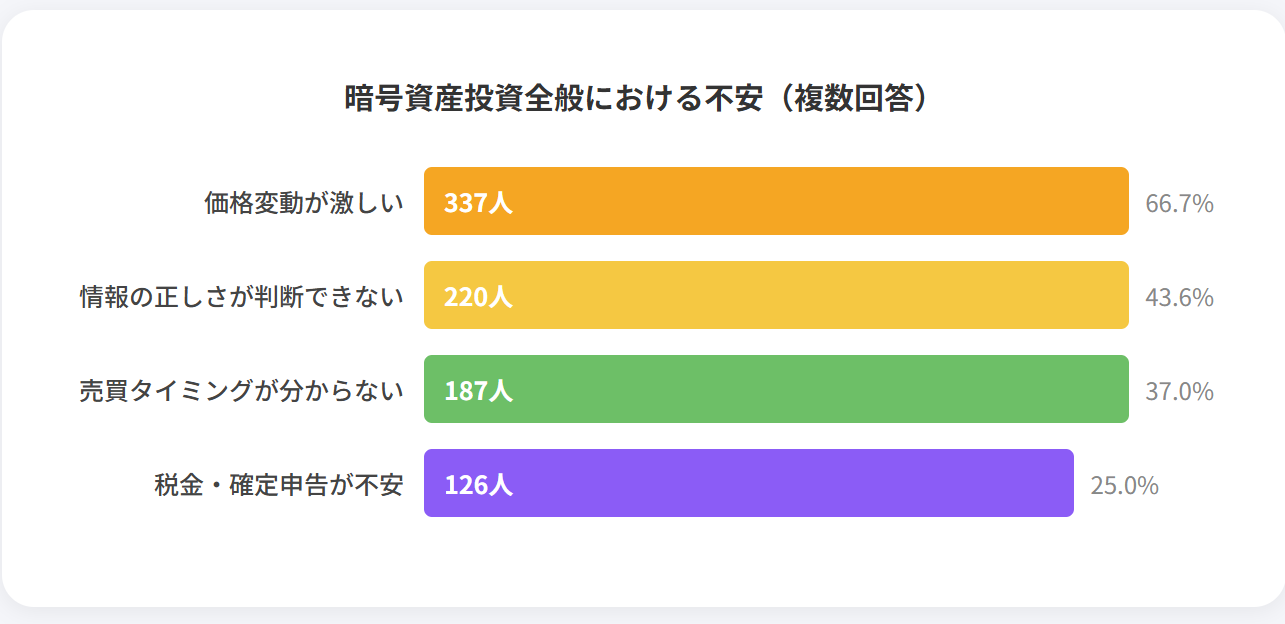
Concerns (All Holders) | Responses | Percentage |
|---|---|---|
Price volatility is severe | 337 | 66.73% |
Cannot judge the accuracy of information | 220 | 43.56% |
Unsure of buy/sell timing | 187 | 37.03% |
Anxious about taxes and tax filing | 126 | 24.95% |
Investigating sources of anxiety around crypto asset investing overall, "cannot judge the accuracy of information" reached 43.56%, second only to concern over volatility. Among holders who use multiple strategies, combining long-term holding with short-term trading, this figure was an extremely high 66.73%. The survey highlighted a reality in which the more diverse investment methods holders adopt, the more information they must reference, making it harder to judge its credibility.
An overload of information can sometimes throw holders into a panic and contribute to poor judgment when trouble strikes. This survey, too, shows a picture of holders who, while often "researching and handling it themselves" during recovery, struggle to judge the accuracy of information. Malicious traps that prey on this anxiety — such as fake recovery-support sites and fake accounts on social media — are also increasing, making the ability to filter information a life-or-death skill.
Practical concerns such as "buy/sell timing" and "tax rules" also remain deep-seated, adding to the psychological burden on holders. Resolving these concerns requires not just individual effort but also accurate information and clear guidelines from trustworthy platforms. Industry-wide education efforts will become increasingly important going forward, so that gaps in literacy do not translate directly into gaps in assets.
Summary
This survey's results highlighted the severity of the risks involved in self-custody of crypto assets and the gap in literacy among holders. In particular, the fact that more than 60% of holders have experienced wallet trouble, and that roughly 1 in 3 of them faced real damage in the form of lost assets or lockout, symbolizes the difficulty of self-custody. While the leading causes of trouble are concentrated in human error such as lost devices and forgotten passwords, phishing damage is also approaching 40%, and it must be said that threats capable of shaking the foundations of personal management have become an everyday occurrence.
It is also worth noting that the success rate of asset recovery depends heavily on years of experience. The data showing that beginners abandon recovery efforts at roughly four times the rate of veterans illustrates the danger of using a highly capable wallet without sufficient knowledge. While more than half of holders attempt to resolve trouble on their own, a large number also struggle to judge the accuracy of information and remain anxious — a major challenge going forward. Full recovery of assets once lost is extremely difficult, and the fact that "partial recovery" is the most common outcome vividly demonstrates just how much more important prevention is than after-the-fact measures.
Going forward, safely continuing crypto asset investment will require not merely pursuing convenience, but making thorough physical backups and habitually referring to official information. In particular, the survey showed a tendency for interest in preventive measures to rise as investment amounts increase, but ideally this sense of crisis awareness should be present from the stage of small-scale investment as well. We are convinced that the only true path to protecting one's assets in an unstable market is to replace the notion of "self-responsibility" with genuine technical proficiency and thorough risk management, and to hone the skills needed to prevent trouble before it occurs.
Survey Overview
Survey date: February 24, 2026
Survey method: Internet survey
Survey subjects: Men and women residing in Japan (people currently investing, or who have invested, in crypto assets)
Valid responses: 292
Conducted by: Clabo, Inc.
Survey Questions
- Have you ever used cryptocurrency (crypto assets)?
- Have you ever experienced any of the following types of trouble with a cryptocurrency wallet?
- Please tell us which of the following describes the nature of that trouble.
- How much of an impact did that trouble have?
- What ultimately happened to your wallet or assets after the trouble occurred?
- Please tell us which of the following actions you took to recover or respond.
- Please select the option that most closely matches your cryptocurrency investment experience at the time this trouble occurred.
- Please select the range that most closely matches the amount you had invested in cryptocurrency at the time the trouble occurred.
- Where did you primarily get information about how to use cryptocurrency and wallets?
- Please select the option that most closely matches the information you would especially like to know going forward about wallet hijacking and recovery trouble.
This article is for informational purposes only and does not constitute financial or investment advice. Please consult a qualified professional before making investment decisions.


