


When it comes to crypto asset investing, tax filing is an issue no one can avoid. Among the many rules involved, the so-called ¥200,000 rule — the idea that gains of ¥200,000 or less do not need to be reported — is a topic of particular interest to many holders. Yet surprisingly few people accurately understand its specific conditions and how the calculation actually works.
Our editorial team conducted an independent survey on tax literacy among 317 people with experience using crypto assets (also known as virtual currencies). The results revealed that only around 20% correctly understand the ¥200,000 rule, while roughly 70% of holders say they feel uncertain about whether they are obligated to file. Between the complexity of calculating gains and doubts about the reliability of available information, the "tax wall" holders face turns out to be higher than expected.
This article uses the specific figures from our survey to thoroughly analyze gaps in understanding by age group and investment style. Let's use the latest survey data to see just how directly acquiring accurate knowledge connects to avoiding future risk.
Awareness of the ¥200,000 Rule Reaches 60%, but Calculating Gains and Filing Conditions Remain a Barrier
Only 20% Have a Correct Understanding; Around 40% Say They "Sort Of" Understand
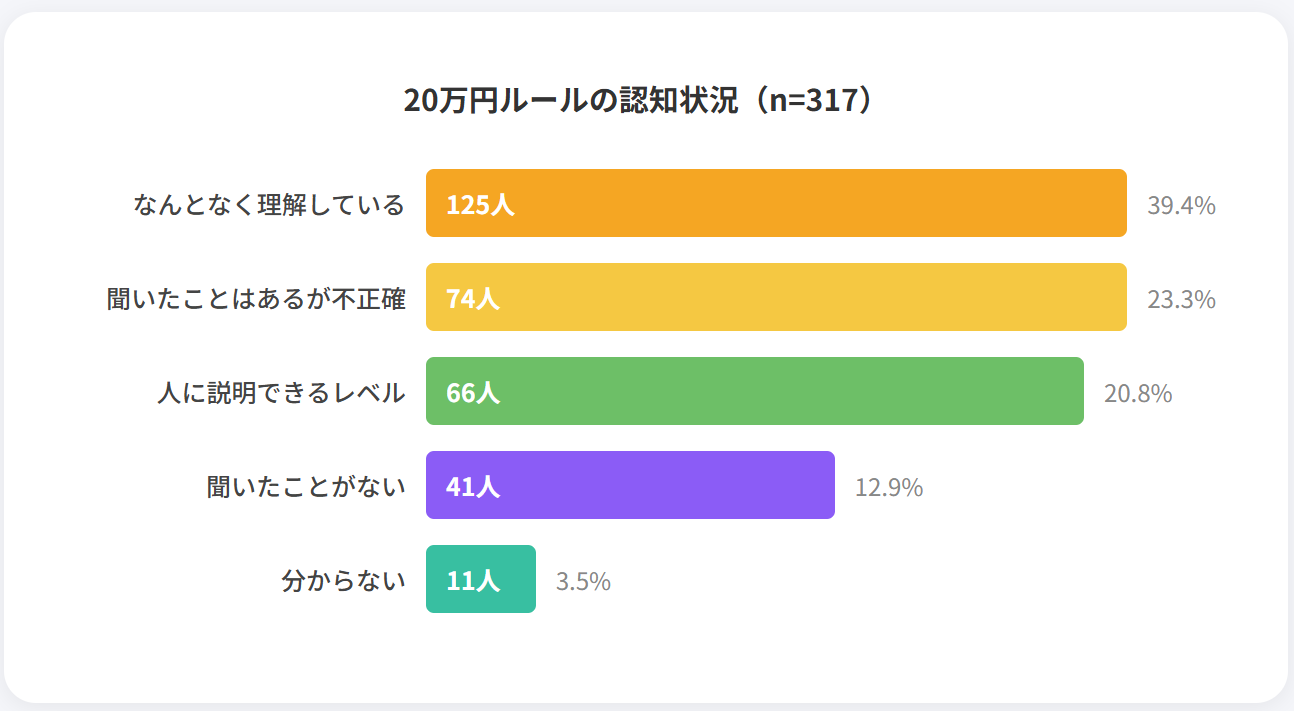
Answer | Responses | Share |
|---|---|---|
I sort of understand it | 125 | 39.43% |
I've heard of it but don't know the details | 74 | 23.34% |
I understand it well enough to explain it to others | 66 | 20.82% |
I've never heard of it | 41 | 12.93% |
I don't know | 11 | 3.47% |
When we surveyed awareness of the ¥200,000 rule in crypto tax filing, only 20.82% of respondents said they understand it well enough to explain it to others. The largest group, at 39.43%, said they "sort of" understand it.
These results highlight that while most holders are aware the rule exists, many lack confidence about its specific conditions and detailed application. Combined with those who say they've heard of it but don't know the details, more than 60% of holders are continuing to trade while carrying this kind of knowledge gap.
For income tax filing purposes, this rule allows salaried employees who meet certain conditions to skip reporting income of ¥200,000 or less, and it is an extremely important consideration in crypto trading. However, the ¥200,000 exemption does not apply to residence tax (juminzei), and this two-tier structure is one reason the rule is difficult for many people to fully grasp.
Under Japan's current tax code (as of July 2026), gains from selling crypto assets are treated as miscellaneous income and taxed under aggregate taxation (comprehensive taxation) alongside other income, such as salary. On July 15, 2026, however, Japan's House of Councillors passed a revised Financial Instruments and Exchange Act (FIEA) that reclassifies crypto assets as financial instruments under the FIEA. A flat 20% separate self-assessment tax rate is expected to take effect from the fiscal year following the revised law's implementation, currently projected as January 2028.
Calculating Gains and Filing Conditions Are the Biggest Barriers; Over 40% Struggle With Complex Calculation Methods
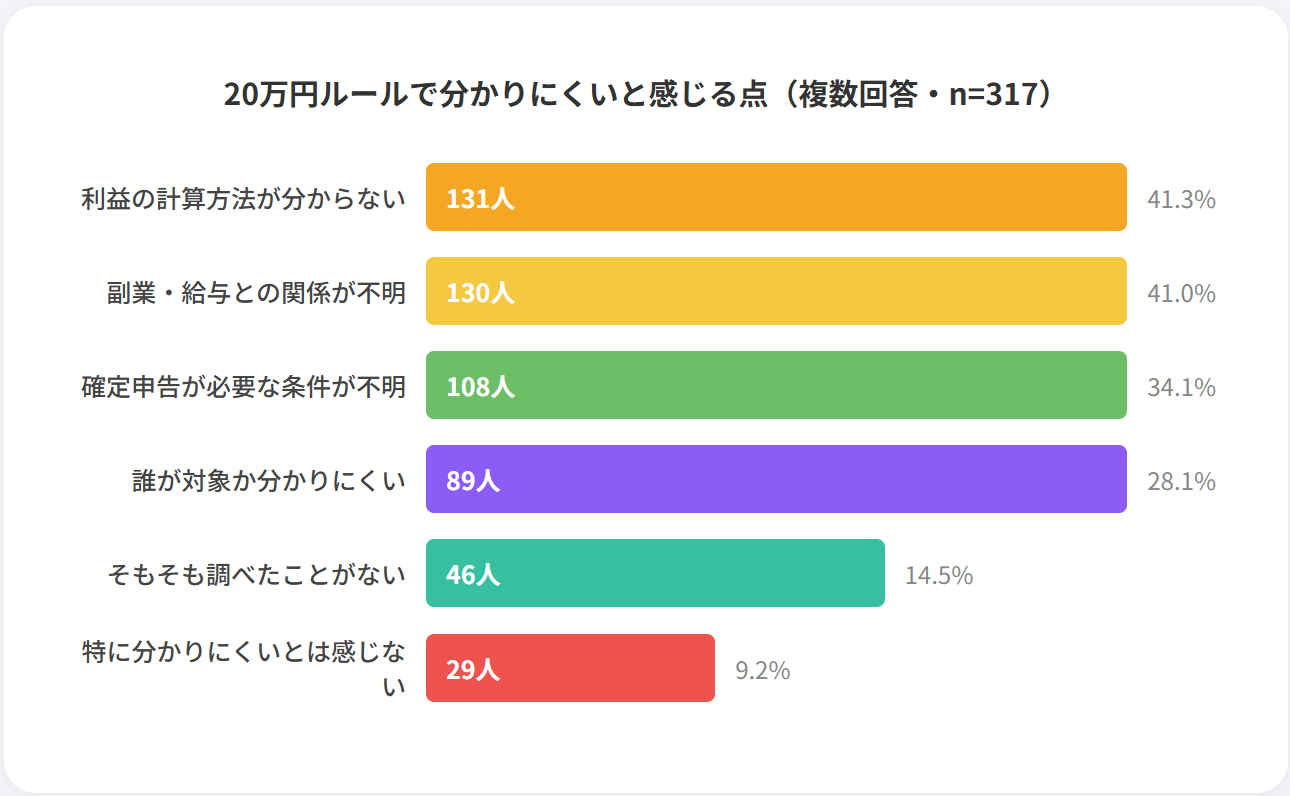
Answer | Responses | Share |
|---|---|---|
I don't know how to calculate gains | 131 | 41.32% |
I don't understand how it relates to side income or salary | 130 | 41.01% |
The conditions that trigger a filing requirement are unclear | 108 | 34.07% |
It's unclear who the rule applies to | 89 | 28.08% |
I've never actually looked into it | 46 | 14.51% |
I don't find it particularly confusing | 29 | 9.15% |
Digging into exactly what holders find difficult about the ¥200,000 rule, both "how to calculate gains" (41.32%) and "how it relates to side income or salary" (41.01%) came in above 40%, making them the biggest barriers. Calculating crypto gains can be done using either the moving average method or the total average method, and gains can arise not only from buying and selling but also from "exchanging" one crypto asset for another or using crypto for payment — all of which makes the process very complex for beginners.
The high number of responses citing "side income or salary" also suggests that many holders don't fully understand that crypto gains are classified as miscellaneous income and combined with other income sources. Because the threshold for needing to file depends on a person's annual salary and whether they have side income, many holders find it hard to judge whether they personally are required to file. Note that losses from crypto trading can only be offset against other miscellaneous income — they cannot be offset against salary or other income categories, which differs from the loss-offsetting rules that apply to stocks.
The fact that 34.07% specifically cited "conditions that trigger a filing requirement" reflects holders' genuine anxiety about avoiding the risk of tax evasion. It's now clear that holders need more than a general overview of the rule — they want practical guidance on exactly what to do once the rule is applied to their own situation.
Long-Term Holders Tend to Understand the Rule Best; Over 30% Can Explain It to Others
Investment Style | Can Explain to Others | Sort of Understand | Not Sure of Details | Never Heard of It | Don't Know |
|---|---|---|---|---|---|
Mainly long-term holding | 33.03% | 38.53% | 16.51% | 8.26% | 3.67% |
Mainly short-term trading | 17.82% | 45.54% | 20.79% | 11.88% | 3.96% |
Both | 14.71% | 41.18% | 39.71% | 4.41% | 0.00% |
Low usage frequency | 9.52% | 28.57% | 23.81% | 38.10% | 0.00% |
Prefer not to say | 0.00% | 16.67% | 16.67% | 50.00% | 16.67% |
Breaking down understanding of the ¥200,000 rule by investment style, holders who mainly hold long-term stood out with 33.03% saying they can explain the rule to others — noticeably higher than any other group. Long-term holders tend to gather information with an eye toward their eventual exit strategy, which likely means they also approach tax risk with relatively high awareness.
By contrast, the "mainly short-term trading" and "both" groups showed higher rates of vague, "sort of" understanding — the groups that need the most complex calculations turn out to have the fuzziest knowledge. Short-term trading tends to generate a huge volume of transaction history, making individual gain/loss calculations cumbersome, so many of these holders likely hit the limits of what they can manage before ever grasping the rule's details.
Among infrequent users, 38.10% said they'd "never heard of" the rule, suggesting that holders who trade only small amounts or leave their holdings untouched tend to underestimate tax risk. Regardless of trading style, because a tax obligation can arise the moment a gain is realized, it's essential for every holder to have accurate knowledge in order to participate in the market responsibly.
Understanding Is Highest Among Those Earning ¥10 Million or More; Higher Earners Are More Tax-Risk Aware
Household Income | Can Explain to Others | Sort of Understand | Not Sure of Details | Never Heard of It | Don't Know |
|---|---|---|---|---|---|
Under ¥2 million | 24.44% | 24.44% | 22.22% | 20.00% | 8.89% |
¥2–4 million | 17.74% | 41.94% | 22.58% | 14.52% | 3.23% |
¥4–6 million | 16.30% | 39.13% | 25.00% | 17.39% | 2.17% |
¥6–8 million | 24.14% | 39.66% | 27.59% | 5.17% | 3.45% |
¥8–10 million | 25.00% | 50.00% | 18.75% | 3.13% | 3.13% |
¥10 million or more | 31.82% | 59.09% | 9.09% | 0.00% | 0.00% |
*The "¥10 million or more" group combines the survey's original brackets of ¥10–12 million, ¥12–15 million, ¥15–20 million, and ¥20 million or more.
Cross-tabulating by household income shows that as income rises, the share saying they've "never heard of" the rule declines and overall understanding clearly improves. Among high earners with household income above ¥10 million, every single respondent was aware the rule exists, and 31.82% had knowledge deep enough to explain it to others.
High earners are often already accustomed to filing tax returns, and it's likely they're also keenly aware of how Japan's progressive tax rates mean that adding crypto gains on top of other income can push their tax bracket higher. Because their resulting tax bills tend to be larger, they're more proactive about researching tax-saving strategies and proper filing — which paints a picture of holders who, as a result, are also well versed in finer rules like the ¥200,000 threshold.
Meanwhile, among those with household income under ¥4 million, 14.52% to 20.00% said they'd "never heard of" the rule, suggesting a risk that these holders assume the rule "doesn't apply to them" simply because of their income level. But the ¥200,000 rule is only a special exception for income tax; the requirement to report for residence tax purposes, along with the effect on dependent deductions, applies regardless of income level — meaning lower-income holders may actually be at greater risk of unexpected disadvantages.
Nearly 70% Have Struggled With Whether the Rule Applies to Them; Tools Emerge as the Key to Deciding
67.82% Have Felt Uncertain; the Vast Majority Face Difficulty Making the Call
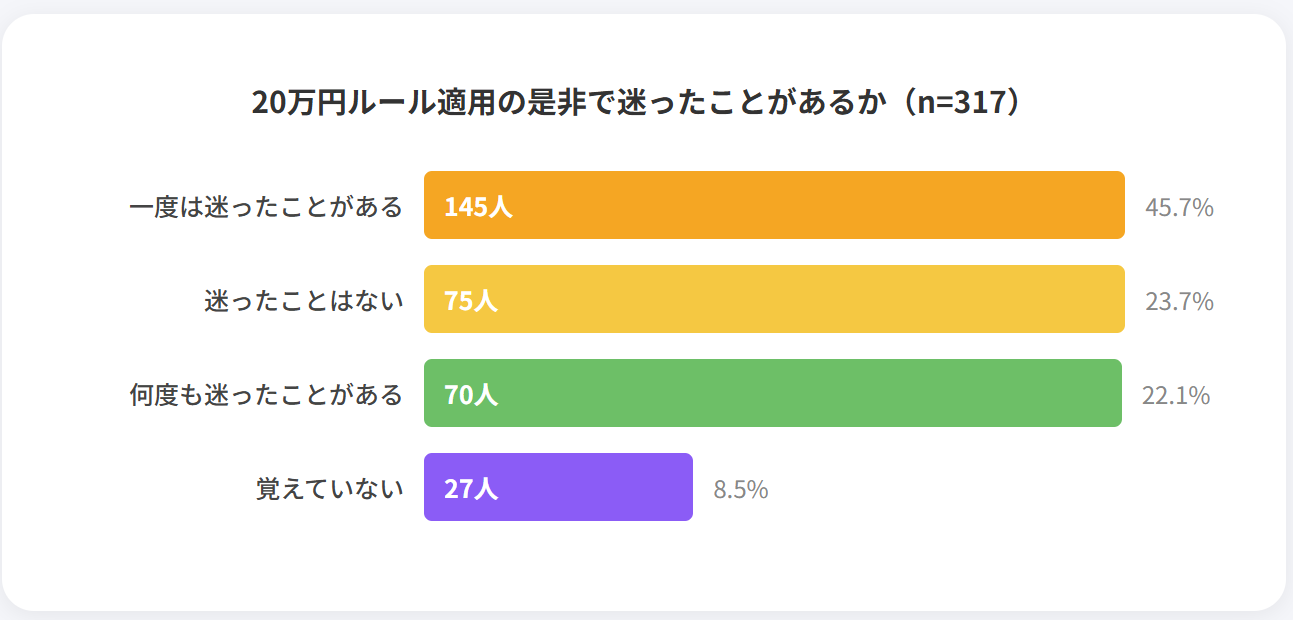
Answer | Responses | Share |
|---|---|---|
I've been unsure at least once | 145 | 45.74% |
I've never been unsure | 75 | 23.66% |
I've been unsure many times | 70 | 22.08% |
I don't remember | 27 | 8.52% |
Combining "I've been unsure many times" and "I've been unsure at least once" regarding whether their trading falls under the ¥200,000 rule, 67.82% of respondents said they've felt uncertain. This confirms that roughly 7 out of every 10 crypto holders feel some degree of doubt or anxiety when trying to determine whether they owe taxes.
The fact that 22.08% say they've "been unsure many times" suggests that calculating crypto gains and losses isn't a one-time task but an ongoing management burden. Because crypto prices are highly volatile and gains can arise at many different points — from staking rewards to assets received via a hard fork — it's not easy to instantly judge whether the rule applies in a given case.
On the other hand, the 23.66% who said they've "never been unsure" are likely either small-scale users whose gains are clearly under ¥200,000, or holders who track their monthly gains and losses with extreme discipline. For the majority of holders, though, the pressure of needing to "get the compliance call right" appears to be a genuine psychological barrier.
Using a Calculation Tool Is the Top Response at 30.91%, With Self-Research and Expert Consultation Close Behind
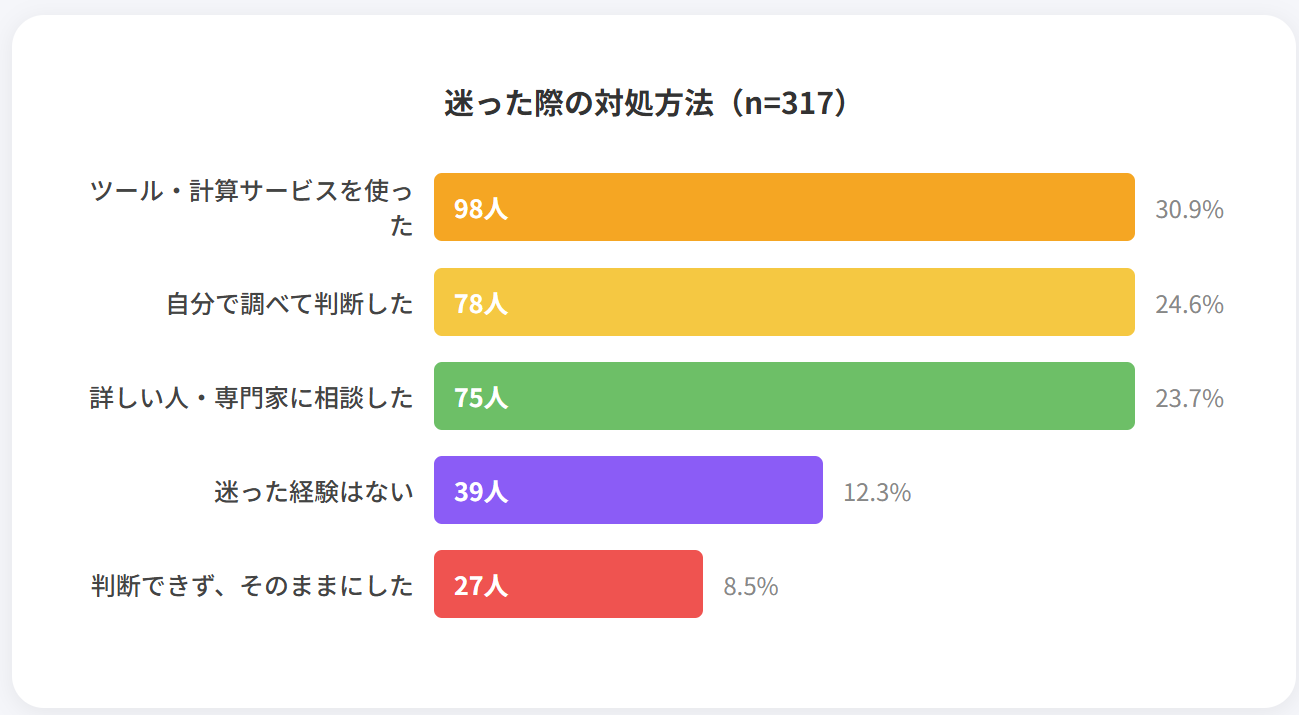
Answer | Responses | Share |
|---|---|---|
I used a tool or calculation service | 98 | 30.91% |
I researched it myself and made a judgment | 78 | 24.61% |
I consulted someone knowledgeable or a professional | 75 | 23.66% |
I've never been unsure | 39 | 12.30% |
I couldn't decide and left it as is | 27 | 8.52% |
When it comes to what holders actually did when uncertain, the most common response, at 30.91%, was "used a tool or calculation service." Manually tallying a large volume of transaction data simply isn't realistic, and it appears many holders rely on gain/loss calculation software and similar technology to determine whether the ¥200,000 rule applies.
The fact that "researched it myself and made a judgment" (24.61%) and "consulted someone knowledgeable or a professional" (23.66%) came in at almost the same rate shows a split in how people get information. While some holders rely on explainer articles online to work things out themselves, roughly 1 in 4 seek certainty by turning to professionals such as tax accountants (zeirishi) or knowledgeable acquaintances.
One concerning finding is the 8.52% who said they "couldn't decide and left it as is." This group faces a real risk of forgetting to file a return they were actually required to submit, or of unintentionally ending up in a state of non-filing — either of which could eventually attract scrutiny from the tax authorities. It's hard to deny that the complexity unique to crypto assets is pushing some holders into a kind of paralysis that leads to simply leaving the issue unresolved.
The Six-Month-to-Three-Year Mark Is the Danger Zone; Over 60% of Mid-Tenure Holders Struggle to Judge
Time Since Starting to Invest | Been Unsure Many Times | Been Unsure At Least Once | Never Been Unsure | Don't Remember |
|---|---|---|---|---|
Under 6 months | 9 (17.65%) | 14 (27.45%) | 18 (35.29%) | 10 (19.61%) |
6 months to under 1 year | 24 (24.24%) | 51 (51.52%) | 19 (19.19%) | 5 (5.05%) |
1 year to under 3 years | 26 (26.53%) | 51 (52.04%) | 17 (17.35%) | 4 (4.08%) |
3 years or more | 11 (22.45%) | 29 (59.18%) | 8 (16.33%) | 1 (2.04%) |
Don't remember | 0 (0.00%) | 0 (0.00%) | 13 (65.00%) | 7 (35.00%) |
Analyzing how often holders feel uncertain by length of investing experience shows that the share who have "felt uncertain" jumps sharply once someone has been investing for six months or more. Specifically, 75.76% of the "6 months to under 1 year" group and 78.57% of the "1 to under 3 years" group reported feeling unsure — suggesting that the point at which someone faces their first tax return, or when their trading activity starts to diversify, becomes a "turning point" for this kind of judgment call.
Even among veteran holders with "3 years or more" of experience, 81.63% said they've felt uncertain, underscoring a distinctive feature of crypto taxation: gaining experience doesn't necessarily make the judgment any easier. The longer someone holds crypto, the harder it can become to track their original acquisition cost, and they may need to consider switching calculation methods (such as filing to use the total average method) — meaning the difficulty, if anything, tends to deepen over time.
Among beginners with under 6 months of experience, by contrast, 35.29% said they've "never been unsure" — higher than any other group — likely because they've had fewer opportunities to realize gains or simply haven't yet encountered tax-related challenges. As holders progress, the barrier of calculating gains is bound to appear eventually, so building a management system from the start that assumes uncertainty will arise can help avoid trouble down the road.
News Sites Are the Top Information Source for Over Half of Holders; 40% Worry About Judging What's Accurate
Is Reliability an Afterthought? 53.31% Prioritize News Sites for Information
Answer | Responses | Share |
|---|---|---|
News sites | 169 | 53.31% |
Social media (X, YouTube, TikTok, etc.) | 154 | 48.58% |
Specialized crypto media | 122 | 38.49% |
Guidance from exchanges or official services | 103 | 32.49% |
Content from tax accountants or accounting professionals | 66 | 20.82% |
Haven't specifically looked into it | 25 | 7.89% |
When we asked where holders get their information about the ¥200,000 rule, "news sites" came out on top at 53.31%. "Social media" followed closely at 48.58%, revealing that many holders are prioritizing the "speed" and "convenience" of information over its accuracy.
By contrast, "guidance from exchanges or official services" — which should in principle be the most accurate source — was cited by only 32.49%, and "content from tax accountants or accounting professionals" by just 20.82%. Even on a topic as rigorous as tax filing, it turns out many holders rely more on processed secondary information than on authoritative primary sources.
Information circulating on social media in particular carries the risk of oversimplifying the conditions for applying the ¥200,000 rule, or of overlooking the separate filing obligation for residence tax. Taking knowledge from convenient sources at face value carries a real danger of unintentionally under-reporting income, making it urgent for holders to build the habit of accessing official information.
43.56% of Holders Are Concerned: Doubts About Information Accuracy Are Clouding Their Judgment
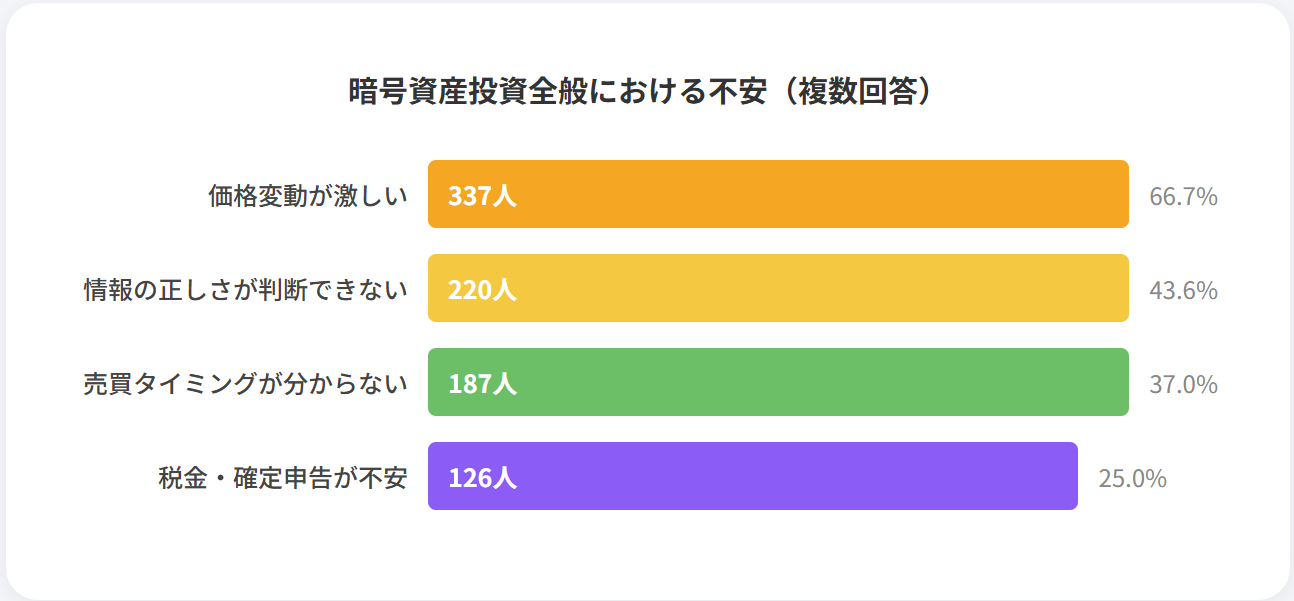
Concern (Overall) | Responses | Share |
|---|---|---|
Price volatility is extreme | 337 | 66.73% |
I can't judge whether information is accurate | 220 | 43.56% |
I don't know the right time to buy or sell | 187 | 37.03% |
I'm anxious about taxes and filing | 126 | 24.95% |
Asked about their broader anxieties around crypto investing, holders ranked "I can't judge whether information is accurate" second only to concerns about volatility, at 43.56%. This paints a somewhat contradictory picture: holders favor social media and news sites for gathering information, yet at the same time harbor strong distrust and uncertainty about how reliable that information actually is.
Another 24.95% said they're "anxious about taxes and filing," and this is likely closely tied to the stress of not being able to tell accurate information from inaccurate. Even holders motivated to learn the correct rules face a significant burden in developing the literacy needed to identify which pieces of information, among the flood available, are actually grounded in official sources.
This "credibility wall" ends up being one reason holders delay or neglect tax decisions altogether, and it could contribute to declining compliance across the market as a whole. Organizing reliable primary-source information and providing clear explanations from professionals will undoubtedly be key to giving holders greater peace of mind.
60% of People in Their 30s Rely on Social Media; Younger Holders Tend to Avoid "Official Guidance"
Age Group | Social Media (X, etc.) | Specialized Media | News Sites | Official Guidance | Tax Professionals' Content | Haven't Looked Into It |
|---|---|---|---|---|---|---|
20s | 30 (56.60%) | 18 (33.96%) | 32 (60.38%) | 14 (26.42%) | 12 (22.64%) | 4 (7.55%) |
30s | 51 (60.00%) | 31 (36.47%) | 43 (50.59%) | 22 (25.88%) | 20 (23.53%) | 9 (10.59%) |
40s | 36 (50.70%) | 32 (45.07%) | 36 (50.70%) | 25 (35.21%) | 15 (21.13%) | 5 (7.04%) |
50s | 26 (42.62%) | 28 (45.90%) | 38 (62.30%) | 26 (42.62%) | 13 (21.31%) | 4 (6.56%) |
60s and older | 11 (26.19%) | 13 (30.95%) | 20 (47.62%) | 16 (38.10%) | 6 (14.29%) | 3 (7.14%) |
*"60s and older" combines the survey's original brackets of "60s" and "70 and older."
Breaking down information sources by age group shows that holders in their 30s and younger rely heavily on social media (X, YouTube, etc.), at a very high 50% to 60%. Meanwhile, the rate at which people in their 20s and 30s reference "guidance from exchanges or official services" stays in the 20% range — the lowest of any age group.
For digital-native generations, social media has become their primary search engine, and the same behavior pattern shows up even in a field like taxation, where accuracy matters most. A preference for easily digestible, visualized information — paired with an avoidance of dense official documents — is creating a gap in information quality between generations.
By contrast, holders in their 50s and older reference "official guidance" at a rate of about 40%, reflecting a more cautious approach and a stronger commitment to accuracy in how they gather information. As younger holders eventually build up larger asset holdings, learning to balance the convenience of social media against the accuracy of official information — and correcting for any resulting bias — will be an important challenge.
Conclusion
This independent survey makes clear that the ¥200,000 rule remains a significant psychological and practical hurdle for crypto holders when it comes to taxes. Only 20.82% of holders overall have reached a level of understanding where they could correctly explain the rule to someone else. Meanwhile, roughly 40% remain in a vague state of "sort of" understanding, continuing to trade while carrying this kind of knowledge gap.
What's especially concerning is that as many as 67.82% of holders have felt uncertain about whether they owe taxes at all. Crypto-specific complexities — such as difficult gain calculations and the rule aggregating gains with salary income — are major obstacles to understanding. In response to this uncertainty, 30.91% turned to calculation tools, while 8.52% said they "couldn't decide and left it as is" — meaning the risk of unfiled returns cannot be ruled out.
When it comes to gathering information, 53.31% rely on news sites and 48.58% on social media, showing that "speed" tends to win out over "accuracy." Holders in their 20s show a willingness to actively use multiple media sources, yet 43.56% still feel anxious about being unable to judge whether that information is correct. Relying too heavily on convenient secondary sources risks leading to tax mistakes born of incomplete knowledge, so caution is warranted.
As the crypto market matures, acquiring accurate tax knowledge is arguably becoming part of investing skill itself. Going forward, demand is likely to grow for more practical information, such as "ways to check whether the rule applies to me" (39.75%) and "easy-to-understand explanations using concrete examples" (24.61%). Precisely because this is a world governed by the principle of self-responsibility, referring to reliable primary-source information and continuing to manage one's assets based on accurate knowledge is ultimately what protects those assets.
Survey Overview
Survey date: February 24, 2026
Survey method: Internet survey
Survey population: Men and women residing in Japan who are currently investing in crypto assets or have invested in the past
Valid responses: 317
Conducted by: Clabo Inc.
Survey Questions
- Have you ever used crypto assets (also known as virtual currencies)?
- Which of the following best describes your current understanding of the "¥200,000 rule" for crypto taxes?
- What aspects of the "¥200,000 rule" have you found confusing?
- Have you ever been unsure whether the ¥200,000 rule applies to you?
- When you felt uncertain as described above, how did you ultimately decide or respond?
- What was the approximate scale of your investments at the time you made that judgment about the ¥200,000 rule?
- What were your main sources of information about the ¥200,000 rule?
- What kind of information would help you feel confident you could judge the ¥200,000 rule correctly in the future?
This article is for informational purposes only and does not constitute financial or investment advice. Please consult a qualified professional before making investment decisions.


